


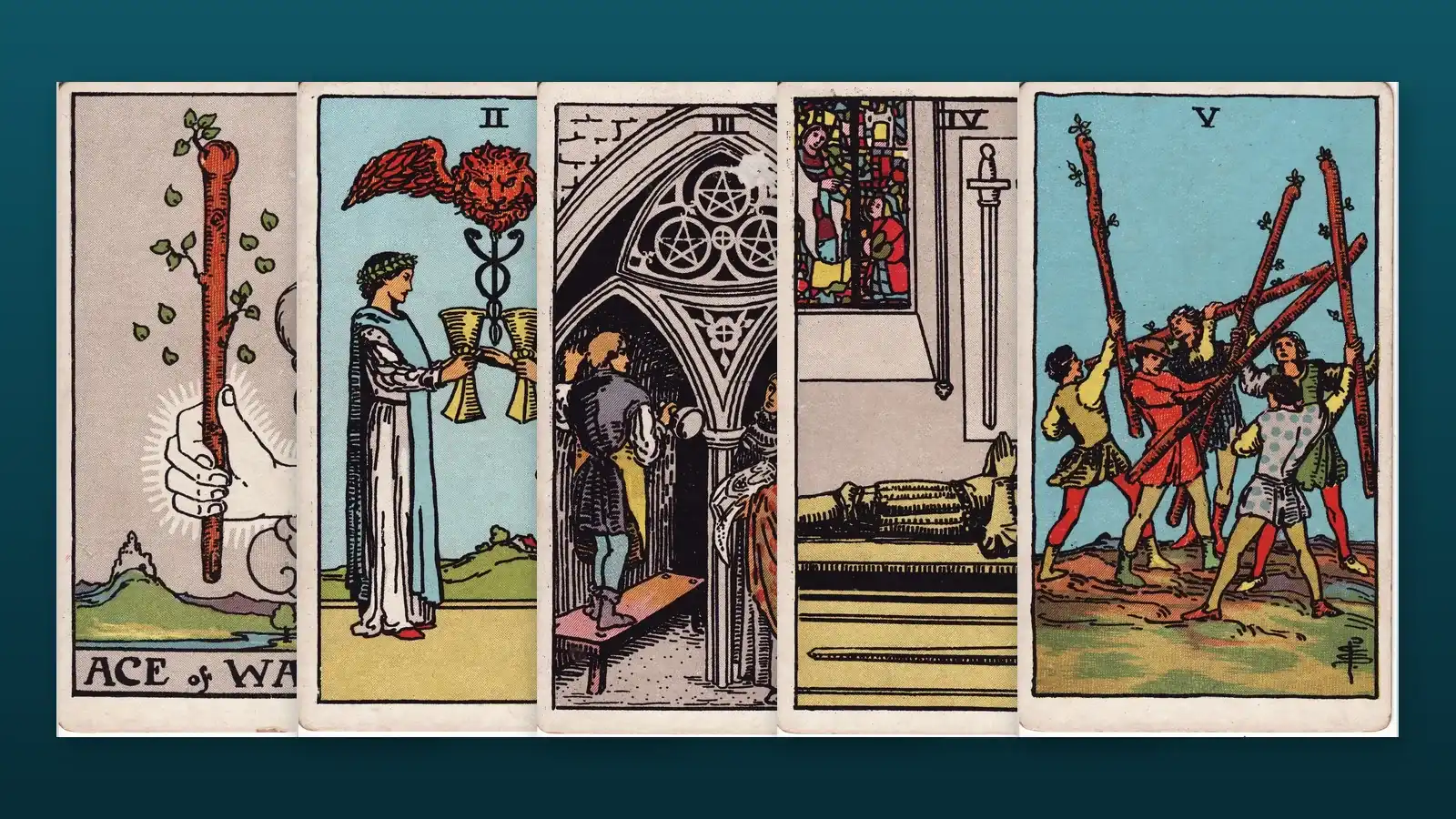
In this lesson: what the numbers Ace to Ten mean in the Minor Arcana, and how number plus suit lets you read any card.
Here is the secret that makes the Minor Arcana manageable: you do not need to memorize 40 number cards. You need four suits and ten numbers. Suit plus number gives you a starting meaning for any card, and once you have that, the picture fills in the rest. This lesson gives you the numbers and shows you how to combine them.
The number tour
Each number has a character that repeats through all four suits. Keep this short list somewhere you can see it for the first few weeks.
- Ace: a seed or new start, the raw energy of the suit.
- Two: balance, choice, a first partnership of forces.
- Three: growth, expression, early teamwork or success.
- Four: foundation, pause, structure, sometimes stuckness.
- Five: conflict, loss, contest, an unstable middle.
- Six: repair, giving and receiving, movement towards balance.
- Seven: assessment, persistence, temptation, strategy.
- Eight: work, skill, speed, something breaking open.
- Nine: the suit’s theme nearly full, a personal peak.
- Ten: completion, a full cycle, a shared load, ready to turn into a new Ace.
Putting suit and number together
Let us try it. Take the Five of Cups. Five is conflict or loss, and Cups are feelings, so the starting meaning is emotional loss or regret. The picture agrees: a cloaked figure mourns three spilled cups, while two cups still stand behind. Now the Eight of Pentacles. Eight is work and skill, Pentacles are craft, so the starting meaning is diligent practice. The picture shows a craftsman carving coin after coin.
It does not always fit perfectly, and that is fine. Numbers are a starting point. The picture and your question do the rest.
Where number meanings come from
Historical Giving meanings to numbers is very old. The followers of Pythagoras in ancient Greece treated numbers as the basis of the world, and they saw the ten as perfect, because 1 + 2 + 3 + 4 = 10. Medieval and Renaissance writers kept up this interest.
Later tradition In the late nineteenth century the Golden Dawn linked the ten number cards of each suit to the ten sephiroth, the spheres of the Kabbalistic Tree of Life, from Kether, the crown, at the top to Malkuth, the kingdom, at the bottom. That is one reason why Aces feel like pure beginnings and Tens like full, earthy results. You do not need Kabbalah to use the keywords, but it helps to know where some of them come from.
Nine is not Ten
Beginners often mix these two up. Nine is usually a private, personal fullness. The Nine of Cups is private satisfaction, a man sitting contentedly before his row of cups. The Nine of Wands is tired persistence, one person guarding a line of staves. Ten is more often a completed structure or a shared load. The Ten of Cups is a family’s shared happiness under a rainbow, while the Ten of Wands is overload, one person carrying the whole bundle. So remember: Nine is personal fullness, Ten is a completed cycle.
The numbers rhyme across suits
Lay out all four Aces and you will see four kinds of beginning: a new feeling, a new idea, a new opportunity and a new spark. Lay out all four Fives and you will see four kinds of trouble. The numbers rhyme without becoming identical, and seeing that is one of the quiet joys of learning tarot.
The Major Arcana have numbers too, from 0 to 21, but they work differently. A Major’s number tells you where it sits on the Fool’s Journey. Some readers enjoy linking the Magician (I) with the Aces or the Wheel of Fortune (X) with the Tens, but that is an optional extra layer. The court cards sit outside this count altogether, and you will learn them as characters in module 5.
An example: decoding a card you have never studied
Imagine you draw the Three of Wands and cannot remember a thing about it. Say it out loud: “Three, growth. Wands, energy and drive. So growing energy, maybe a project starting to take off.” Now look at the picture: a figure stands on a cliff, watching ships sail out across the water. Your guess and the picture meet. It is the card of early expansion and waiting for efforts to return. You decoded it in ten seconds without a book.
A table of the numbers in prose
To fix the numbers in your memory, connect each with a picture you know. Ace, a seed in the hand. Two, a pair of scales or a choice between two paths. Three, a small group or the first shoot. Four, a table with four legs, stable and maybe stuck. Five, a scuffle or a setback.
Six, a bridge or a gift that restores balance. Seven, a test, a hill to climb. Eight, movement and effort, the road. Nine, nearly there, the last stretch. Ten, the end of the cycle, a full harvest or a heavy load. Draw these little pictures next to the numbers in your notebook.
Two more worked examples
Imagine you draw the Six of Swords and cannot remember it. Six is harmony or a bridge back to balance; Swords is thoughts and difficulty. Together: “moving from a troubled mind toward calmer water”. The 1909 picture shows a boat carrying people across water, which matches. Now try the Four of Cups. Four is stability, perhaps stuck; Cups is feeling. Together: “feelings that have gone flat”. In the picture, a young man sits with folded arms, ignoring a cup offered by a hand from a cloud. The system works even when the picture is unfamiliar.
The four Fours, in Waite’s words
Historical A good way to see that numbers rhyme across suits is to read Waite’s own lines for the same number in each suit, from The Pictorial Key to the Tarot (1910). Here are the four Fours.
Four of Wands: “country life, haven of refuge, a species of domestic harvest-home, repose, concord, harmony, prosperity, peace”.
Four of Cups: “Weariness, disgust, aversion, imaginary vexations, as if the wine of this world had caused satiety only”.
Four of Swords: “Vigilance, retreat, solitude, hermit’s repose”.
Four of Pentacles: “He holds to that which he has.”
Put them side by side, and the number’s theme appears: stability, stopping, holding still. In Wands the stillness is a celebration at home. In Cups it turns into boredom, too much of the same. In Swords it becomes rest after strain. In Pentacles it is holding on tightly. One number, four climates. That is the whole method of this lesson in a single example.
Practice variations
Number of the week. Choose one number each week and lay out its four cards every morning. Ask what the number means in each suit, then draw one card from the rest of the deck and see whether its number fits the day.
The odd and even game. Some readers notice that odd numbers often feel active or unsettled, and even numbers often feel steady or balanced. Lay out all forty number cards in odd and even rows and see whether that pattern holds for you. You may find exceptions, and noticing them is just as useful.
Count the objects. On Smith’s cards, the number is shown by the objects in the picture. Choose any card and count its suit symbols, then look at how they are arranged. Are they stacked, scattered, carried or displayed? The arrangement often tells you how the number is being lived.
Beginners’ questions about numbers
What about the court cards? They do not have numbers in the same way. Lesson 5 treats them as people and energies. Some systems give them numbers from eleven to fourteen, but you do not need that to read them well.
Do I need numerology to read tarot? No. The simple number keywords in this lesson are enough. If numerology interests you, enjoy it as an extra layer, but remember that different numerology systems disagree, just as suit correspondences do.
What if a number meaning clashes with the picture? Trust the picture first. The number is a helpful pattern, not a rule that overrides what you see.
A worked example with the Sevens
Try the method on a new number. Sevens often carry a sense of testing or uncertainty. In Wands, a figure defends a hilltop. In Cups, someone faces a cloud of daydreams. In Swords, a figure tiptoes away with an armful of blades. In Pentacles, a gardener pauses to look at slow growth. Four pictures, one shared question: is this worth the effort, and what do I really want? Once you can see that thread, you can read any Seven.
A quick check for any number card: say the number’s keyword, then the suit’s climate, then look at the picture and ask whether it agrees. That three-step habit, practiced daily for a month, will let you read cards you have never studied with real confidence.
Questions beginners ask
Do Aces count as one or as something special? As one, but many readers treat Aces as especially strong beginnings, “the gift of the suit”.
Why are Fives so often hard? After the stability of Four, Five breaks the balance, which is how growth starts. It can feel like trouble.
Do the numbers work for the Majors too? Some readers link them, for example the Magician, I, with the Aces. It can be a fun extra layer, not a rule.
Myths to drop: Number meanings are not identical in every book; small differences are normal. A high number is not automatically better. And you do not need to know numerology to read numbers.
Try this
Lay out the four Fives side by side. Write one sentence about what they share and one about how they differ. Then, for the next few days, whenever you draw a number card, say the number and the suit before you look anything up.
Recap
Four suits and ten numbers give you a starting meaning for all 40 number cards. An Ace is a seed or new start, and Five often brings conflict or loss. Nine is personal fullness, while Ten is a completed cycle or shared load. Combine the number with the suit, then let the picture and your question refine the meaning. Court cards are read differently, as characters.
What next
Press “Mark as done” and continue with Wands. For more on how numbers and elements work together, read numerology and elements.
Further reading: Rachel Pollack, Seventy-Eight Degrees of Wisdom (first published 1980 and 1983), part 2, on the Minor Arcana.
Sources
- Lauri Mukkala, The Novice’s Guide to Tarot, “Numerology in Tarot”.
Quick check
Go deeper: The Novice's Guide to Tarot: Numerology in Tarot
Get the free Mini-Grimoire
A short printable starter guide to tarot and everyday witchcraft, plus my newsletter. Unsubscribe any time.
Opens Substack in a new tab to confirm. More about the newsletter · Privacy
Comments
Questions and notes from readers. Anyone with a free account can comment, and I reply when I can. Please read the community guidelines.
Comments load from Google Firebase (EU) when you ask for them. Nothing is stored on your device. Privacy