


| Arcana | Minor Arcana: Cups |
|---|---|
| Image | RWS 1909 (PD) |
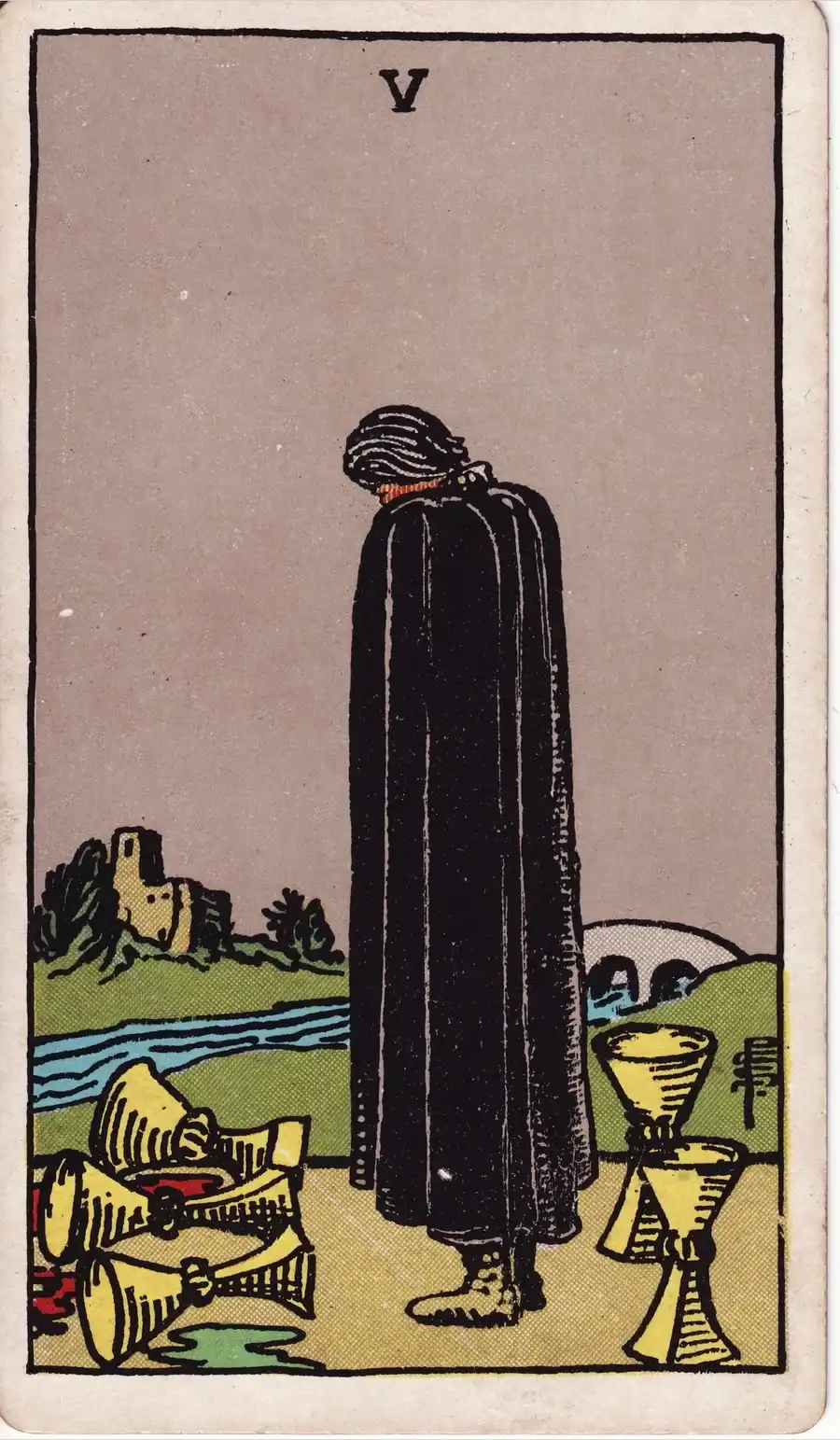
The Five of Cups shows a figure in a long black cloak looking down at three spilled cups. Two cups still stand behind him, but he has not turned to see them. Across the river, a bridge leads to a small house.
It is a card of grief, regret and loss. This page covers what the Five of Cups means upright and reversed, what Pamela Colman Smith drew and a gentle spread for hard times.
Here is the Five of Cups at a glance.
| At a glance | This card |
|---|---|
| Upright keywords | regret, loss, sorrow |
| Reversed keywords | acceptance, moving on, forgiveness |
| Number | 5 in the suit of Cups |
| Golden Dawn title | Lord of Loss in Pleasure Later tradition |
| Astrology | Mars in Scorpio, first decan (0° to 10° Scorpio) Later tradition |
| Tree of Life | Geburah (5), Severity Later tradition |
| Suit and element | Cups, Water Later tradition |
| Yes or no | No Modern |
The Golden Dawn named the Five of Cups the Lord of Loss in Pleasure and gave it Mars in Scorpio, the first decan of the sign, on Geburah. In older astrology Mars rules Scorpio, so the decan is intense and cutting. The title is gentler than the image: it names a loss within pleasure, not a total ruin.
Later tradition The Golden Dawn also gave each decan two of the 72 Goetic spirits, one for the day and one for the night. For the first decan of Scorpio, and so for the Five of Cups, they are Ipos (spirit 22, day) and Amy (spirit 58, night). Their pages read the old entries as history; see the spirit directory for all 72.
The card: what Pamela Colman Smith drew
Waite wrote: “A dark, cloaked figure, looking sideways at three prone cups; two others stand upright behind him; a bridge is in the background, leading to a small keep or holding.” A keep is a small fortified tower, a place of shelter.
The black cloak. The cloak is the color of mourning, and it covers him almost completely. Grief can feel exactly like this: wrapped up, heavy and turned inward.
Three spilled, two standing. Three cups have fallen and their contents are lost. Two are still upright behind him. The card does not say the loss is small. It says it is not everything.
The bridge. A bridge crosses the river to a safe house. There is a way forward when he is ready. Nobody is asking him to cross today.
Upright meaning
Upright, the Five of Cups is grief. A figure in a black cloak bows over three spilled cups, while two full cups stand behind him, unseen. Across the river, a bridge leads to a house. The card speaks of loss, regret and disappointment, the natural sorrow after something has gone wrong.
The card does not tell you to stop grieving. Loss is real, and the cloak is a sign of mourning, which deserves time. What it shows is that the loss is not total. Two cups remain. There is a bridge and a home on the other side of the river, even if you cannot look at it yet.
When you are ready, turn around. What remains may be smaller than what you lost, but it is still yours.
Reversed meaning
Reversed, the Five of Cups shows the turning point in grief: acceptance, forgiveness, and the first steps across the bridge. It can also show grief that is being avoided, pushed down or never spoken, which tends to come back later.
Ask whether you have let yourself mourn. If you have, it may be time to pick up the cups that are left. If you have not, find a safe place to let the sorrow out.
Reversed, this card can also describe the moment you finally speak about a loss years after it happened. That is not a step backward. Late grief is still grief, and naming it is often what lets the two standing cups come back into view.
In love, work and spirituality
In love. Upright: Heartbreak, regret over a past relationship, or sadness about what did not happen. Reversed: Healing after a breakup, forgiveness and the possibility of new love.
At work. Upright: Disappointment, a failed project or a lost opportunity. Reversed: Recovering from a setback and seeing what can still be saved.
With money. Upright: Financial loss or regret over a decision. Reversed: Recovering, and learning what you will do differently.
In spiritual practice. Upright: Honoring grief as part of the path. Ancestor or mourning work. Reversed: Finding peace after loss.
As feelings. Sadness, regret or longing. They may still be mourning something.
As a person. Someone grieving or focused on what went wrong.
As advice. Grieve what is gone, then turn toward what remains.
Reading the Five of Cups: positions and yes or no
In the past position: A loss shaped you, and you may still feel it. In the present position: You are grieving. Be gentle with yourself.
In the future position: A disappointment may come, and you will get through it. As advice: Let yourself feel it, then look at what remains.
In modern yes or no readings, the Five of Cups leans no. Loss and regret point to no for now.
What the Five means, and the history behind the card
Five breaks the balance of Four, and in Cups the break is felt as loss. Mars in Scorpio, the decan the Golden Dawn gave it, is not gentle, which helps explain why this is the sorrow card of the suit.
Here is how the Five looks across the four suits:
- Five of Wands: conflict, competition, tension
- Five of Cups (this card): regret, loss, sorrow
- Five of Swords: conflict, defeat, betrayal
- Five of Pentacles: financial loss, poverty, insecurity
When A. E. Waite published The Pictorial Key to the Tarot in 1910, he listed these divinatory meanings for the Five of Cups: “It is a card of loss, but something remains over; three have been taken, but two are left; it is a card of inheritance, patrimony, transmission, but not corresponding to expectations.”
Reversed, he gave: “News, alliances, affinity, consanguinity, ancestry, return, false projects.”
Common questions
Is the Five of Cups a yes or no card? It leans no. It shows loss and regret, though not the end of everything.
What does the Five of Cups mean in love? Sadness and regret after a breakup or disappointment. Reversed, forgiveness and healing.
What does the Five of Cups mean reversed? Acceptance and moving on. You start to see what is still standing.
Try this
Use this gentle spread when you are grieving or disappointed.
| Card | Question | What it shows |
|---|---|---|
| 1 | What have I lost? | The loss to honor. |
| 2 | What remains? | What is still standing for me. |
| 3 | What helps me heal? | The support or step toward the bridge. |
Affirmation: I let sorrow exist without making it the whole of me.
Reversed affirmation: I turn toward what remains when I am ready.
If you keep a tarot journal, take one of these questions to it: What am I grieving, even if it seems small? What is still standing behind me? What would help me cross the bridge, when I am ready?
What next
Cards that sit close to this one are Death (the Major Arcana card of endings and transformation), Three of Swords (another card of heartbreak) and Six of Cups (the next card, where gentleness and memory return).
The Five of Cups is part of the lesson Cups in my free Tarot for Beginners course. To see the whole suit on one page, go to the suit of Cups. To keep walking the suit, read the card before it, Four of Cups or the card after it, Six of Cups, or go back to all the card meanings.
For the suits and numbers in one place, see The Minor Arcana: suits and numbers made simple. For every card with keywords, affirmations and examples, see my book The Novice’s Guide to Tarot. If you would like a printable cheat sheet for all 78 cards, my 45-page Tarot Workbook is on Etsy.
Sources
- A. E. Waite, The Pictorial Key to the Tarot (London: Rider, 1910), Part III, sections 1 and 2.
- Pamela Colman Smith and A. E. Waite, the Rider-Waite-Smith tarot (London: Rider, 1909).
- Nicolas Conver, Tarot de Marseille (Marseille, 1760).
- Lauri Mukkala, The Novice’s Guide to Tarot, entry for the Five of Cups.
- Aleister Crowley, 777 (London: Walter Scott, 1909), columns of the decans, the Minor Arcana and the court cards.
- Israel Regardie, ed., The Golden Dawn (Chicago: Aries Press, 1937 to 1940), “Book T”, titles and attributions of the small cards and the court.
All 78 cards
Major Arcana
- The Fool
- The Magician
- The High Priestess
- The Empress
- The Emperor
- The Hierophant
- The Lovers
- The Chariot
- Strength
- The Hermit
- Wheel of Fortune
- Justice
- The Hanged Man
- Death
- Temperance
- The Devil
- The Tower
- The Star
- The Moon
- The Sun
- Judgement
- The World
Wands
- Ace of Wands
- Two of Wands
- Three of Wands
- Four of Wands
- Five of Wands
- Six of Wands
- Seven of Wands
- Eight of Wands
- Nine of Wands
- Ten of Wands
- Page of Wands
- Knight of Wands
- Queen of Wands
- King of Wands
Cups
- Ace of Cups
- Two of Cups
- Three of Cups
- Four of Cups
- Five of Cups
- Six of Cups
- Seven of Cups
- Eight of Cups
- Nine of Cups
- Ten of Cups
- Page of Cups
- Knight of Cups
- Queen of Cups
- King of Cups
Swords
- Ace of Swords
- Two of Swords
- Three of Swords
- Four of Swords
- Five of Swords
- Six of Swords
- Seven of Swords
- Eight of Swords
- Nine of Swords
- Ten of Swords
- Page of Swords
- Knight of Swords
- Queen of Swords
- King of Swords
Pentacles
Get the free Mini-Grimoire
A short printable starter guide to tarot and everyday witchcraft, plus my newsletter. Unsubscribe any time.
Opens Substack in a new tab to confirm. More about the newsletter · Privacy