


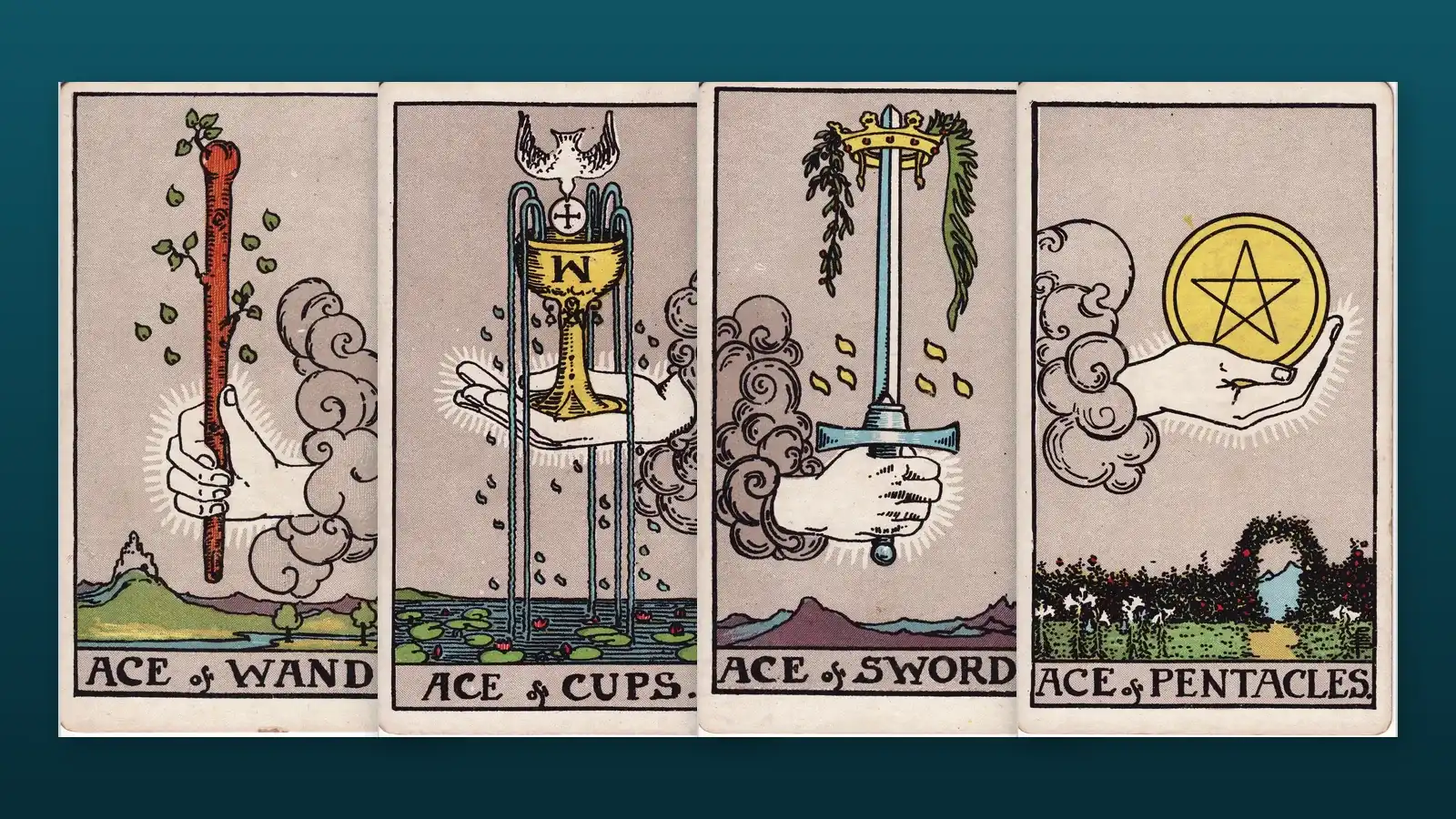
In this lesson: the four suits of the Minor Arcana, Cups, Swords, Pentacles and Wands, and the four elements that help you remember them.
Now we turn to the Minor Arcana: 56 cards in four suits of fourteen. If the Major Arcana are the chapter titles of your life, the Minors are the everyday sentences: moods, conversations, work, money, conflict and timing. Most cards in most readings are Minors, so understanding the suits is what turns a beginner into someone who can read almost any spread. The good news is that the suits follow a simple, memorable logic.
Four suits, four climates
Each suit runs from Ace to Ten, followed by four court cards: Page, Knight, Queen and King. And each suit has its own climate, a little like the weather in a picture.
Cups, sometimes called Chalices, speak to feeling, relationships and imagination, and their element is water. Think of the way water takes the shape of whatever holds it, the way feelings take the shape of our relationships. Swords speak to thought, words, conflict, truth-telling and worry, and their element is air.
Like air, thoughts are invisible, fast and sometimes stormy. Pentacles, also called Coins or Disks in other decks, speak to the body, work, money and practical care, and their element is earth: solid, slow and real. Wands, also called Batons, Rods or Staves, speak to drive, creativity, courage and momentum, and their element is fire.
The elements as a memory trick
The four classical elements are a compact way to remember the suits, and each one carries both a gift and a risk. Fire gives heat, initiative and courage, and its risk is burnout. Water gives feeling, bonds and imagination, and its risk is overwhelm. Air gives thought, language and clarity, and its risk is overthinking. Earth gives body, craft and money, and its risk is getting stuck.
So when you draw a Minor card and forget its meaning, start with the suit’s climate. A Cups card is about feelings in some way. A Swords card is about thoughts or words. Then add the number, which you will learn in the next lesson, and you already have a starting meaning.
Where the suits come from
Historical The four tarot suits are the old Italian card suits: cups, coins, swords and batons. They descend from the suits of Mamluk playing cards that reached Europe in the late fourteenth century, where the batons were polo sticks, a game Europeans did not play, so they became sticks or clubs. The Golden Dawn and Waite renamed coins as pentacles, coins engraved with a five-pointed star, and batons as wands, giving them a magical flavor. So when you shuffle a tarot deck, you are handling suits that link Cairo, Venice and London.
Why elements, and why they vary
Later tradition Linking suits to the four classical elements is a later idea, developed mainly by nineteenth-century French occultists and by the Golden Dawn. The four elements themselves go back to the Greek philosopher Empedocles in the fifth century BCE, and the related four temperaments, sanguine, choleric, melancholic and phlegmatic, to Greek medicine.
The most common system today, used in this course, is Wands for fire, Cups for water, Swords for air and Pentacles for earth. Some readers swap Wands and Swords, giving Swords to fire because swords are forged in fire. Neither is wrong; choose one and stay with it.
Reading suits together
When several cards of one suit appear in a reading, that suit sets the tone. Many Swords suggest the situation is mostly in your head or in conversations. Many Pentacles point to money, work or the body. Many Cups point to relationships and feelings, and many Wands to energy, projects and drive. A missing suit can be just as telling: a career reading with no Pentacles at all might be asking whether this is really about money, or about something else.
The suits also color the Major cards around them. A Tower with three Pentacles might be about a job or a home. A Tower with three Swords might be a sudden truth about how you have been thinking.
An example: one question, two suits
Imagine someone asks, “Why do I feel so tired lately?” In one version of the reading she draws the Nine of Swords, the Two of Swords and the Seven of Swords. All air: her tiredness is coming from worry, an unmade decision and possibly something she is not saying.
In another version she draws the Four of Pentacles, the Ten of Wands and the Eight of Pentacles. Earth and fire: now the answer is about overwork and carrying too much. Same question, different suits, entirely different advice. Before you look up a single keyword, the suits have already told you where to look.
If your deck is different
Some decks swap the elements of Swords and Wands, or use other suit names. Learn the system in front of you first. The meanings in this course follow the Rider-Waite-Smith tradition, which is the most common.
A practice variation: the suit count
Before reading any spread, count the suits. If one suit dominates, the reading is mostly about that area of life. If a suit is missing, notice that too: no Cups might mean feelings are being left out of the picture; no Pentacles might mean practical matters are being ignored. Then count the Majors: many Majors suggest a big life theme, while mostly Minors suggest everyday matters. This takes ten seconds and often tells you the shape of the answer before you read a single card.
A second worked example
Imagine a five-card reading about a house move: three Pentacles, one Swords and one Cups, no Wands, no Majors. Before reading anything, the reader notes: “Mostly practical, some worry, a little feeling, and not much energy or enthusiasm. An everyday matter, not a life turning point.” When she reads the cards, the pattern holds: the Pentacles are about money and logistics, the Swords is a worry about timing and the Cups a small sadness about leaving neighbors. The missing Wands prompts her to ask what would make the move exciting rather than only a chore.
Waite matched the suits differently
Historical Many modern books say that Wands match the playing-card suit of Clubs, Cups match Hearts, Swords match Spades and Pentacles match Diamonds. Waite, writing in 1910, gave a different list. He called Wands “the antecedents of Diamonds in modern cards”, matched Cups to Hearts, said Swords “answer to Clubs”, and made Pentacles “the prototypes of Spades”.
Neither list is the single right answer. The shapes on French playing cards, which appeared in the fifteenth century, are not direct copies of the Italian suits, so any match is an interpretation. The point for a beginner is reassuring: if two books disagree about a correspondence, they are not both failing to know a secret. They are making different reasonable choices. Pick the system your main deck and book use, and stay with it while you learn.
Practice: reading with ordinary playing cards
If you have a standard pack of playing cards, you can practice suit reading without a tarot deck. Choose one correspondence list, such as Clubs for Wands, Hearts for Cups, Spades for Swords and Diamonds for Pentacles, and write it on a sticky note. Draw three cards and read only the suits and numbers: “Hearts, Diamonds, Diamonds. Feelings, then two practical matters.” It is a quick way to train the suit and number layers, and it works on a train or in a waiting room where you might not want to bring your tarot deck.
Suits as four questions
Another way to remember the suits is to give each one a question. Wands: what do I want to do? Cups: how do I feel about it? Swords: what do I think, and what is true? Pentacles: what will it take in time, money and effort? When you are stuck on a reading, ask the question of the suit that appears most. When a suit is missing, ask its question anyway. A reading about a new job with no Cups at all might gently ask whether you have checked how you feel, not just what you can earn.
A worked example: the missing suit
Imagine someone asks, “How can I make my weekends more restful?” and draws the Eight of Wands, the Knight of Swords and the Six of Wands. Two Wands and a Sword: lots of movement and thinking, and no Cups or Pentacles at all. Before reading any single card, the suit count speaks.
The weekends are full of activity and planning, with little room for feeling or for the body. A simple practical answer might be to plan one slow, physical thing, a walk or cooking, and leave a few hours unplanned. The cards did not need to be complicated to be useful.
A beginner’s question: “Should I memorize elements or suits first?” Suits first. The element is a memory aid; the suit’s picture is what you will actually see on the table.
Questions beginners ask
Do the suits match ordinary playing cards? Roughly: Cups and hearts, Pentacles and diamonds, Swords and spades, Wands and clubs, though the match is a modern convenience.
What if my deck uses different suit names? Many decks rename suits, for example “Disks” in the Thoth deck. Find out which traditional suit each one replaces.
Do I have to believe in elements? No. Use them as a memory aid if they help.
Myths to drop: The suits were not designed to represent elements. Swords are not always bad news. And the elemental system is not the same in every tradition.
Try this
Sort your Minor Arcana into four piles by suit. Look at each pile for a minute and write one word for the mood of each. Do the colors or skies differ between piles? Note anything you notice.
Recap
The Minor Arcana are 56 cards in four suits, each with Ace to Ten and four court cards. Cups are linked to water and feelings, Swords to air, thought and conflict, Pentacles (Coins or Disks in other decks) to earth, body, work and money, and Wands to fire, drive and creativity. Start with the suit’s climate when you forget a card, and notice which suits dominate or are missing in a reading.
What next
Press “Mark as done” and continue with Numbers one to ten. For a longer look, read the Minor Arcana and numerology and elements, and if you are also learning witchcraft, see the four elements.
Further reading: Michael Dummett, The Game of Tarot (Duckworth, 1980), on the history of the suits.
Sources
- Lauri Mukkala, The Novice’s Guide to Tarot, “The Minor Arcana” and “Elements in Tarot”.
Quick check
Go deeper: The Novice's Guide to Tarot: The Minor Arcana; Elements in Tarot
Get the free Mini-Grimoire
A short printable starter guide to tarot and everyday witchcraft, plus my newsletter. Unsubscribe any time.
Opens Substack in a new tab to confirm. More about the newsletter · Privacy
Comments
Questions and notes from readers. Anyone with a free account can comment, and I reply when I can. Please read the community guidelines.
Comments load from Google Firebase (EU) when you ask for them. Nothing is stored on your device. Privacy