


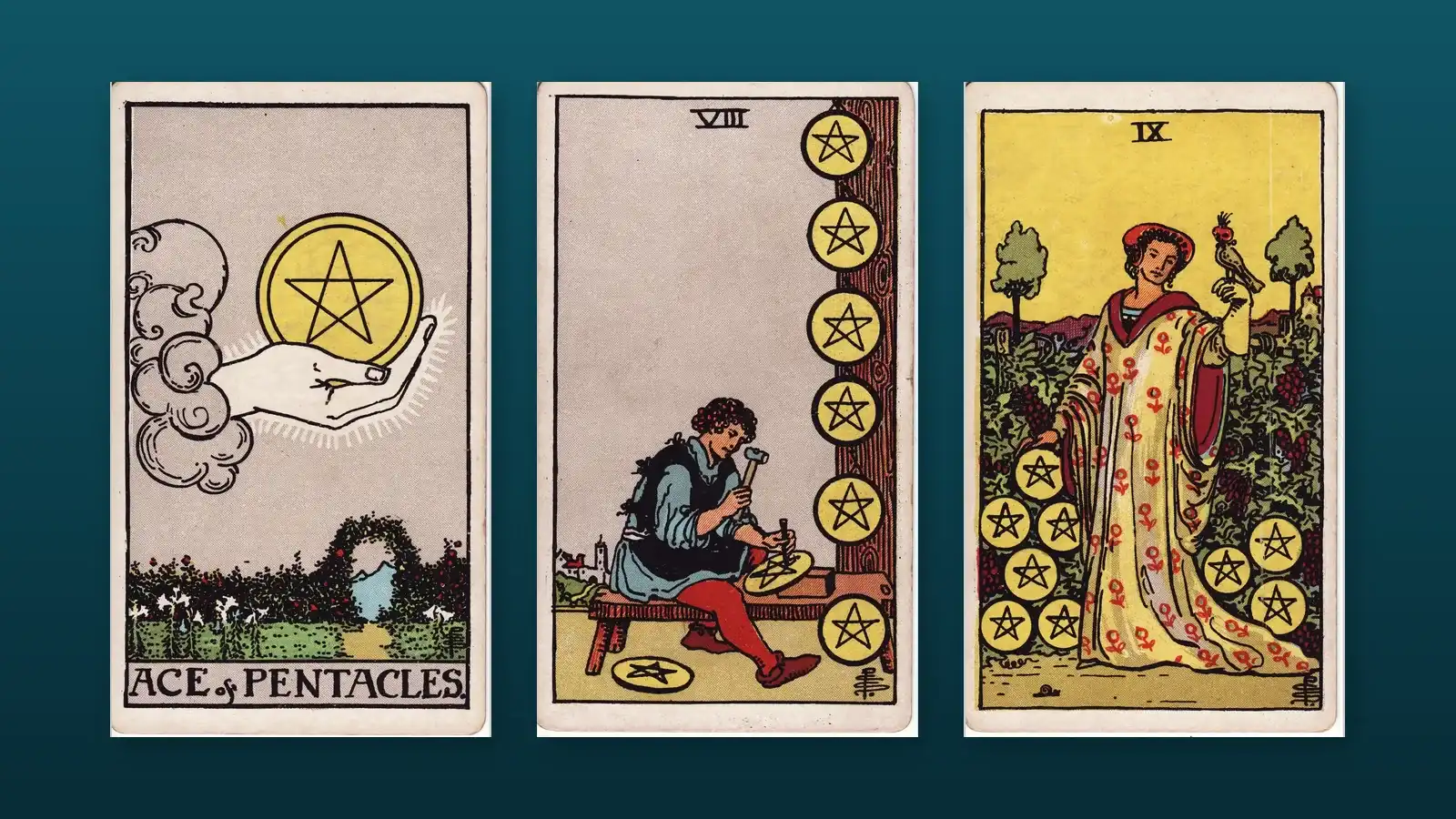
In this lesson: the 14 cards of the suit of Pentacles, the suit of earth, work, money and the body, with keywords and the 1909 pictures.
Pentacles are the suit of things you can touch: the body, the paycheck, the craft, the home. Their element is earth. When Pentacles fill a reading, the question is practical: work, money, health, time and the slow growth of what you build. Many people find Pentacles the least glamorous suit at first, and the most useful one later, because it keeps readings grounded in real life.
The climate of Pentacles
Pentacles are about resources, skill, the body and everyday care. Their gift is patience and steady effort. Their risk is getting stuck, worrying about money or holding on too tightly. Money and work are real, and the cards can help you plan. They do not promise. For big money decisions, the right adviser is a person who knows your finances.
The number cards as a story
In order, the Pentacles tell the story of building a life. The scenes are the 1909 Rider-Waite-Smith pictures.
The Ace of Pentacles shows a hand from a cloud holding a pentacle over a garden path: a real, tangible opportunity. In the Two, a young man juggles two pentacles in a loop while ships ride the waves behind him, adaptability and balancing many things at once. In the Three, a craftsman works in a cathedral while two people hold the plans: skill meeting teamwork.
Then comes the tension around having and not having. In the Four, a man clutches a pentacle, with others under his feet and on his crown, security turning into holding on tight. In the Five of Pentacles, two figures walk through snow past a lit church window. It is hardship and insecurity, and also help that may be nearer than it seems. The Six answers with a merchant holding scales and giving coins to two people, generosity, giving and receiving.
Then patience pays off. In the Seven, a farmer leans on his hoe and studies his growing plant, assessing and waiting. In the Eight of Pentacles, a craftsman practicing his skill carves pentacle after pentacle, diligence and focus. The Nine shows a woman standing in her vineyard with a falcon on her glove, comfort and self-sufficiency she has earned. And the Ten gathers an old man, a family and two dogs under an archway, legacy and roots that last.
Waite on three Pentacles cards
Historical Waite’s Pictorial Key (1910) describes the Eight of Pentacles in one line: “An artist in stone at his work, which he exhibits in the form of trophies.” For the Five he wrote: “Two mendicants in a snowstorm pass a lighted casement.” Mendicants are beggars, and the casement is a window; in Smith’s picture it is a stained-glass window.
For the Ten: “A man and woman beneath an archway which gives entrance to a house and domain”, with a child, two dogs and an old man. These lines show how much of the suit is about work, hardship, home and inheritance across generations.
From coins to pentacles
Historical In older decks this suit is coins, denari in Italian and deniers in French, and the cards simply show round coins. The Golden Dawn turned them into pentacles, disks marked with a five-pointed star, a symbol used in their magic. In the Thoth deck they became Disks. Whatever the name, the suit is about the material world: money, work, the body, home and things we can touch.
The court of Pentacles
The Page of Pentacles studies a pentacle in a green field, a new skill, study or venture. The Knight of Pentacles sits still on a heavy horse facing a plowed field, slow, steady, responsible. The Queen of Pentacles holds a pentacle in a lush garden with a rabbit nearby, practical, nurturing care. The King of Pentacles sits among vines and bulls, steady, generous success.
An example: a practical reading
Imagine someone asks, “How can I make my side business more stable?” and draws the Two of Pentacles, the Seven of Pentacles and the Page of Pentacles. All earth. The Two says she is juggling too much, the Seven that some of her work needs time to grow before she judges it, and the Page that learning one new practical skill, perhaps bookkeeping, would help. Nothing mystical, nothing frightening: three cards that turn into a to-do list. That is Pentacles at their best.
Pentacles in different areas of life
In love, Pentacles point to stability, commitment and shared life: a home, a budget, everyday kindness. In work they are the most direct suit: jobs, skills, income and long projects. In spiritual practice they ask you to ground your practice in the body and in daily routine. When a reading has many Pentacles, ask: what am I building, and is it built to last?
A practice variation: the Pentacles week
For one week, draw one card a day from the Pentacles only, with the question “What do I need to take care of in practical life today?” Each evening, write one line about how the card’s idea showed up: a bill paid, a meal cooked, a walk taken, a task finished. Pentacles reward this kind of grounded attention, and by the end of the week you will have a concrete memory for each card.
A second worked example
Imagine someone worried about money draws the Four of Pentacles, the Six of Pentacles and the Queen of Pentacles. Four is stability, perhaps stuck, and the picture shows a figure clutching coins: holding on tightly out of fear. Six is balance restored, and the picture shows a merchant giving to people in need: give and take, perhaps asking for help or a fair deal.
The Queen of Pentacles is practical care and comfort. Her note reads: “Loosen my grip, ask for what is fair and look after the basics kindly.” She then makes an appointment with a debt adviser, which is the real help the cards pointed toward.
Waite on the Ace, the Four and the Nine
Historical Three more lines from The Pictorial Key to the Tarot (1910) show the range of this suit.
The Ace. In Waite’s words, a hand “issuing, as usual, from a cloud” holds up a single pentacle. Waite adds a thoughtful warning: the card “shews prosperity, comfortable material conditions, but whether these are of advantage to the possessor” depends on other factors. Even in 1910, money was not automatically good news.
The Four. “A crowned figure, having a pentacle over his crown, clasps another with hands and arms; two pentacles are under his feet. He holds to that which he has.” That last short sentence is the easiest way to remember the card: security, or holding on too tightly.
The Nine. “A woman, with a bird upon her wrist, stands amidst a great abundance of grapevines in the garden of a manorial house.” Waite suggests the garden is “Possibly” her own, a sign of “material well-being”. Modern readers often see independence and the reward of patient effort.
Practice variations
The Pentacles inventory. Pentacles are about the things that keep life running: work, money, home, health and time. Make a page in your notebook with those five headings. Each time a Pentacles card appears, note which heading it seems to touch. After a month, you will see which parts of your practical life your readings return to most.
One small practical step. Every Pentacles card can end with an action. When you draw one, finish your note with one concrete step for the next three days: pay a bill, stretch for ten minutes, clear a shelf. This suit rewards doing more than thinking.
Slow cards, slow look. Many Pentacles pictures show patient work, gardens and growth. Choose the Seven of Pentacles and look at it for three minutes without reading anything. What is the gardener waiting for? What would happen if he gave up now? Slow looking suits this slow suit.
A worked example: a money worry
Imagine someone asks, “How can I feel calmer about money this month?” and draws the Four of Pentacles, the Eight of Pentacles and the Nine of Pentacles. The Four shows holding on tightly, perhaps out of worry. The Eight shows steady work and skill. The Nine shows comfort that comes from patience and good choices.
Read together, the cards do not promise money. They suggest a path: notice where fear is making you grip, put your energy into one skill or task you can control, and let calm build from steady effort. A reading like this is a starting point for thinking, and for a real budget if one is needed, not a financial plan by itself.
Pentacles and the body
Pentacles are linked to earth, and many readers also connect them to the body: sleep, food, movement and rest. When Pentacles crowd a reading about stress, it can be worth asking a very simple question: “Am I looking after my body?” Sometimes the most useful answer to a worried reading is an early night.
A beginner’s question: “Are Pentacles boring?” They can seem plain next to dramatic Swords or romantic Cups. But much of a good life is built in Pentacles: work done well, a home kept, a body cared for. Readers often come to love this suit most of all.
Questions beginners ask
Are Pentacles only about money? No. They include health, the body, work, skills, home and nature.
Is the Five of Pentacles a sign of poverty? It reflects feeling left out or struggling; it does not predict poverty. Notice the lit window.
Is the Ten of Pentacles about inheritance? It can be, but more broadly it is about lasting security and family over time.
Myths to drop: Pentacles are not “boring”. The pentagram on them is not evil. And a Pentacles reading cannot replace financial advice.
Try this
Draw one Pentacles card and write one small, practical thing it suggests you do this week. Then put that thing in your calendar.
Recap
Pentacles belong to earth and speak of work, money, the body and everyday care. Their number cards tell the story of building a life, from opportunity through hardship and patience to lasting legacy. The Eight of Pentacles shows a craftsman practicing his skill. The court cards show earth as study, steadiness, care and generous success. The main risk of too much earth is getting stuck.
What next
Press “Mark as done” and continue with Meet the court. Every card in the suit has its own page, starting from the suit of Pentacles.
Further reading: A. E. Waite, The Pictorial Key to the Tarot (1910), the Pentacles section, free online.
Sources
- Lauri Mukkala, The Novice’s Guide to Tarot, “Pentacles”.
- A. E. Waite, The Pictorial Key to the Tarot (London: Rider, 1910).
Quick check
Go deeper: The Novice's Guide to Tarot: Pentacles
Get the free Mini-Grimoire
A short printable starter guide to tarot and everyday witchcraft, plus my newsletter. Unsubscribe any time.
Opens Substack in a new tab to confirm. More about the newsletter · Privacy
Comments
Questions and notes from readers. Anyone with a free account can comment, and I reply when I can. Please read the community guidelines.
Comments load from Google Firebase (EU) when you ask for them. Nothing is stored on your device. Privacy