


In this lesson: the 14 cards of the suit of Swords, the suit of air, thought and truth, with keywords and the 1909 pictures.
Swords are the suit of the mind: words, ideas, arguments, hard truths and worry. Their element is air. Swords have a reputation as the scary suit, and some of its pictures are hard to look at. But Swords also bring clarity, honesty and the courage to say what is true. Learning to read them calmly is one of the most useful things a beginner can do, because the worries Swords describe are the very ones that keep people up at night.
The climate of Swords
This suit works in the mind. Its gift is clarity and truth. Its risk is overthinking, anxiety and cutting words. A hard Swords card names pressure, not certainty. It does not prove that the worst will happen. Read the picture and the position, then decide what ordinary support the situation needs.
The number cards as a story
In order, the Swords tell the story of a mind under pressure finding its way through. The scenes described are the 1909 Rider-Waite-Smith pictures.
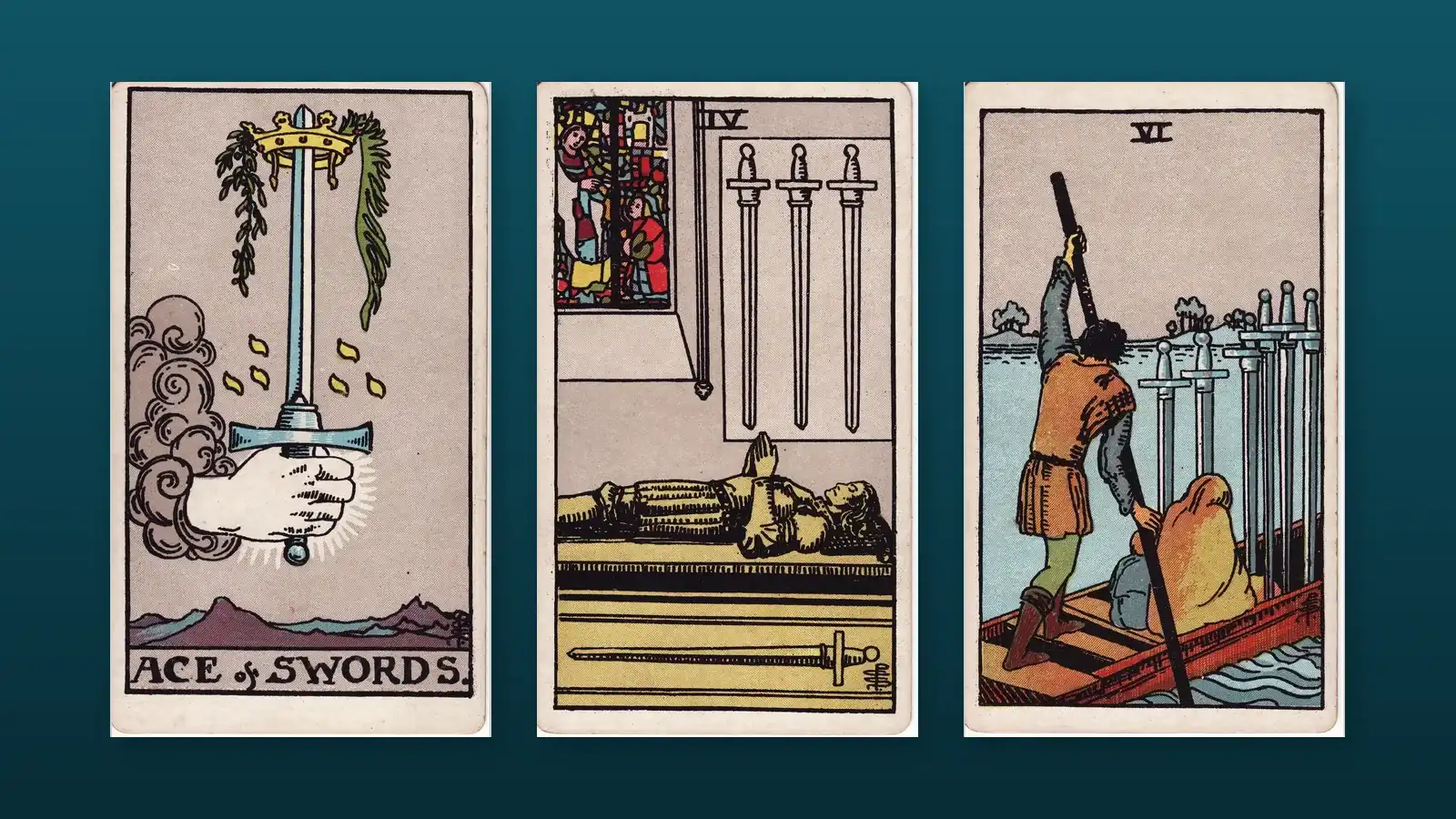
The Ace of Swords shows a hand from a cloud holding a sword through a crown: mental clarity, truth, a clear thought cutting through fog. Then comes avoidance. In the Two of Swords a blindfolded woman sits by the sea holding two crossed swords, a stalemate, a choice she does not want to make. In the Three, three swords pierce a heart in the rain. It names heartbreak and sorrow honestly, without decoration.
After hurt comes rest. In the Four of Swords, a figure lies still on a tomb in a quiet church, hands together: rest and recovery. The Five shows a man gathering swords while two others walk away, a win that costs trust. In the Six, a ferryman carries passengers across calmer water, a slow transition, moving on and healing.
Then the mind’s tricks. In the Seven, a man sneaks away with five swords, strategy or something not quite honest. In the Eight, a bound and blindfolded woman stands among swords, but nobody guards her, and the trap may be looser than it looks. The Nine of Swords shows a person sitting up in bed with their face in their hands: anxiety and night worries. And the Ten shows a figure lying with ten swords in his back while dawn breaks on the horizon. A painful chapter is ending, and the day is already coming.
Waite on two Swords cards
Historical Waite describes the Three of Swords in The Pictorial Key (1910) as “Three swords piercing a heart; cloud and rain behind.” He adds that its meanings include “removal, absence, delay, division, rupture”, and that it is “too simple and obvious” to need more explanation.
Of the Ten he wrote: “A prostrate figure, pierced by all the swords belonging to the card.” But then he adds a sentence many beginners would find comforting: “It is not especially a card of violent death.” Even the most dramatic card in the deck was, for its designer, about pain and sadness rather than literal disaster.
Why swords mean the mind
Later tradition In the elemental system used in this course, Swords belong to air, the element of thought and communication. A sword cuts, divides and clarifies, just as thinking does. That is why the suit can mean both sharp insight and painful overthinking. The Ace of Swords, a hand holding up a sword crowned with a wreath, is clarity itself. The Nine, a figure sitting up in bed with face in hands, is the mind turning on itself at night.
The court of Swords
The Page of Swords holds a sword up on a windy hill, alert, curious and full of sharp questions. The Knight of Swords charges into the wind, fast, direct and sometimes careless. The Queen of Swords raises her sword with one hand held out, independent, honest and clear. The King of Swords holds his sword upright: authority, truth and fair, reasoned judgment.
An example: reading through worry
Imagine someone asks, “Why can’t I stop worrying about my exam?” and draws the Nine of Swords, the Eight of Swords and the Ace of Swords. The Nine names exactly what she feels: sleepless worry. The Eight suggests that part of the trap is a story she is telling herself, that she is more able to move than she believes. And the Ace, landing last, offers a way through: one clear thought, one clear plan. Perhaps that means writing a simple revision schedule tonight. The reading does not deny her worry. It shows her a door.
Be gentle with yourself
If you draw several hard Swords cards in a row, put the deck down for a moment. The Nine of Swords names worry, not a breakdown. The Ten names an ending, not the end of you. And if worry keeps you awake night after night, talking to someone you trust or to a doctor will help more than any card.
Swords in different areas of life
In love, Swords show communication, arguments and honesty. In work, they point to decisions, plans, negotiations and stress. In spiritual practice they speak of study, discernment and clear thinking. When a reading has many Swords, ask: how much of this is happening in my head, and what is actually true?
A practice variation: rewriting the story
Swords cards often show the worst moment of a story. Try this exercise with any Swords card that upsets you: write one sentence about what happened just before the picture, and one about what happens just after. For the Nine of Swords, perhaps: “Before, she had a long, stressful day. After, she gets up, makes tea and writes her worries down.” This simple step reminds you that each card is a moment, not a life sentence.
A second worked example
Imagine someone drawing the Two of Swords, the Six of Swords and the Page of Swords about a difficult conversation with her manager. Two is a choice, and the picture shows a blindfolded figure holding two crossed swords: avoiding a decision. Six is moving toward balance, and the picture shows a boat crossing to calmer water. The Page of Swords is curiosity and sharp, honest words. Her note reads: “Stop avoiding, prepare for the crossing and speak clearly and curiously.” She writes three questions to ask her manager. The reading turned dread into a plan.
Waite on the Six and the Eight
Historical Two more of Waite’s descriptions in The Pictorial Key to the Tarot (1910) are worth knowing, because both are gentler than many beginners expect.
The Six. “A ferryman carrying passengers in his punt to the further shore. The course is smooth, and seeing that the freight is light, it may be noted that the work is not beyond his strength.” Smith’s picture shows a hunched figure with a child, and many modern readers see a move away from trouble towards calmer waters.
The Eight. “A woman, bound and hoodwinked, with the swords of the card about her. Yet it is rather a card of temporary durance than of irretrievable bondage.” “Hoodwinked” here means blindfolded. Waite saw the card as a temporary trap, and modern readers often add that the bindings look loose and the swords do not block every path. The trap is partly in the mind, which is exactly the territory of this suit.
Practice variations
Thought and fact. When a Swords card appears, draw a line down a notebook page. On the left, write the thought the card brings up, such as “I always get this wrong”. On the right, write what you actually know to be true. This simple exercise is borrowed from everyday good sense about worry, and it fits the suit perfectly.
The Swords conversation. Swords are also about words. Choose the Page, Knight, Queen and King of Swords and imagine each one giving you advice about a hard conversation. Who is curious, who is too quick, who is clear and kind, who is fair but firm? Write one line for each. It is a gentle way to learn the court and to prepare for real conversations.
Light the dark cards. For each of the Eight, Nine and Ten of Swords, find one hopeful detail in the picture: the loose bindings, the patterned quilt, the dawn on the horizon. Smith often put a small sign of hope in her hardest images.
A worked example: a sleepless night
Imagine someone draws the Nine of Swords the morning after a bad night. The picture shows a figure sitting up in bed, head in hands, with nine swords on the dark wall. She might fear it predicts more trouble. Instead, she reads it as the card is commonly read: worry that is worse at night than in daylight. She writes down the three thoughts that kept her awake, then beside each the smallest step she could take today. The card has not solved anything, but it has turned a cloud of worry into a short list.
A beginner’s question: “Why do so many Swords cards look painful?” Because thinking can hurt: worry, conflict and hard truths are all part of the mind’s life. But Swords also bring clarity, honesty and fair decisions. A sharp blade can wound, and it can also cut through confusion.
Questions beginners ask
Is a Swords-heavy reading a bad sign? It means the matter is mostly about thoughts, words and conflict, which can be worked with.
Does the Ten of Swords mean betrayal? It can mean feeling stabbed in the back, but more often a painful ending that is now over.
Why are Swords so hard to read? Because thoughts are hard to watch. Be kind to yourself.
Myths to drop: Swords are not curses. The Three of Swords does not predict heartbreak; it names it. And the Ace of Swords is one of the most positive cards for clarity.
Try this
Draw one Swords card and write down the thought or worry it makes you think of. Then write one kinder, truer way to think the same thought.
Recap
Swords belong to air in this course and speak of thought, words, truth and worry. Their number cards trace a mind under pressure, from clarity through hurt, rest and worry to an ending with dawn behind it. The Four of Swords suggests rest and recovery. A hard Swords card names pressure, not certainty, and the main risk of too much air is overthinking.
What next
Press “Mark as done” and continue with Pentacles. Every card in the suit has its own page, starting from the suit of Swords.
Further reading: A. E. Waite, The Pictorial Key to the Tarot (1910), the Swords section, free online.
Sources
- Lauri Mukkala, The Novice’s Guide to Tarot, “Swords”.
- A. E. Waite, The Pictorial Key to the Tarot (London: Rider, 1910).
Quick check
Go deeper: The Novice's Guide to Tarot: Swords
Get the free Mini-Grimoire
A short printable starter guide to tarot and everyday witchcraft, plus my newsletter. Unsubscribe any time.
Opens Substack in a new tab to confirm. More about the newsletter · Privacy
Comments
Questions and notes from readers. Anyone with a free account can comment, and I reply when I can. Please read the community guidelines.
Comments load from Google Firebase (EU) when you ask for them. Nothing is stored on your device. Privacy