


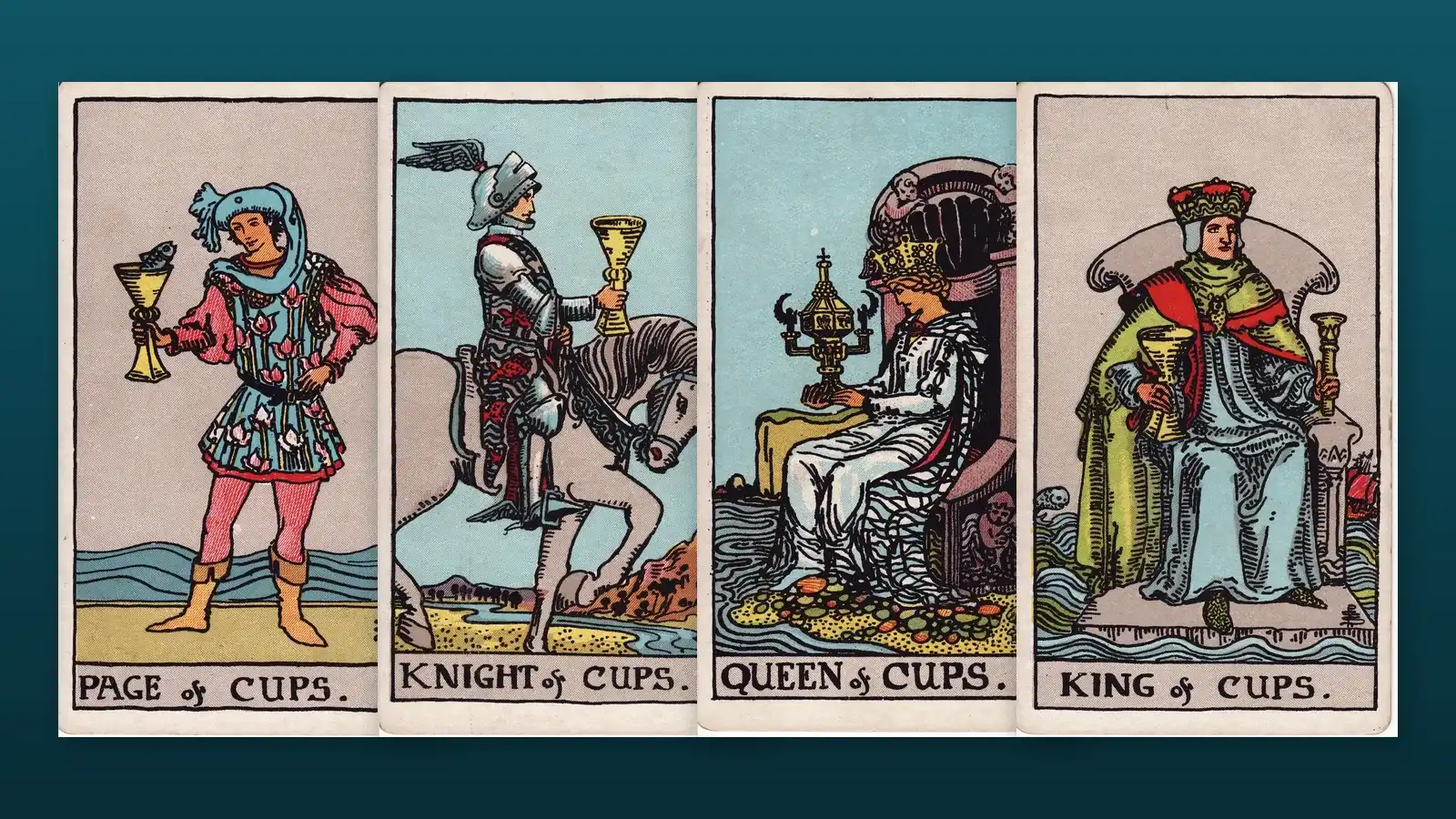
In this lesson: the 16 court cards, Pages, Knights, Queens and Kings, explained simply with the suit of each one.
Court cards confuse almost every beginner, so if they confuse you, you are in good company. There are sixteen of them: a Page, a Knight, a Queen and a King in each of the four suits. They matter because they bring people, roles and attitudes into a reading, which is often exactly what a question is about. The good news is that once you understand four ranks and four suits, you can read all sixteen without memorizing them one by one.
The four ranks as stages of a skill
Think of the ranks as four stages of learning any skill, whether it is baking bread or leading a team.
The Page is the beginner. A Page usually brings a beginning or a message: curiosity, a first step, apprentice energy. Pages are students of their suit, and they often arrive with news. The Knight is the one in motion. Knights show movement and pursuit, travel and commitment in action, and sometimes too much of their suit’s style.
They are going somewhere fast. The Queen has mastered the suit from the inside. Her skill is embodied, caring and receptive, and she knows when to act and when to wait. The King leads with the suit. He carries responsibility, direction and public skill, and he looks after others with what he knows.
Rank plus suit
Now combine rank and suit, the same way you combined number and suit in module 4. The Page of Cups is a beginner in feelings: a sweet surprise, a creative idea, an open heart. The Knight of Swords is thought in motion: fast, direct and sometimes careless with words. The Queen of Pentacles is mastery of practical care, someone who makes a home, a budget and a garden grow. The King of Wands leads with fire: vision, charisma, a natural leader.
Try a few yourself before reading on. A Knight of Cups? Feelings in motion: romance, an offer of the heart. A King of Swords? Leading with the mind: fair judgment and clear authority. A Page of Pentacles? A beginner in practical matters: a new course of study or a first job.
Courts in the oldest decks
Historical Ordinary Italian playing cards of the fifteenth century had three court cards per suit: king, knight and jack. Tarot added a queen, making four, which is still the pattern today. One early hand-painted deck made for the Visconti family of Milan, now called the Cary-Yale Visconti tarot after its home at Yale University, went further: it has female knights and female pages as well, six court cards per suit. The idea that court cards can be read without fixed gender is modern, but the cards themselves have not always been all male.
Later tradition The Golden Dawn renamed the court cards King, Queen, Prince and Princess, and the Thoth deck uses Knight, Queen, Prince and Princess. Waite kept King, Queen, Knight and Page. If you meet another deck, translate the ranks by their position: the youngest, the active one, the nurturing one and the mature one.
Not about gender or age
The figures on the cards are drawn as young people, men and women, but court cards are not limited by the gender or age of the figure. A Queen can describe anyone, including a man. A Page can describe a grandmother learning something new. A Knight can describe a strategy rather than a person. Read the energy, not the costume.
Court cards also sit outside the Ace to Ten count, so do not read them by number. When a court appears, read character and approach first. Many systems pair the courts with elements or zodiac signs, and different books disagree about the pairings. You do not need any of that to read well. If your deck prints a sign on its courts, follow your deck, and if not, leave it.
An example: four Queens at one table
Imagine a reader lays the four Queens side by side and asks each the same question: “How would you handle a difficult conversation with a friend?” The Queen of Wands would speak warmly and directly, confident it will turn out fine. The Queen of Cups would listen first and make sure the friend feels understood.
The Queen of Swords would say the honest thing clearly, without cruelty and without softening it into nothing. The Queen of Pentacles would bring practical help, perhaps a meal, and talk while doing something together. Four mature women, four kinds of mastery. That is the whole court system in one example.
How to learn them
Sort the sixteen courts into a grid on a table: four rows for the suits, four columns for the ranks. Look across a row and you will see one suit growing up. Look down a column and you will see one rank in four moods. That grid is the whole system on one table.
The ranks as a working life
Another way to remember the ranks is to think of a craft workshop. The Page is the apprentice, curious and still learning. The Knight is the journeyman, traveling and practicing with energy, sometimes too much. The Queen has mastered the craft from the inside and nurtures it in others. The King has mastered it in the outside world and takes responsibility for it. A Page of Pentacles is an apprentice in practical life; a King of Pentacles runs the workshop.
A practice variation: court portraits
Lay out the sixteen court cards in a grid of four rows (ranks) and four columns (suits). For each, write a short description as if of a person you might meet: “The Knight of Cups is a romantic who brings flowers and poems but may not stay.” Then mark any court card who reminds you of yourself, a friend or a colleague, and write why. This is how many readers learn the courts, and it is fun.
A worked example in prose
Imagine someone drawing the Knight of Swords about a team project. Rank: Knight, active and driven. Suit: Swords, thoughts and words. Together: “fast, sharp thinking and blunt speech”. In the picture, a rider charges forward with sword raised, against a stormy sky. She asks whether this is a colleague, herself or the approach the project needs. She realizes it is herself, rushing ahead with ideas and leaving others behind, and decides to slow down in the next meeting.
Waite on how to read the court
Historical In The Pictorial Key to the Tarot (1910), Waite gave a simple rule that is still the best starting point. The King of Wands, he said, “is not exactly the same personage as the King of Cups”, but “the symbolism resides in their rank and in the suit to which they belong.” Rank plus suit: that is the method of this lesson, in Waite’s own words.
He also noted that the Page is “most correctly” an esquire in the service of the Knight, and that “there are certain rare sets in which the page becomes a maid of honour”. Court cards have changed shape many times, which is another reason not to treat their gender as fixed.
Watching the riders
The Knights are the easiest court cards to tell apart, because their horses show their pace. Waite himself pointed to this. Of the Knight of Wands he wrote, “The motion of the horse is a key to the character of its rider”. The Knight of Pentacles, by contrast, “rides a slow, enduring, heavy horse, to which his own aspect corresponds.”
Lay out the four Knights side by side and look only at the horses. The Wands horse rears, the Cups horse walks calmly, the Swords horse charges, and the Pentacles horse stands still. Pace, in this suit of riders, is personality. A Knight of Swords rushing through a reading about a decision might ask you to slow down, while a Knight of Pentacles might ask you to finally get moving.
Practice variations
Court card casting. Think of a favorite novel, film or series. Cast its main characters as court cards, choosing a rank and a suit for each and writing one sentence on why. Characters are easier to remember than abstract qualities, and you will start to see the court everywhere.
Your own court. Which court card are you at work? With friends? At home when you are tired? Most people find they shift between several cards. Writing them down helps you see the court as roles anyone can step into, not fixed personalities.
Rank by rank. For one week, focus on one rank each day: Pages on Monday, Knights on Tuesday, Queens on Wednesday, Kings on Thursday. Lay out the four cards of that rank and compare their faces, postures and backgrounds.
A worked example: two Pages
Imagine someone draws the Page of Cups and the Page of Pentacles together for the question “How should I approach my new course?” Waite described the Page of Cups contemplating a fish rising from his cup and called it “the pictures of the mind taking form”. His Page of Pentacles is “looking intently at the pentacle which hovers over his raised hands.” Two learners: one dreamy and imaginative, one careful and studious. The reading might suggest bringing both to the course: let curiosity lead, and support it with steady, practical study habits.
A beginner’s question: “Why do court cards feel harder than the rest?” Because they describe people, and people are complicated. Give yourself time. Most readers find the court is the last part of the deck to feel natural.
Questions beginners ask
Why are court cards so hard? Because each can be a person, a part of you or an approach. The next lesson helps.
Is the Page always a child? No. A Page can be anyone at the start of something.
Do Queens always mean women? No. Ranks describe ways of acting, not gender.
Myths to drop: Court cards do not have to be identified with astrological signs or hair colors, although some old systems did that. A King is not “better” than a Page. And you do not need to learn all sixteen at once.
Try this
Lay out the four Queens side by side and write one sentence for each about how she is different from the others. If you have time, do the same with the four Pages.
Recap
There are sixteen court cards, four ranks in four suits. A Page usually brings a beginning or a message, Knights show movement and pursuit, Queens show inner mastery and Kings show leadership. Combine rank and suit to read any court. They are not limited by gender or age, so a Queen can describe anyone, and they are read as characters rather than numbers.
What next
Press “Mark as done” and continue with People, roles or energies?. For more, read the court cards guide.
Further reading: Mary K. Greer and Tom Little, Understanding the Tarot Court (Llewellyn, 2004).
Sources
- Lauri Mukkala, The Novice’s Guide to Tarot, “The Court Cards”.
Quick check
Go deeper: The Novice's Guide to Tarot: The Court Cards
Get the free Mini-Grimoire
A short printable starter guide to tarot and everyday witchcraft, plus my newsletter. Unsubscribe any time.
Opens Substack in a new tab to confirm. More about the newsletter · Privacy
Comments
Questions and notes from readers. Anyone with a free account can comment, and I reply when I can. Please read the community guidelines.
Comments load from Google Firebase (EU) when you ask for them. Nothing is stored on your device. Privacy