


In this lesson: the last seven Major Arcana cards, from the Devil to the World, the cards of shadow, hope and completion.
This is the last part of the Fool’s Journey: seeing through and returning. These seven cards face the shadow, shake what is false, bring back hope and end in wholeness. They are some of the most powerful pictures in the deck, and when several of them appear in one reading, something important is usually moving. Learning them well completes your knowledge of all 22 Major Arcana.
Shadow and upheaval: the Devil and the Tower
The Devil, card XV, is bondage, attachment and temptation. A horned figure looms over two chained people. Look closely at the chains: they are loose enough to lift off over the figures’ heads. That detail is the heart of the card. It names habits and attachments that hold you only as long as you let them. Reversed, it often shows release and breaking free.
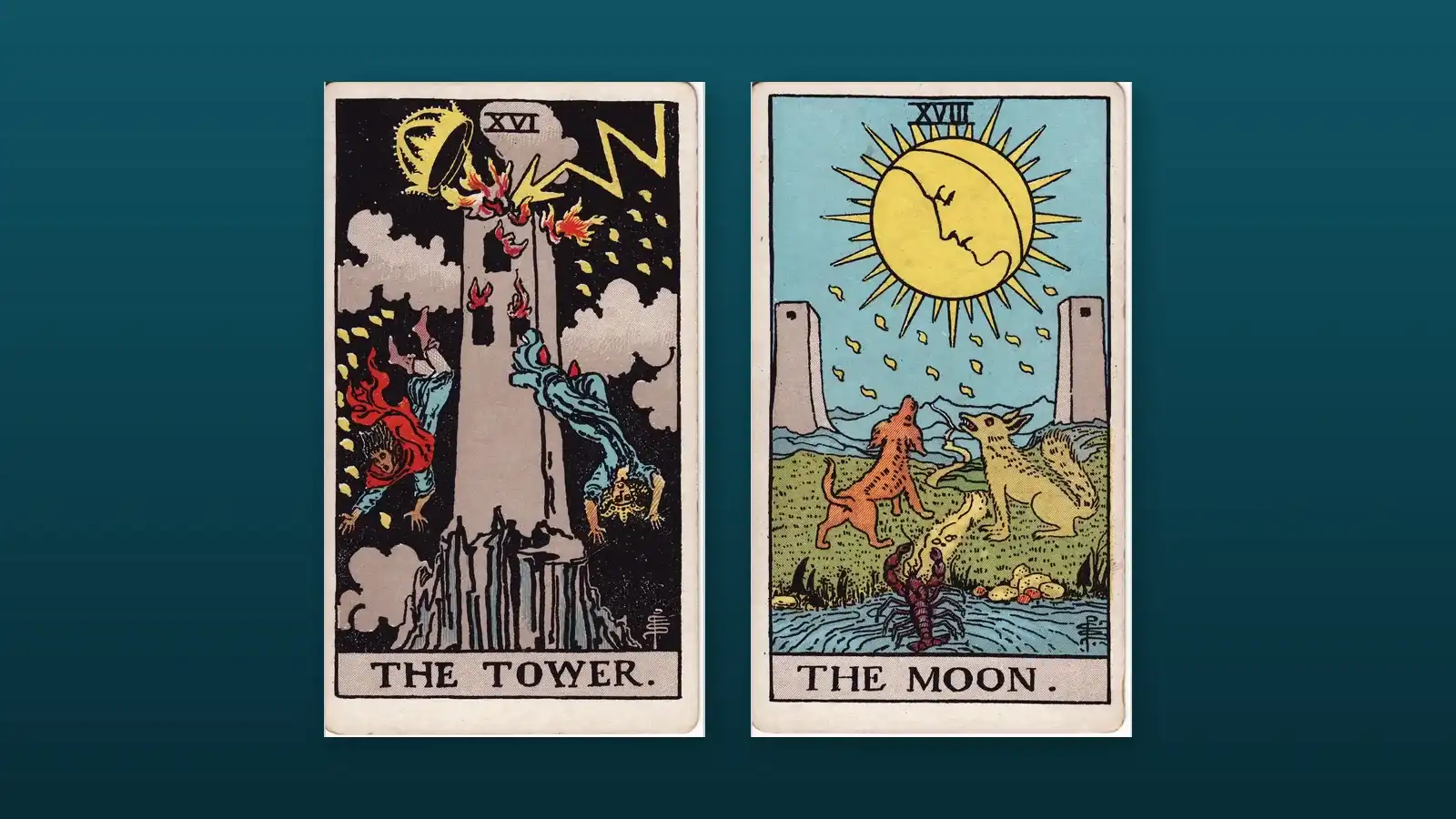
The Tower, card XVI, is upheaval, sudden change and revelation. Lightning strikes a tall tower and knocks off its crown. Something false or fragile falls. Safety comes first, then meaning. Reversed, it can show a collapse that someone keeps delaying.
Hope in the dark: the Star and the Moon
The Star, card XVII, brings hope after the Tower. Under a great star and seven smaller ones, a figure pours water onto the land and into a pool. It is quiet healing after the storm, inspiration and renewal. Reversed, it can show discouragement or lost faith.
The Moon, card XVIII, is illusion, intuition and fear. A moon shines over a dog, a wolf and a crayfish crawling out of a pool, and a path winds between two towers into the distance. Things are not fully clear yet, so slow down and check what is true. Reversed, the fog may be lifting, or confusion may be growing, and the other cards will tell you which.
Daylight and arrival: the Sun, Judgement and the World
The Sun, card XIX, is success, vitality and joy. A child rides a white horse under a huge smiling sun, with sunflowers behind a wall. It is pure warmth and clarity. Reversed, joy is muted or delayed, not gone.
Judgement, card XX, is reflection, reckoning and awakening. An angel blows a trumpet and people rise with open arms. It is a call to review your life and answer it. Reversed, it may show a harsh inner critic or a call being ignored.
The World, card XXI, means completion and wholeness. A dancer floats inside a laurel wreath, with four creatures in the corners. A cycle is completed and whole. Reversed, there are loose ends to finish before the circle closes.
Older names and pictures
Historical The Devil card does not survive in the famous Visconti-Sforza deck; it is one of the missing cards. In Marseille decks, a horned, winged devil stands on a pedestal with two smaller devils tied to it by cords around their necks. Waite’s Devil, drawn by Smith, borrows heavily from the Baphomet figure that Éliphas Lévi drew for his Dogme et rituel de la haute magie in the 1850s: horns, bat wings, a raised hand and an inverted pentagram. Knowing that the image comes from a nineteenth-century French occultist helps you see it as a symbol, not a portrait.
Historical The Tower had several names. In Marseille decks it is La Maison Dieu, “the House of God”, perhaps an echo of the Tower of Babel or simply of a hospital, since a maison-Dieu was also a name for a hospital or almshouse. Early Italian lists call it things like “the Arrow” or “the Fire”. In Marseille Moon cards, two dogs howl at the moon between two towers while a crayfish climbs from a pool, an image Waite kept almost exactly.
Historical The World card in many decks shows a figure inside a wreath, surrounded at the corners by an angel, an eagle, a lion and a bull. These four creatures come from the Bible, from the vision in Ezekiel 1:10 and from Revelation 4:7, and Christian art used them as symbols of the four Gospel writers. Judgement, with its angel blowing a trumpet over people rising from their graves, is a straightforward picture of the Last Judgement.
Seeing the pattern
The Devil shows what binds us. The Tower breaks it, sometimes painfully. The Star brings hope, the Moon tests it in the dark and the Sun brings full daylight. Judgement calls us to rise and take stock, and the World closes the circle. It is a story of shadow, crisis, healing and arrival, and almost everyone knows a version of it from their own life.
An example: the Tower and the Star
Imagine someone asks, “What do I need to know about the year after my divorce?” and draws the Tower and the Star. Together, these two cards are almost a complete sentence: a structure has fallen, and what comes next is hope and slow healing. A good reading does not dwell on the lightning. It notices that the Star, the very next card in the Major Arcana, shows a figure calmly tending water under an open sky. The advice is to rest, refill and trust that renewal is already beginning.
About the images on this site
The 1909 Devil, Star, Sun, Judgement and World cards include nude figures. On this site I show simple drawings of their key symbols instead, such as the chain and torches, the stars and water, or the trumpet and graves. Your own deck will show the full scenes, and the meanings are exactly the same.
How to remember them
One keyword and one picture detail each: the loose chains, the lightning, the pouring water, the howling dog, the child on the horse, the trumpet and the wreath. You now know all 22 Major Arcana. Take a moment to notice that. It is a real step.
Waite’s Star, quoted
Historical Waite described the Star in The Pictorial Key to the Tarot (1910) as “A great, radiant star of eight rays, surrounded by seven lesser stars–also of eight rays.” He added that the kneeling woman pours “Water of Life” from two jugs. When you read this card after the Tower, as so often happens in teaching, remember that the stars in the picture are many, and that the water keeps flowing.
A variation: the light cards
The last cards of the Majors move from night to day: the Star, the Moon, the Sun. Lay them in a row and write how the light changes in each picture: starlight, moonlight, full sun. Then ask which light fits your situation right now. Are you finding hope in the dark, feeling your way through uncertainty or seeing clearly? This is a gentle way to read a whole phase of life.
Waite on the last cards
Historical A few phrases from The Pictorial Key to the Tarot (1910) open these cards up.
The Moon. Waite wrote that the card “represents life of the imagination apart from life of the spirit.” Of the animals: “The dog and wolf are the fears of the natural mind in the presence of that place of exit, when there is only reflected light to guide it.” This is a lovely way to read the card: moving forward by moonlight, with your fears barking beside you.
The Devil. He described “a ring in front of the altar, from which two chains are carried to the necks of two figures, male and female.” Many modern readers point out that the chains in Smith’s picture hang loosely, as though the figures could lift them off. That observation is the root of the modern reading of the card as attachments we could leave if we chose.
Judgement. Waite noticed that his version shows more than three people rising, unlike older decks, and that “all the figures are as one in the wonder, adoration and ecstacy expressed by their attitudes.” Whatever your beliefs, the picture is one of shared awakening, not of punishment.
Practice: the light and dark pairs
These seven cards fall naturally into contrasts. Lay them out as pairs: the Devil and the Star, the Tower and the Sun, the Moon and the World, with Judgement alone. For each pair, write one sentence about how the darker card might lead to the brighter one. For example: “The Tower clears away what is false, so the Sun can shine on what is real.” This exercise teaches you that hard cards in this group are rarely the end of a story.
When these cards appear in a daily draw
It can be startling to draw the Tower or the Devil on an ordinary morning. Remember that a daily card is a small prompt, not a forecast of the day’s events. The Tower might simply ask you to let a plan change without fighting it. The Devil might point to a habit, such as scrolling late at night, that has more hold on you than you would like. The Moon might ask you to wait for more information before deciding. Read them small, and they become useful.
A beginner’s question: “Why are the last cards so intense?” Because they describe the large turning points of a life: loss of illusions, hope, clarity, renewal and completion. Intense does not mean frightening. It means important.
Questions beginners ask
Is the Devil card about evil? In modern reading it is about attachments, temptations and patterns that bind us. Notice that in the 1909 picture the chains around the two figures’ necks are loose.
Does the Tower mean disaster? It means sudden change, often unwelcome, which can clear the way for something truer.
Why is the World the last card, not the Fool? In most decks the Fool is unnumbered or zero and stands outside the sequence. The World completes the cycle.
Myths to drop: The Devil card is not a sign of demonic contact. The Moon is not only deception; it is also dreams and intuition. And the Sun does not guarantee a happy ending, though it is one of the most cheerful cards.
Try this
Lay out the last seven Majors in a row and tell their story out loud in seven short sentences, one per card. Then write the story down in your notebook.
Recap
The final Majors trace shadow, crisis, healing and arrival. The Devil’s chains are loose enough to lift off, which is why it names attachments we can leave. The Tower breaks what is false, and the Star brings hope after it. The Moon asks for patience in uncertainty, the Sun brings joy, Judgement calls for a reckoning, and the World means completion and wholeness.
What next
Press “Mark as done” and continue with Suits and elements, where the Minor Arcana begin. For the whole picture, see the Major Arcana overview.
Further reading: Éliphas Lévi, Transcendental Magic: Its Doctrine and Ritual, translated by A. E. Waite (1896), for the original Baphomet drawing.
Sources
- Lauri Mukkala, The Novice’s Guide to Tarot, “Major Arcana XV to XXI”.
- A. E. Waite, The Pictorial Key to the Tarot (London: Rider, 1910).
Quick check
Go deeper: The Novice's Guide to Tarot: Major Arcana XV to XXI
Get the free Mini-Grimoire
A short printable starter guide to tarot and everyday witchcraft, plus my newsletter. Unsubscribe any time.
Opens Substack in a new tab to confirm. More about the newsletter · Privacy
Comments
Questions and notes from readers. Anyone with a free account can comment, and I reply when I can. Please read the community guidelines.
Comments load from Google Firebase (EU) when you ask for them. Nothing is stored on your device. Privacy