


In this lesson: the one-card daily draw, the best habit for learning tarot, with good questions, an example and simple tips.
Welcome to module 6, where we start laying out spreads. A spread is a layout of positions, each with a job. We begin with the smallest and most useful one of all: a single card. If you only ever learned one spread, this should be it. It fits into a busy morning, it teaches you the deck one card at a time and it keeps your practice tied to real days rather than to theory.
Why one card is enough
One honest card beats ten rushed ones. A single card gives you a clear daily focus or a quick check-in before something that matters. It is also the best way to learn the deck, because you meet each card in the context of your actual life. After a month of daily draws you will have met most of the deck at least once, and each card will carry a small memory with it.
How to do it
The whole practice takes three to five minutes. Find a quiet minute, in the morning with coffee, on the bus or before bed, anywhere you can notice. Ask a simple, open question, such as “What matters most to notice today?” or “What do I need to remember before this meeting?” Shuffle in any way that feels natural and draw one card.
Then read in layers, as you learned in module 1: first the keywords, then the picture, then how the card meets your question. Write one line in your notebook with the date, the card and one small thing you will do or watch for. Then put the deck away. Closing the session gives it a clear end, so you are not tempted to keep drawing until you get a card you like.
A worked example
Say you ask, “What do I need to remember before this conversation?” and draw the Queen of Swords. Her keywords are independence, clarity and intellect. In the picture she sits upright with her sword raised and one hand held out, as if inviting the truth. Your line might be: “Speak plainly, keep my independence and do not apologize for needing facts.” That is a whole reading. In the evening you look again and add: “I asked for the numbers in writing. It went better than I feared.” Now the Queen of Swords will always remind you of that day.
Why daily practice builds skill
Modern Learning a symbolic language works much like learning a spoken one: small, frequent practice beats rare marathons. The spacing effect you met in the first lesson applies here, and so does habit research.
In a 2010 study, Phillippa Lally and colleagues at University College London followed people forming new daily habits and found that it took on average about 66 days for a behavior to become automatic, with a wide range from 18 to 254 days. Missing a single day did not ruin the process. So a daily draw does not need to be perfect; it needs to be frequent.
Habits that help
Keep the question tight, because one card does not like vague multitasking. Write a one-line takeaway, since a small action is more useful than a vague impression. Look again in the evening and notice what matched, without forcing the card to be prophetic. And do not redraw because you dislike the card. If a hard card comes up, read it calmly. If you are truly unsure what it is telling you, draw one advice card asking “What helps?”, and then stop.
The one-card draw is tempting for yes or no questions. You can use it that way for small things, but treat the answer as a tone, not a verdict. For anything that matters, an open question works better.
Variations for different days
On a busy day, draw a card, look at it for thirty seconds and write one word. On a slow day, write a paragraph and sketch the card. On a hard day, ask “What would help me today?” and read the card only as support. On a weekly basis, draw one card on Sunday as a theme for the week, then a daily card that you read in relation to it. In a creative variation, use the card as a writing prompt and write a four-line poem about it.
A worked example across three days
Imagine someone drawing a card each morning for three days. Monday: the Two of Pentacles, juggling. She writes “Balance work and home today.” In the evening she notes that she did manage two deadlines and a school pickup. Tuesday: the Hermit. She writes “Find quiet.” She takes a short walk alone at lunch and notes that it helped. Wednesday: the Five of Wands. She writes “Expect friction.” A meeting is tense, and she notes, “I stayed calm because I expected it.” None of these were predictions in a strong sense. Each was a small lens for the day.
Simplicity has a long history
Historical One card may seem too simple to count as “real” tarot. But simplicity has always had defenders. Introducing the reading methods in The Pictorial Key to the Tarot (1910), Waite wrote that he set aside the most involved ones, “because persons who are versed in such questions believe that the way of simplicity is the way of truth.” A single card, looked at carefully and connected honestly to your day, is a very good place to start.
Morning or evening?
Readers disagree about when to draw, and both times work.
A morning draw gives you a theme to carry through the day. You might notice the card’s picture echoed in a conversation or a choice. The risk is that you start looking for it everywhere and bend events to fit.
An evening draw works as a reflection on the day that has passed. You ask, “What did today teach me?” and the card helps you name it. The risk is that you only see what you already think.
Try each for two weeks and keep the one that feels more useful. Some readers like to do both: a card in the morning and a short note about it in the evening.
What to write each day
A daily note does not need to be long. Four short lines are enough.
The card. Its name, and whether it was upright or reversed if you read reversals.
One detail. Something in the picture you noticed today.
One connection. A sentence about how it might relate to your day or your question.
One look back. In the evening, or the next morning, a line about whether the card turned out to be useful.
After a month, you will have more than a hundred small observations. Reading them back is one of the best ways to learn the deck, because the meanings are tied to your own life.
When the same card keeps coming
Many beginners draw one card several times in a week and wonder what it means. First, check your shuffle: cards that stay together can come up together. If the shuffle is thorough, treat the repeat as an invitation to look closer. Spend a few minutes with the card, find three details you have not noticed and write one question it seems to ask you. Often the repeated card points to something you have been avoiding, or simply to a card you have not yet got to know.
Practice variations
The theme month. For one month, ask the same daily question, such as “Where can I be kinder today?” Reading many cards against one question shows you how varied the answers can be.
Major only, Minor only. For a week, draw only from the Majors, then for a week only from the Minors. You will feel the difference between big themes and everyday detail.
The pocket card. Draw your card, then photograph it or write its name on a small slip and carry it with you. Look at it once at midday. This small check-in keeps the card alive in your attention.
A worked example: an ordinary Tuesday
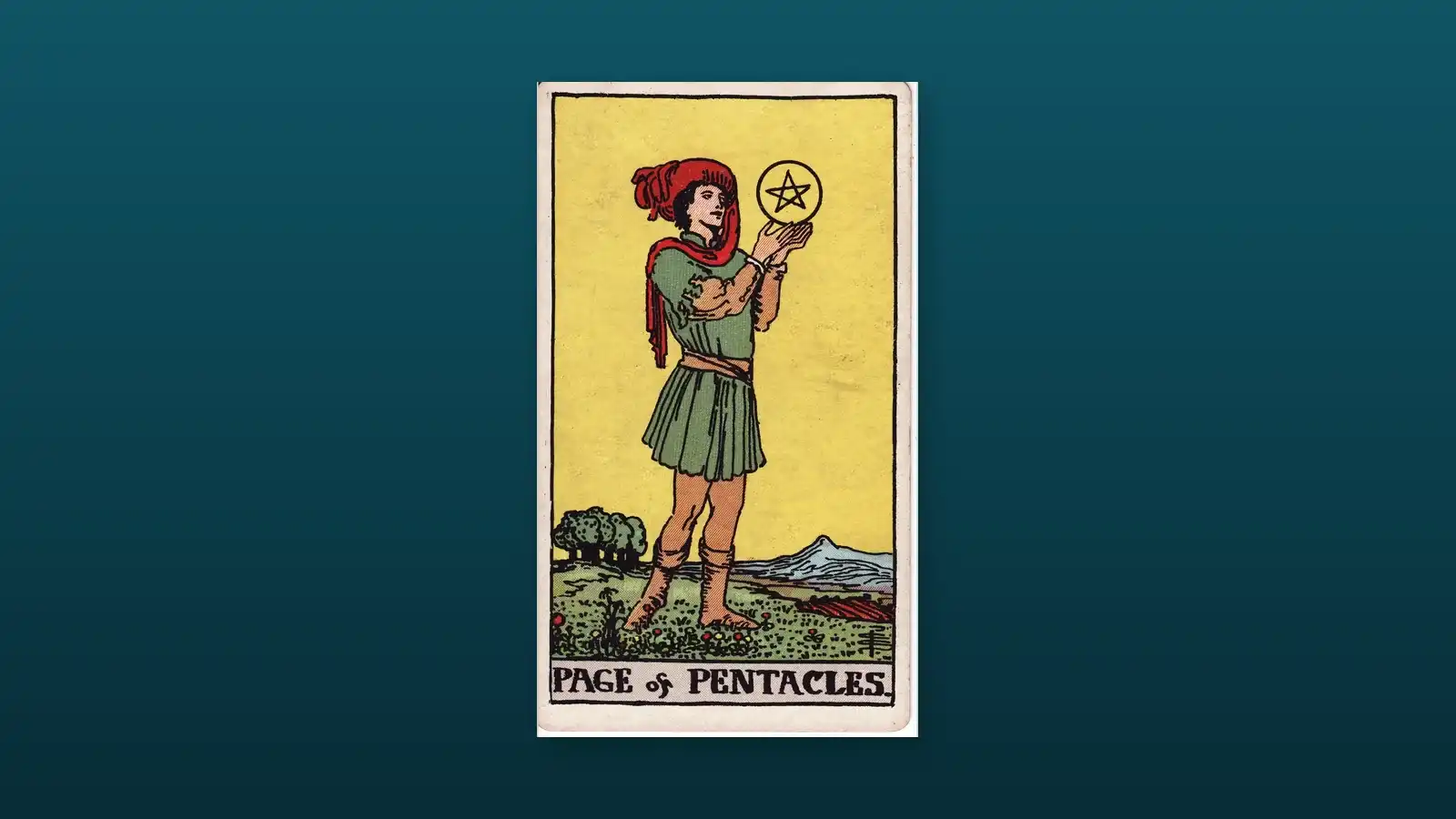
Imagine someone draws the Page of Pentacles on a Tuesday morning. In her note she writes: “Detail: he looks at the coin very carefully. Connection: I have a report to check at work.” In the evening she adds: “Took my time over the report and found two mistakes. Useful.” That is the whole practice: a picture, a link, and a short look back. Done most days, it builds real skill.
If you miss a day, simply draw tomorrow. A daily practice is a habit, not a test, and gaps are part of every habit.
Questions beginners ask
Morning or evening? Either. Morning draws set a theme; evening draws reflect.
What if I draw the same card several days in a row? Shuffle well, and if it keeps coming, ask what theme in your life it might be pointing to.
Can I draw for the day ahead on a hard day? Yes, but use supportive questions.
Myths to drop: A daily card is not a forecast of what will happen. You do not fail if you miss a day. And one card is not “too simple”; many experienced readers use it every day.
Try this
Start a seven-day daily draw: one card each morning with one line in your notebook, and one more line in the evening. On day seven, reread the whole week without forcing a story. You may notice a suit that keeps appearing, or a card that showed up twice.
Recap
A one-card draw is best for a clear daily focus. Ask a short open question, read keywords, picture and question in turn, and write a one-line takeaway before putting the deck away. Look again in the evening. Do not redraw a card you dislike: if you feel stuck, draw one advice card and then stop. Seven days of this teaches you more than any list.
What next
Press “Mark as done” and continue with Three cards. For the spread on its own page, see the one-card spread, and for other tiny daily rituals, try the 5-minute practices.
Further reading: Phillippa Lally and others, “How are habits formed: modelling habit formation in the real world”, European Journal of Social Psychology 40 (2010).
Sources
- Lauri Mukkala, The Novice’s Guide to Tarot, “The One-Card Spread”.
Quick check
Go deeper: The Novice's Guide to Tarot: The One-Card Spread
Get the free Mini-Grimoire
A short printable starter guide to tarot and everyday witchcraft, plus my newsletter. Unsubscribe any time.
Opens Substack in a new tab to confirm. More about the newsletter · Privacy
Comments
Questions and notes from readers. Anyone with a free account can comment, and I reply when I can. Please read the community guidelines.
Comments load from Google Firebase (EU) when you ask for them. Nothing is stored on your device. Privacy