


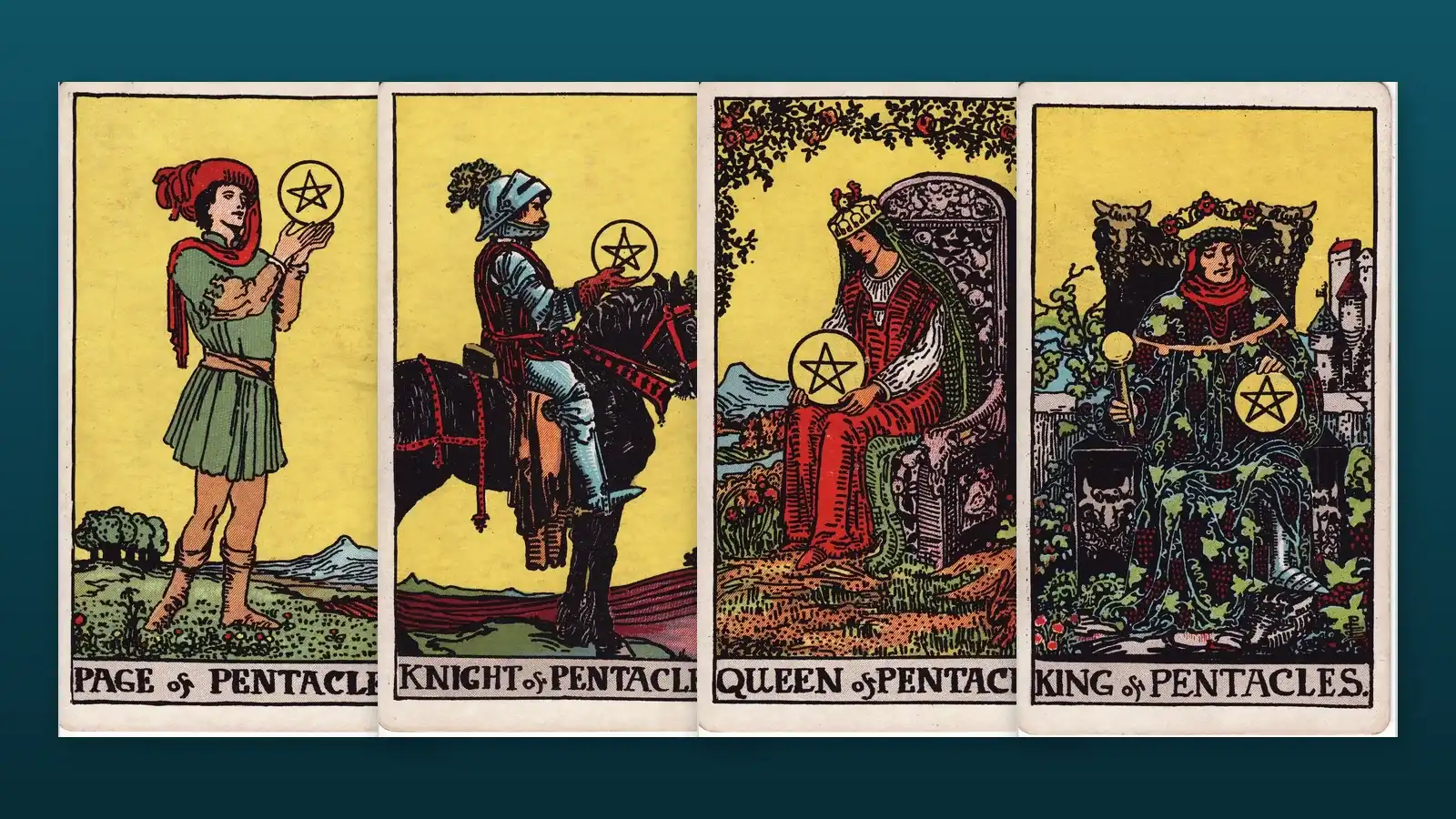
In this lesson: how to decide whether a court card in a reading is a person, a part of you, a role or an approach to the situation.
In the last lesson you met the sixteen courts. Now comes the real question: when one turns up in a reading, who or what is it? A court card can represent a person, a part of you or an approach. Choosing between those three is one of the skills that separates a confident reader from a nervous one, and it is also an ethical skill, because it decides whether a reading stays about what you can do or drifts into guessing about other people.
Another person
Sometimes a court card points to someone in your life. The Queen of Pentacles might be a practical, caring friend. The Knight of Wands might be an exciting new colleague. If a person comes to mind straight away, note it, but hold it lightly. The card describes a style or an influence, not a person’s hidden thoughts. Remember the ethics module: tarot cannot read someone else’s mind, so avoid inventing their private thoughts, feelings or plans.
A part of you
Very often a court card is you, or a side of you. The Page of Swords might be your curious, questioning self. The King of Cups might be the part of you that stays calm when others panic. This reading is often the most useful one, because it is about what you can actually do.
An approach or a role
A court card can also describe an approach to the situation. In an advice position, the Queen of Swords might simply mean: be honest and clear. The Knight of Pentacles might mean: be patient and steady, one step at a time. A court can even describe a role you are being asked to play, such as teacher, leader, beginner or messenger. A good default reading of a court card in an advice position is an approach to take.
Old ways of reading courts
Historical Older fortune-telling books often read court cards as people described by appearance, for example by hair and eye color, or by age and status: a fair young man, a dark widow, a man of law. Some readers still do this, especially with playing cards. Modern Modern teachers usually prefer to read courts by personality and approach, because appearance is a poor guide and can slide into stereotypes. If you like the old method, use it lightly and never as the only clue.
How to choose
Three questions help. First, does the position point to someone? In a spread with a “them” position, a court there is probably about the other person. In an advice position, it is probably an approach. Second, does a person come to mind at once? If you have to search for someone, it is probably not a person. Third, which reading helps more? When in doubt, read the court as a part of you or as advice. That keeps you at the center and gives you something you can do.
A worked example
Imagine you ask, “How can I handle the stress at work?” and draw the Knight of Swords. As a person, it might be a colleague rushing everyone into decisions. As a part of you, it might be your own habit of charging ahead without thinking. As an approach, it might say: act quickly and directly on the one thing that matters most.
Each reading is possible. Now apply the three questions. The question was about you and what you can do, no particular colleague came to mind, and the “part of you” reading is the one you can act on. So you write in your notebook: “I’ve been charging at everything at once. Slow down and pick one target.” A week later you check whether that fitted.
When several courts appear
Many court cards in one reading often mean that other people play a big role in the situation, or that you are juggling several roles at once. Notice which suits and ranks appear. Three Pages suggest a time of learning and new beginnings. Two Kings might point to a question about leadership or authority.
This is one of the places where your notebook teaches you most. When you write down a court card, note which reading you chose. A week later, see which one turned out to fit. Over time you will develop a feel for it.
Three questions to decide
When a court card appears and you are unsure, ask three short questions in order. First, does a specific person come to mind at once? If yes, consider reading it as that person, but check with the question: is this person part of the situation? Second, does the card describe a part of me I recognize?
If yes, read it as you. Third, is the card telling me how to act? If the first two do not fit, read it as an approach. Writing your answer down helps you notice which reading you lean toward most, and over time you will learn your own habits.
A second worked example
Imagine someone asking, “How can I handle the move to a new team?” She draws the Queen of Wands, the Eight of Pentacles and the Page of Cups. Her first thought for the Queen is her new manager, a confident, warm person.
But the question is about her own handling, so she tries the second reading, a part of herself: her own confidence and warmth, which she sometimes hides at work. The Page of Cups she reads as an approach: be open and curious about her new colleagues. Her note: “Bring my confidence, do the work carefully and approach people with curiosity.”
Facing and turning: crowded readings
If three or more courts appear, many readers see a situation with many people or many voices. One useful step is to ask how the court cards are facing: toward each other, away from each other or toward a particular card. In the 1909 deck, figures turned toward each other often suggest cooperation or conversation, while figures turned away suggest distance. This is a later reading habit, not a rule, but it is a good prompt for looking.
What the old meanings looked like
Historical To understand why modern teachers moved away from appearance, it helps to see a real example. In The Pictorial Key to the Tarot (1910), Waite’s divinatory meanings for the Queen of Wands begin: “A dark woman, countrywoman, friendly, chaste, loving, honourable.” For the Queen of Cups: “Good, fair woman; honest, devoted woman, who will do service to the Querent”. The Knight of Wands is “A dark young man, friendly”, and the Page of Cups a “Fair young man”.
Those descriptions made sense in a fortune-telling session where the reader tried to pick out real people in the client’s life. They work poorly today. Hair and skin color say nothing about character, and they leave many people out completely. That is why this course reads courts by temperament and approach. Notice, though, that Waite’s own descriptions of the pictures are already about character. Of the Queen of Cups he wrote that “she sees, but she also acts, and her activity feeds her dream.” That line works for anyone.
A step-by-step method
When a court card appears and you are unsure how to read it, try these steps in order.
First, read it as a part of you. Ask whether you have been acting like this card, or need to. This reading is always available and keeps the focus on what you can change.
Second, consider an approach. Ask whether the card describes a way of handling the situation: the Knight of Swords suggests directness, the Queen of Pentacles patient care.
Third, and only if it clearly fits, consider another person. If someone in your life plainly matches the card’s temperament, it may point to them. Even then, ask about your side of the relationship, not about their hidden thoughts.
Going through the steps in this order prevents a common mistake: deciding that a court card “is” someone and then building the whole reading around a guess.
Practice variations
Same card, three readings. Draw one court card and write three short readings of it: as a part of you, as an approach and as another person. Then decide which feels most useful for your question and why.
A court card for advice. When you are stuck, separate the sixteen courts from the deck, shuffle them and draw one. Ask, “How would this person handle my situation?” Write down their likely advice. It is a gentle way to borrow a different temperament for a while.
A worked example: the King of Swords at work
Imagine someone asks, “How can I handle the conflict in my team?” and draws the King of Swords. As another person, the card might suggest a clear, fair-minded manager. As a part of herself, it might ask her to step into calm, honest authority. As an approach, it suggests stating the facts plainly and making a fair decision.
She chooses the second reading, because it gives her something to do: prepare what she wants to say, keep it clear and kind, and speak first. The card has not told her what anyone else is thinking. It has shown her how she might act.
Questions beginners ask
What if a court card is clearly a specific person I know? You can read it that way, but keep the reading about your side of the relationship.
Can a court card be me if it does not match my gender? Yes. Court cards describe approaches, not bodies.
What if all three readings seem to fit? Choose the one most useful for your question and note the others in your journal.
Myths to drop: Court cards do not always mean other people. You cannot read a stranger’s personality from a card. And there is no single correct answer about who a court card “is”.
Try this
Draw one court card and write three readings of it: as another person, as a part of you and as advice. Then decide which one fits your life today, and write one sentence about why.
Recap
A court card can represent a person, a part of you or an approach. If it could be someone else, avoid inventing their private thoughts. Use the position, your first impression and usefulness to choose, and when in doubt read it as a part of you or as advice, since in an advice position the best default is an approach to take. Several courts together often mean other people or several roles matter.
What next
Press “Mark as done” and continue with The one-card daily draw, where spreads begin. For more practice, see the court cards guide.
Further reading: Mary K. Greer and Tom Little, Understanding the Tarot Court (Llewellyn, 2004).
Sources
- Lauri Mukkala, The Novice’s Guide to Tarot, “The Court Cards”.
Quick check
Go deeper: The Novice's Guide to Tarot: The Court Cards
Get the free Mini-Grimoire
A short printable starter guide to tarot and everyday witchcraft, plus my newsletter. Unsubscribe any time.
Opens Substack in a new tab to confirm. More about the newsletter · Privacy
Comments
Questions and notes from readers. Anyone with a free account can comment, and I reply when I can. Please read the community guidelines.
Comments load from Google Firebase (EU) when you ask for them. Nothing is stored on your device. Privacy