


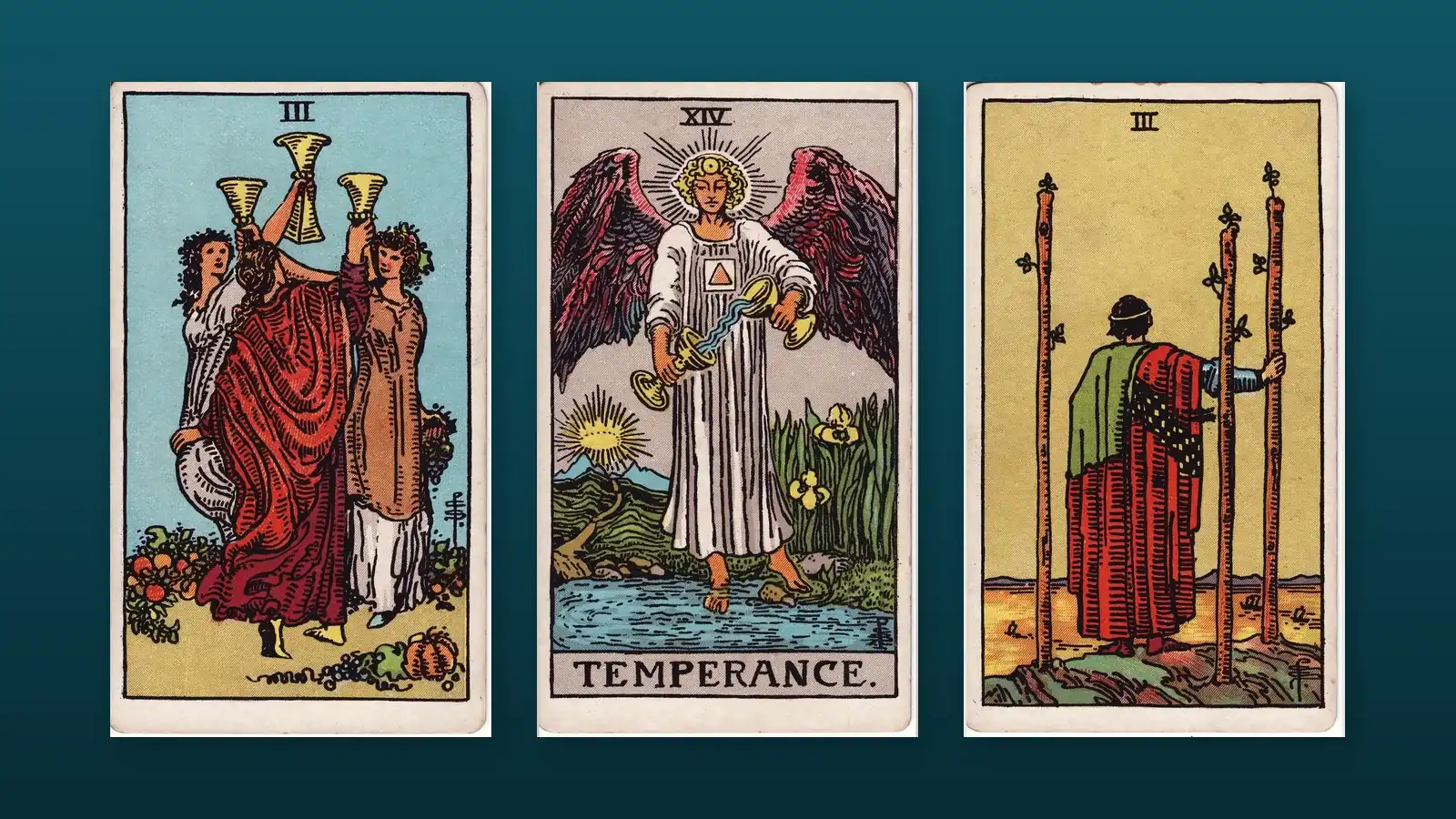
In this lesson: the three-card spread, past, present and future, and other simple three-card layouts, with an example reading.
Three cards are the next step up, and many readers use three-card spreads more than any other. They are small enough to read in a few minutes and big enough to tell a story. Once you can read three cards as one story, you have the core skill behind every larger spread, including the Celtic Cross.
Past, present, future
The classic three-card spread lays the cards from left to right. The first card is the past: what shaped the situation. The second is the present: what is active now. The third is the future, and here it is worth being precise. “Future” in this spread means a likely direction if nothing changes, a trajectory, not a locked ending. Your choices still matter. If you do not like where the third card points, that is useful to know, because you can change course.
Read the arc, not three fortunes
The most common beginner mistake is to read each card alone, as if it were three separate one-card draws. Instead, read the three cards as one arc or story. Does the mood rise or fall from left to right? Do the suits change? Is there a Major card that names the theme? The relationship between the cards is often more important than any one of them.
A good test is to write the arc in a single sentence. If you can do that, you have read the spread.
A worked example
Imagine you are deciding whether to stay in a job and draw three cards. In the past position comes the Four of Pentacles, security and holding on tight. In the present comes the Two of Wands, a figure on a castle wall holding a small globe, planning an expansion not yet committed to. In the future position comes the Three of Wands: a figure watching ships sail out, progress already moving.
Read separately, these are three keywords. Read as an arc, they tell a story: you have been holding tight for safety, you are now looking at a bigger plan, and things can move forward if you actually send the ships out. The suits move from earth to fire, from security to drive. That one sentence is the reading.
Why three works so well
Modern Three is a natural number for stories: beginning, middle and end. Storytellers, speechwriters and advertisers know that people remember things in threes. In a reading, three cards are enough to show movement and relationship, but few enough to hold in your mind at once. That is why so many teachers make the three-card spread the workhorse of practice, and why many experienced readers still use it more than any other.
Other three-card layouts
The same three positions can hold other questions, and changing them is a simple way to keep practice fresh.
- Situation, challenge, advice.
- What to keep, what to release, what to welcome.
- You, the other person, the relationship (influences only, never the other person’s private mind).
If three cards feel like too much on a busy day, try two: challenge and advice. The first card names the snag and the second offers an approach. The Five of Wands as challenge (scattered, noisy effort) with the Eight of Pentacles as advice (return to careful craft, one step at a time) is a complete and useful reading. Treat the advice as something to try, not a command.
When the direction looks hard
Sometimes the future card is the Ten of Swords or the Five of Pentacles. Remember that it shows a direction if nothing changes. If the direction looks hard, you can add an advice card, asking, “What helps me change this?” Name your positions before you shuffle, write them down, and come back to the reading a week or a month later to see how the story actually unfolded.
Ten three-card layouts to try
Here are more layouts to rotate through, so that your practice stays fresh. Situation, action, outcome. Mind, body, spirit. What to keep, what to release, what to welcome. You, the other person, the relationship. What helps, what hinders, what to do. Strength, weakness, advice. Option A, option B, what I need to know to choose. Morning, afternoon, evening. Before, during, after an event. Head, heart, gut. Choose one each week and note which layouts give you the clearest readings.
A second worked example in prose
Imagine someone uses “what to keep, what to release, what to welcome” at the start of a new year. Keep: the Nine of Pentacles, independence and enjoyment of her home. Release: the Five of Swords, an old argument she keeps replaying. Welcome: the Three of Wands, looking out to new horizons. Her note: “Keep enjoying my own space, let go of that argument, and say yes to new plans.” She writes a small plan for each: a weekend of her own, a letter she writes but never sends, then tears up, and an application to a summer course.
Why three cards is so popular
Many modern tarot books teach a three-card spread before any other. There is a good practical reason for this: three cards are enough to show a beginning, a middle and an end, or a cause, a situation and an advice, yet few enough to see at a glance. Your eye can hold three pictures at once without effort. Larger spreads, as you will see later in this module, ask you to break them into smaller groups, and those groups are often threes anyway.
Reading the middle card first
Many readers find it helpful to start with the middle card instead of the left one. The middle card is the heart of the spread, the present situation or the central issue. Once you know what it says, the cards on either side become easier: one shows where it came from, the other where it may go. Try it both ways and see which order helps you more.
Linking words
The most useful skill in a three-card reading is joining the cards with small words. Try these patterns.
“Because… so…” “Because of the first card, the second is happening, so the third may follow.”
“But… and…” “The first card, but the second, and so the third.”
“From… through… to…” “From the first card, through the second, to the third.”
Choose the linking words before you look at the meanings, and the cards will start to tell a story instead of three separate fortunes.
Practice variations
Three cards, three questions. Lay out three cards once and read them three times, as past, present and future, then as situation, challenge and advice, then as mind, body and heart. The same cards will tell three different stories. This shows how much the positions shape a reading.
Pick the middle on purpose. Choose a card that describes where you are now and place it face up in the middle. Then draw two cards at random for the sides. Choosing the center card deliberately is a good way to read about a situation you already understand well.
The one-line summary. After every three-card reading, write a single line that captures it. If you cannot, read the spread again. A reading you can summarize in one line is a reading you will remember.
A worked example: situation, challenge, advice
Imagine someone asks, “How can I enjoy my new hobby more?” and draws the Three of Pentacles, the Five of Swords and the Six of Cups. The situation card shows people working together on a building, so the hobby involves a group. The challenge card shows a figure gathering swords while others walk away, which might point to competitiveness spoiling the fun.
The advice card shows a simple, kind exchange of flowers in a garden. Joined with linking words, the reading becomes: “I enjoy working with others, but competing spoils it, so I could focus on simple kindness and shared pleasure.” That is a useful thought, and it came from three pictures in a few minutes.
Checking your three-card reading
When you finish, check three things. Did you read the cards in relation to each other, not one by one? Did you answer the question you asked? Did you end with something you can do? If yes, the reading has done its work.
A beginner’s question: “Can I use three cards for every question?” Yes, and many readers do. You can go a long way with only this spread.
When one card does not fit
Sometimes two cards in a three-card spread tell a clear story and the third seems to belong to another reading. Do not force it. Read the two that agree, then ask the odd card a direct question: “What are you adding that I have missed?”
Often the odd card points to something outside the story you were telling yourself: a feeling you have ignored, a practical detail, or another person’s part in the situation. If it still makes no sense after a minute, note it in your journal and move on. Many readers find that the puzzling card makes sense a few days later, once events have moved on. Leaving room for that is part of reading honestly.
Questions beginners ask
Should I always use past, present, future? It is a good start, but other layouts often give more useful answers.
What if the “future” card is frightening? Read it as a direction if things continue unchanged, and use the other two cards to see what you can change.
Can I add a fourth card for advice? Yes. Many readers do, and it is a good habit.
Myths to drop: The future card is not fixed. Three cards are not “too few” for serious questions. And you do not need a special cloth or candle to read.
Try this
Do one three-card reading on a real situation. Name the positions before you shuffle, then write one sentence that tells the whole arc. If the future card worries you, add one advice card.
Recap
The past, present, future spread shows what shaped a situation, what is active and a likely direction if nothing changes. Read the three cards as one arc or story, not three fortunes, and test yourself by writing the arc in one sentence. You can swap in other positions, use two cards for challenge and advice, and add an advice card if the direction looks hard.
What next
Press “Mark as done” and continue with Cards in conversation. See the three-card spread and challenge and advice for printable layouts.
Further reading: Lauri Mukkala, The Novice’s Guide to Tarot.
Sources
- Lauri Mukkala, The Novice’s Guide to Tarot, “The Past-Present-Future Spread”.
Quick check
Go deeper: The Novice's Guide to Tarot: The Past-Present-Future Spread
Get the free Mini-Grimoire
A short printable starter guide to tarot and everyday witchcraft, plus my newsletter. Unsubscribe any time.
Opens Substack in a new tab to confirm. More about the newsletter · Privacy
Comments
Questions and notes from readers. Anyone with a free account can comment, and I reply when I can. Please read the community guidelines.
Comments load from Google Firebase (EU) when you ask for them. Nothing is stored on your device. Privacy