


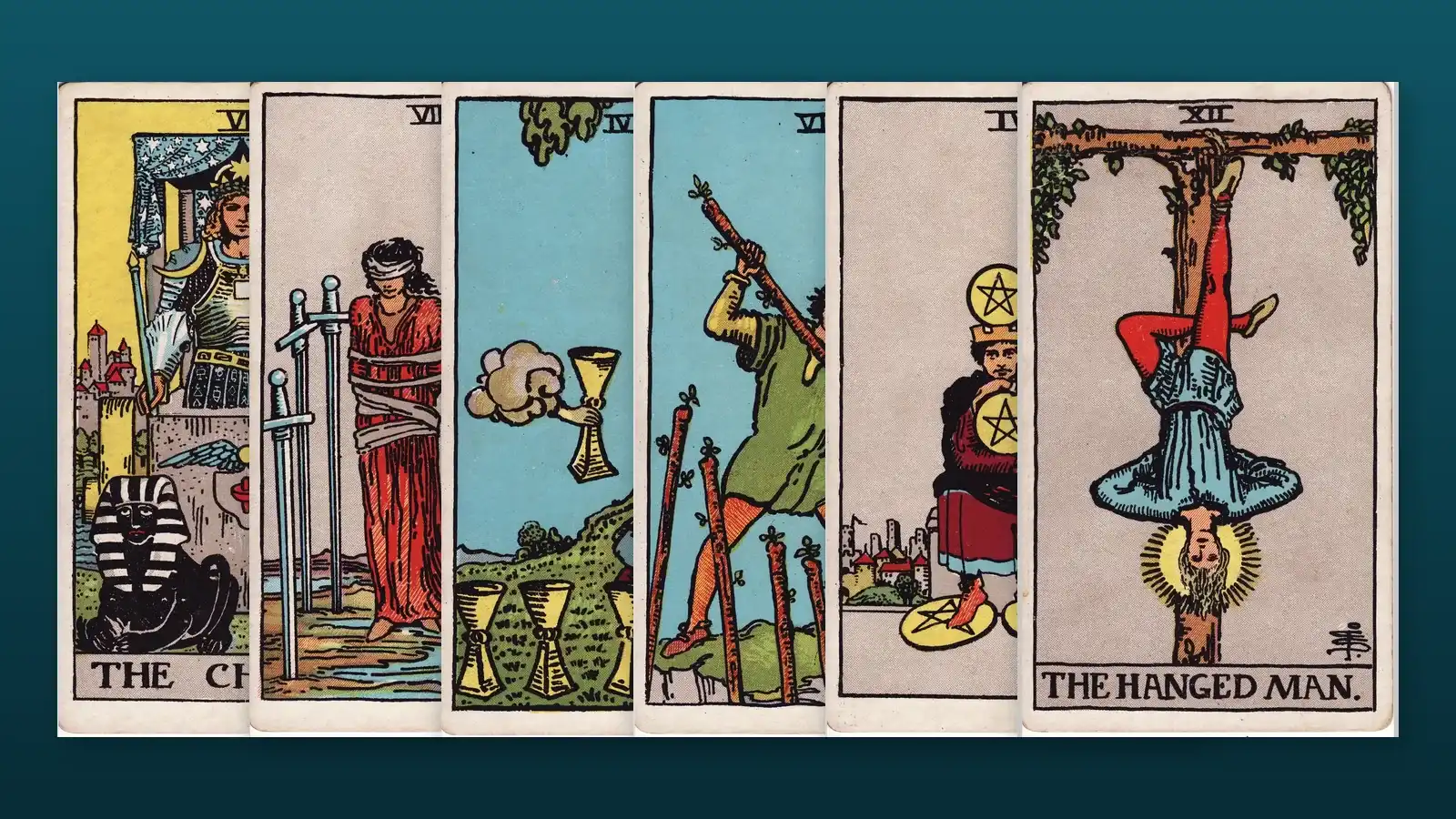
In this lesson: the ten-card Celtic Cross, how to lay it out, what each position means, a worked example and tips for reading it.
The Celtic Cross is the classic long spread. It has ten positions and can explore a question in real depth, which is why it appears in almost every tarot book. It looks intimidating, but if you have done the five-card cross, you already know half of it. This lesson walks you through the layout, the positions and a full example, so the first time you lay one out it feels familiar.
A little history
The Celtic Cross was popularized in English by A. E. Waite in The Pictorial Key to the Tarot in 1910, the book that accompanied the 1909 deck. Different books label the positions slightly differently. That is normal. Choose one version and stick with it while you learn.
Waite’s “ancient Celtic method”
Historical Waite presented the spread in The Pictorial Key to the Tarot (1910) under the heading “An Ancient Celtic Method of Divination”. There is no evidence that it is either ancient or Celtic. It was probably used in Golden Dawn circles in the 1890s and Waite named it with a flourish.
Waite’s version also began with a significator, a card chosen to represent the person asking, usually a court card, placed in the center before the others were laid on top. Many modern readers skip the significator and simply lay ten cards, as this lesson does. Both ways are fine.
How to lay it out
First you build the cross. Card 1 goes in the center, and card 2 is laid sideways across it. Card 3 goes below, card 4 to the left, card 5 above and card 6 to the right. Then you build the staff: cards 7 to 10 in a column to the right of the cross, from the bottom to the top.
The ten positions
- Heart of the matter: the present core.
- Challenge: the pressure crossing it.
- Foundation: the root or deep basis.
- Recent past.
- Crown: your conscious aim, or the best path you can currently imagine.
- Near future.
- Your perspective: how you see yourself in it.
- Outside influences: people and circumstances around you.
- Hopes and fears.
- Outcome: the direction if the story continues on present terms.
Two positions trip beginners up. Position 5 is not a second present. The present is position 1, and position 5 is your aim, or the high road, what you are reaching for. And the outcome card should be treated as the direction if things continue as they are, not a decree that erases your choices.
A worked example
Imagine someone considering a career change. Before reading single cards, she looks at the whole table: five Majors out of ten, so this is a big life question, and the suits lean towards Pentacles and Cups, practical security and feeling.
At the heart is the Fool: a real wish to begin again, with risk attached. Crossing it is the Eight of Swords, mental binds and fear of moving. The foundation is the Empress, a deep need for creative, livable work. In the recent past sits the Four of Pentacles, clinging to security. In the crown is the Hierophant: she is aiming for structure, training or a recognized path. The near future shows the Ace of Pentacles, a chance to notice a real offer or resource.
The staff adds the human picture. Her own perspective is the Seven of Cups, too many options, seen from the inside. The outside influence is the Lovers, a values choice, perhaps involving a partner’s life too. Her hopes and fears are the Ten of Wands: hope for success, fear of overload. And the outcome is the World: this chapter can complete into a more integrated role, if the work gets done.
The core tension sits in cards 1 and 2: the wish to leap against the fear that binds her. Comparing card 7 with card 8 shows that “the problem” is less the outside world than her own crowded mind, while the important outside factor is a shared values decision. The advice that comes out of the whole spread is practical: choose one option from the Seven of Cups, look for a structured training route, and talk honestly with her partner.
Reading it well
Start with the big picture before any single card, as she did. Focus first on the heart and the challenge, because cards 1 and 2 set the main tension. Compare positions 7 and 8 before you decide who or what the problem is. A Celtic Cross can take half an hour, and that is fine. If ten cards feel like too much today, go back to three. Match the size of the spread to the size of the question.
Reading the cross in pairs
A helpful way to tame ten cards is to read them in pairs that talk to each other. Cards 1 and 2: the core and what crosses it. Cards 3 and 5: the deep root and the conscious aim; do they agree? Cards 4 and 6: what is passing and what is coming; is there a trend?
Cards 7 and 8: how you see yourself and how others or circumstances affect you. Cards 9 and 10: hopes and fears, and the likely direction; do the fears match the outcome, or is the worry bigger than the reality? Reading five pairs feels less overwhelming than ten singles, and the pairs often reveal the story.
A second worked example, briefly
Imagine a reading about whether to adopt a dog. Heart: the Ten of Pentacles, home and family. Challenge: the Eight of Wands, a fast pace of life. Root: the Four of Cups, some boredom with the routine. Aim: the Sun, joy. Recent past: the Six of Swords, recovery from a hard time. Near future: the Page of Pentacles, learning. Self: the Queen of Cups, caring.
Outside: the Two of Pentacles, juggling schedules. Hopes and fears: the Three of Swords, fear of loss. Direction: the Ace of Cups, love. Read in pairs, the story is clear: she wants warmth at home, but her life is busy; she will need to learn and juggle, and the fear of one day losing a pet is natural, but the direction is love. She decides to research breeds and her schedule first.
Waite’s words for each position
Historical Waite gave the reader short phrases to say aloud while laying each card. The first card covers the significator, and the reader says, “This covers him.” The second is laid across it: “This crosses him. It shews the nature of the obstacles in the matter.” The third: “This crowns him”, which represents “the Querent’s aim or ideal in the matter”. The fourth: “This is beneath him”, the “foundation or basis of the matter”. The fifth and sixth are “behind him” and “before him”, the past and the near future, placed according to the way the significator faces.
His diagram labels the last four cards simply: “Himself”, “His house”, “His hopes or fears” and “What will come.” Many modern versions keep these labels almost unchanged, only replacing “him” with “you”.
What Waite advised about the last card
Waite treated the tenth card as the summary of the whole spread. He wrote that “It should embody whatsoever you may have divined from the other cards on the table”. If the tenth card was unclear, he suggested repeating the reading, “taking in this case the Tenth Card as the Significator”. And if the tenth card was a court card, he read it to mean that the matter “falls ultimately into the hands of a person represented by that card”.
Modern readers often soften this. The tenth card is usually read as the likely direction if nothing changes, not a fixed result. Waite’s advice to read it in the light of all the other cards remains excellent: never read the outcome card alone.
Practice variations
The cross only. Before trying all ten cards, practice with the first six, the cross itself. Read them for a week until the positions feel familiar, then add the staff of four.
One position a day. Lay out a full Celtic Cross on Monday and leave it on a shelf if you can. Each day, read one or two positions in depth and write a few lines. By the end of the week, read the whole spread again. You will see far more than you did on the first day.
The hopes and fears card. The ninth position is often the most revealing for beginners, because hopes and fears are so often the same thing seen from two sides. Each time you do the spread, write one sentence about the hope and one about the fear in that card.
A beginner’s checklist after a Celtic Cross
When you finish, ask yourself four questions and write the answers. What is the main theme? What is the biggest obstacle? What is within my control? What is one thing I will do this week? If you can answer those four, you have read the spread well, whatever the cards were.
Questions beginners ask
Do I have to use a significator? No. It is an older custom that many modern readers drop.
Why do books give different position meanings? Because the spread has been passed on and adapted for over a century. Choose one version.
How long should a Celtic Cross take? Twenty to forty minutes for a beginner. There is no need to rush.
Myths to drop: The Celtic Cross is not ancient. The outcome card is not fate. And you do not need to master it before reading for others; a three-card spread is often better.
Try this
Lay out a Celtic Cross for a real question. Before reading single cards, write down which suits you see and how many Majors there are. Then read cards 1 and 2 together and write one sentence about the core tension.
Recap
The Celtic Cross was popularized in English by A. E. Waite in 1910. It has a six-card cross and a four-card staff. Position 5 is your aim or the high road, not a second present, and the outcome is the direction if things continue as they are. Read the whole table first, focus on cards 1 and 2, compare 7 and 8, and take your time.
What next
Press “Mark as done” and continue with Reversals: yes or no?. A printable layout is on the Celtic Cross page.
Further reading: A. E. Waite, The Pictorial Key to the Tarot (1910), part 3, the section on the Celtic method.
Sources
- Lauri Mukkala, The Novice’s Guide to Tarot, “The Celtic Cross Spread”.
- A. E. Waite, The Pictorial Key to the Tarot (London: Rider, 1910).
Quick check
Go deeper: The Novice's Guide to Tarot: The Celtic Cross Spread
Get the free Mini-Grimoire
A short printable starter guide to tarot and everyday witchcraft, plus my newsletter. Unsubscribe any time.
Opens Substack in a new tab to confirm. More about the newsletter · Privacy
Comments
Questions and notes from readers. Anyone with a free account can comment, and I reply when I can. Please read the community guidelines.
Comments load from Google Firebase (EU) when you ask for them. Nothing is stored on your device. Privacy