


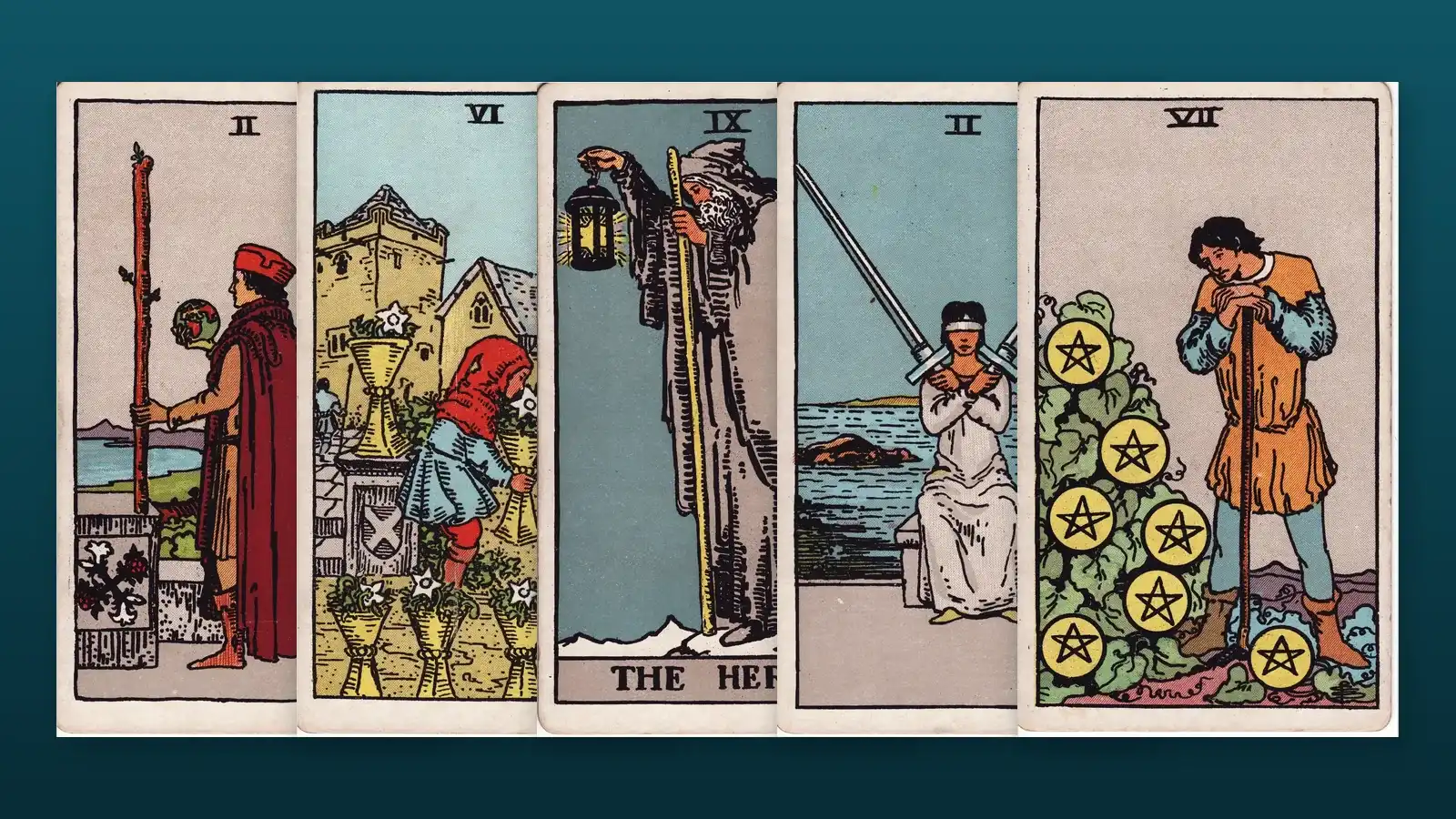
Once three cards feel easy, you are ready for slightly bigger spreads. Bigger does not mean better, but some questions have more layers than three cards can hold: a cause underneath the problem, or a week with a rhythm of its own. In this lesson you will learn two favorites, the five-card cross for a layered question and the seven days spread for planning a week, and meet a seven-card cousin, the horseshoe.
The five-card cross
Five cards give more structure than three without the full Celtic Cross. You lay them out like a plus sign, and each position has a clear job.
- Center, in the middle: the heart of the situation.
- Challenge, to the left: what makes it hard.
- Root, below: the cause or deeper pattern.
- Advice, to the right: an approach that helps.
- Outlook, above: the likely direction.
The center card names the reading, like a title. The root is a cause or deeper pattern. It does not always mean childhood, though it sometimes points there. And the outlook stays provisional, like every “future” position in this course.
A worked example with the cross
Imagine someone asks about a strained friendship. At the center she draws the Two of Cups: the bond still matters. The challenge is the Five of Cups, a focus on what has spilled. The root is the Six of Cups, old patterns and nostalgia for how things used to be. The advice is Temperance: pace the repair, blend old and new slowly. The outlook is the Star, quiet renewal if care continues.
In one sentence: the friendship still matters, but both people are stuck on the hurt and on the past, and a patient, gentle repair could bring real hope. Notice how the root card explained the challenge. That is what the extra positions buy you.
How spreads came about
Historical Laying cards in set positions is older than tarot reading itself. Eighteenth-century card readers such as Etteilla described layouts in rows and circles, and nineteenth-century books on cartomancy, fortune-telling with cards, offered many patterns. Twentieth-century tarot books then multiplied spreads endlessly. Today there are thousands, and you are free to invent your own. The five-card cross and the horseshoe are common because they are clear and balanced, not because they are ancient.
The seven days spread
This is a planning spread. On Sunday or Monday, lay out seven cards in a row, one for each day of the coming week. It is best used as a theme map for the week, a way to notice rhythm: where to push, where to rest, where to expect friction. It is a planning lens, not a weather forecast.
Imagine a week that comes out like this. Monday is the Sun: clear energy for visible tasks, so schedule the presentation then. Tuesday is the Four of Cups: a flat mood, so look for what you might be ignoring. Wednesday is the Tower: a disruption or hard truth, so protect the basics and keep the day simple.
Thursday is the Three of Pentacles, when teamwork can pay off. Friday is the Lovers, a choice that follows your values. Saturday is the Nine of Swords, so worry may spike, and it is a good day to rest and cut back on news and screens. Sunday is the World: close loops and mark what you finished.
Read each card for its own day without demanding that the whole week obey one mood. A Tower on Wednesday is a reminder to keep things simple that day, not a disaster scheduled in advance. Each evening, compare the card with what actually happened. That feedback trains your skill faster than anything.
A seven-card cousin: the horseshoe
The horseshoe spread also uses seven cards, laid in a shallow U: past influences, present situation, hidden factors, advice, outside influences, hopes or fears, and likely direction. It is useful when a choice has history and involves more than one person. Try it once you are comfortable with the five-card cross.
Design your own five-card spread
Once you know the cross, try making a spread for a question you often ask. Choose five positions that matter to you, give each a short name and draw the layout in your notebook. For a creative project, for example: 1, where I am now; 2, what inspires me; 3, what blocks me; 4, a skill to develop; 5, the next step. Use the spread three times over a month and adjust the positions if any feel unclear. A good spread has positions that are distinct and that end in something you can act on.
A worked example with the horseshoe
Imagine someone asking about starting evening classes draws a seven-card horseshoe: past, present, hidden influences, obstacles, outside influences, advice, likely direction. Past: Eight of Pentacles, good habits of study. Present: Four of Swords, tiredness and a need for rest. Hidden influences: the Moon, unclear fears. Obstacles: Ten of Wands, an overloaded schedule.
Outside influences: Three of Cups, friends who encourage her. Advice: Temperance, balance. Likely direction: the Star, renewed hope. Her summary: “I can study well, but I am tired and overloaded. If I balance my week and let friends help, this could bring real hope.” She decides to start with one class, not two.
How elaborate older spreads could be
Historical If five or seven cards feel like a lot, it may help to see what earlier readers tried. Waite’s The Pictorial Key to the Tarot (1910) describes, after the Celtic Cross, “An Alternative Method of Reading the Tarot Cards”.
It begins: “Shuffle the entire pack and turn some of the cards round, so as to invert their tops.” The reader then deals “the first forty-two cards in six packets of seven cards each”, rearranges them into seven new packets, and finally lays out “six horizontal lines of seven cards each.” A further section describes a method using thirty-five cards.
Waite himself was not a fan of complexity for its own sake. Introducing his methods, he wrote that “persons who are versed in such questions believe that the way of simplicity is the way of truth.” Five and seven card spreads sit in a sensible middle: big enough to show a story, small enough to see at a glance.
Choosing between five and seven
A five-card spread works well for one question with a few moving parts: a decision, a relationship, a project. A seven-card spread suits questions that unfold over time, like the days of a week, or questions with many people or factors. If you are unsure, start with five. You can always draw two more cards later as “clarifiers” if something in the reading feels unfinished.
Reading a larger spread in stages
Bigger spreads can feel overwhelming. Read them in stages instead of all at once.
Stage one: the whole table. Before any positions, count Majors, suits and court cards, and note any repeats.
Stage two: the center. Read the card in the central or most important position first. It anchors everything else.
Stage three: pairs. Read cards in pairs that belong together, such as past and future, or challenge and advice.
Stage four: the story. Only now, tell the whole spread as one short story in three or four sentences.
Stage five: one action. End by writing one thing you will do. A long reading that ends without an action is easy to forget.
Practice variations
Same question, two spreads. Ask the same question with a three-card spread on one day and a five-card spread the next. Compare what the extra cards added. Sometimes they add depth; sometimes they add only noise. Learning to tell the difference is part of becoming a reader.
Spread on paper. Before trying a new seven-card layout, draw it in your notebook with the position names written in each box. Lay the cards on the drawing the first few times. It keeps you from losing track of which position is which.
The timed reading. Give yourself ten minutes for a five-card spread, and stop when the time is up. Readings that go on for an hour often go in circles. A time limit trains you to find the heart of a spread quickly.
A worked example with the seven days spread
Imagine someone lays out the seven days spread on a Sunday evening and sees Wands on Monday and Tuesday, the Four of Swords on Wednesday, Cups on Thursday and Friday, and Pentacles at the weekend. Without reading any card in depth, the shape of the week is clear: an energetic start, a midweek rest, a sociable end of the week and practical tasks at the weekend. She decides to protect Wednesday evening for rest. The spread has not predicted her week. It has helped her plan it.
A beginner’s question: “What if I forget a position’s meaning halfway through?” Look it up. Even experienced readers check their notes. It is much better than guessing.
When the cards seem to contradict each other: larger spreads often contain cards that pull in different directions. That is not a failed reading. Real situations are mixed. Name the tension plainly, such as “I want change, but I also want safety”, and let the advice position speak to it.
Clarifier cards: if one position stays unclear, draw a single extra card and lay it beside that position only. Use clarifiers sparingly, one or two at most.
Questions beginners ask
Is a longer spread more accurate? Not necessarily. Longer spreads give more detail but are harder to read clearly.
Can I change the positions in a spread? Yes, but decide before you draw, not after.
What if one position feels empty? Note it and read the rest. Sometimes a card makes sense only later.
Myths to drop: Spreads are not ancient sacred shapes. You do not need to memorize dozens. And a seven-card spread is not seven separate fortunes; read the story.
Try this
On Sunday or Monday, lay out a seven days spread for the coming week. Write the seven cards in your notebook with one line each, and check each card in the evening of its day.
Recap
The five-card cross has a center that names the reading, plus challenge, root, advice and outlook. The root is a cause or deeper pattern, not always childhood. The seven days spread is a theme map for the week, read one day at a time and checked each evening. The horseshoe is a seven-card spread for choices with history and several people involved.
What next
Press “Mark as done” and continue with The Celtic Cross. Printable layouts: the five-card cross and the horseshoe.
Further reading: Lauri Mukkala, The Novice’s Guide to Tarot, for more beginner spreads.
Sources
- Lauri Mukkala, The Novice’s Guide to Tarot, “Five-Card Cross” and “Seven Days”.
Quick check
Go deeper: The Novice's Guide to Tarot: Five-Card Cross; Seven Days
Get the free Mini-Grimoire
A short printable starter guide to tarot and everyday witchcraft, plus my newsletter. Unsubscribe any time.
Opens Substack in a new tab to confirm. More about the newsletter · Privacy
Comments
Questions and notes from readers. Anyone with a free account can comment, and I reply when I can. Please read the community guidelines.
Comments load from Google Firebase (EU) when you ask for them. Nothing is stored on your device. Privacy