


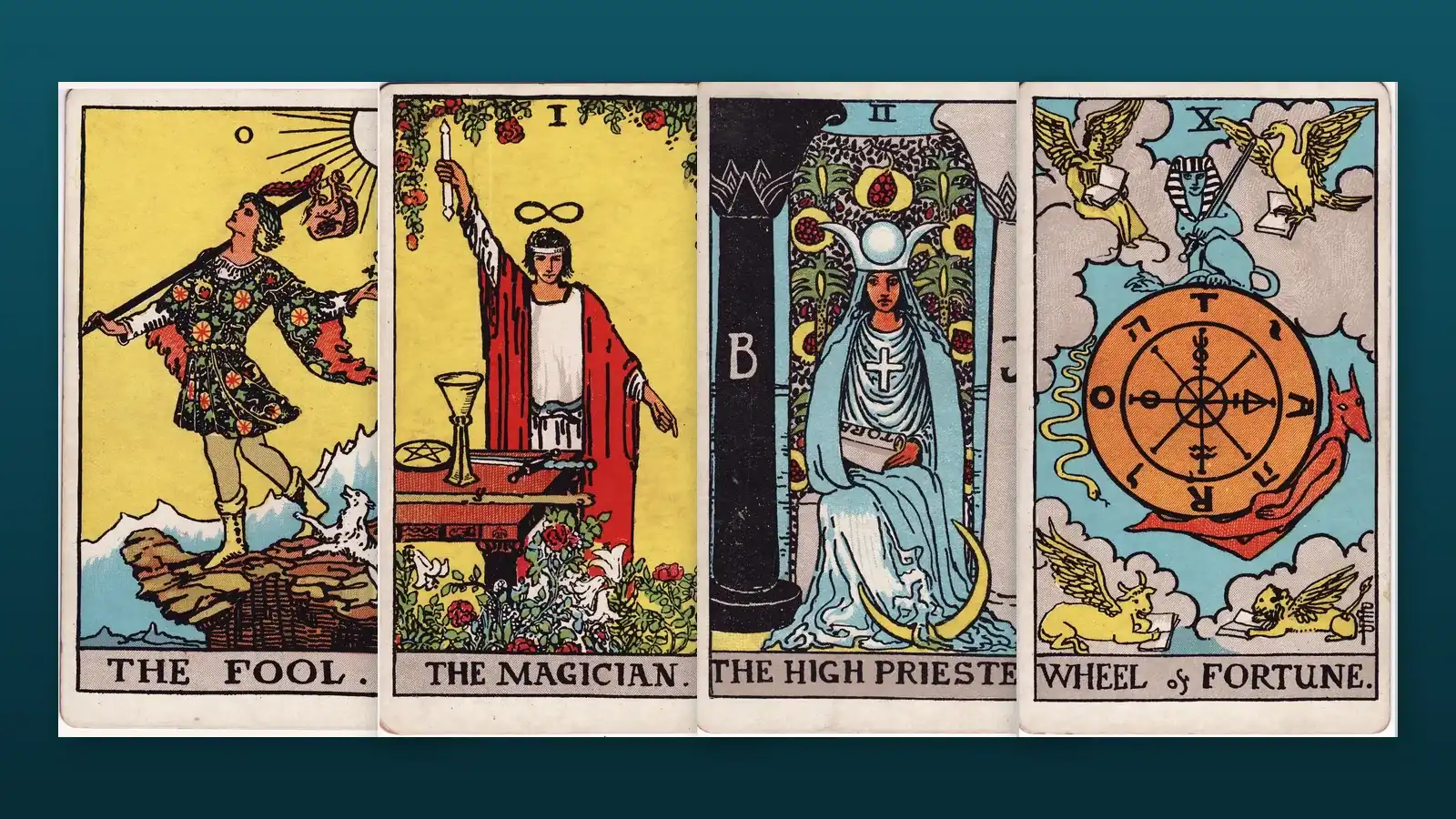
Sooner or later most readers want a second deck. One of the best known is the Thoth tarot, and it is also one of the most confusing for beginners because several cards change names. In this lesson you learn what is different in the Thoth deck, how to compare any new deck with the one you know, and how to choose and start a second deck calmly.
What the Thoth deck changes
Historical The Thoth tarot was designed by Aleister Crowley and painted by Lady Frieda Harris between about 1938 and 1943. Crowley’s companion book, The Book of Thoth, appeared in 1944, but the full deck was not published until 1969, after both had died.
Later tradition The deck follows the Golden Dawn system with Crowley’s own changes. Some trumps are renamed: Justice becomes Adjustment, Strength becomes Lust, Temperance becomes Art, Judgement becomes the Aeon and the World becomes the Universe. The courts are Knight, Queen, Prince and Princess. The minor cards show patterned suit symbols rather than scenes, and each has a title, such as Dominion for the Two of Wands.
Modern You do not have to accept Crowley’s religious ideas to read with the deck. Many people simply enjoy the art. If you do, read the card titles as keywords and lean on number and suit, as you did with the Marseille deck.
Historical The minor cards are where the Thoth deck feels most different in daily use. Every numbered card has a one-word title printed on it. The Two of Cups is Love, the Three of Swords is Sorrow, the Ten of Swords is Ruin and the Six of Wands is Victory. These titles come from the Golden Dawn system and help beginners, because the card tells you its keyword.
The courts are also renamed: Knight, Queen, Prince and Princess replace Waite’s King, Queen, Knight and Page, and the Knight in the Thoth system sits at the top of the court. If you compare decks, match the Thoth Knight with the Waite King and the Thoth Prince with the Waite Knight, at least as a starting point.
Historical Another point that confuses people is the date. The paintings were finished in the early 1940s, and a few black and white images appeared in The Book of Thoth in 1944, but the full color deck was only published in 1969, after both Crowley and Harris had died. So the deck is younger than many people expect.
Choosing a second deck
Modern There is no rule that your first deck must be a gift, and no rule against buying your own. Choose with your eyes and your values: art you want to look at every day, card sizes that fit your hands, a guidebook you can trust, and a publisher that credits and pays its artists. Many beautiful decks follow the Waite-Smith structure, so they are easy to start. A Marseille or Thoth deck is a bigger step and a good one once you know your first deck well.
Your second deck practice, step by step
What you need: your first deck, the second deck or online images of it, your notebook and about thirty minutes, then ten minutes a day for two weeks.
- Look through the whole new deck once, face up, without reading the guidebook.
- Pull out any cards with new names or a very different picture and lay them beside the matching cards of your first deck.
- For each pair, write one line on what stays the same and one on what changes.
- Do the deck interview from the exercise below.
- For the next two weeks, use the new deck for your daily draw and your first deck for anything important.
- At the end, decide whether the new deck is for daily practice, special questions or the shelf.
Journal prompts: What drew you to this deck: the art, the name, a recommendation? Which card looks most different from the version you learned, and what does the difference teach you? Do you read more confidently or less with the new deck, and why might that be?
Questions beginners ask about second decks
Modern People often ask whether a new deck needs to be cleansed or bonded with. These are personal choices; a simple way to start is the deck interview in this lesson, which is really a way of getting to know the art. Another question is whether using two decks will confuse you. For a few weeks it might, but comparing two versions of the same card often deepens your understanding of both. And some ask whether they should buy oracle cards instead. Oracle decks are a different tool with their own rules, and you can enjoy both.
Modern A myth to drop is that the Thoth deck is dangerous because of Crowley’s reputation. A deck is printed card and art; how you use it is up to you. Another myth is that you must not buy your own first deck; there is no evidence for it, and plenty of readers have happily bought every deck they own. Finally, you do not need a large collection. Many readers own two or three decks and know them well, which is worth more than a full shelf.
A second worked example: choosing on a budget
Imagine a reader with a budget for one new deck. She writes three needs: art she likes looking at, cards small enough for her hands, and a creator she can support. She looks at images of the full deck online, not only the box, because some decks have beautiful Majors and plain Minors. She checks whether the deck is sold by the publisher or the artist, and avoids obvious copies sold without credit. In the end she chooses a smaller deck by an independent artist and gives herself two weeks of daily draws before deciding whether it suits her.
Using the Thoth titles as keywords
One helpful feature of the Thoth deck for learners is that every numbered minor card carries a one-word title. You can treat these titles as keywords and compare them with what you already know from the Waite-Smith deck. A few examples make the point.
Four of Wands, “Completion”. Close to Waite’s celebration and “harmony”, with a sense of a finished stage.
Five of Cups, “Disappointment”. Very close to the grief of Smith’s cloaked figure, though without the two standing cups that offer hope.
Eight of Pentacles, “Prudence”. Different in flavor from Smith’s busy craftsman, focusing on careful, patient growth.
Six of Swords, “Science”. Quite different from Smith’s ferry, pointing to clear understanding rather than a journey.
Ten of Cups, “Satiety”. A surprise for Waite-Smith readers, who know the card as happy family life. Satiety means being full, even too full.
Comparing titles like this teaches you a lot. Where they agree, you can be confident about the core of the card. Where they differ, you see two traditions reading the same number and suit in different ways, and you can choose which feels truer to you.
Practice variations
One title a day. For two weeks, draw one numbered card each day from either deck and write both the Thoth title and the Waite-Smith keyword. Note in one line where they meet and where they part.
Read with titles only. Do a three-card reading using only the Thoth titles, without any book meanings. You will be surprised how much a single word can carry.
Any second deck. If the Thoth deck does not appeal, apply the same method to any second deck you are drawn to: compare names, pictures and keywords with your first deck. The method matters more than the particular deck.
Looking after two decks
Once you have two decks, a few habits keep them from getting mixed up. Store them in separate boxes or bags. Keep a small note in each box with its name and any missing or extra cards. If you use one for daily practice and one for special questions, write that on the note too. It sounds simple, but many readers have found a stray card from one deck in another and spent an evening sorting it out.
When a second deck feels wrong
Sometimes a new deck simply does not work for you. The art may be beautiful but hard to read, or the cards may feel stiff in your hands. That is not a failure. Give it the two weeks suggested in this lesson, then decide honestly. You can keep it for looking at, pass it to a friend who will enjoy it, or sell it second-hand.
Many experienced readers own several decks but use only one or two regularly. The right deck is the one that makes you want to look closer, not the one with the most impressive reputation or the highest price. Trust your own eyes over anyone else’s list of favorites.
A worked example
A reader with a Waite-Smith deck borrows a Thoth deck from a friend. She lays Lust beside Strength. Both show a woman and a lion, but the Waite-Smith woman calmly closes the lion’s mouth while the Thoth figure rides a many-headed beast with joy. She writes: “Same theme, strength with an animal force, but Thoth adds passion and celebration.” In her interview the deck answers “How should we start?” with the Princess of Cups, and she decides to begin slowly and playfully.
Try this
Make a deck interview page: shuffle a new or old deck and draw three cards for “What are you good at?”, “What will be hard with you?” and “How should we start?”. Write what you see in each card before any meaning.
Recap
The Thoth deck was painted by Frieda Harris to Crowley’s design and published in 1969. It renames several trumps and the courts and gives every minor card a title. Choose a second deck for art, quality and values, compare it card by card and give it two weeks of daily use before you judge it.
What next
Press “Mark as done” and continue with Your certificate and where to go next. My decks and books page has ideas for your next deck.
Further reading: Lon Milo DuQuette, Understanding Aleister Crowley’s Thoth Tarot (Weiser, 2003).
Sources
- Aleister Crowley, The Book of Thoth (London: O.T.O., 1944).
- A. E. Waite, The Pictorial Key to the Tarot (London: Rider, 1910).
Quick check
Go deeper: the tarot history and deck pages on this site
Get the free Mini-Grimoire
A short printable starter guide to tarot and everyday witchcraft, plus my newsletter. Unsubscribe any time.
Opens Substack in a new tab to confirm. More about the newsletter · Privacy
Comments
Questions and notes from readers. Anyone with a free account can comment, and I reply when I can. Please read the community guidelines.
Comments load from Google Firebase (EU) when you ask for them. Nothing is stored on your device. Privacy