


How to read the labels Historical what the old sources say. Later tradition what later writers added. Modern modern practice and my own notes.
In 1909 the London publisher William Rider and Son brought out a tarot deck designed by the occultist A. E. Waite and drawn by the artist Pamela Colman Smith. It became the model for most tarot decks made since. On my card meaning pages I treat these images as tools for reading. Here I want you to see them as what they also are: a set of small, bold illustrations by a trained artist.
This gallery shows all twenty-two Major Arcana. A few of them, such as the Lovers and the Star, show nude figures, as Pamela Colman Smith drew them. These are historical cards in the public domain, and apart from them I keep the site free of nudity. If you want to know more about the woman behind the deck, start with my page on Pamela Colman Smith.
About these images
These are scans of an early printing, shared on Wikimedia Commons as public domain. A printed card is not a unique museum object, so there is no object number in the captions.
Historical Look at the style before the symbols. Smith trained at the Pratt Institute in Brooklyn under Arthur Wesley Dow, who taught design through outline, flat color and strong composition, influenced by Japanese prints. You will see thick black outlines, flat areas of yellow, red and blue, and figures placed like actors on a stage. She worked in the theater, and it shows.
The cards
The Fool to The High Priestess
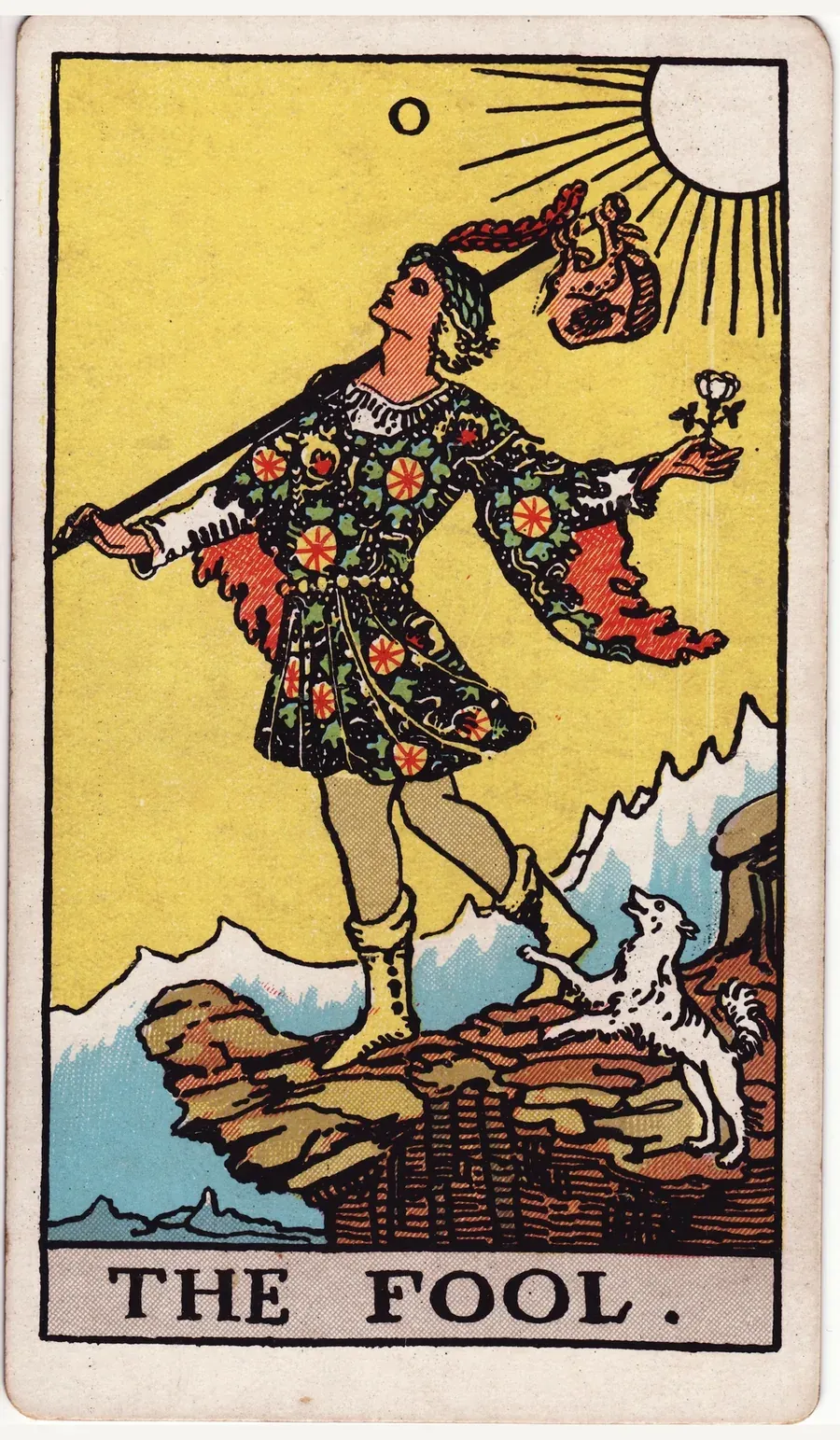
The Fool, Pamela Colman Smith, designed with A. E. Waite, published by William Rider and Son, London, 1909. Printed card. Image: Wikimedia Commons, RWS_Tarot_00_Fool.jpg. Public domain. No museum object number: this is a scan of a printed deck.

Look at where he is looking: up, not down. The bright yellow sky and the mountains behind him set up a journey that the rest of the deck follows. Card meaning: The Fool.
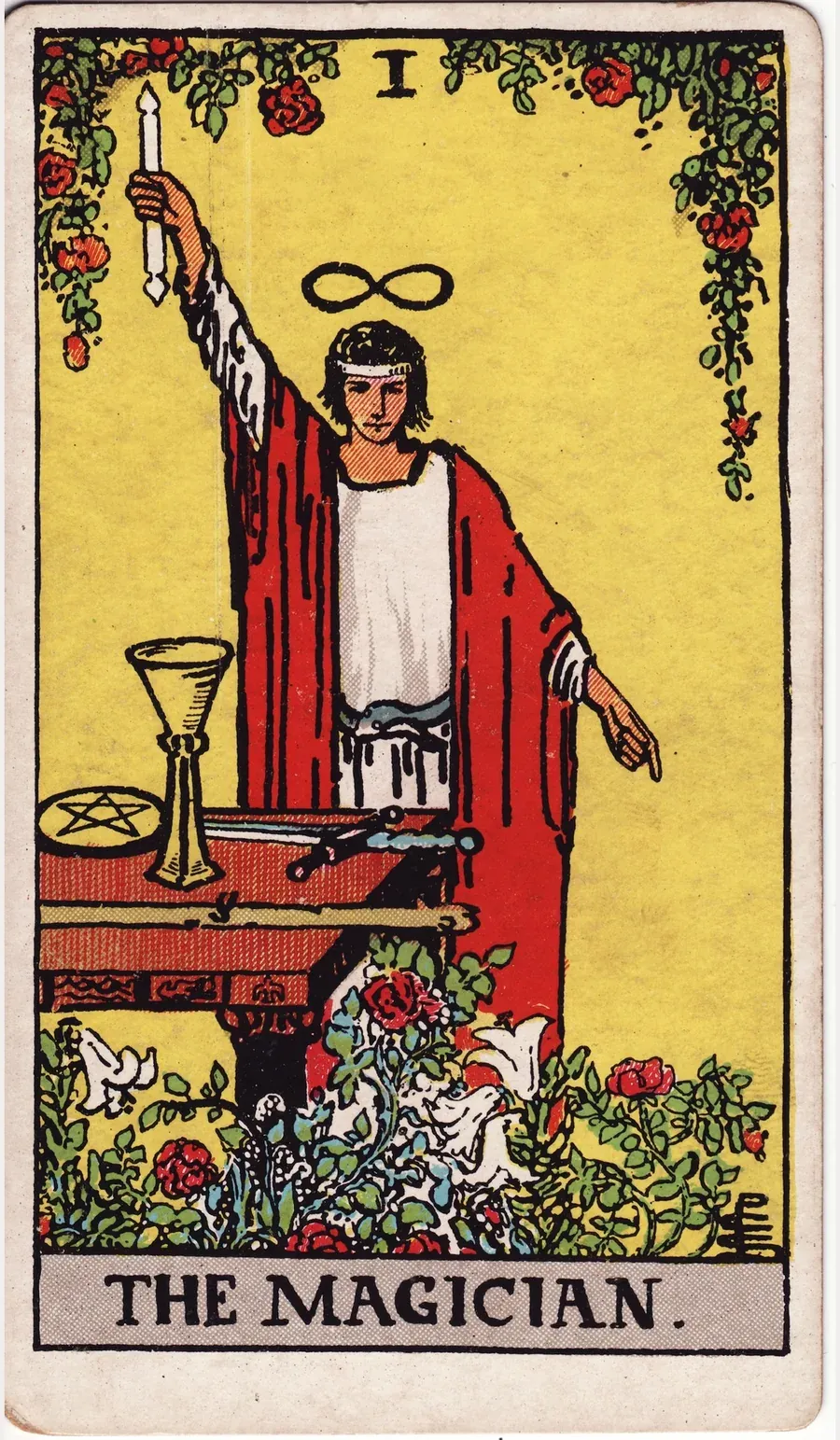
The Magician, Pamela Colman Smith, designed with A. E. Waite, published by William Rider and Son, London, 1909. Printed card. Image: Wikimedia Commons, RWS_Tarot_01_Magician.jpg. Public domain. No museum object number: this is a scan of a printed deck.

The four suit symbols lie on the table like tools. Above his head floats the sideways figure eight, the sign of infinity. Card meaning: The Magician.
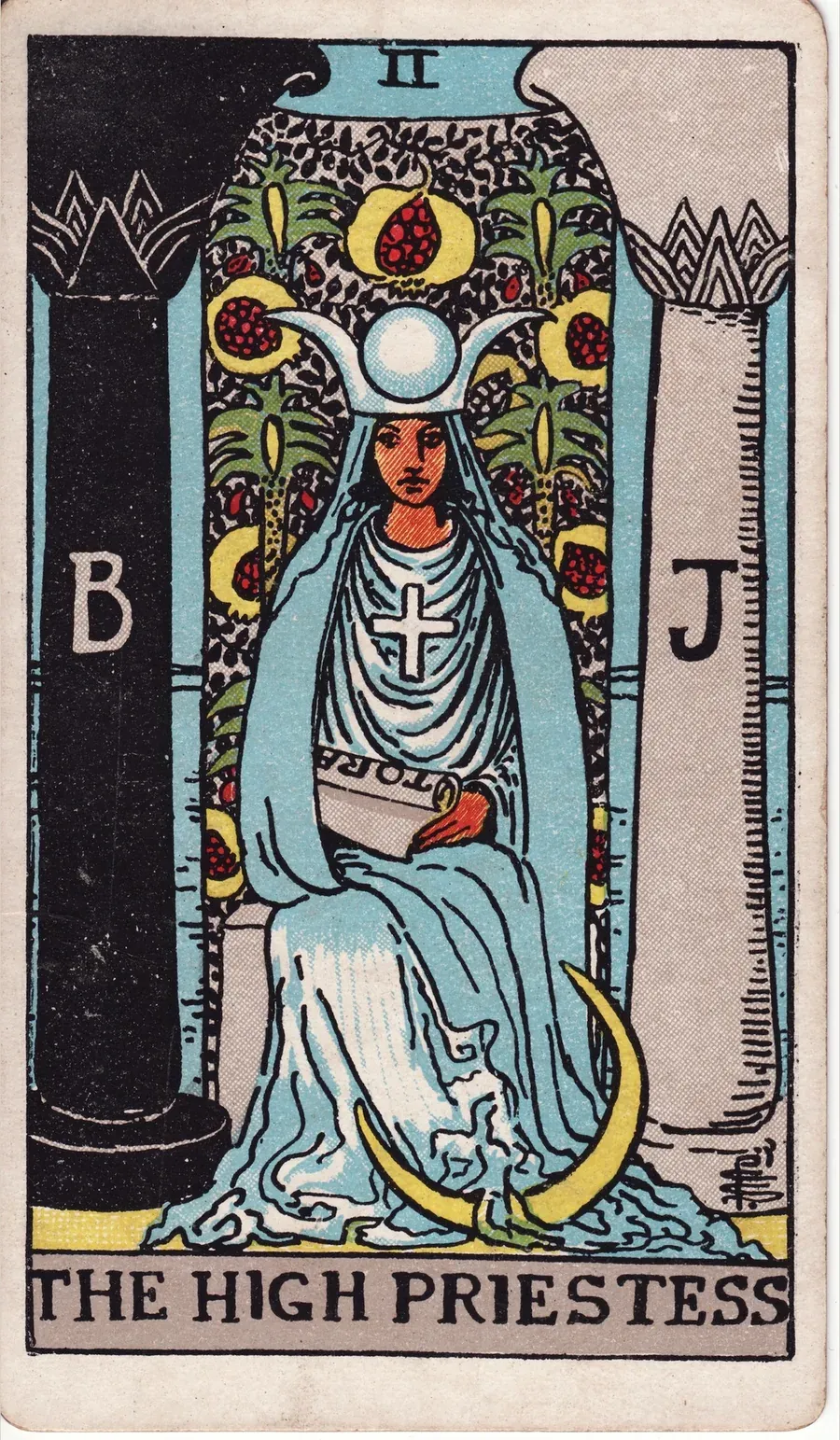
The High Priestess, Pamela Colman Smith, designed with A. E. Waite, published by William Rider and Son, London, 1909. Printed card. Image: Wikimedia Commons, RWS_Tarot_02_High_Priestess.jpg. Public domain. No museum object number: this is a scan of a printed deck.

The veil behind her is painted with pomegranates. Smith uses strong blue and white here, a cool card after the hot red of the Magician. Card meaning: The High Priestess.
The Empress to The Lovers
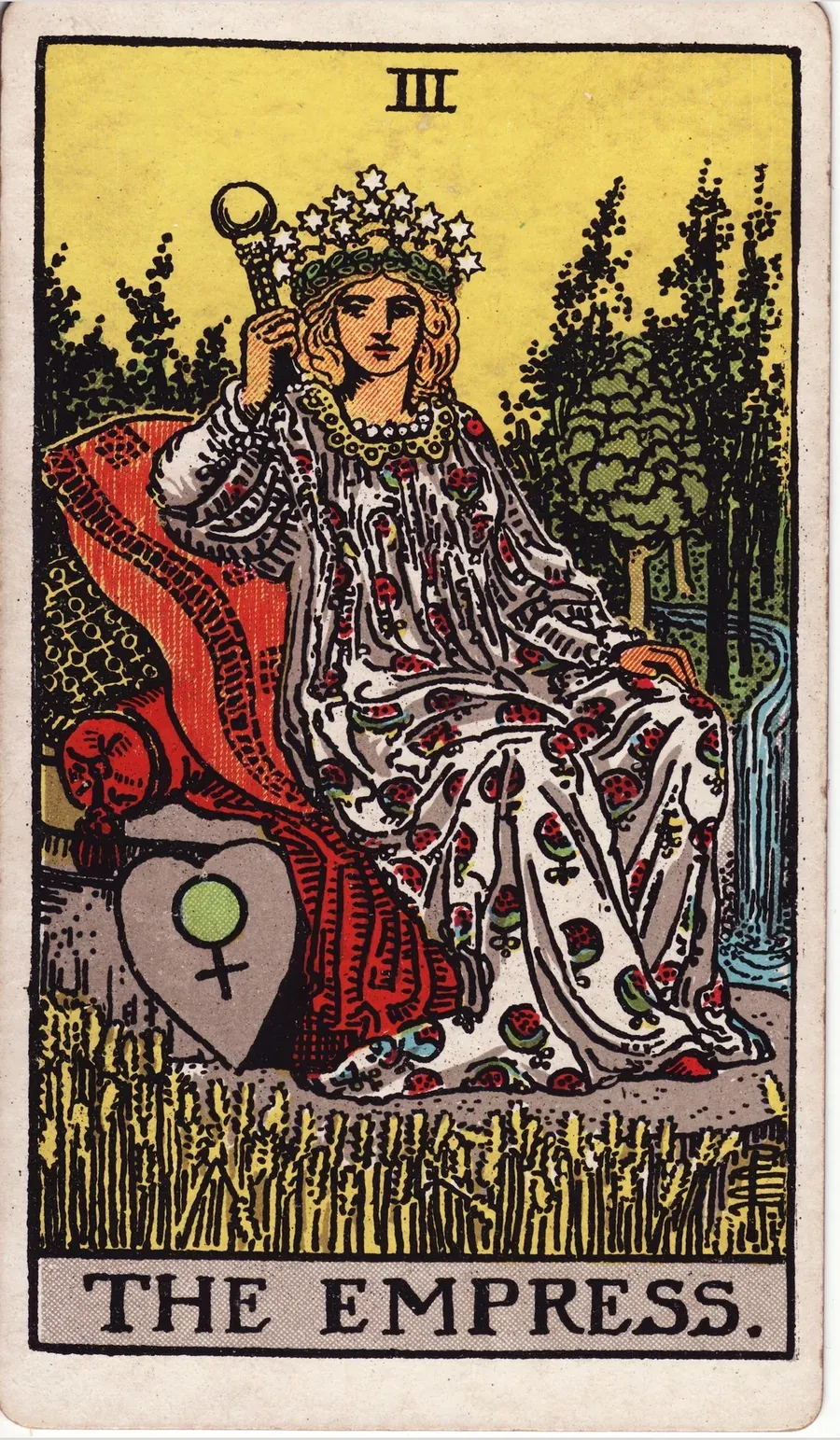
The Empress, Pamela Colman Smith, designed with A. E. Waite, published by William Rider and Son, London, 1909. Printed card. Image: Wikimedia Commons, RWS_Tarot_03_Empress.jpg. Public domain. No museum object number: this is a scan of a printed deck.

A heart-shaped shield with the sign of Venus rests beside her. Everything in this card grows. Card meaning: The Empress.
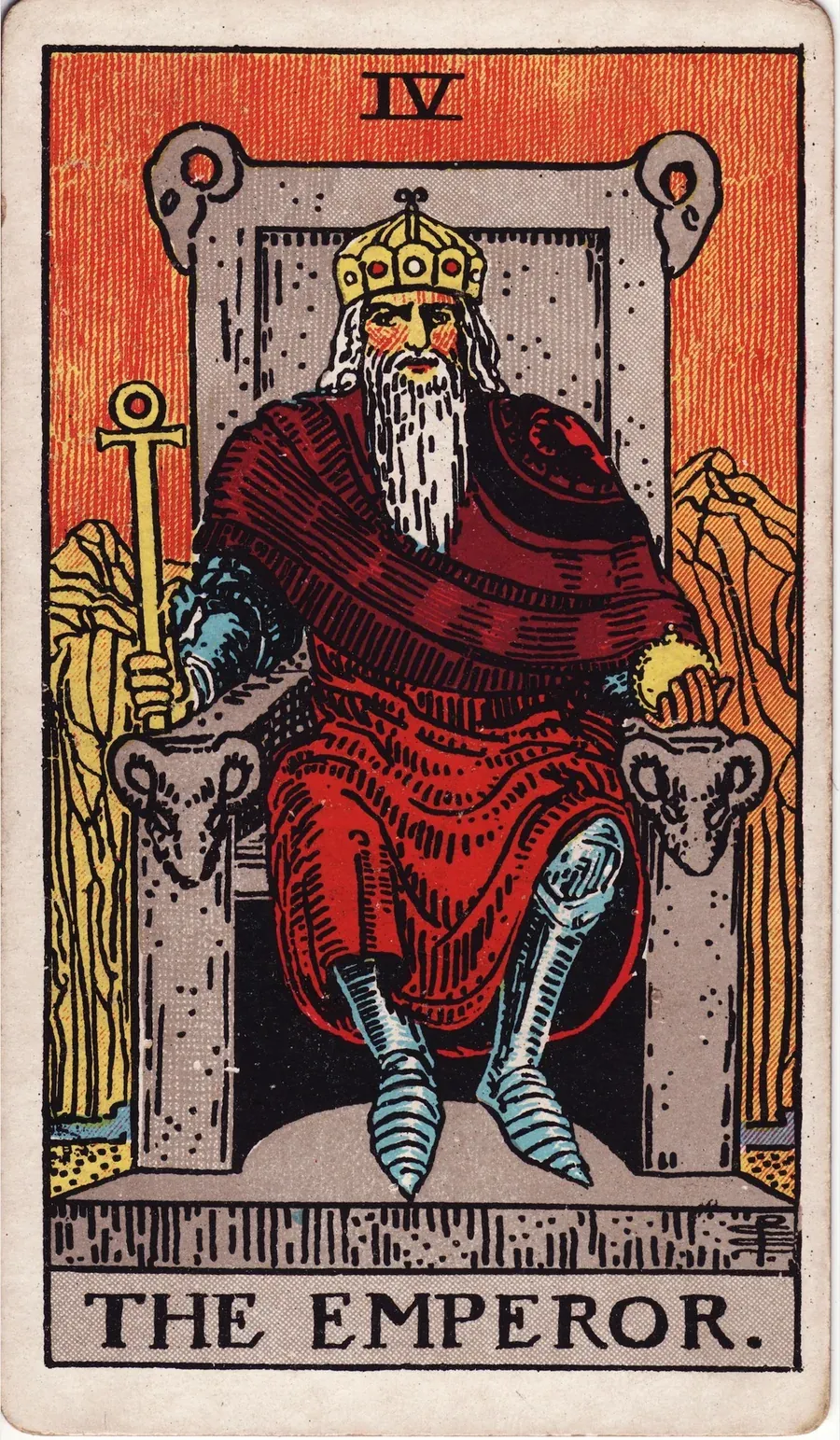
The Emperor, Pamela Colman Smith, designed with A. E. Waite, published by William Rider and Son, London, 1909. Printed card. Image: Wikimedia Commons, RWS_Tarot_04_Emperor.jpg. Public domain. No museum object number: this is a scan of a printed deck.

Compare his rocky landscape with the Empress’s wheat field. Smith gives each figure its own country. Card meaning: The Emperor.
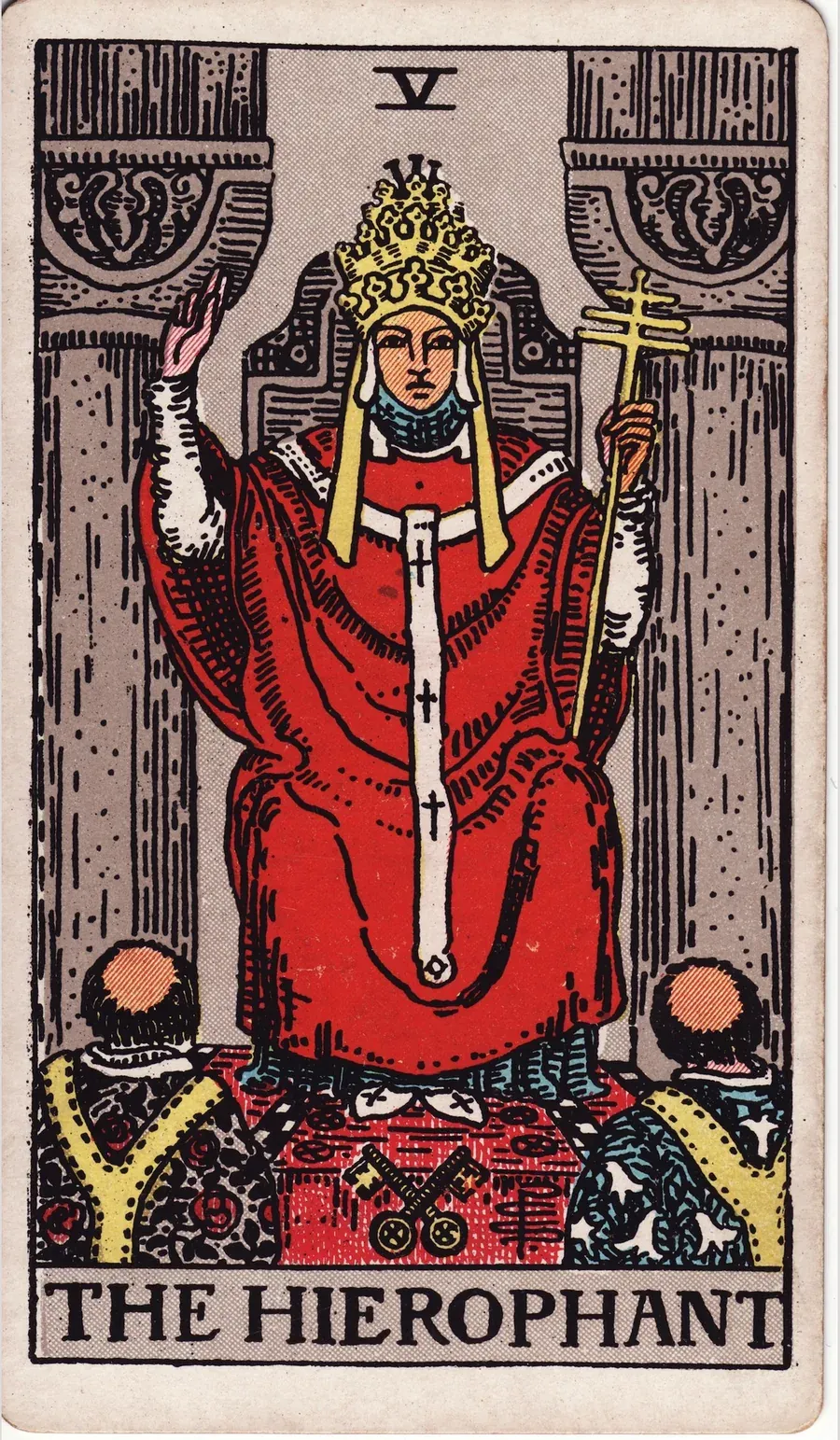
The Hierophant, Pamela Colman Smith, designed with A. E. Waite, published by William Rider and Son, London, 1909. Printed card. Image: Wikimedia Commons, RWS_Tarot_05_Hierophant.jpg. Public domain. No museum object number: this is a scan of a printed deck.

This is the most symmetrical card so far. The crossed keys and the two followers make a strong triangle. Card meaning: The Hierophant.
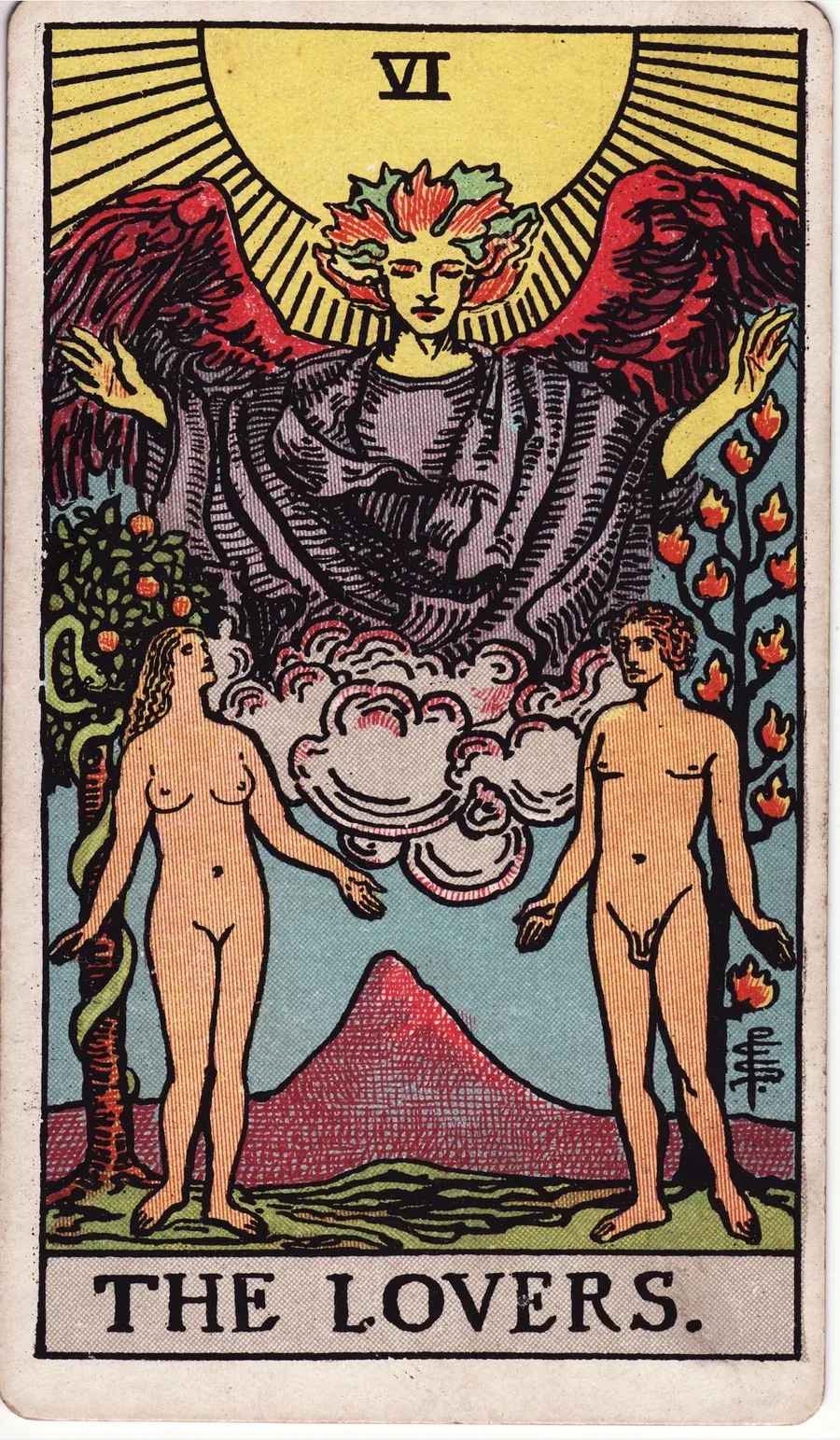
The Lovers, Pamela Colman Smith, designed with A. E. Waite, published by William Rider and Son, London, 1909. Printed card. Image: Wikimedia Commons, RWS_Tarot_06_Lovers.jpg. Public domain. No museum object number: this is a scan of a printed deck.

The Chariot to The Hermit
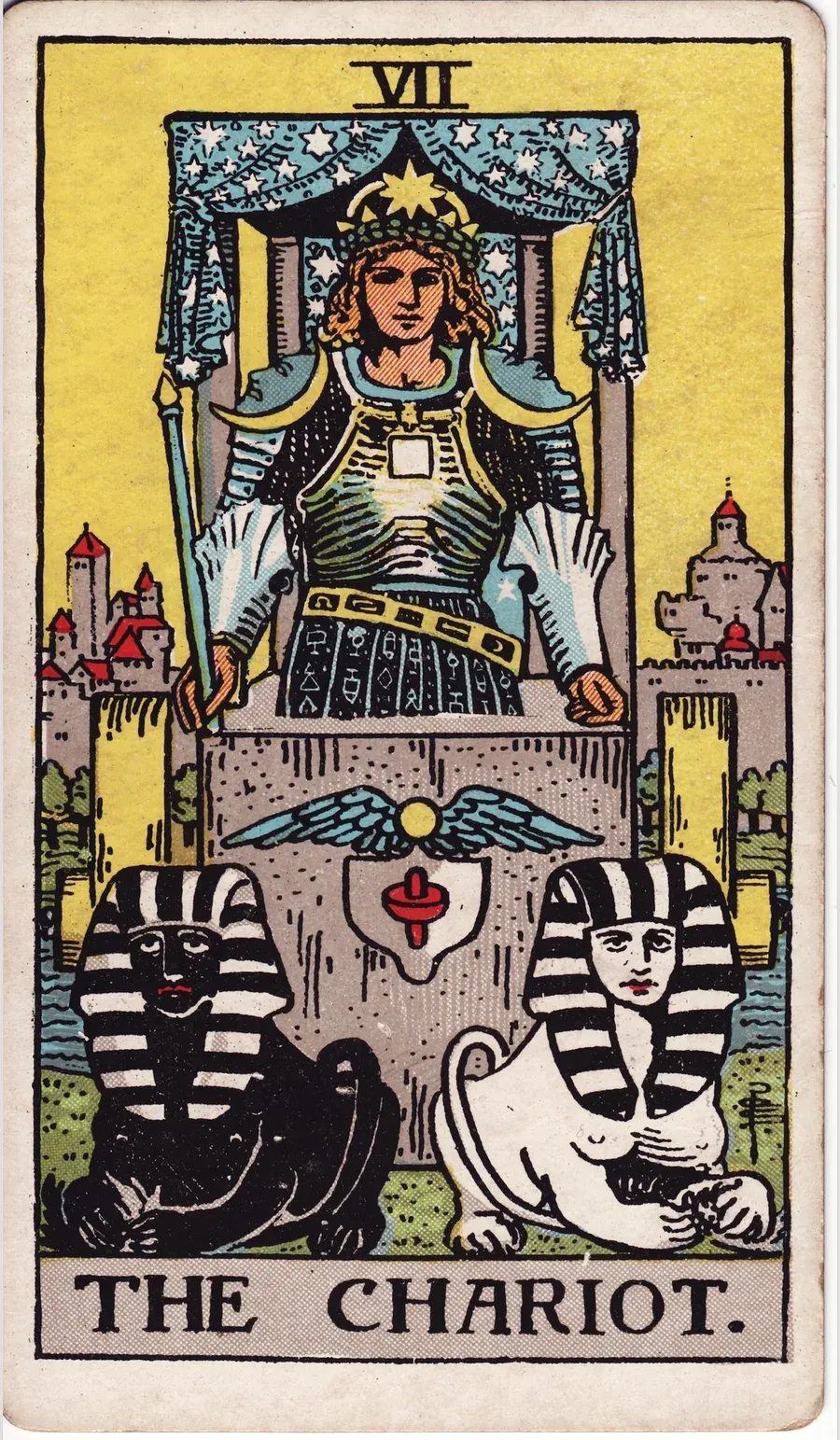
The Chariot, Pamela Colman Smith, designed with A. E. Waite, published by William Rider and Son, London, 1909. Printed card. Image: Wikimedia Commons, RWS_Tarot_07_Chariot.jpg. Public domain. No museum object number: this is a scan of a printed deck.

There are no reins. Waite’s design asks how the driver steers at all. Card meaning: The Chariot.
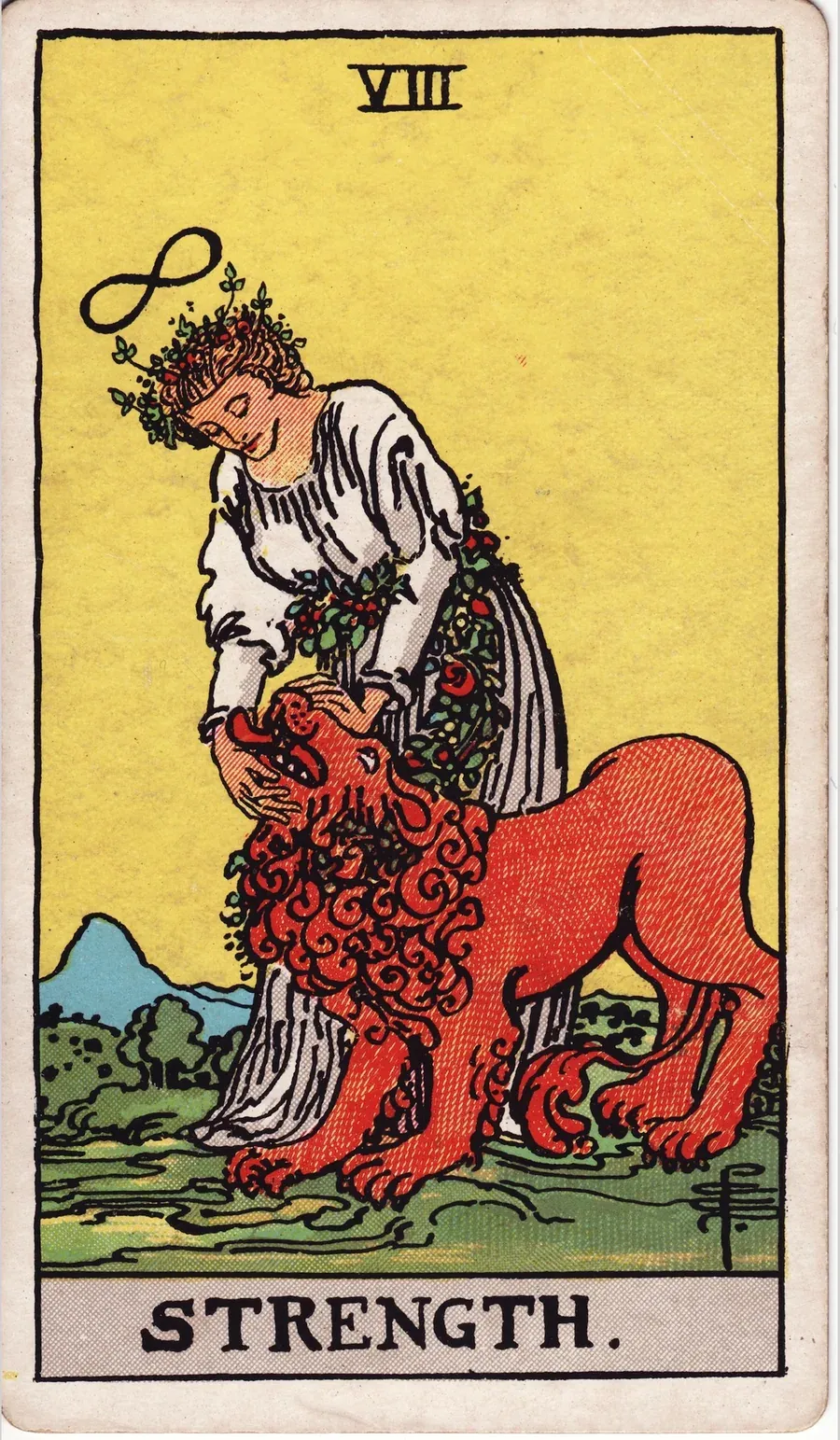
Strength, Pamela Colman Smith, designed with A. E. Waite, published by William Rider and Son, London, 1909. Printed card. Image: Wikimedia Commons, RWS_Tarot_08_Strength.jpg. Public domain. No museum object number: this is a scan of a printed deck.

In this deck Strength is card 8, swapped with Justice compared with older decks. Waite explained the change in his book. Card meaning: Strength.
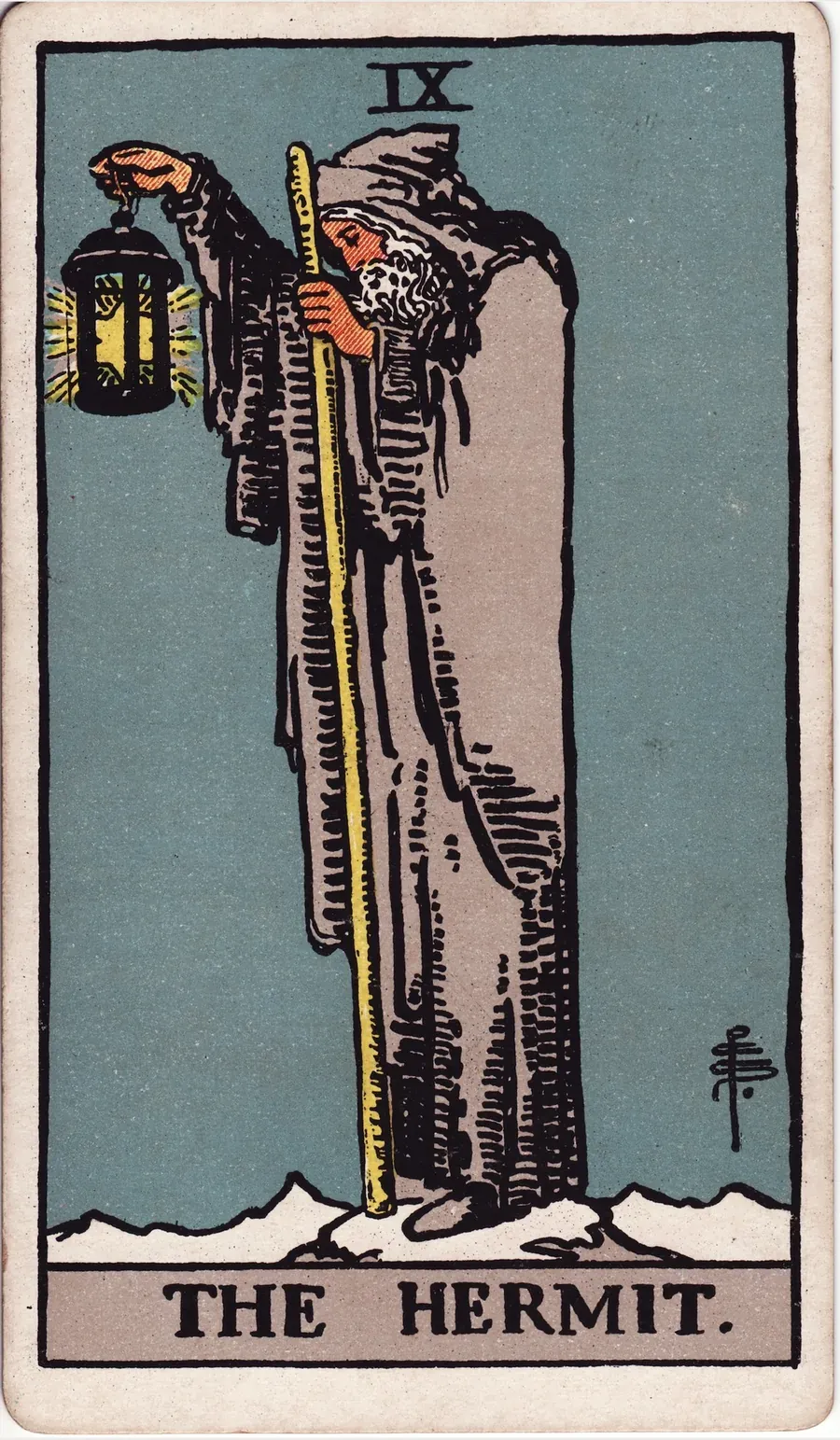
The Hermit, Pamela Colman Smith, designed with A. E. Waite, published by William Rider and Son, London, 1909. Printed card. Image: Wikimedia Commons, RWS_Tarot_09_Hermit.jpg. Public domain. No museum object number: this is a scan of a printed deck.

I have a whole page on this card as an artwork, with a comparison to older Marseille Hermits. Card meaning: The Hermit.
Wheel of Fortune to The Hanged Man
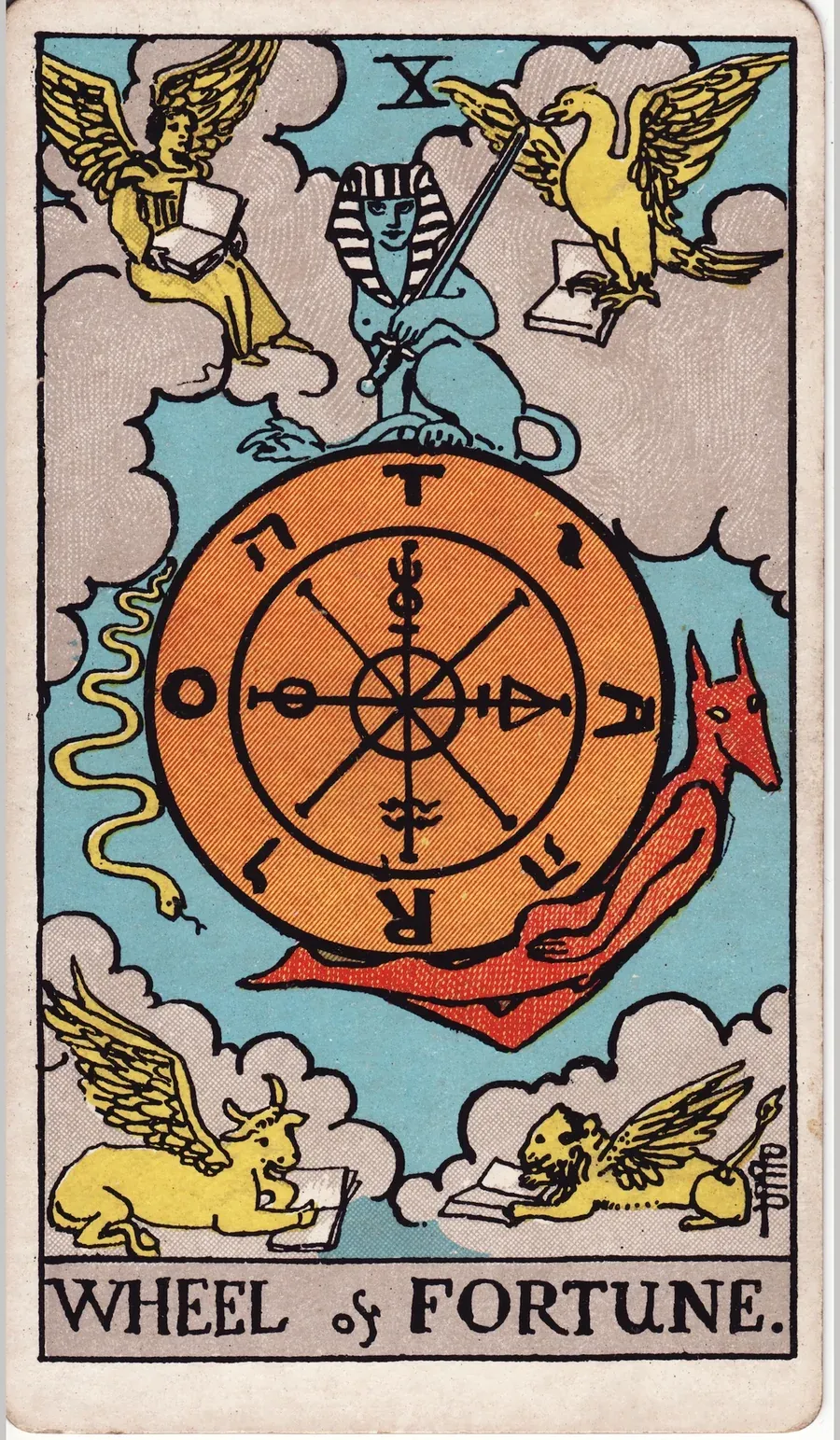
Wheel of Fortune, Pamela Colman Smith, designed with A. E. Waite, published by William Rider and Son, London, 1909. Printed card. Image: Wikimedia Commons, RWS_Tarot_10_Wheel_of_Fortune.jpg. Public domain. No museum object number: this is a scan of a printed deck.

The four winged figures reading books in the corners return on the World card. Card meaning: Wheel of Fortune.
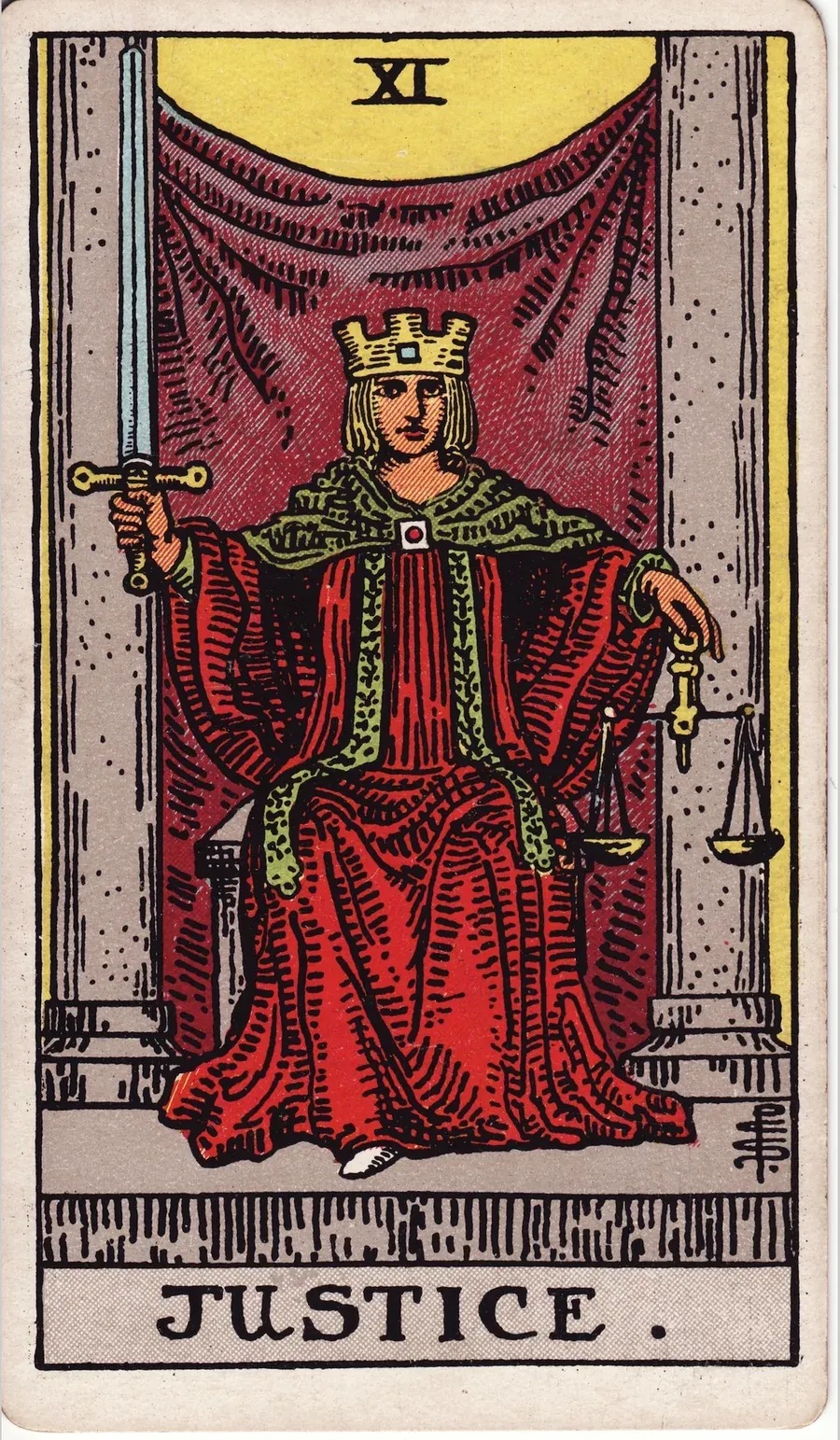
Justice, Pamela Colman Smith, designed with A. E. Waite, published by William Rider and Son, London, 1909. Printed card. Image: Wikimedia Commons, RWS_Tarot_11_Justice.jpg. Public domain. No museum object number: this is a scan of a printed deck.

Unlike many images of Justice, she is not blindfolded. Look at her steady, open gaze. Card meaning: Justice.
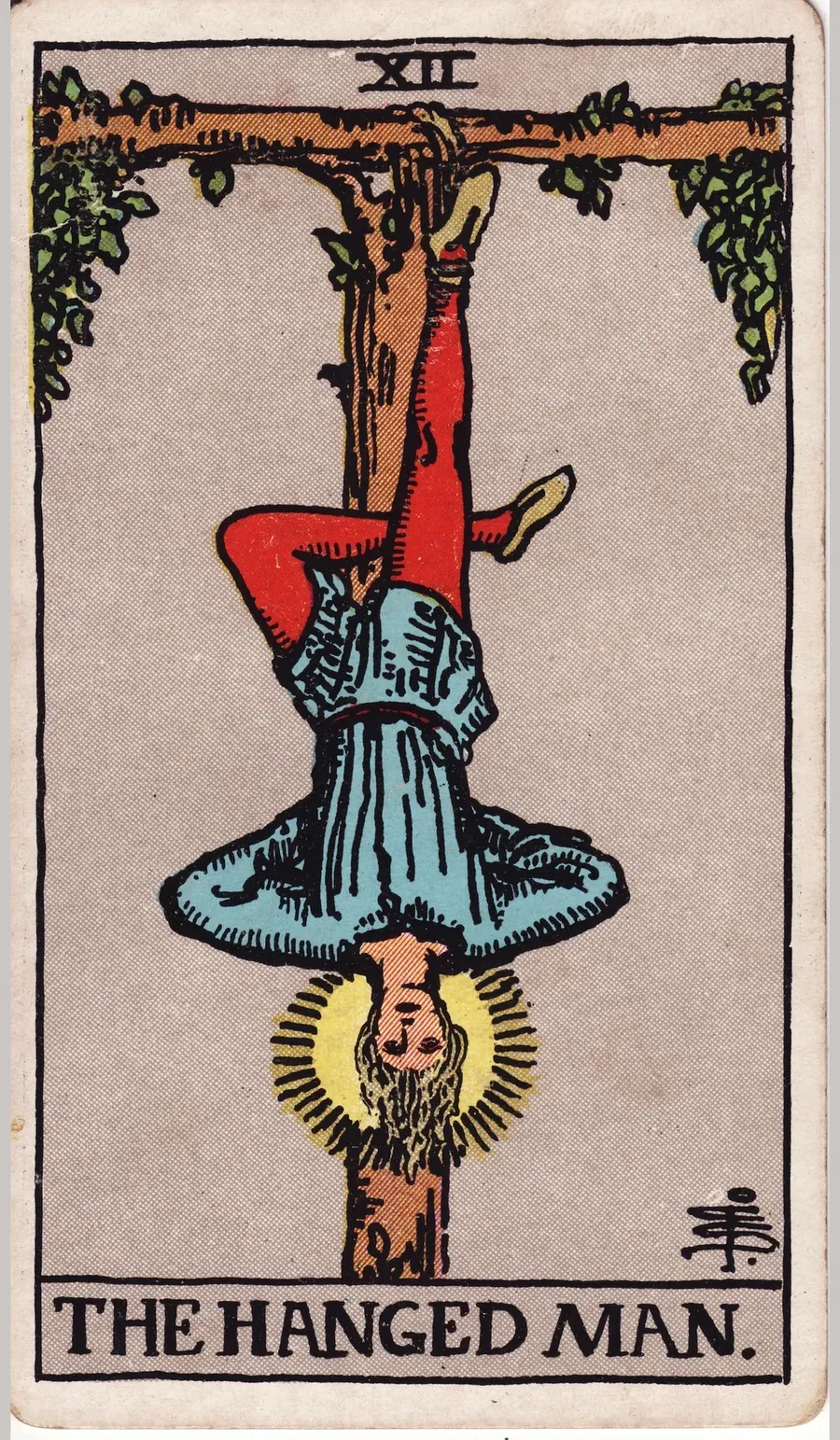
The Hanged Man, Pamela Colman Smith, designed with A. E. Waite, published by William Rider and Son, London, 1909. Printed card. Image: Wikimedia Commons, RWS_Tarot_12_Hanged_Man.jpg. Public domain. No museum object number: this is a scan of a printed deck.

His face is calm, and the halo tells us this is not a punishment scene. The leaves on the wood show it is alive. Card meaning: The Hanged Man.
Death to The Tower
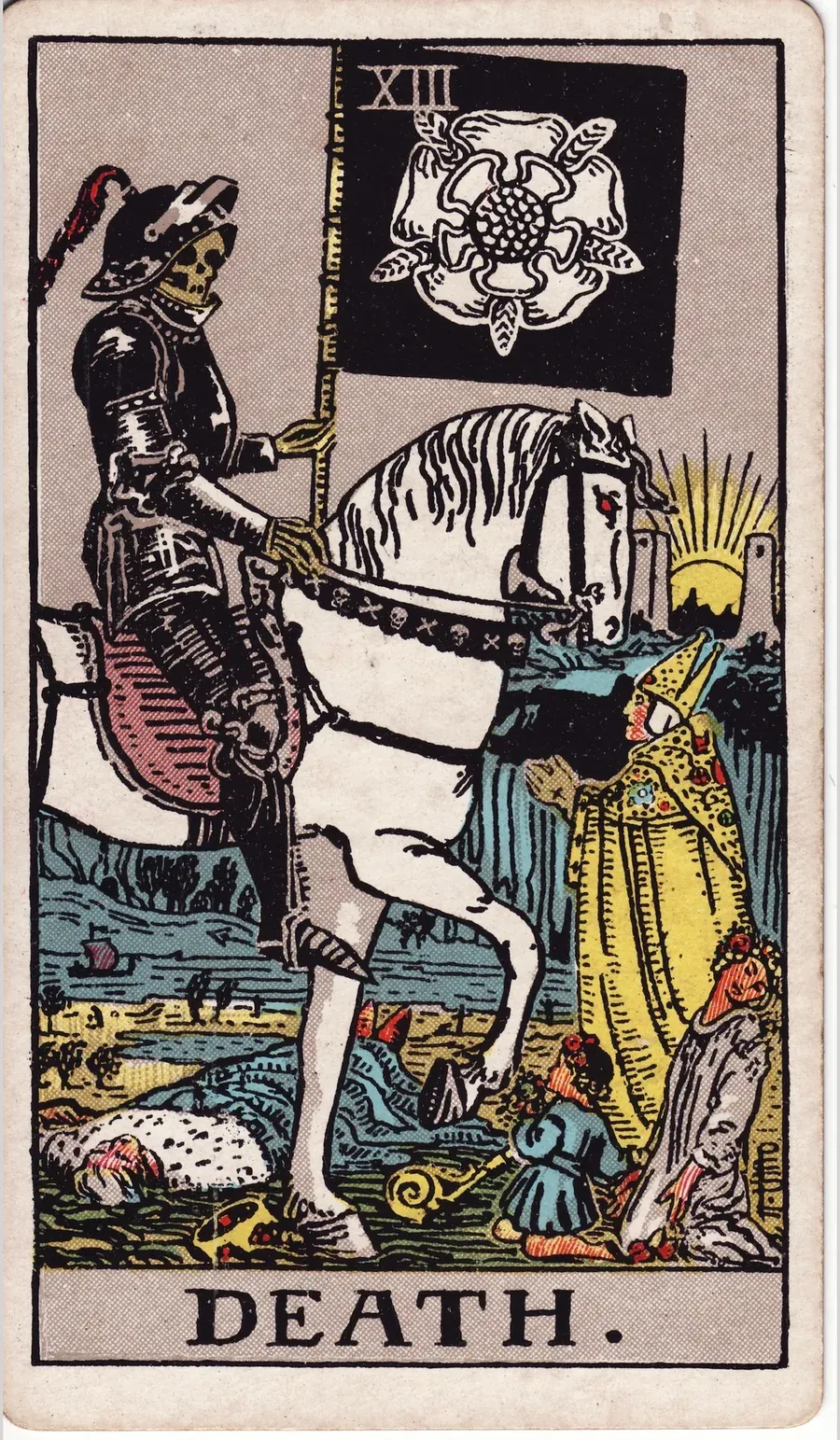
Death, Pamela Colman Smith, designed with A. E. Waite, published by William Rider and Son, London, 1909. Printed card. Image: Wikimedia Commons, RWS_Tarot_13_Death.jpg. Public domain. No museum object number: this is a scan of a printed deck.

Even here there is a sunrise on the horizon. Smith never lets a card be only one thing. Card meaning: Death.
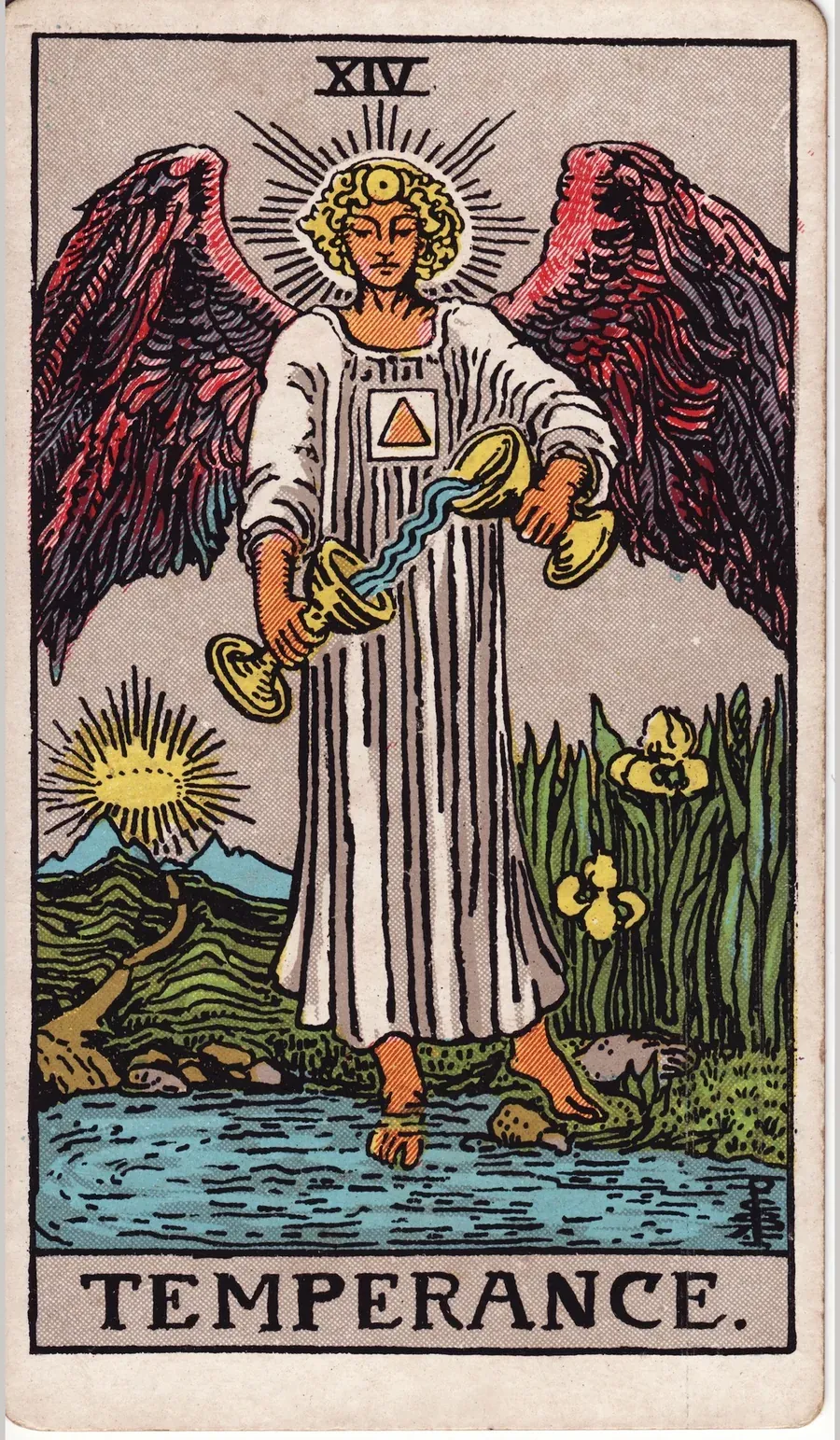
Temperance, Pamela Colman Smith, designed with A. E. Waite, published by William Rider and Son, London, 1909. Printed card. Image: Wikimedia Commons, RWS_Tarot_14_Temperance.jpg. Public domain. No museum object number: this is a scan of a printed deck.

The pouring water flows at an impossible angle. Nothing in the card is in a hurry. Card meaning: Temperance.
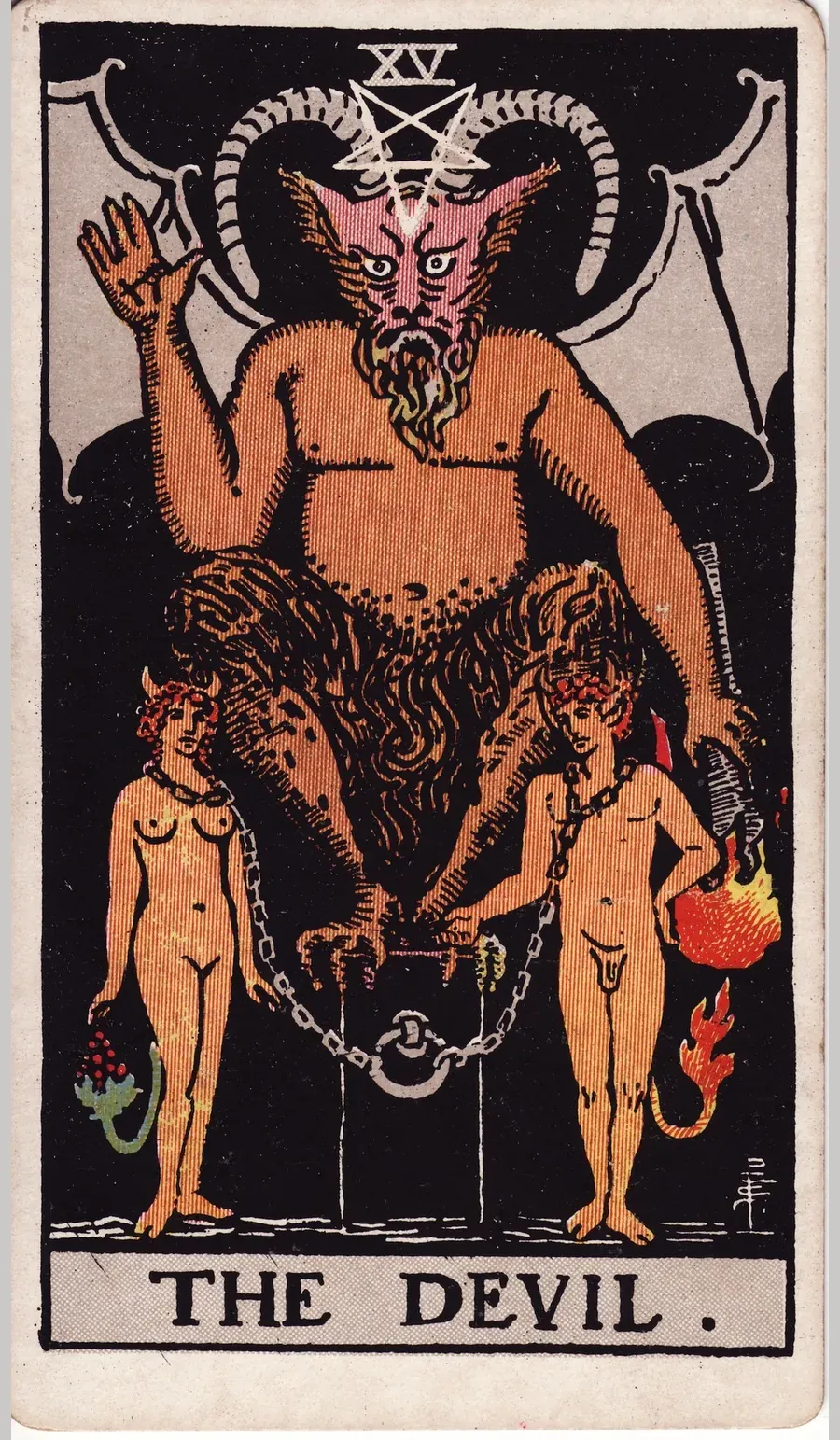
The Devil, Pamela Colman Smith, designed with A. E. Waite, published by William Rider and Son, London, 1909. Printed card. Image: Wikimedia Commons, RWS_Tarot_15_Devil.jpg. Public domain. No museum object number: this is a scan of a printed deck.

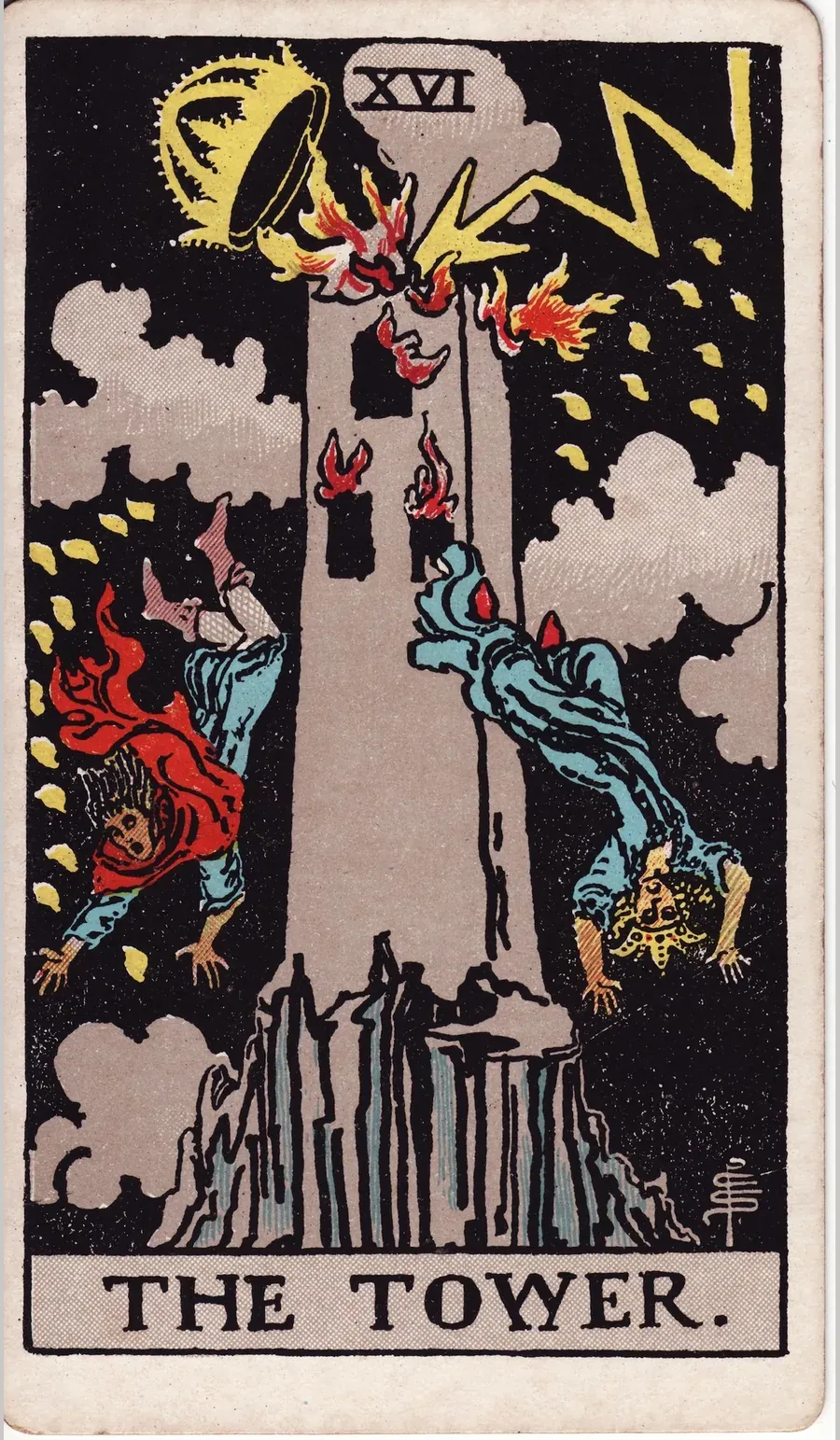
The Tower, Pamela Colman Smith, designed with A. E. Waite, published by William Rider and Son, London, 1909. Printed card. Image: Wikimedia Commons, RWS_Tarot_16_Tower.jpg. Public domain. No museum object number: this is a scan of a printed deck.

This is the most dramatic composition in the deck, with drops of fire falling like rain. Card meaning: The Tower.
The Star to The World
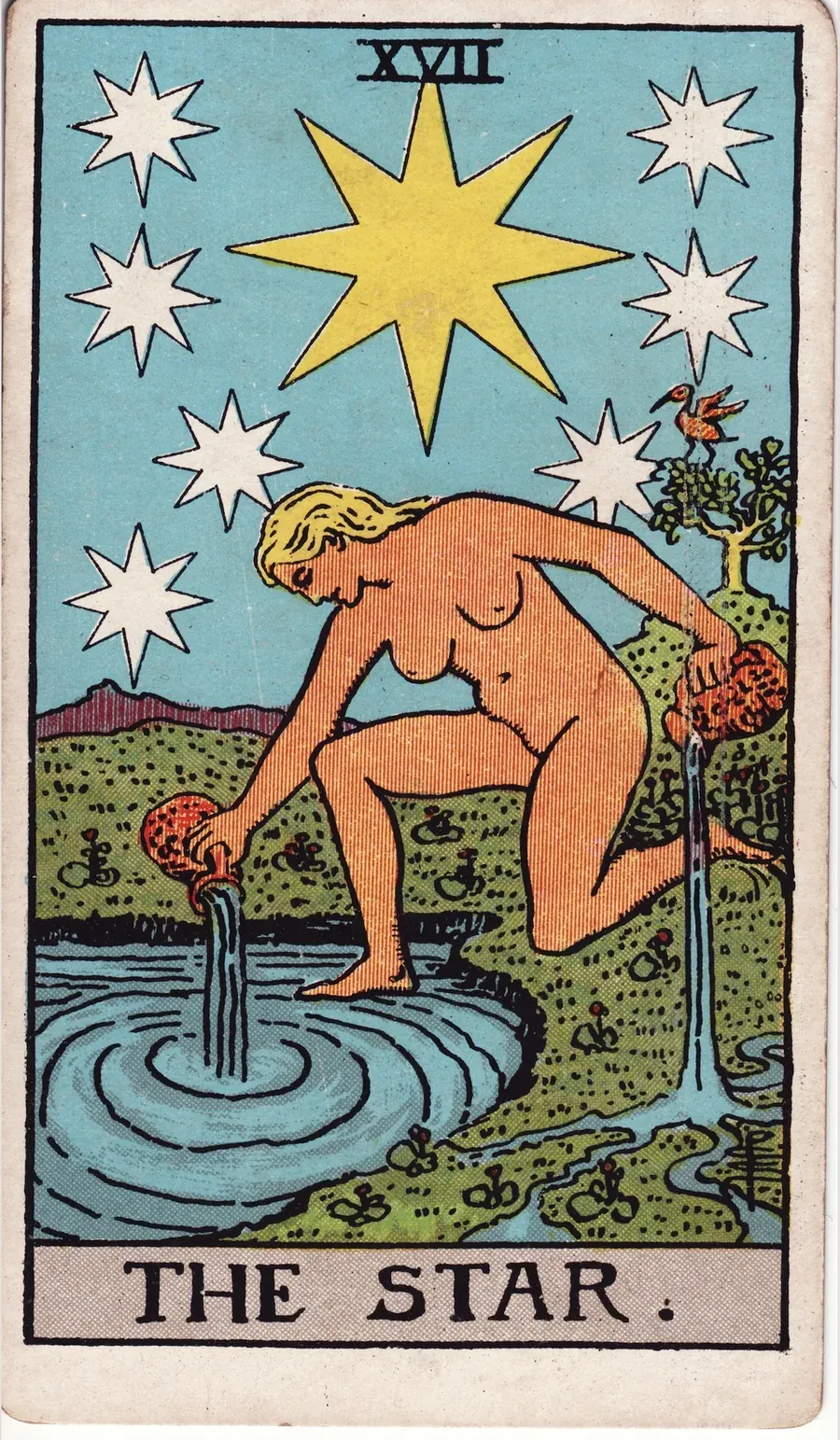
The Star, Pamela Colman Smith, designed with A. E. Waite, published by William Rider and Son, London, 1909. Printed card. Image: Wikimedia Commons, RWS_Tarot_17_Star.jpg. Public domain. No museum object number: this is a scan of a printed deck.

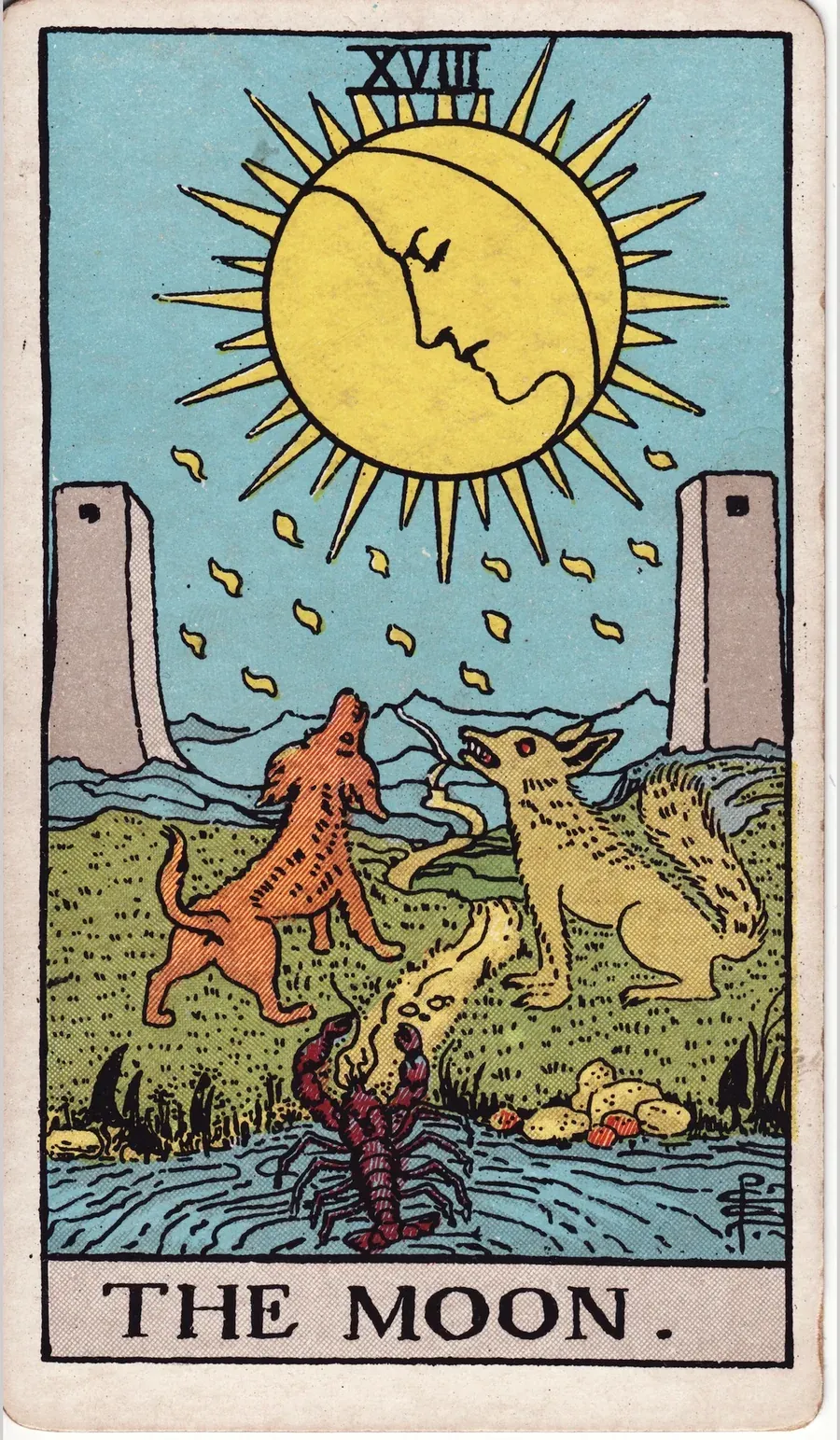
The Moon, Pamela Colman Smith, designed with A. E. Waite, published by William Rider and Son, London, 1909. Printed card. Image: Wikimedia Commons, RWS_Tarot_18_Moon.jpg. Public domain. No museum object number: this is a scan of a printed deck.

Compare this with the moon pictures in my moon and night gallery. Here the moon is a face, a story and a road. Card meaning: The Moon.
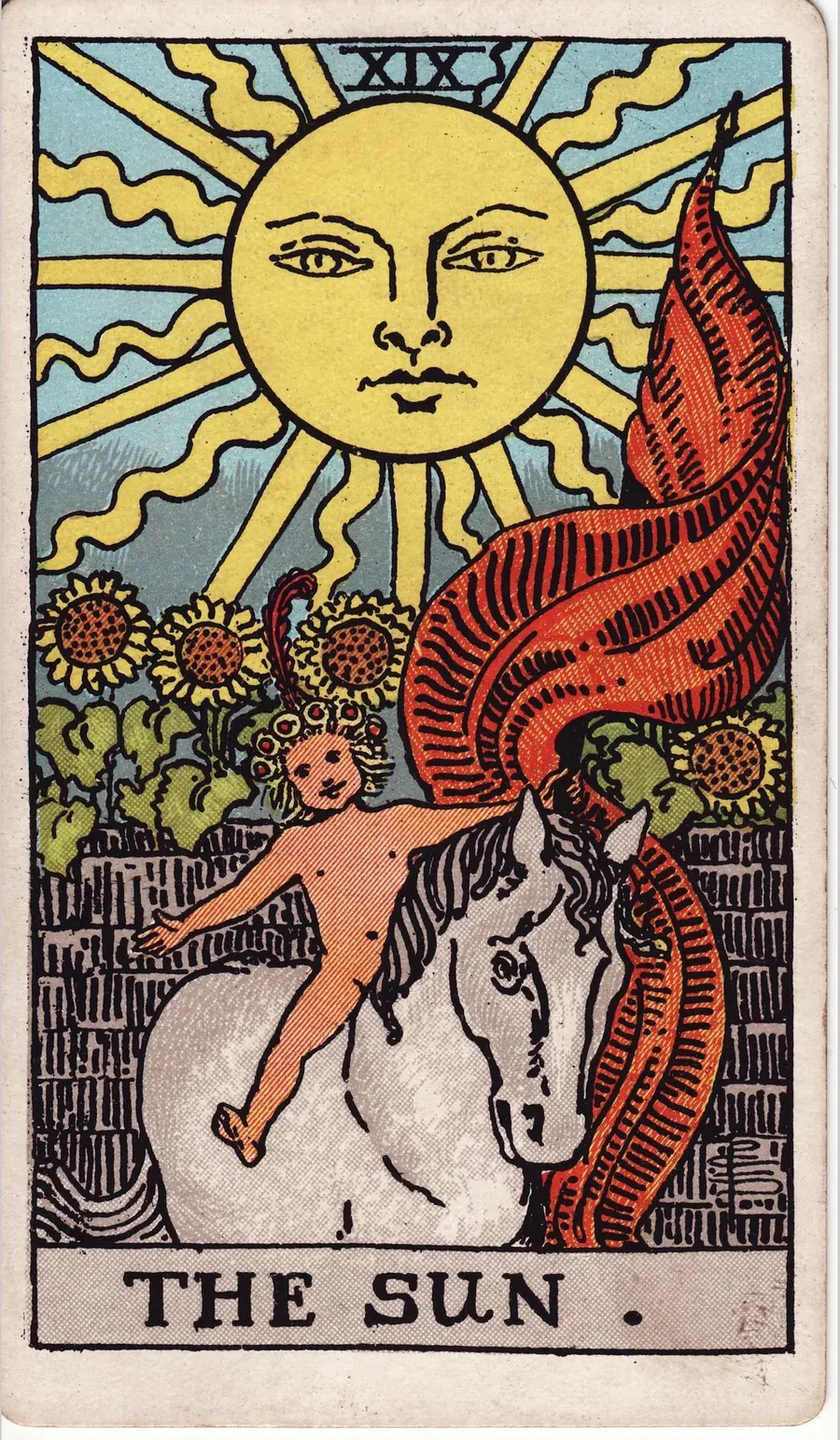
The Sun, Pamela Colman Smith, designed with A. E. Waite, published by William Rider and Son, London, 1909. Printed card. Image: Wikimedia Commons, RWS_Tarot_19_Sun.jpg. Public domain. No museum object number: this is a scan of a printed deck.

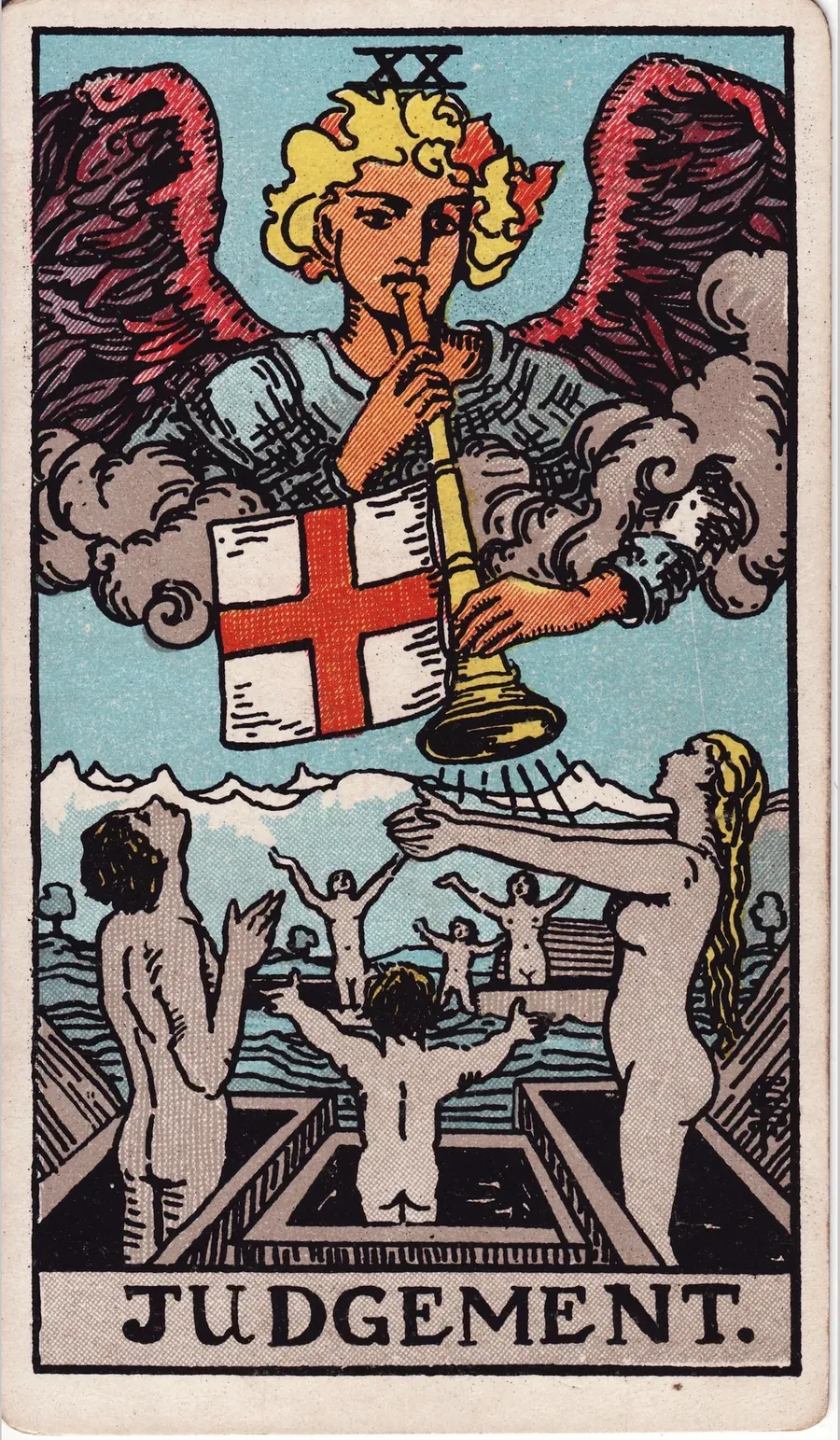
Judgement, Pamela Colman Smith, designed with A. E. Waite, published by William Rider and Son, London, 1909. Printed card. Image: Wikimedia Commons, RWS_Tarot_20_Judgement.jpg. Public domain. No museum object number: this is a scan of a printed deck.

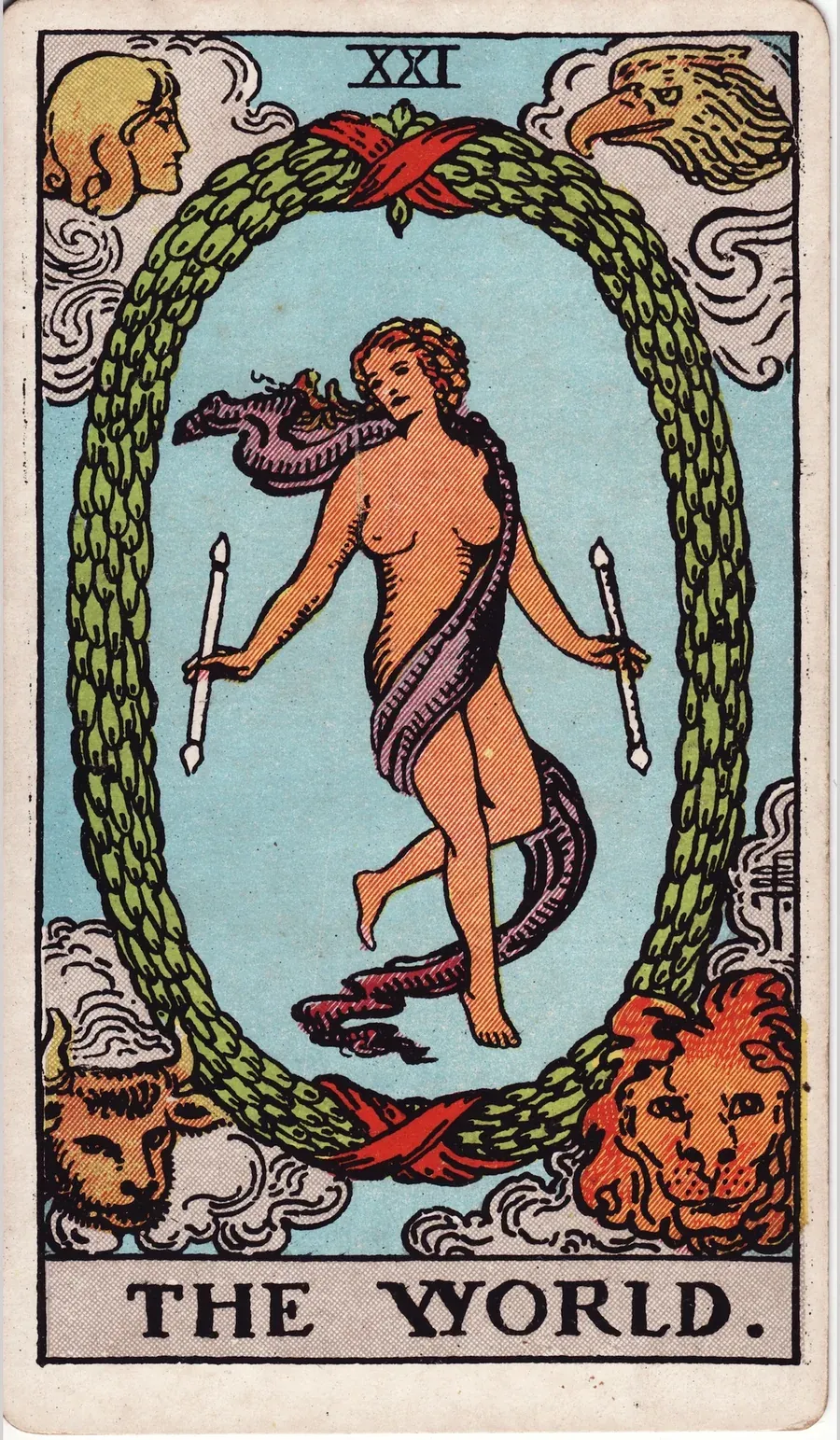
The World, Pamela Colman Smith, designed with A. E. Waite, published by William Rider and Son, London, 1909. Printed card. Image: Wikimedia Commons, RWS_Tarot_21_World.jpg. Public domain. No museum object number: this is a scan of a printed deck.

What to look for across the deck
Once you have looked at a few cards, compare them. Notice how often figures stand between two pillars (the High Priestess, the Hierophant, Justice) or two towers (Death, the Moon). Notice the yellow skies that open many cards, and the gray ones that close in on others. Find the same mountains returning in the background.
How to reuse these images
The scans in this gallery are shared on Wikimedia Commons as public domain, and the 1909 drawings are public domain in many countries, including the EU and the UK. Some later recolored editions of the deck are still under copyright, so use scans of the early printing. I recommend keeping the caption with the image: the artist, the date, the museum and the object number. Before you reuse anything, open the source page from the caption and check the licence there yourself, because policies can change. My page on museums and open access explains how to check an image and where to find thousands more.
The esoteric angle
Historical The symbol program came from Waite, who drew on the Hermetic Order of the Golden Dawn, where he and Smith met. He explained much of it in his book The Pictorial Key to the Tarot, published in 1910.
Later tradition The letters, pillars and signs in these cards mix Hebrew letters, astrology, alchemy and Christian imagery, the typical blend of late nineteenth century occultism.
Modern For modern readers, the pictures themselves are often the best way in. Many people learn this deck by describing what they see before they ever read a meaning, which is exactly what an art historian does. You can learn more in my Major Arcana guide.
Try it yourself
Here are the worksheet questions I use for every close reading. Copy them into a notebook, open the image as large as your screen allows, and give yourself twenty minutes. Fill them in order and do not skip ahead to meaning.
- Basic information. Write down the title, artist, date, material, size and collection number from the At a glance box. Size matters: picture the real object on a wall or in your hand.
- First look, two minutes. Before you read anything else, write three words for your first reaction.
- Description. List at least fifteen things you can see, without explaining any of them. People, animals, objects, places, colors, marks, writing.
- What is going on here? Then ask: what do I see that makes me say that? What more can I find?
- Formal analysis. Where are the lightest and darkest areas? Where do the lines lead your eye? Is the space deep or shallow? What is the focal point?
- Meaning in three levels. What is shown (a woman, a dog, an old man)? What story or theme do those things stand for? What does the work tell you about the time and place that made it?
- Evidence check. Mark each statement you wrote with E for evidence you can see or document, I for an interpretation, and P for your personal response. For the tarot, add one question: what is the figure doing with their hands, and what would the card mean if you only had that gesture to go on?
If you want the full method with a worked example, my page on how to look at a painting walks through it step by step.
Questions
Who drew the Rider-Waite tarot cards?
Pamela Colman Smith drew all 78 cards in 1909, working to a program designed by A. E. Waite. The deck was published by William Rider and Son in London.
Are the 1909 tarot images in the public domain?
The original 1909 artwork is public domain in many countries, including the EU and the UK, because Smith died in 1951, more than seventy years ago. Some later recolored editions are still under copyright, so I use scans of the early printing from Wikimedia Commons.
Why do some cards in this gallery show nude figures?
Six cards, The Lovers, The Devil, The Star, The Sun, Judgement and The World, include nude figures, as Pamela Colman Smith drew them in 1909. I show the original public-domain cards uncropped. Apart from these historical cards, I keep the site free of nudity.
Get the free Mini-Grimoire
A short printable starter guide to tarot and everyday witchcraft, plus my newsletter. Unsubscribe any time.
Opens Substack in a new tab to confirm. More about the newsletter · Privacy