


How to read the labels Historical what the old sources say. Later tradition what later writers added. Modern modern practice and my own notes.
| Number | 6 of 72 |
|---|---|
| Rank | Duke |
| Legions | 10 |
| Office (1904) | Is "a good Familiar." |
| Other spellings | Valefar, Malaphar, Malephar (Weyer, Scot) |
Valefor is spirit 6 of the 72 in the Ars Goetia, the first book of the Lesser Key of Solomon. The 1904 edition by S. L. MacGregor Mathers and Aleister Crowley calls him a duke ruling 10 legions, and the first office it gives him is this: Valefor is “a good Familiar.”
His short entry is one of the bleakest in the catalog once Weyer’s version is read beside it. Each part below carries a label for its layer, explained in how to read a spirit page.
At a glance
| Fact | In the entry |
|---|---|
| Number | 6 of 72, in the 1904 order. |
| Name and spellings | Valefor in 1904; other spellings: Valefar, Malaphar, Malephar (Weyer, Scot). |
| Rank and legions | Duke, 10 legions. |
| Metal of his rank (Observations) | Copper. |
| Hours for dukes (Observations) | “From Sunrise till Noonday in Clear Weather.” |
| In Weyer’s catalog (1577) | Yes, as the source comparison below shows. |
The 1904 entry
Historical The full entry from the 1904 edition, with footnote numbers and the dash after the heading left out and the heading set in ordinary type:
Valefor. The Sixth Spirit is Valefor. He is a mighty Duke, and appeareth in the shape of a Lion with an Ass’s Head, bellowing. He is a good Familiar, but tempteth them he is a familiar of to steal. He governeth 10 Legions of Spirits. His Seal is this, which is to be worn, whether thou wilt have him for a Familiar, or not.
The 1904 entry has only three details: a lion with an ass’s head, “bellowing”; the office of being “a good Familiar” who tempts his companions to steal; and ten legions. The last line, that his seal is to be worn “whether thou wilt have him for a Familiar, or not”, is unusual. It suggests that a familiar was something one might receive whether wanted or not, and that the seal protects in either case.
Appearance
Historical Valefor appears “in the shape of a Lion with an Ass’s Head, bellowing.”
Offices in the Ars Goetia
Historical The offices of Valefor, in the order the 1904 text gives them:
- Is “a good Familiar.”
- Tempts those he is familiar with to steal.
He governs 10 legions. The text says his seal is to be worn “whether thou wilt have him for a Familiar, or not.”
Source comparison: Weyer and Scot
Historical Weyer’s Valefar, “alias Malephar,” is “a strong duke, comming foorth in the shape of a lion, and the head of a theefe.” The Goetia has “an Ass’s Head” instead.
Weyer adds a grim line: he is “verie familiar with them to whom he maketh himselfe acquainted, till he hath brought them to the gallowes.” The Goetia softens this to tempting them to steal. Both give 10 legions.
Historical Weyer’s Latin says he is familiar with his own “donec laqueo suspendantur”, until they are hanged with the noose. His head is “capite latronis”, the head of a robber, which Scot rendered as “the head of a theefe”. The Goetia’s “Ass’s Head” may be a misreading somewhere in the chain of copies (a guess), and its “tempteth them to steal” quietly drops the gallows. (About Weyer and Scot.)
Name and etymology
Historical Weyer gives Valefar alias Malaphar; Scot has Malephar. The variants Valefor, Valefar and Malaphar have no agreed meaning.
Seal and images
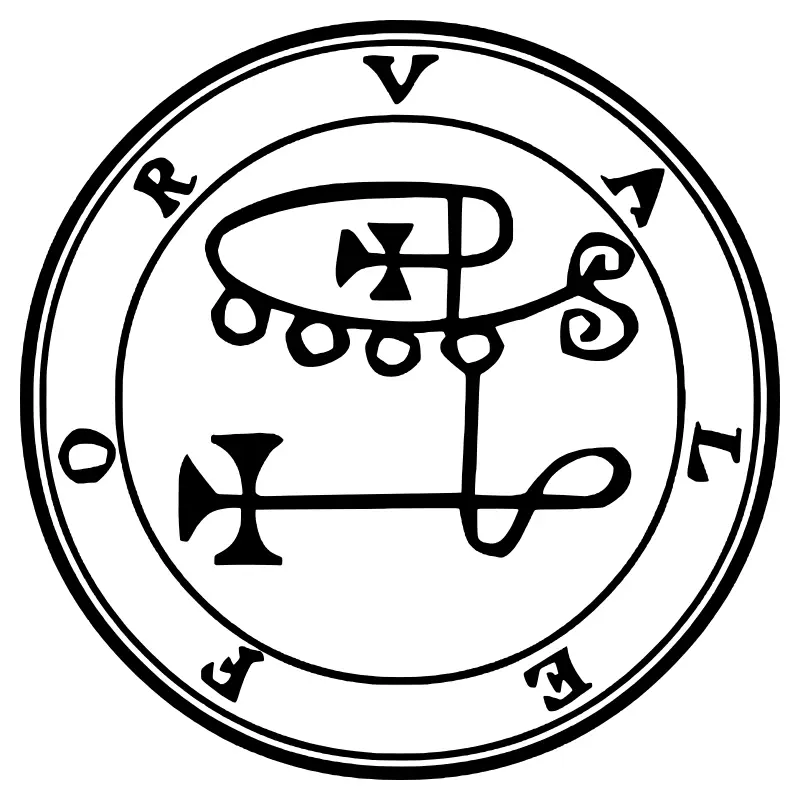
Historical The seal above is Valefor’s as printed in 1904, and by the rules of the Observations it would be made in copper, the metal of his rank. Why seals were worn, why editions draw them differently and how to study one are explained in seals, circle and triangle.
Later tradition and modern practice
Later tradition The change from “the head of a thief” to “an Ass’s Head” may be a copying or translation error.
Modern Modern writers sometimes read Valefor as a spirit of cunning or of those who live on the edges of the law, and some present him as a protector of possessions. These are modern interpretations, and the last reverses the text.
Lore about Valefor’s personality, likes or chosen people is modern, not grimoire material; modern approaches explains where such claims come from.
Beginner’s quick reference
| Item | What the sources say |
|---|---|
| Rank metal and hours (Goetia) | Duke: copper; sunrise to noon, in clear weather. |
| Planet (later tradition: Golden Dawn and Crowley’s 777) | Venus. |
| Decan and day or night spirit (later tradition: 777) | Taurus, third decan (20 to 30 degrees); day spirit. 777 decan incense: cassia. Tarot card of the decan: Seven of Pentacles. |
| Commonly reported color, incense, and plant (modern UPG; sources copy each other) | Color green; incense sandalwood; plant dandelion. |
| Associated symbols | Goetia image: a lion with a donkey’s head, bellowing. 777 Magical Image: the same image. Modern Demonolatry/UPG: the seal, used as an altar image. |
| Associated offerings | Modern practice, not in the Goetia manuscripts: most often listed, sandalwood and dandelion. |
Before you burn or handle anything listed for Valefor, read incense, plants and offerings.
Practical notes
Valefor’s only offices concern familiarity and theft, and Weyer says he leads his companions to the gallows. The beginner criteria would not suggest this spirit for a first contact. I do not teach any practice involving theft. Read his entry as a reminder that the Goetia’s “familiars” were not always presented as friends.
In the directory, Valefor is not among the 30 spirits that fit the beginner criteria.
Try this: one question to study
Read the Latin “donec laqueo suspendantur” and decide for yourself what a “good Familiar” means in this entry.
What next
To compare Valefor with other spirits of his rank, read Barbatos and Agares.
Later tradition In the Golden Dawn scheme of the decans, Valefor is the day spirit of the third decan of Taurus, which belongs to the Seven of Pentacles; the night spirit of the same decan is Vepar (spirit 42).
Common questions
Is Valefor a good spirit for beginners?
Not as a first choice. He does not meet all three beginner criteria I use: not a king, at least one teaching office, and no central harm, deception or compulsion. His entry is still worth reading as history.
What does Valefor do in the Ars Goetia?
The 1904 text calls him a duke ruling 10 legions. Its first office for him is this: Valefor is "a good Familiar." The entry lists 2 offices in all.
Does looking at Valefor's seal call him?
No. Reading a name or looking at a seal does not call a spirit. The seal is a drawing from a 1904 book, and even the grimoire itself required long rituals for its own purposes.
Get the free Mini-Grimoire
A short printable starter guide to tarot and everyday witchcraft, plus my newsletter. Unsubscribe any time.
Opens Substack in a new tab to confirm. More about the newsletter · Privacy