


| Arcana | Minor Arcana: Swords |
|---|---|
| Image | RWS 1909 (PD) |
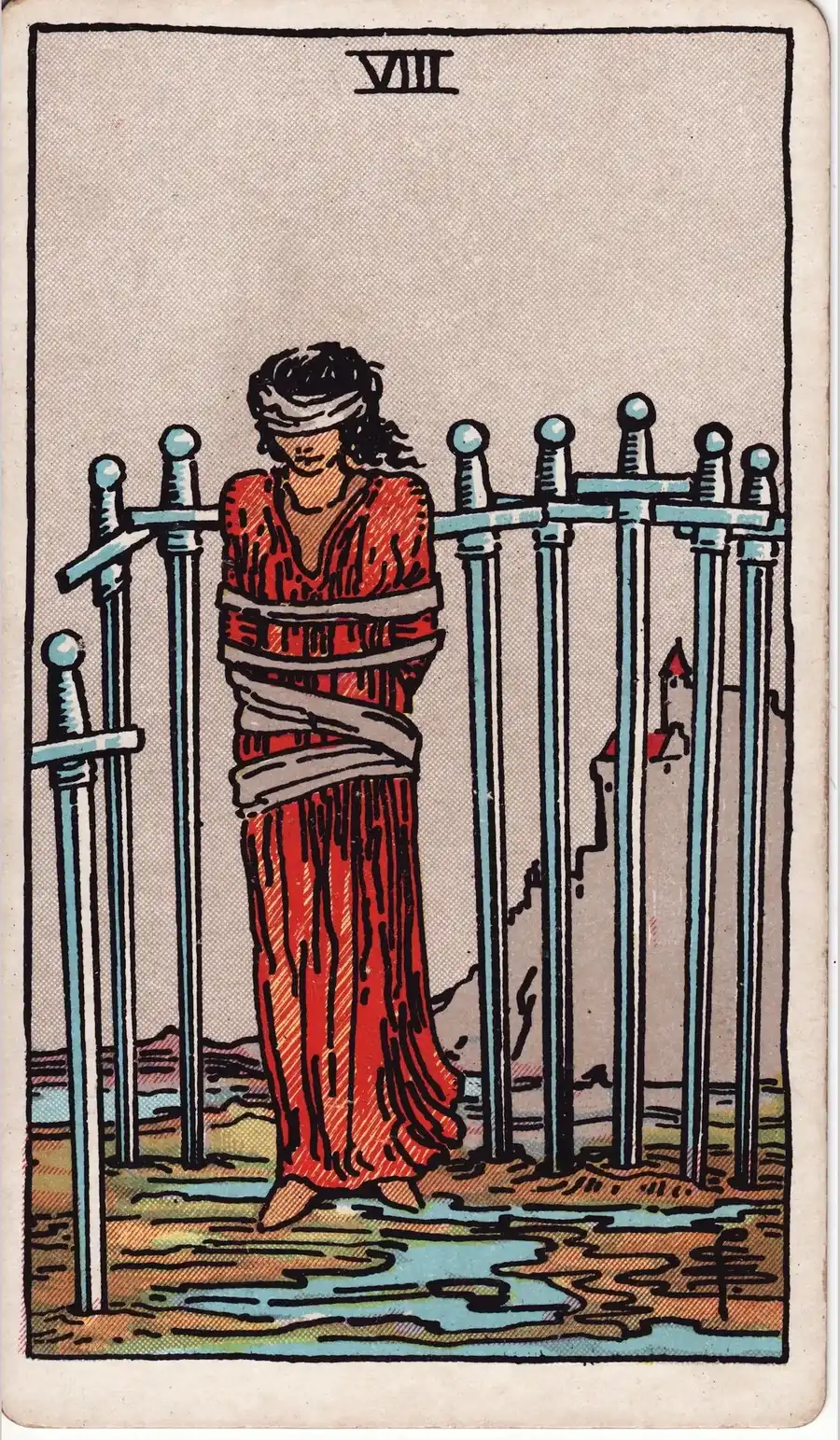
The Eight of Swords shows a woman blindfolded and loosely bound, standing among eight swords stuck in the muddy ground. A castle stands on the cliff behind her. The swords do not fully surround her, and her feet are free.
It is a card of restriction, fear and the way out that is closer than it looks. Here is what the Eight of Swords means upright and reversed, the symbols in the 1909 card and a spread for feeling stuck.
Here is the Eight of Swords at a glance.
| At a glance | This card |
|---|---|
| Upright keywords | restriction, imprisonment, fear |
| Reversed keywords | release, finding solutions, freedom |
| Number | 8 in the suit of Swords |
| Golden Dawn title | Lord of Shortened Force Later tradition |
| Astrology | Jupiter in Gemini, first decan (0° to 10° Gemini) Later tradition |
| Tree of Life | Hod (8), Splendour Later tradition |
| Suit and element | Swords, Air Later tradition |
| Yes or no | No Modern |
The Golden Dawn named the Eight of Swords the Lord of Shortened Force and gave it Jupiter in Gemini, the first decan of the sign, on Hod. Jupiter is weak in Gemini by traditional astrology, so expansion is cut short. The title fits Smith’s bound woman: her force is shortened, but not taken away.
Later tradition The Golden Dawn also gave each decan two of the 72 Goetic spirits, one for the day and one for the night. For the first decan of Gemini, and so for the Eight of Swords, they are Amon (spirit 7, day) and Sabnock (spirit 43, night). Their pages read the old entries as history; see the spirit directory for all 72.
The card: what Pamela Colman Smith drew
Waite wrote: “A woman, bound and hoodwinked, with the swords of the card about her. Yet it is rather a card of temporary durance than of irretrievable bondage.” Durance means confinement. Waite himself says it does not last.
The blindfold and bindings. She cannot see and her arms are tied, but the bindings are loose and her legs are free. Part of the trap is real, and part is what she believes.
The open side. The swords stand around her, but there is a gap. If she could see, she could walk out.
The castle. The castle on the cliff may be where she came from or where she belongs. Safety is not far away.
Upright meaning
Upright, the Eight of Swords is feeling trapped. A woman is blindfolded and loosely bound, standing among eight swords stuck in the mud. A castle stands behind her. But the swords do not fully surround her, and her feet are free. The card speaks of restriction, fear and the sense of having no options, much of which comes from the mind.
It appears when you feel stuck in a situation, powerless or paralyzed by fear. The card gently points out that the prison is not as solid as it seems. She could walk away if she could see.
Look for one small step that is possible. The first step out of the swords is usually smaller than you think.
Reversed meaning
Reversed, the Eight of Swords shows release. The blindfold slips, the bindings loosen and she walks out. It can mean finding a solution, overcoming fear or seeing a situation clearly for the first time.
Ask what belief is keeping you stuck. Once you name it, it often loses its power.
Reversed, the Eight may also show that someone else helped loosen the bindings, a friend, a therapist or a piece of information. Accepting help does not make the escape less yours. You still have to walk out of the swords on your own feet.
In love, work and spirituality
In love. Upright: Feeling trapped in a relationship, or limited by fear. Reversed: Breaking free from a restrictive pattern.
At work. Upright: Feeling stuck in a job, or limited by fear of change. Reversed: Finding a way out, or seeing new options.
With money. Upright: Feeling trapped by money worries. Reversed: Finding a practical solution.
In spiritual practice. Upright: Recognizing limiting beliefs. Reversed: Freedom from old fears.
As feelings. Stuck, anxious or unsure how to act on their feelings.
As a person. Someone who feels powerless or trapped, often more by fear than by facts.
As advice. Take off the blindfold and take one small step.
Reading the Eight of Swords: positions and yes or no
In the past position: Fear or a limiting situation held you back. In the present position: You may be more free than you feel. Test the bindings.
In the future position: A sense of being stuck may come, and it will pass. As advice: Take one small step out of the circle.
In modern yes or no readings, the Eight of Swords leans no. Fear blocks the way for now.
What the Eight means, and the history behind the card
Eight is movement after testing, but in Swords the movement is blocked by the mind. The Golden Dawn’s Shortened Force names the limit precisely.
Here is how the Eight looks across the four suits:
- Eight of Wands: swift action, movement, progress
- Eight of Cups: walking away, letting go, seeking meaning
- Eight of Swords (this card): restriction, imprisonment, fear
- Eight of Pentacles: diligence, craftsmanship, skill development
Waite wrote that this is rather a card of temporary durance than of irretrievable bondage, and the picture agrees. The swords stand around the woman but do not close her in, her feet are free, and the ropes are loosely tied.
A castle on a cliff stands behind her, so help and home are not far away. Readers often use this card to ask a simple question: which part of this trap is real, and which part is fear telling me there is no way out?
When A. E. Waite published The Pictorial Key to the Tarot in 1910, he listed these divinatory meanings for the Eight of Swords: “Bad news, violent chagrin, crisis, censure, power in trammels, conflict, calumny; also sickness.” Reversed, he gave: “Disquiet, difficulty, opposition, accident, treachery; what is unforeseen; fatality.”
Common questions
Is the Eight of Swords a yes or no card? It leans no, because fear is in the way. Reversed, it points to freedom.
What does the Eight of Swords mean in love? Feeling trapped or held back by fear. Reversed, release.
Is the Eight of Swords about anxiety? Often. It shows how fear and thoughts can trap us. If anxiety affects your daily life, talk to a health professional as well.
Try this
Try this small spread for the Eight of Swords. Use it when you feel trapped.
| Card | Question | What it shows |
|---|---|---|
| 1 | What binds me? | The fear or limit I feel. |
| 2 | What is real? | The actual limit, honestly. |
| 3 | Where is the way out? | The gap I can walk through. |
Affirmation: I separate real limits from the stories that keep me stuck.
Reversed affirmation: I take the next freeing step I can safely make.
If you keep a tarot journal, take one of these questions to it: Which of my limits are real, and which are fears? Who could help me see the gap? What one small step would test the binding?
What next
Cards that sit close to this one are Two of Swords (another blindfolded figure, stuck in a choice), The Devil (the Major Arcana card of chains that can be lifted) and Nine of Swords (the worry that follows if the fear grows).
The Eight of Swords is part of the lesson Swords in my free Tarot for Beginners course. To see the whole suit on one page, go to the suit of Swords. To keep walking the suit, read the card before it, Seven of Swords or the card after it, Nine of Swords, or go back to all the card meanings.
For the suits and numbers in one place, see The Minor Arcana: suits and numbers made simple. For every card with keywords, affirmations and examples, see my book The Novice’s Guide to Tarot. If you would like a printable cheat sheet for all 78 cards, my 45-page Tarot Workbook is on Etsy.
Sources
- A. E. Waite, The Pictorial Key to the Tarot (London: Rider, 1910), Part III, sections 1 and 2.
- Pamela Colman Smith and A. E. Waite, the Rider-Waite-Smith tarot (London: Rider, 1909).
- Nicolas Conver, Tarot de Marseille (Marseille, 1760).
- Lauri Mukkala, The Novice’s Guide to Tarot, entry for the Eight of Swords.
- Aleister Crowley, 777 (London: Walter Scott, 1909), columns of the decans, the Minor Arcana and the court cards.
- Israel Regardie, ed., The Golden Dawn (Chicago: Aries Press, 1937 to 1940), “Book T”, titles and attributions of the small cards and the court.
All 78 cards
Major Arcana
- The Fool
- The Magician
- The High Priestess
- The Empress
- The Emperor
- The Hierophant
- The Lovers
- The Chariot
- Strength
- The Hermit
- Wheel of Fortune
- Justice
- The Hanged Man
- Death
- Temperance
- The Devil
- The Tower
- The Star
- The Moon
- The Sun
- Judgement
- The World
Wands
- Ace of Wands
- Two of Wands
- Three of Wands
- Four of Wands
- Five of Wands
- Six of Wands
- Seven of Wands
- Eight of Wands
- Nine of Wands
- Ten of Wands
- Page of Wands
- Knight of Wands
- Queen of Wands
- King of Wands
Cups
- Ace of Cups
- Two of Cups
- Three of Cups
- Four of Cups
- Five of Cups
- Six of Cups
- Seven of Cups
- Eight of Cups
- Nine of Cups
- Ten of Cups
- Page of Cups
- Knight of Cups
- Queen of Cups
- King of Cups
Swords
- Ace of Swords
- Two of Swords
- Three of Swords
- Four of Swords
- Five of Swords
- Six of Swords
- Seven of Swords
- Eight of Swords
- Nine of Swords
- Ten of Swords
- Page of Swords
- Knight of Swords
- Queen of Swords
- King of Swords
Pentacles
Get the free Mini-Grimoire
A short printable starter guide to tarot and everyday witchcraft, plus my newsletter. Unsubscribe any time.
Opens Substack in a new tab to confirm. More about the newsletter · Privacy