


How to read the labels Historical what the old sources say. Later tradition what later writers added. Modern modern practice and my own notes.
| Number | 9 of 72 |
|---|---|
| Rank | King |
| Legions | 200 |
| Office (1904) | Teaches all arts and sciences and other secret things. |
| Other spellings | Paymon, Paimonia (as a king of the quarters, in some texts) |
Paimon is spirit 9 of the 72 in the Ars Goetia, the first book of the Lesser Key of Solomon. The 1904 edition by S. L. MacGregor Mathers and Aleister Crowley calls him a king ruling 200 legions, and the first office it gives him is this: Paimon teaches all arts and sciences and other secret things.
His entry is one of the longest in the catalog and one of the few to give detailed instructions for receiving a spirit. Each part below carries a label for its layer, explained in how to read a spirit page.
At a glance
| Fact | In the entry |
|---|---|
| Number | 9 of 72, in the 1904 order. |
| Name and spellings | Paimon in 1904; other spellings: Paymon, Paimonia (as a king of the quarters, in some texts). |
| Rank and legions | King, 200 legions. |
| Direction | The text places him in the West. |
| Metal of his rank (Observations) | Gold. |
| Hours for kings (Observations) | “From 9 till 12 o’clock at Noon, and from 3 till Sunset.” |
| In Weyer’s catalog (1577) | Yes, as the source comparison below shows. |
The 1904 entry
Historical The full entry from the 1904 edition, with footnote numbers and the dash after the heading left out and the heading set in ordinary type:
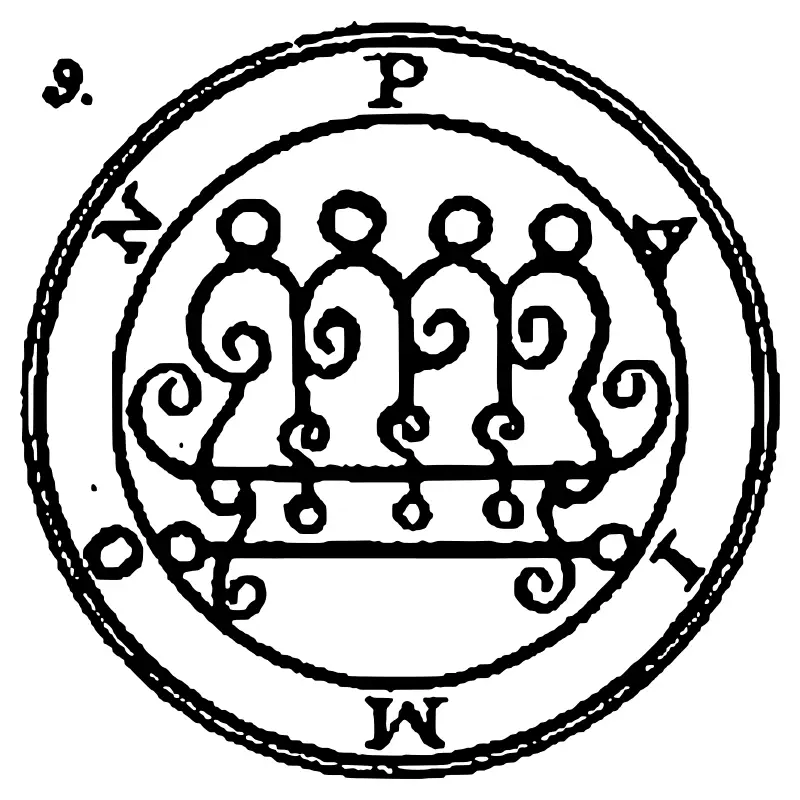
Paimon. The Ninth Spirit in this Order is Paimon, a Great King, and very obedient unto LUCIFER. He appeareth in the form of a Man sitting upon a Dromedary with a Crown most glorious upon his head. There goeth before him also an Host of Spirits, like Men with Trumpets and well sounding Cymbals, and all other sorts of Musical Instruments. He hath a great Voice, and roareth at his first coming, and his speech is such that the Magician cannot well understand unless he can compel him. This Spirit can teach all Arts and Sciences, and other secret things. He can discover unto thee what the Earth is, and what holdeth it up in the Waters; and what Mind is, and where it is; or any other thing thou mayest desire to know. He giveth Dignity, and confirmeth the same. He bindeth or maketh any man subject unto the Magician if he so desire it. He giveth good Familiars, and such as can teach all Arts. He is to be observed towards the West. He is of the Order of Dominations. He hath under him 200 Legions of Spirits, and part of them are of the Order of Angels, and the other part of Potentates. Now if thou callest this Spirit Paimon alone, thou must make him some offering; and there will attend him two Kings called LABAL and ABALIM, and also other Spirits who be of the Order of Potentates in his Host, and 25 Legions. And those Spirits which be subject unto them are not always with them unless the Magician do compel them. His Character is this which must be worn as a Lamen before thee, etc.
Paimon is “very obedient unto LUCIFER”. He rides a dromedary under a glorious crown, preceded by spirits playing trumpets and cymbals, and roars at his arrival. His teaching office is the broadest in the book: “all Arts and Sciences”, what the Earth is and “what holdeth it up in the Waters”, what mind is. He also gives dignities, binds people to the magician and gives familiars. The entry ends with practical rules: face west, make an offering if he is called alone, and expect two attendant kings, Labal and Abalim.
Appearance
Historical Paimon is “a Great King, and very obedient unto Lucifer.” He appears “in the form of a Man sitting upon a Dromedary with a Crown most glorious upon his head.”
Before him goes “an Host of Spirits, like Men with Trumpets and well sounding Cymbals, and all other sorts of Musical Instruments.” He “roareth at his first coming,” and his speech is hard to understand “unless he can compel him.”
Offices in the Ars Goetia
Historical The offices of Paimon, in the order the 1904 text gives them:
- Teaches all arts and sciences and other secret things.
- Can reveal “what the Earth is, and what holdeth it up in the Waters; and what Mind is, and where it is.”
- Gives dignity and confirms it.
- Binds any man and makes him subject to the magician.
- Gives good familiars who can teach all arts.
He is “of the Order of Dominations” and has 200 legions, part angels and part Potentates. If called alone, “thou must make him some offering,” and two kings, Labal and Abalim, attend him.
Source comparison: Weyer and Scot
Historical Scot’s translation of Weyer gives a much longer entry. It adds that Paimon has “an effeminate countenance,” that the magician should not be dismayed if he cannot understand him, and that he will explain “what is Abyssus, or where the wind is.”
Weyer also gives the binding of resisters and the good familiars. Scot tells the magician to face northwest, “bicause there is his house”; Weyer’s Latin says north; the 1904 text says west. Weyer also gives Paimon 200 legions and 25 more in his train.
Historical Weyer’s Latin adds that Paimon has a “vultu foemineo”, a woman’s face, which Scot rendered “an effeminate countenance”. The Latin direction is “Aquilonem versus”, toward the north, while Scot wrote northwest and the Goetia west. The attendant kings are “Bebal et Abalam” in Weyer. Weyer also explains Lucifer through Ezekiel 28, “every precious stone was thy covering”. (About Weyer and Scot.)
Name and etymology
Historical No etymology for Paimon or Paymon is agreed. A suggested link to Hebrew pa’amon, “bell”, fits the music in his entry, but it is a modern guess.
Seal and images
Historical The seal above is Paimon’s as printed in 1904, and by the rules of the Observations it would be made in gold, the metal of his rank. Why seals were worn, why editions draw them differently and how to study one are explained in seals, circle and triangle.
Later tradition Le Breton’s 1863 plate shows a slight, crowned rider on a camel, following the dromedary of the text.
Later tradition and modern practice
Later tradition In some grimoires Paimon is one of the four kings of the quarters, ruling the West or another direction.
Modern Paimon is one of the most famous Goetic spirits today, largely because of the horror film Hereditary (2018), in which a cult seeks to give him a human host.
The film’s Paimon is a fictional creation drawing on the Goetia. Paimon also appears as a companion character in the video game Genshin Impact (2020), with no link to the Goetia beyond the name. Modern devotional practitioners often describe him as a teacher.
Lore about Paimon’s personality, likes or chosen people is modern, not grimoire material; modern approaches explains where such claims come from.
Beginner’s quick reference
| Item | What the sources say |
|---|---|
| Rank metal and hours (Goetia) | King: gold; 9 a.m. to noon and 3 p.m. to sunset. |
| Planet (later tradition: Golden Dawn and Crowley’s 777) | Sun. |
| Decan and day or night spirit (later tradition: 777) | Gemini, third decan (20 to 30 degrees); day spirit. 777 decan incense: cypress. Tarot card of the decan: Ten of Swords. |
| Commonly reported color, incense, and plant (modern UPG; sources copy each other) | Color yellow; incense frankincense; plant bindweed. |
| Associated symbols | Goetia image: a crowned man on a dromedary, led by musicians with trumpets and cymbals; a roaring voice. 777 Magical Image: the same image. Le Breton engraving (1863): a crowned rider on a dromedary. Modern Demonolatry/UPG: the seal, used as an altar image. |
| Associated offerings | The Goetia says that if Paimon is called alone, “thou must make him some offering,” but does not say what. Modern practice, not in the Goetia manuscripts: most often listed, frankincense, then gum arabic and balm of Gilead. |
Before you burn or handle anything listed for Paimon, read incense, plants and offerings.
Practical notes
Paimon is a king with 200 legions and a special requirement for offerings. His teaching office is broad, but the text treats him as among the most powerful and most demanding spirits, and his offices include subjecting others to the magician’s will.
This spirit falls outside the beginner criteria. His film fame is a reason for caution, not a reason to start with him.
In the directory, Paimon is not among the 30 spirits that fit the beginner criteria.
Try this: one question to study
List every practical instruction in Paimon’s entry and compare the direction given in Weyer’s Latin, Scot and the 1904 text.
What next
To compare Paimon with other spirits of his rank, read Beleth and Bael.
Later tradition In the Golden Dawn scheme of the decans, Paimon is the day spirit of the third decan of Gemini, which belongs to the Ten of Swords; the night spirit of the same decan is Vine (spirit 45).
Common questions
Is Paimon a good spirit for beginners?
Not as a first choice. He does not meet all three beginner criteria I use: not a king, at least one teaching office, and no central harm, deception or compulsion. His entry is still worth reading as history.
What does Paimon do in the Ars Goetia?
The 1904 text calls him a king ruling 200 legions. Its first office for him is this: Paimon teaches all arts and sciences and other secret things. The entry lists 5 offices in all.
Does looking at Paimon's seal call him?
No. Reading a name or looking at a seal does not call a spirit. The seal is a drawing from a 1904 book, and even the grimoire itself required long rituals for its own purposes.
Get the free Mini-Grimoire
A short printable starter guide to tarot and everyday witchcraft, plus my newsletter. Unsubscribe any time.
Opens Substack in a new tab to confirm. More about the newsletter · Privacy