


How to read the labels Historical what the old sources say. Later tradition what later writers added. Modern modern practice and my own notes.
| Number | 2 of 72 |
|---|---|
| Rank | Duke |
| Legions | 31 |
| Office (1904) | Makes those who stand still run, and brings back runaways. |
| Other spellings | Agreas, Agarus |
Spirit 2 of the Ars Goetia is Agares. The 1904 edition by S. L. MacGregor Mathers and Aleister Crowley calls him a duke ruling 31 legions, and the first office it gives him is this: Agares makes those who stand still run, and brings back runaways.
He is the first of the dukes and the first spirit in the list with a teaching office, the gift of languages. Each part below carries a label for its layer, explained in how to read a spirit page.
At a glance
| Fact | In the entry |
|---|---|
| Number | 2 of 72, in the 1904 order. |
| Name and spellings | Agares in 1904; other spellings: Agreas, Agarus. |
| Rank and legions | Duke, 31 legions. |
| Direction | The text places him in the East. |
| Metal of his rank (Observations) | Copper. |
| Hours for dukes (Observations) | “From Sunrise till Noonday in Clear Weather.” |
| In Weyer’s catalog (1577) | Yes, as the source comparison below shows. |
The 1904 entry
Historical The full entry from the 1904 edition, with footnote numbers and the dash after the heading left out and the heading set in ordinary type:
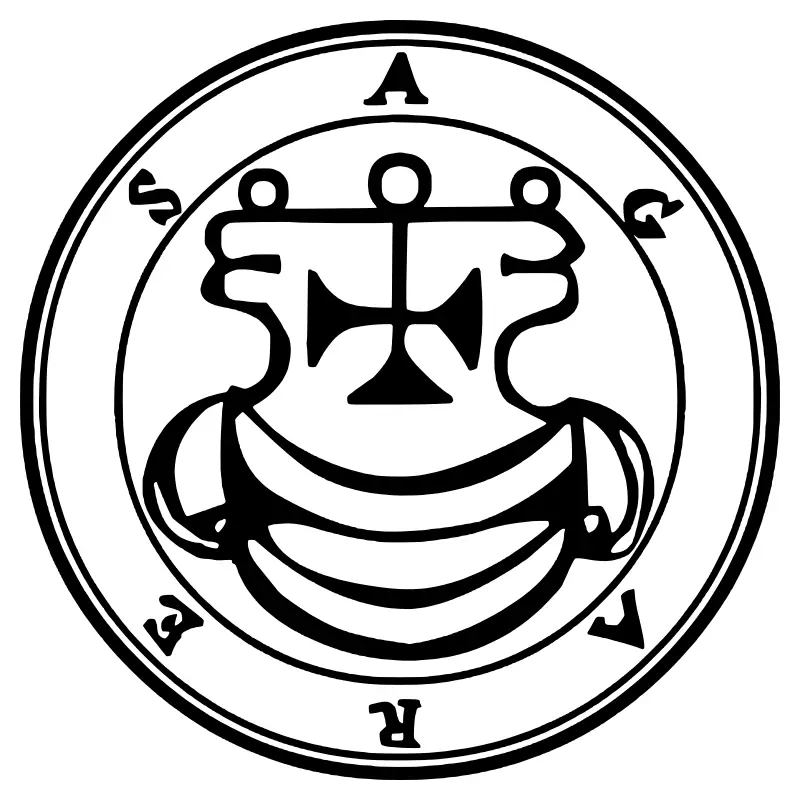
Agares. The Second Spirit is a Duke called Agreas, or Agares. He is under the Power of the East, and cometh up in the form of an old fair Man, riding upon a Crocodile, carrying a Goshawk upon his fist, and yet mild in appearance. He maketh them to run that stand still, and bringeth back runaways. He teaches all Languages or Tongues presently. He hath power also to destroy Dignities both Spiritual and Temporal, and causeth Earthquakes. He was of the Order of Virtues. He hath under his government 31 Legions of Spirits. And this is his Seal or Character which thou shalt wear as a Lamen before thee.
Agares is introduced under two names, “Agreas, or Agares”, a sign that Mathers’s manuscripts did not agree. The entry mixes mild and violent offices: the image is “mild in appearance”, and the first office, making those who stand still run and bringing back runaways, reads like a charm for fugitives and servants. Then come the gift of “all Languages or Tongues presently” (at once), the destruction of “Dignities both Spiritual and Temporal” and earthquakes. “He was of the Order of Virtues” places him among the fallen angels, using the names of the angelic choirs.
Appearance
Historical Agares comes up “in the form of an old fair Man, riding upon a Crocodile, carrying a Goshawk upon his fist, and yet mild in appearance.”
Offices in the Ars Goetia
Historical The offices of Agares, in the order the 1904 text gives them:
- Makes those who stand still run, and brings back runaways.
- Teaches all languages “presently,” that is, at once.
- Has power to destroy dignities, both spiritual and temporal. Reported as history; not taught here.
- Causes earthquakes. Reported as history; not taught here.
He “was of the Order of Virtues” and rules 31 legions. He is “under the Power of the East.”
Source comparison: Weyer and Scot
Historical Scot’s Weyer calls Agares “the first duke under the power of the east” and describes him almost word for word as the Goetia does: “a faire old man, riding upon a crocodile, and carrieng a hawke on his fist.”
The wording follows Scot’s English closely here, as it does throughout the catalog. Scot’s mistakes give the clearest evidence: where he turned Weyer’s “thirty” into “three” for Focalor, some Goetia manuscripts copy his error. Weyer also gives the order of Virtues and 31 legions.
Historical Weyer’s Latin has a striking detail the English smooths over: where the Goetia says he “causeth Earthquakes”, the Latin says he makes “the spirits of the earth dance” (tripudiare facit spiritus terrae). Scot translated this as “hee maketh earthquakes”, and the Goetia copied him. Weyer also calls him “Dux primus sub potestate Orientis”, the first duke under the power of the East. (About Weyer and Scot.)
Name and etymology
Historical No agreed etymology exists for Agares or Agreas. The double form in the 1904 heading probably records a copying variant, not two different spirits.
Seal and images
Historical The seal above is Agares’s as printed in 1904, and by the rules of the Observations it would be made in copper, the metal of his rank. Why seals were worn, why editions draw them differently and how to study one are explained in seals, circle and triangle.
Later tradition Louis Le Breton’s plate for the 1863 Dictionnaire Infernal shows a heavy old man in a tall headdress seated on a crocodile, close to the text’s image.
Later tradition and modern practice
Later tradition In Collin de Plancy’s Dictionnaire Infernal, Agares appears as an old man on a crocodile with a hawk, following the text.
Modern The crocodile and hawk have been read by some modern writers as Egyptian imagery, but there is no evidence that the compilers intended it.
Modern practitioners often associate Agares with language learning, following his teaching office. Some also connect him with “bringing back” lost situations. Claims about his preferred offerings or colors are modern and vary by source.
Lore about Agares’s personality, likes or chosen people is modern, not grimoire material; modern approaches explains where such claims come from.
Beginner’s quick reference
| Item | What the sources say |
|---|---|
| Rank metal and hours (Goetia) | Duke: copper; sunrise to noon, in clear weather. |
| Planet (later tradition: Golden Dawn and Crowley’s 777) | Venus. |
| Decan and day or night spirit (later tradition: 777) | Aries, second decan (10 to 20 degrees); day spirit. 777 decan incense: “Stammonia” (unidentified; may refer to a toxic plant: do not burn it). Tarot card of the decan: Three of Wands. |
| Commonly reported color, incense, and plant (modern UPG; sources copy each other) | Color green (sometimes with red); incense sandalwood; plant carnation (toxic to cats). |
| Associated symbols | Goetia image: a mild old man riding a crocodile, with a goshawk on his fist. 777 Magical Image: the same image. Le Breton engraving (1863): an old man riding a crocodile. Modern Demonolatry/UPG: the seal, used as an altar image; one practitioner’s blog adds the tiger. |
| Associated offerings | Modern practice, not in the Goetia manuscripts: most often listed, sandalwood, myrrh, and red sandalwood. |
Before you burn or handle anything listed for Agares, read incense, plants and offerings.
Practical notes
Agares’s office of teaching languages fits the beginner criteria, and he is a duke, not a king. His other offices include destroying dignities and causing earthquakes, which I do not teach.
A question about language study would suit a first contact. If you choose him, do not ask him to “bring back” a person, which would be work on another’s will.
In the directory, Agares is one of the 30 spirits that fit the beginner criteria.
Try this: one question to study
Compare “maketh earthquakes” with Weyer’s “makes the spirits of the earth dance” and note how one translation choice changed the image.
What next
To compare Agares with other spirits of his rank, read Valefor and Barbatos.
Later tradition In the Golden Dawn scheme of the decans, Agares is the day spirit of the second decan of Aries, which belongs to the Three of Wands; the night spirit of the same decan is Halphas (spirit 38).
Common questions
Is Agares a good spirit for beginners?
He is counted among the 30 of the 72 that fit the three beginner criteria I use: not a king, at least one teaching office, and no central harm, deception or compulsion. Even so, read his whole entry first, because nearly every entry is mixed.
What does Agares do in the Ars Goetia?
The 1904 text calls him a duke ruling 31 legions. Its first office for him is this: Agares makes those who stand still run, and brings back runaways. The entry lists 4 offices in all.
Does looking at Agares's seal call him?
No. Reading a name or looking at a seal does not call a spirit. The seal is a drawing from a 1904 book, and even the grimoire itself required long rituals for its own purposes.
Get the free Mini-Grimoire
A short printable starter guide to tarot and everyday witchcraft, plus my newsletter. Unsubscribe any time.
Opens Substack in a new tab to confirm. More about the newsletter · Privacy