


| Arcana | Minor Arcana: Swords |
|---|---|
| Image | RWS 1909 (PD) |
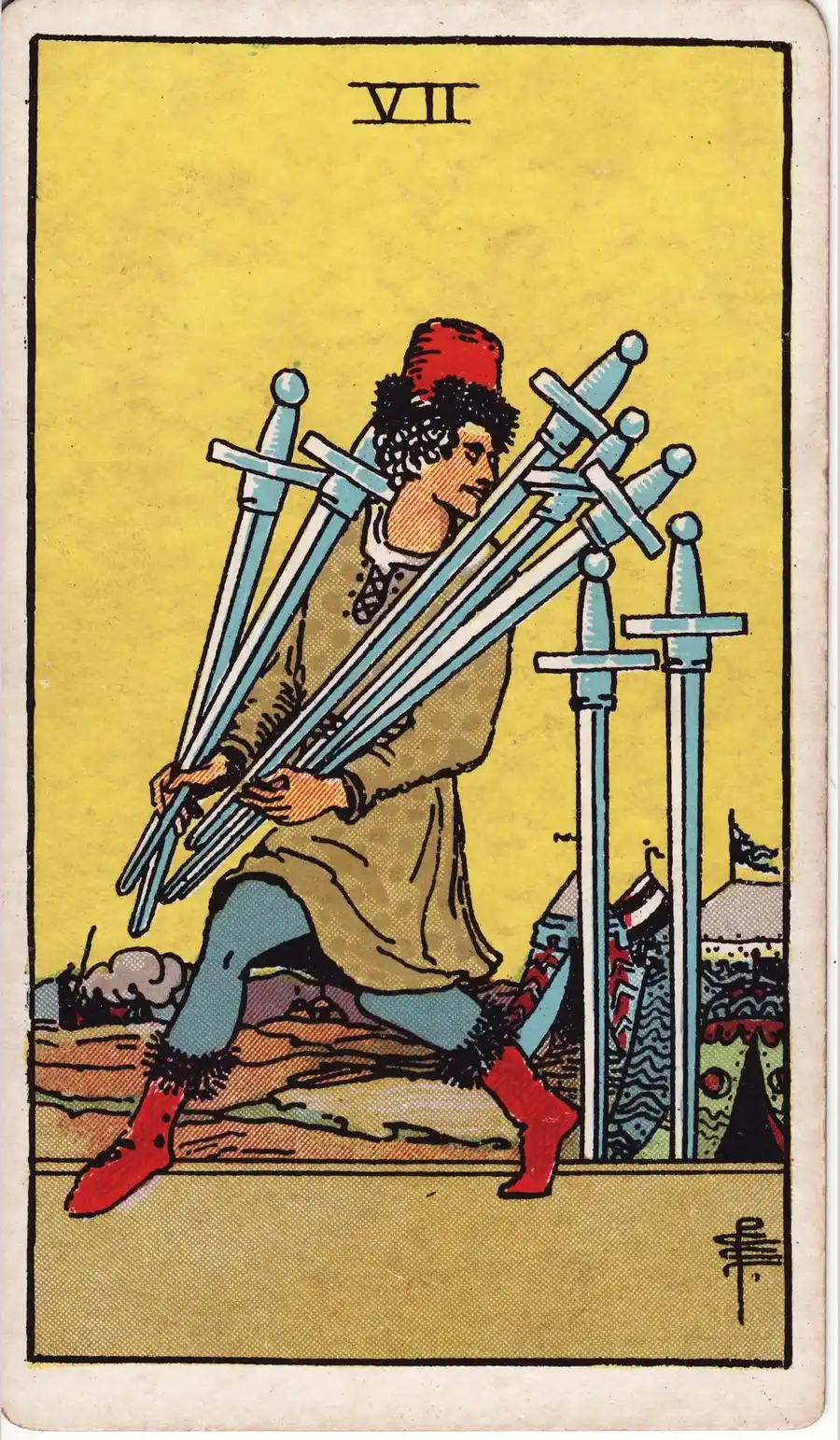
The Seven of Swords shows a man tiptoeing away from a camp, carrying five swords in his arms and glancing back over his shoulder. Two swords are left stuck in the ground behind him.
It is a card of strategy, secrets and getting away with something. This page covers what the Seven of Swords means upright and reversed, the symbols in the 1909 card and how to read it honestly.
Here is the Seven of Swords at a glance.
| At a glance | This card |
|---|---|
| Upright keywords | deception, trickery, strategy |
| Reversed keywords | confession, regret, getting caught |
| Number | 7 in the suit of Swords |
| Golden Dawn title | Lord of Unstable Effort Later tradition |
| Astrology | Moon in Aquarius, third decan (20° to 30° Aquarius) Later tradition |
| Tree of Life | Netzach (7), Victory Later tradition |
| Suit and element | Swords, Air Later tradition |
| Yes or no | No Modern |
Book T calls the Seven of Swords the Lord of Unstable Effort and gives it the Moon in Aquarius, the last decan of the sign, on Netzach. The changeable Moon in a detached sign gives a picture of effort that is clever but not quite steady, which fits the man sneaking away with five swords.
Later tradition The Golden Dawn also gave each decan two of the 72 Goetic spirits, one for the day and one for the night. For the third decan of Aquarius, and so for the Seven of Swords, they are Gaap (spirit 33, day) and Decarabia (spirit 69, night). Their pages read the old entries as history; see the spirit directory for all 72.
The card: what Pamela Colman Smith drew
Waite wrote: “A man in the act of carrying away five swords rapidly; the two others of the card remain stuck in the ground. A camp is close at hand.”
Tiptoeing. He walks on his toes, trying not to be heard. Whatever he is doing, he does not want to be seen.
The look back. He glances over his shoulder, half smiling. He may be pleased with his plan, or nervous about being caught.
Two swords left. He cannot carry everything. Strategies that rely on secrecy often leave something important behind.
Upright meaning
Upright, the Seven of Swords is strategy and stealth. A man tiptoes away from a camp, carrying five swords and glancing back over his shoulder. Two swords remain behind. The card speaks of deception, cunning, secrecy or getting away with something, but also of clever strategy and working alone.
It can describe someone lying to you, or you avoiding a conflict by going around it. It can also describe a sensible plan carried out quietly. The key question is whether the secrecy is protecting something or hiding something.
He did not take all the swords. Some readers see this as a hint that the plan is incomplete, and that something left behind will matter later.
Reversed meaning
Reversed, the Seven of Swords can show confession, getting caught, or a plan that collapses. It can also show guilt, or deciding to come clean.
Ask what you are hiding, or what someone may be hiding from you. Honesty now is usually easier than discovery later.
Turn the question inward as well. The reversed Seven sometimes describes self-deception: telling yourself a plan is fine, that a habit is under control, or that you do not care. The swords you are sneaking away with may be things you are hiding from yourself.
In love, work and spirituality
In love. Upright: Secrets, dishonesty, or someone not being fully open. Reversed: A confession, or truth coming out.
At work. Upright: Strategy, office politics, or working alone. Protect your ideas. Reversed: Getting caught, or a plan that does not work.
With money. Upright: Be careful with money and contracts. Reversed: Uncovering a financial deception.
In spiritual practice. Upright: Keeping your practice private. Reversed: Deceiving yourself about your path.
As feelings. Guarded or secretive. They may be hiding something.
As a person. A clever, strategic person, perhaps not entirely trustworthy.
As advice. Be strategic, but stay honest.
Reading the Seven of Swords: positions and yes or no
In the past position: A secret or a strategy shaped this situation. In the present position: Something is not being said. Look closely.
In the future position: A clever move, or a deception, may come up. As advice: Be strategic, and stay honest.
In modern yes or no readings, the Seven of Swords leans no. Hidden factors point to no.
What the Seven means, and the history behind the card
Seven tests what was gained, and in Swords the test is honesty. The Golden Dawn’s title, Unstable Effort, hints that cleverness without integrity does not hold.
Here is how the Seven looks across the four suits:
- Seven of Wands: defense, perseverance, challenge
- Seven of Cups: fantasy, illusion, choices
- Seven of Swords (this card): deception, trickery, strategy
- Seven of Pentacles: patience, long-term planning, assessment
The man in this card tiptoes away from a camp of tents, holding five swords and looking back over his shoulder. Two swords stay stuck in the ground behind him. Beginners often read the card only as theft, but the picture is more interesting than that.
He is smiling, and no one seems to have noticed him yet. The card can describe a clever plan, a quiet exit or a shortcut, so ask what the strategy is for, and who pays if it fails.
When A. E. Waite published The Pictorial Key to the Tarot in 1910, he listed these divinatory meanings for the Seven of Swords: “Design, attempt, wish, hope, confidence; also quarrelling, a plan that may fail, annoyance. The design is uncertain in its import, because the significations are widely at variance with each other.”
Reversed, he gave: “Good advice, counsel, instruction, slander, babbling.”
Common questions
Is the Seven of Swords a yes or no card? It leans no. Something is hidden or not quite right.
Does the Seven of Swords mean cheating? It can point to secrets or dishonesty, but it can also mean strategy or privacy. Never accuse someone based on a card alone.
What does the Seven of Swords mean reversed? A confession, a secret revealed or giving up a plan that relied on hiding.
Try this
Try this small spread for the Seven of Swords. Use it when something feels hidden.
| Card | Question | What it shows |
|---|---|---|
| 1 | What is hidden? | The secret or half-truth. |
| 2 | Who benefits? | Whose interests are served. |
| 3 | What is the honest move? | How to act with integrity. |
Affirmation: I choose strategy that I can stand behind in daylight.
Reversed affirmation: I tell the needed truth and stop the clever cover story.
If you keep a tarot journal, take one of these questions to it: What am I not saying, and why? Where do I need privacy, and where am I hiding? What did I leave behind?
What next
Cards that sit close to this one are The Moon (the Major Arcana card of hidden things), Five of Swords (another card of taking at someone else’s cost) and The Magician (the Major Arcana card of skill, for better or worse).
The Seven of Swords is part of the lesson Swords in my free Tarot for Beginners course. To see the whole suit on one page, go to the suit of Swords. To keep walking the suit, read the card before it, Six of Swords or the card after it, Eight of Swords, or go back to all the card meanings.
For the suits and numbers in one place, see The Minor Arcana: suits and numbers made simple. For every card with keywords, affirmations and examples, see my book The Novice’s Guide to Tarot. If you would like a printable cheat sheet for all 78 cards, my 45-page Tarot Workbook is on Etsy.
Sources
- A. E. Waite, The Pictorial Key to the Tarot (London: Rider, 1910), Part III, sections 1 and 2.
- Pamela Colman Smith and A. E. Waite, the Rider-Waite-Smith tarot (London: Rider, 1909).
- Nicolas Conver, Tarot de Marseille (Marseille, 1760).
- Lauri Mukkala, The Novice’s Guide to Tarot, entry for the Seven of Swords.
- Aleister Crowley, 777 (London: Walter Scott, 1909), columns of the decans, the Minor Arcana and the court cards.
- Israel Regardie, ed., The Golden Dawn (Chicago: Aries Press, 1937 to 1940), “Book T”, titles and attributions of the small cards and the court.
All 78 cards
Major Arcana
- The Fool
- The Magician
- The High Priestess
- The Empress
- The Emperor
- The Hierophant
- The Lovers
- The Chariot
- Strength
- The Hermit
- Wheel of Fortune
- Justice
- The Hanged Man
- Death
- Temperance
- The Devil
- The Tower
- The Star
- The Moon
- The Sun
- Judgement
- The World
Wands
- Ace of Wands
- Two of Wands
- Three of Wands
- Four of Wands
- Five of Wands
- Six of Wands
- Seven of Wands
- Eight of Wands
- Nine of Wands
- Ten of Wands
- Page of Wands
- Knight of Wands
- Queen of Wands
- King of Wands
Cups
- Ace of Cups
- Two of Cups
- Three of Cups
- Four of Cups
- Five of Cups
- Six of Cups
- Seven of Cups
- Eight of Cups
- Nine of Cups
- Ten of Cups
- Page of Cups
- Knight of Cups
- Queen of Cups
- King of Cups
Swords
- Ace of Swords
- Two of Swords
- Three of Swords
- Four of Swords
- Five of Swords
- Six of Swords
- Seven of Swords
- Eight of Swords
- Nine of Swords
- Ten of Swords
- Page of Swords
- Knight of Swords
- Queen of Swords
- King of Swords
Pentacles
Get the free Mini-Grimoire
A short printable starter guide to tarot and everyday witchcraft, plus my newsletter. Unsubscribe any time.
Opens Substack in a new tab to confirm. More about the newsletter · Privacy