


| Arcana | Minor Arcana: Pentacles |
|---|---|
| Image | RWS 1909 (PD) |
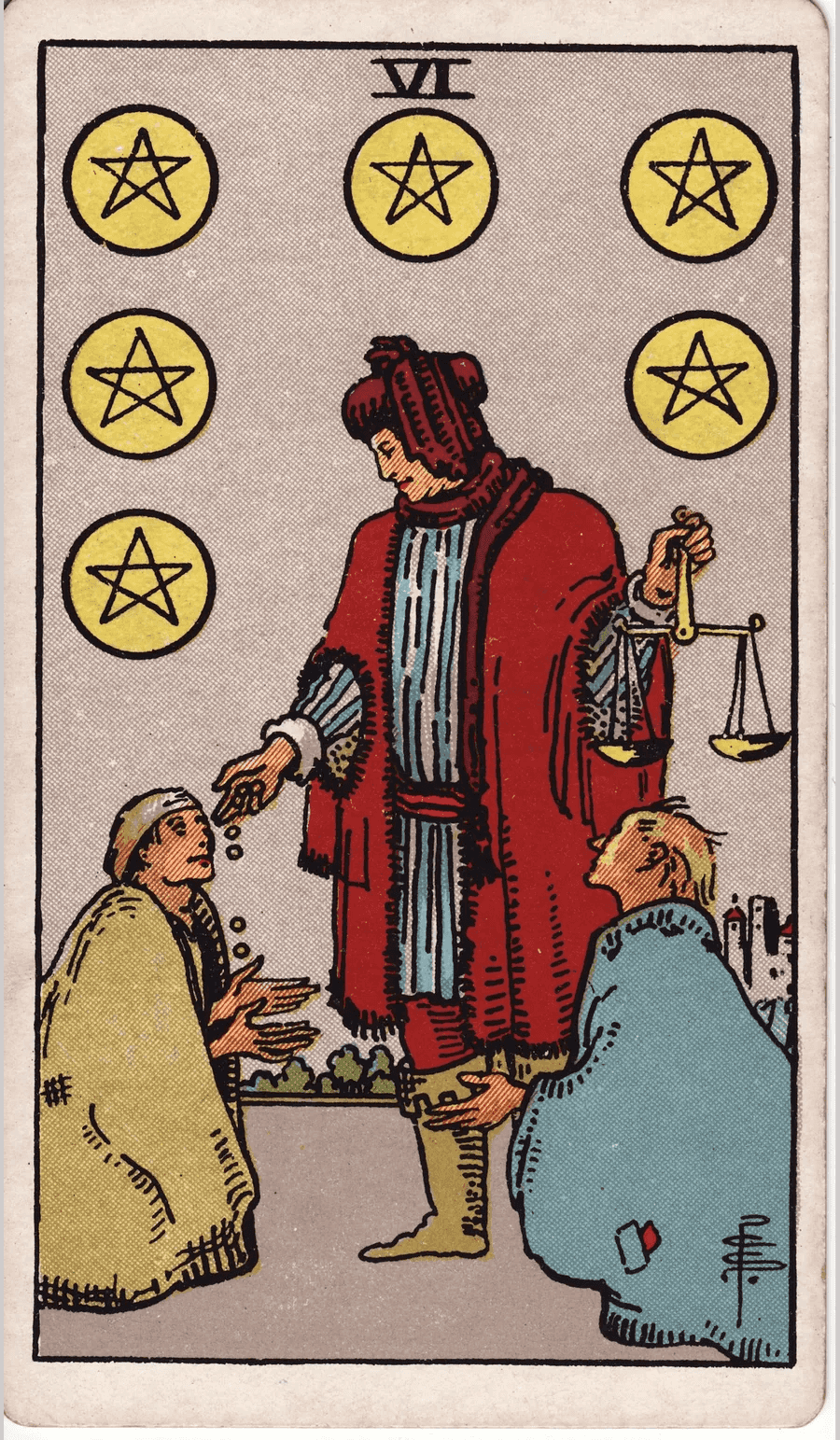
The Six of Pentacles shows a merchant holding a pair of scales in one hand and dropping coins into the hands of a kneeling person with the other. A second person kneels beside them, waiting. It is a card of generosity, giving and receiving and fairness. Here is what the Six of Pentacles means upright and reversed, the symbols in the 1909 card and how to read it.
At a glance
- Upright keywords: generosity, charity, balance
- Reversed keywords: debt, selfishness, one-sided charity
- Number: 6 in the suit of Pentacles
- Suit and element: Pentacles, Earth Later tradition
- Astrology: Moon in Taurus Later tradition
- Yes or no: Yes Modern
The element and the planet in a sign (one of the 36 ten-degree slices of the zodiac called decans) come from the Golden Dawn system of the 1880s and 1890s, not from the first tarot decks. The yes or no lean is a modern reading habit. Use these layers if they help you remember the card, and skip them if they get in the way.
The card: what Pamela Colman Smith drew
Waite wrote: “A person in the guise of a merchant weighs money in a pair of scales and distributes it to the needy and distressed. It is a testimony to his own success in life, as well as his goodness of heart.”
The scales
The merchant weighs what he gives. Generosity here is measured and fair.
Two kneeling figures
Two people kneel, but only one receives. Many readers ask who decides, and how fairly.
Giving from above
He stands while they kneel. The card can show real kindness, and also power in giving.
Upright meaning
Upright, the Six of Pentacles asks how resources move between people. You may have something useful to offer, or you may be the person who needs assistance. Money is one possibility. Time, knowledge and practical help count too.
Give what you can, receive what you need, and keep it fair. Gifts with strings attached are not really gifts.
Reversed meaning
Reversed, the Six of Pentacles can show debt, selfishness or one-sided charity. Someone may give to control, or receive without ever giving back.
Look at the balance. Pay what you owe, and set limits where giving has become a duty that hurts.
Reversals are optional. Many readers never use them and read every card upright, and that is a complete way to read. If you do use them, decide before you shuffle what a reversed card will mean for you, and keep to that choice for the whole reading.
In love, work and spirituality
Love
Upright, a generous partner. Reversed, a power imbalance.
Work and money
A raise, a grant, fair pay. Reversed, unfair pay or debt.
Spirituality
Sharing knowledge freely. Reversed, a teacher who controls students.
As feelings
As someone’s feelings, the Six of Pentacles shows generosity and care.
The Six of Pentacles as past, present, future and advice
- Past: Help or generosity got you here.
- Present: Give and receive fairly.
- Future: Help or a fair exchange is coming.
- Advice: Share what you can.
A Minor Arcana card usually describes the everyday texture of a situation: a mood, a conversation, a task or a step. If the Six of Pentacles appears next to a Major Arcana card, let the Major name the big theme and let this card show how it is playing out in the body and the other things Pentacles rule. If it keeps coming back over several days, write down what was happening each time.
Is the Six of Pentacles a yes or a no?
In modern yes or no readings, the Six of Pentacles leans yes. Generosity points to yes. Tarot is better at showing the shape of a situation than at handing down verdicts, so if the question really matters, turn it into an open question such as “What do I need to know about this?” and draw again.
Affirmation and journal prompts
Affirmation: I offer and receive support with respect for everyone’s dignity.
Reversed affirmation: I clarify expectations and protect my right to make choices.
Journal prompts:
- What can I give?
- What do I need to receive?
- Is this exchange fair?
What the Six means in tarot
Six is repair, reciprocity and movement back toward balance. After the trouble of the Five, the Sixes bring help, recognition, gifts or a journey to calmer ground.
Here is how the Six looks across the four suits:
- Six of Wands: success, recognition, victory
- Six of Cups: nostalgia, memories, reunion
- Six of Swords: transition, moving on, healing
- Six of Pentacles (this card): generosity, charity, balance
Learning a rank across the suits is one of the fastest ways to learn the Minor Arcana: the number or court rank gives you the shape, and the suit gives you the setting.
The history and art behind the card
In most decks before 1909, the number cards showed only a pattern of suit symbols, the way a playing card does. The Sola Busca deck from late 1400s Italy is the famous exception. Pamela Colman Smith gave every Minor Arcana card a scene with people in it, and that choice is a big reason the Rider-Waite-Smith deck is still the easiest deck for beginners. In Italian decks the suit is Denari (coins) and in the Tarot de Marseille it is Deniers, round coins. Occult writers of the 1800s, and then the Golden Dawn, turned the coins into pentacles, discs engraved with a five-pointed star, and Smith followed that. Waite noted that “in old Tarot packs this suit represented money”, but on this site I read it more widely as everything material you tend.
The scales in the merchant’s hand connect this card with Justice in the Major Arcana, which also carries scales. Some readers see that link as a reminder that generosity and fairness belong together. The two kneeling figures have also started many conversations among tarot readers about charity and dignity: is the merchant generous, or does he enjoy being above them? Smith left the picture open, and both readings can be useful. Ask which one fits your question.
The card also pairs well with the Four of Pentacles. In the Four a man holds his coins so tightly that nothing moves. In the Six the money moves, from one hand to another, and the scales show that someone is measuring how much. Reading the two cards side by side is a simple lesson in how the suit works: resources are meant to circulate, and the question is always how fairly and how freely they do.
When A. E. Waite published The Pictorial Key to the Tarot in 1910, he listed these divinatory meanings for the Six of Pentacles: “Presents, gifts, gratification; another account says attention, vigilance; now is the accepted time, present prosperity, etc.” Reversed, he gave: “Desire, cupidity, envy, jealousy, illusion.” Waite said he was offering “a harmony of their meanings” gathered “from all sources”, which means older fortune-telling lists, not his own reading of the picture. On this site I read the picture first and treat lists like this as history.
A spread for the Six of Pentacles
Use this spread to look at giving and receiving.
- What can I give? My gift.
- What do I need? What I should ask for.
- How do I keep it fair? One step.
Lay the three cards in a row, read each one on its own first, then read them together as a short story. Write one sentence for each position and one small action you will take.
Common questions
Is the Six of Pentacles a yes or no card?
Yes, especially for help and fairness.
What does the Six of Pentacles mean for money?
A gift, a loan, fair pay or charity.
What does the Six of Pentacles mean in love?
Generosity. Reversed, a power imbalance.
Related cards
- Justice: the Major Arcana card of fair balance
- Five of Pentacles: the need that comes before
- Four of Pentacles: holding on instead of sharing
Keep learning
The Six of Pentacles is part of the lesson Pentacles in my free Tarot for Beginners course. To see the whole suit on one page, go to the suit of Pentacles. To keep walking the suit, read the card before it, Five of Pentacles or the card after it, Seven of Pentacles, or go back to all the card meanings. For the suits and numbers in one place, see The Minor Arcana: suits and numbers made simple. For every card with keywords, affirmations and examples, see my book The Novice’s Guide to Tarot. If you would like a printable cheat sheet for all 78 cards, my 45-page Tarot Workbook is on Etsy.
Sources
- A. E. Waite, The Pictorial Key to the Tarot (London: Rider, 1910), Part III, sections 1 and 2.
- Pamela Colman Smith and A. E. Waite, the Rider-Waite-Smith tarot (London: Rider, 1909).
- Nicolas Conver, Tarot de Marseille (Marseille, 1760).
- Lauri Mukkala, The Novice’s Guide to Tarot, entry for the Six of Pentacles.
All 78 cards
Major Arcana
- The Fool
- The Magician
- The High Priestess
- The Empress
- The Emperor
- The Hierophant
- The Lovers
- The Chariot
- Strength
- The Hermit
- Wheel of Fortune
- Justice
- The Hanged Man
- Death
- Temperance
- The Devil
- The Tower
- The Star
- The Moon
- The Sun
- Judgement
- The World
Wands
- Ace of Wands
- Two of Wands
- Three of Wands
- Four of Wands
- Five of Wands
- Six of Wands
- Seven of Wands
- Eight of Wands
- Nine of Wands
- Ten of Wands
- Page of Wands
- Knight of Wands
- Queen of Wands
- King of Wands
Cups
- Ace of Cups
- Two of Cups
- Three of Cups
- Four of Cups
- Five of Cups
- Six of Cups
- Seven of Cups
- Eight of Cups
- Nine of Cups
- Ten of Cups
- Page of Cups
- Knight of Cups
- Queen of Cups
- King of Cups
Swords
- Ace of Swords
- Two of Swords
- Three of Swords
- Four of Swords
- Five of Swords
- Six of Swords
- Seven of Swords
- Eight of Swords
- Nine of Swords
- Ten of Swords
- Page of Swords
- Knight of Swords
- Queen of Swords
- King of Swords
Pentacles
Get the free Mini-Grimoire
A short printable starter guide to tarot and everyday witchcraft, plus my newsletter. Unsubscribe any time.
Opens Substack in a new tab to confirm. More about the newsletter · Privacy