


| Arcana | Minor Arcana: Swords |
|---|---|
| Image | RWS 1909 (PD) |
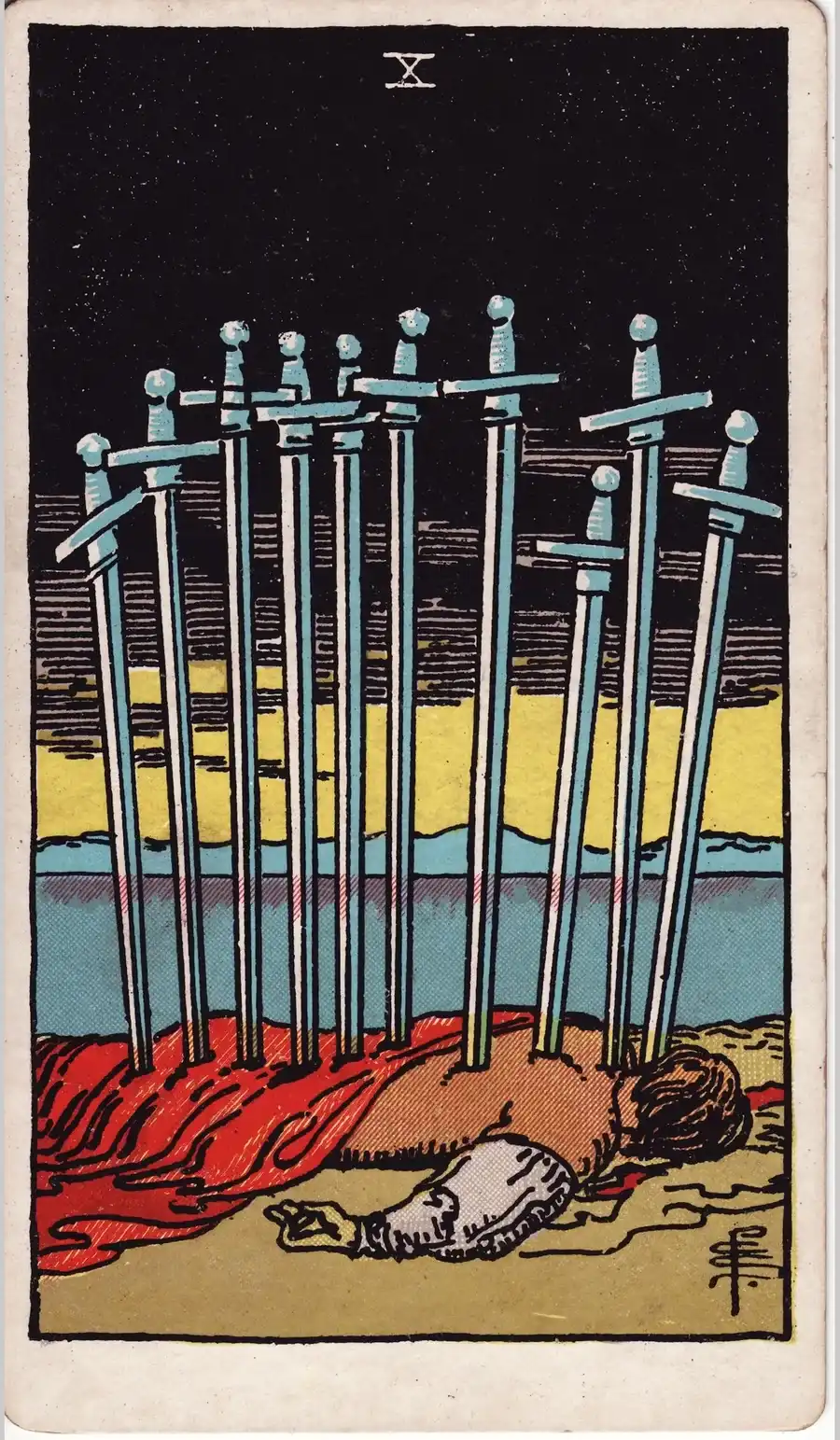
The Ten of Swords shows a figure lying face down by the water with ten swords in his back, under a black sky. On the horizon, a yellow dawn is breaking.
It is a card of painful endings and collapse, and also of the moment when the worst is over. Here is what the Ten of Swords means upright and reversed, the symbols in the 1909 card and a spread for after a hard ending.
Here is the Ten of Swords at a glance.
| At a glance | This card |
|---|---|
| Upright keywords | betrayal, painful endings, collapse |
| Reversed keywords | recovery, regeneration, resisting an inevitable end |
| Number | 10 in the suit of Swords |
| Golden Dawn title | Lord of Ruin Later tradition |
| Astrology | Sun in Gemini, third decan (20° to 30° Gemini) Later tradition |
| Tree of Life | Malkuth (10), the Kingdom Later tradition |
| Suit and element | Swords, Air Later tradition |
| Yes or no | No Modern |
The Golden Dawn named the Ten of Swords the Lord of Ruin and gave it the Sun in Gemini, the last decan of the sign, on Malkuth. The Sun shining at the end of the most mental suit fits the yellow dawn Smith painted on the horizon, beyond the ruin.
Later tradition The Golden Dawn also gave each decan two of the 72 Goetic spirits, one for the day and one for the night. For the third decan of Gemini, and so for the Ten of Swords, they are Paimon (spirit 9, day) and Vine (spirit 45, night). Their pages read the old entries as history; see the spirit directory for all 72.
The card: what Pamela Colman Smith drew
Waite described it plainly: “A prostrate figure, pierced by all the swords belonging to the card.” Smith added the dawn, a strip of gold between the black sky and the calm water.
Ten swords. Ten is the end of the suit. Ten swords is more than enough. The image is extreme on purpose, so that you know this is the bottom.
The dawn. Behind the scene, the sky is getting light. Endings make room for beginnings.
The calm water. The water is still. The storm is over. Nothing worse can happen in this picture.
Upright meaning
Upright, the Ten of Swords is an ending. A figure lies face down by the water with ten swords in his back, under a black sky. But on the horizon, the dawn is breaking. The card speaks of painful endings, betrayal, collapse and hitting bottom.
It is dramatic, and the drama is part of its message: this is the end, and it is final. Nothing more can go wrong in this particular story. That is strangely freeing. When you have reached bottom, the only direction left is up.
The dawn on the horizon is the most important detail. A new day is coming, even if you cannot feel it yet.
Reversed meaning
Reversed, the Ten of Swords shows recovery: getting up, pulling out the swords, slowly healing. It can also show resisting an ending that has already happened, or reliving the same pain again and again.
Ask whether you have accepted the ending. Recovery begins when you stop fighting what is already over.
Some readers say the reversed Ten is the moment the figure begins to stand. It is slow, painful and undignified, and it is also the most hopeful moment in the whole suit. Let the recovery be messy. Getting up counts even when nobody claps.
In love, work and spirituality
In love. Upright: A painful breakup, or the definite end of a relationship. Reversed: Healing after an ending, or refusing to let go.
At work. Upright: Job loss, failure, or the end of a project. Reversed: Recovery and rebuilding after a setback.
With money. Upright: Financial collapse, or hitting rock bottom. Reversed: Slow recovery.
In spiritual practice. Upright: A spiritual crisis that clears the way for something new. Reversed: Rising from despair.
As feelings. Exhausted, hurt or at the end of their emotional strength.
As a person. Someone who has been through a painful ending.
As advice. Accept the ending, and watch for the dawn.
Reading the Ten of Swords: positions and yes or no
In the past position: A painful ending shaped you. In the present position: Something has ended. It is the bottom, and dawn is near.
In the future position: An ending may come, and you can rise from it. As advice: Let it be over, then look east.
In modern yes or no readings, the Ten of Swords leans no. Endings point to no.
What the Ten means, and the history behind the card
Ten completes the suit, and in Swords completion means an ending. The Golden Dawn named it the Lord of Ruin, but the dawn on the horizon shows that the story goes on.
Here is how the Ten looks across the four suits:
- Ten of Wands: burden, responsibility, hard work
- Ten of Cups: harmony, joy, shared belonging
- Ten of Swords (this card): betrayal, painful endings, collapse
- Ten of Pentacles: legacy, inheritance, long-term success
Look at the horizon. Above the figure the sky is black, but along the bottom of the card a band of yellow light is breaking over calm water and distant hills. Many readers also notice that his right hand makes a gesture like the blessing of the Hierophant.
Smith put the worst moment of the suit and the first light of morning in the same picture. The card is dramatic on purpose, and it describes a feeling of being finished, not a literal event.
When A. E. Waite published The Pictorial Key to the Tarot in 1910, he listed these divinatory meanings for the Ten of Swords: “Whatsoever is intimated by the design; also pain, affliction, tears, sadness, desolation. It is not especially a card of violent death.”
Reversed, he gave: “Advantage, profit, success, favor, but none of these are permanent; also power and authority.”
Common questions
Is the Ten of Swords a yes or no card? It leans no. Something has ended.
Does the Ten of Swords mean death? No. It shows a painful ending of a situation, not a physical death.
What does the Ten of Swords mean reversed? Recovery and slowly getting up, or resisting an ending.
Try this
Try this small spread for the Ten of Swords. Use it after a painful ending.
| Card | Question | What it shows |
|---|---|---|
| 1 | What has ended? | The chapter that is over. |
| 2 | What do I need now? | Rest, help or time. |
| 3 | What is dawning? | The first light of what comes next. |
Affirmation: I face a finished ending and begin from what is left.
Reversed affirmation: I stop resisting the ending that has already arrived.
If you keep a tarot journal, take one of these questions to it: What has truly ended? What is the dawn on my horizon? What would help me get up, slowly?
What next
Cards that sit close to this one are The Tower (the Major Arcana card of collapse), Death (the Major Arcana card of endings and transformation) and Ace of Swords (the new clarity that can follow).
The Ten of Swords is part of the lesson Swords in my free Tarot for Beginners course. To see the whole suit on one page, go to the suit of Swords. To keep walking the suit, read the card before it, Nine of Swords or the card after it, Page of Swords, or go back to all the card meanings.
For the suits and numbers in one place, see The Minor Arcana: suits and numbers made simple. For every card with keywords, affirmations and examples, see my book The Novice’s Guide to Tarot. If you would like a printable cheat sheet for all 78 cards, my 45-page Tarot Workbook is on Etsy.
Sources
- A. E. Waite, The Pictorial Key to the Tarot (London: Rider, 1910), Part III, sections 1 and 2.
- Pamela Colman Smith and A. E. Waite, the Rider-Waite-Smith tarot (London: Rider, 1909).
- Nicolas Conver, Tarot de Marseille (Marseille, 1760).
- Lauri Mukkala, The Novice’s Guide to Tarot, entry for the Ten of Swords.
- Aleister Crowley, 777 (London: Walter Scott, 1909), columns of the decans, the Minor Arcana and the court cards.
- Israel Regardie, ed., The Golden Dawn (Chicago: Aries Press, 1937 to 1940), “Book T”, titles and attributions of the small cards and the court.
All 78 cards
Major Arcana
- The Fool
- The Magician
- The High Priestess
- The Empress
- The Emperor
- The Hierophant
- The Lovers
- The Chariot
- Strength
- The Hermit
- Wheel of Fortune
- Justice
- The Hanged Man
- Death
- Temperance
- The Devil
- The Tower
- The Star
- The Moon
- The Sun
- Judgement
- The World
Wands
- Ace of Wands
- Two of Wands
- Three of Wands
- Four of Wands
- Five of Wands
- Six of Wands
- Seven of Wands
- Eight of Wands
- Nine of Wands
- Ten of Wands
- Page of Wands
- Knight of Wands
- Queen of Wands
- King of Wands
Cups
- Ace of Cups
- Two of Cups
- Three of Cups
- Four of Cups
- Five of Cups
- Six of Cups
- Seven of Cups
- Eight of Cups
- Nine of Cups
- Ten of Cups
- Page of Cups
- Knight of Cups
- Queen of Cups
- King of Cups
Swords
- Ace of Swords
- Two of Swords
- Three of Swords
- Four of Swords
- Five of Swords
- Six of Swords
- Seven of Swords
- Eight of Swords
- Nine of Swords
- Ten of Swords
- Page of Swords
- Knight of Swords
- Queen of Swords
- King of Swords
Pentacles
Get the free Mini-Grimoire
A short printable starter guide to tarot and everyday witchcraft, plus my newsletter. Unsubscribe any time.
Opens Substack in a new tab to confirm. More about the newsletter · Privacy