


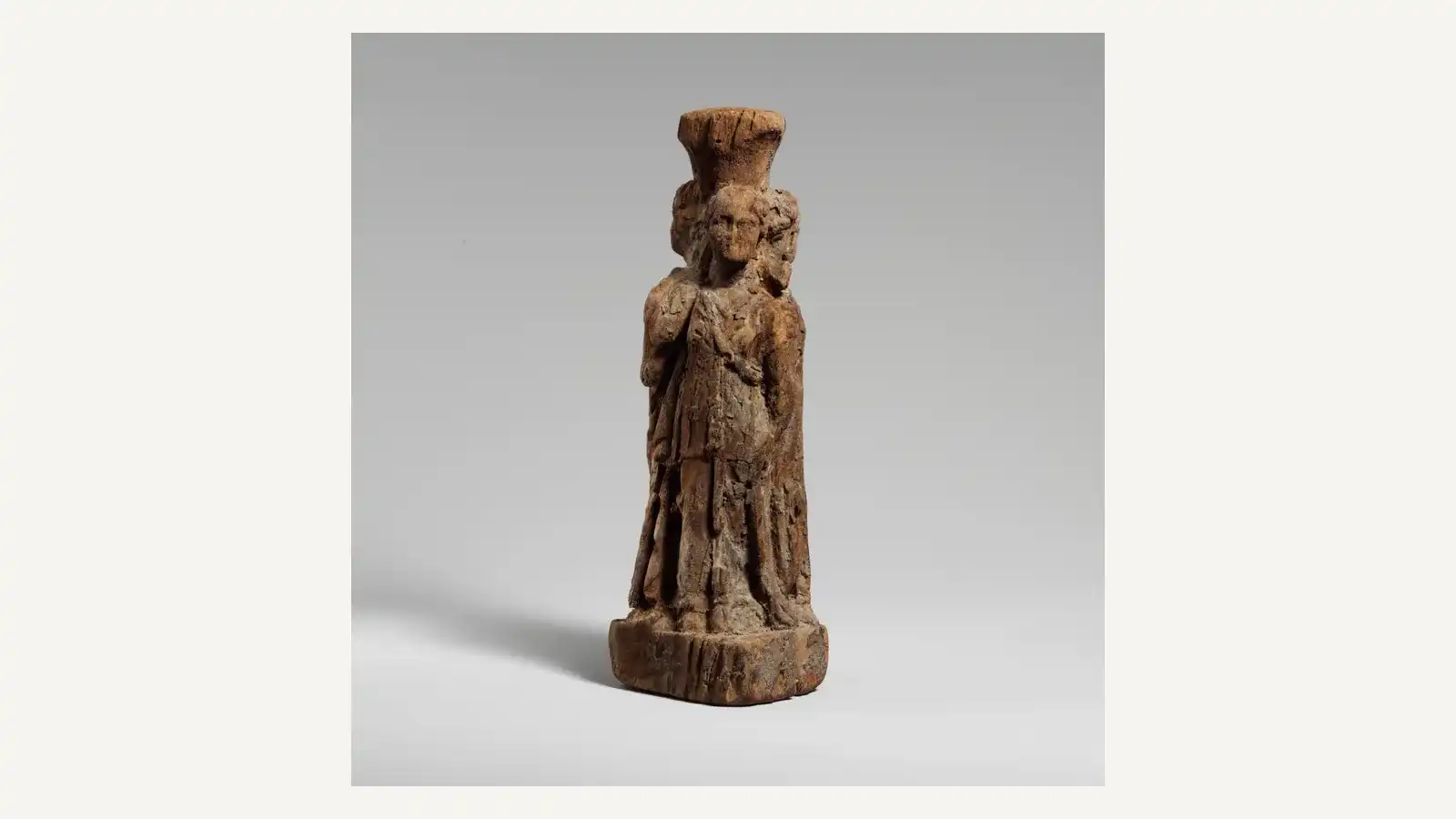
In this lesson: how ancient Greek prayers were shaped, three modern prayers to adapt, safe offerings and the flame rules for any shrine.
Words, gifts and light are the three things people most want to get right at a shrine. The good news is that none of them needs special knowledge. Plain words are enough, water is a complete offering and an LED is a real light. This lesson shows you how ancient Greek prayers were usually shaped, gives you three modern prayers to use or change, and sets out the offering and flame rules I follow every time.
How a Greek prayer was shaped
Historical Scholars of Greek religion, such as Walter Burkert, describe a common pattern in ancient prayers. First came the invocation: the god’s name, often with epithets and places linked to her. Then came the reason: a reminder of the relationship, such as past offerings or the god’s own nature. Last came the request: something specific. Not every prayer asked for anything. Some were only greeting or thanks. People usually prayed standing, and for powers below the earth, literary scenes show gestures toward the ground.
Historical Real ancient hymns to Hekate survive, mostly in the Orphic Hymns, probably of Roman imperial date, where the first numbered hymn is hers, and in the magical papyri. In Thomas Taylor’s free and florid translation of 1792 the Orphic Hymn opens: “I call Einodian Hecate, lovely dame, / Of earthly, wat’ry, and celestial frame.” Einodian means “of the road”. Read a modern translation too, such as Athanassakis and Wolkow’s. Be careful with “ancient prayers to Hekate” online that give no source. Most are modern.
A prayer from the ancient world
Historical Greek prayers often followed a pattern that scholars describe in three parts. First comes the invocation: the god’s name, epithets and favorite places, so that the right god is addressed. Then comes the argument or reminder: “if ever I have given you gifts, if ever you have helped me before”. Last comes the request.
You can see the whole shape in the first book of Homer’s Iliad, where the priest Chryses prays to Apollo: “Hear me, you of the silver bow… if ever I roofed a pleasing shrine for you, or burned fat thigh pieces of bulls or goats, fulfill this wish for me” (Iliad 1.37 to 41, paraphrased from the translation by A. T. Murray, 1924).
Notice that the prayer is honest about the relationship. It does not flatter for the sake of it. It remembers what has passed between the two and then asks. That is the model I use for the prayers in this lesson. For Hekate specifically, Hesiod’s Theogony (lines 411 to 452) supplies many of the ideas you can use in the invocation: she is honored in earth, sea and sky, she sits beside kings in judgment, she helps in assemblies, at sea, in contests and with herds. Using those lines keeps your words rooted in the oldest description we have.
Historical Greeks usually prayed standing, with hands raised, palms upward toward the sky gods, or lowered toward the earth for gods of the earth and underworld. Prayer was normally spoken aloud. Praying silently was unusual enough that ancient writers sometimes treated it as suspicious. Today you may whisper or pray in your head without any problem.
A worked prayer, line by line
Here is how a beginner might build a prayer using the three parts. Invocation: “Hekate, honored by Zeus, at home in earth, sea and starry sky, keeper of doorways.” Reminder: “I have kept your shelf this month and given you water and my attention.” Request: “Help me speak clearly at tomorrow’s meeting, and keep my home safe tonight.” Thanks: “I will light a candle for you on Sunday.” That last line is a promise you can keep. Never promise what you cannot afford or do. A small promise kept builds more trust than a large one broken.
Three modern prayers
Modern These prayers are modern, written for my own practice and this course. Use them, change them or leave them. A greeting for any day: “Hekate, light-bringer, keeper of the keys, guardian of the door: I greet you. Thank you for this day.” An evening prayer: “Hekate of the crossroads, as the day ends I set down what I carried.
Light my way through the night, and turn my thoughts toward what is true and kind.” A prayer before a decision: “Hekate of the three ways, I stand at a crossing. Help me see the paths clearly, choose with care and walk my choice with courage.”
Notice that each has the old shape. A name, a reason drawn from her nature (light, keys, roads) and a request about your own clarity or courage, never about controlling another person.
Offerings that are safe
Modern Fresh water is the simplest gift: a small cup, changed each time you pray. A libation, a little liquid poured out, was central to Greek devotion. Pour it into a dish on your shelf or onto the soil of a plant pot, and outdoors use only water. Bread, honey, an egg or fruit are common modern food offerings, inspired by the ancient suppers. Ancient writers mention cakes and a fish, the red mullet, for Hekate. Eggs and cheese are often called traditional online, but I know of no ancient source for them, so treat them as modern.
Keep them small and indoors, and dispose of them the next day as in lesson 7. A single flower is lovely. Incense is optional: it can trigger asthma, harm pets, especially birds and cats, and is banned in many rentals. Many devotees also offer time, such as an hour at an animal shelter or helping someone through a hard change. That idea is modern, but it suits a goddess Hesiod calls generous to people in every walk of life. This course never includes animal sacrifice or blood of any kind.
The flame rules
Hekate’s torch makes flame feel natural at her shrine, and flame is also the most common source of real harm in home practice. Use a stable, heat-proof holder. Keep 30 cm (12 inches) clear around and above it, especially from curtains, books and dried flowers.
Never leave it burning when you leave the room, and never fall asleep with it lit. Keep it away from children and pets, tie back long hair and sleeves, never cover a smoke alarm and check your rental rules. You do not need to let a candle “burn all the way down”. You can light the same one many times.
Questions beginners ask
Do I have to use old words or Greek? No. Plain English is fine. If you enjoy it, you can learn one Greek greeting, such as “chaire, Hekate”, meaning “hail” or “rejoice, Hekate”.
What if I do not know what to ask for? Then do not ask. A prayer of thanks or simple greeting is complete. Ancient hymns often praised without any request.
Can I offer incense? Yes, if your space is ventilated and no one in the home has asthma. Greeks burned frankincense and myrrh, both imported resins. A single stick or a pinch on a charcoal disk on a heatproof dish is plenty. Many people now skip smoke altogether for health reasons, and that is completely acceptable.
What do I do with the offerings afterward? Water can go to a plant. Food from the shrine is best composted or put in the waste, because leaving it outdoors can hurt animals. Flowers can be composted when they fade.
Is it bad luck if a candle goes out? No. Candles go out because of drafts, short wicks or wax drowning the flame. Relight it if you like, or end the prayer there.
Myths to drop: The belief that offerings must include blood or anything harmful is false for modern practice and unnecessary. The belief that you must say a prayer perfectly is also false: Greek prayers varied, and sincerity mattered more than exact words. And the belief that some colors of candle are “required” for Hekate is a modern custom, not an ancient rule.
A worked example
Imagine someone who wants to pray before telling her family she is changing careers. She writes on a card: “Hekate of the three ways (invocation), you stand where roads part and carry light into hard places (reason). Help me speak clearly and kindly tomorrow (request).”
In the evening she washes her hands, fills an egg cup with water, switches on her LED and reads the card aloud once. She sits for a minute, says thank you and switches the light off. In her journal she writes the prayer and one line on how she felt. The prayer did not promise her a good outcome. It helped her decide what she wanted to say.
Try this
Write your own three-part prayer to Hekate: one line naming her, one line on why you turn to her, one line of thanks or a small, reasonable request. Say it once at your shelf with a cup of fresh water.
A variation for people who cannot use flame: use a battery tealight, a lamp you switch on only for prayer, or the light of a window at dusk. Light is the symbol, not fire itself.
Journal prompts: What do I want to remember before I ask? What can I promise and truly keep? How did saying my prayer aloud feel compared with saying it silently?
A beginner’s worry, answered. “My prayer feels awkward and stiff.” That is how almost everyone begins. Say the same short prayer for a few weeks and it will start to feel like your own. Many people find that a plain sentence spoken honestly feels better than a long, borrowed one.
Recap
Ancient Greek prayers usually named the god, gave a reason drawn from the relationship or her nature, and then asked or thanked. Authentic hymns to Hekate survive in the Orphic Hymns and the papyri, while most “ancient prayers” online are modern. Safe offerings are water, a small libation, simple food disposed of the next day, a flower and time. Follow the flame rules every time, and remember that an LED is a real light.
What next
Press “Mark as done” and continue with The new month and a year of dark moons. For candle colors and holders, see my candle guide.
Further reading: Simon Pulleyn, Prayer in Greek Religion (Oxford University Press, 1997), explains the three-part structure in detail. William D. Furley and Jan Maarten Bremer, Greek Hymns (Mohr Siebeck, 2001), gathers many examples with translations.
Sources
- The Hymns of Orpheus, translated by Thomas Taylor (London, 1792), Hymn 1, “To Hecate”.
- The Orphic Hymns, translated by Apostolos N. Athanassakis and Benjamin M. Wolkow (Baltimore: Johns Hopkins University Press, 2013).
- Walter Burkert, Greek Religion, translated by John Raffan (Cambridge, MA: Harvard University Press, 1985).
- Sarah Iles Johnston, Hekate Soteira (Atlanta: Scholars Press, 1990).
Quick check
Go deeper: the Hekate pages on this site, and The Novice's Guide to Witchcraft
Get the free Mini-Grimoire
A short printable starter guide to tarot and everyday witchcraft, plus my newsletter. Unsubscribe any time.
Opens Substack in a new tab to confirm. More about the newsletter · Privacy
Comments
Questions and notes from readers. Anyone with a free account can comment, and I reply when I can. Please read the community guidelines.
Comments load from Google Firebase (EU) when you ask for them. Nothing is stored on your device. Privacy