


In this lesson: a gentle four-week plan for your first month of devotion, one small step a week, with a journal and safety notes.
You have the history and a first shrine. Now comes the part most beginners ask me about: what do I actually do, day by day? This lesson opens the practice half of the course with a simple plan for your first month. One new step each week, never more than ten minutes a day, and a journal to show you what is working.
Why a month, and why so small
Modern Everything in this plan is modern devotion. Some parts echo ancient Greek habits, and I say which. A month is long enough for a habit to begin and short enough to feel possible. Keeping it small is the whole trick. A practice you can keep on a tired Tuesday is worth more than a grand ritual you do once.
Devotion here means regular, respectful attention to a deity: a place, a few words, a small gift and a record of what you notice. It is not the same as magic. You are not trying to make something happen. You are paying attention to someone.
Historical Ancient Greek religion ran on reciprocity, the give and take of a relationship, and on regular custom more than on feelings. A household kept its doorway shrine and its monthly suppers because that was what one did. That is good news for a beginner: steady, ordinary attention was the heart of it.
The four weeks
Here is the plan. Each week keeps everything from the week before and adds one thing.
- Week 1, place. Each day, stand or sit before your shelf shrine from lesson 6 for one minute. Words are optional. Notice how it feels to have a place set aside. Write one line in your journal.
- Week 2, words. Add a short greeting each day, in your own words or the greeting from lesson 6. On one day, try a three-part prayer (you will learn it in lesson 9). Note what you said and how it felt.
- Week 3, gifts. Add a cup of fresh water, changed daily. On one day, make a different offering: a flower, a piece of bread or an hour spent helping someone. Write what you offered and why.
- Week 4, light and review. If flame is safe where you live, light a candle during your greeting. If not, use an LED, which is a full substitute, not a lesser one. At the end of the week, read your journal from the first page and write a short reflection: what do I want to keep, and what do I want to change?
Wash your hands before you begin each day if you like. Historical Hesiod warns against pouring a libation to the gods “with unwashen hands” (Works and Days 724 to 726), and many devotees keep this small habit today.
What the ancient household actually did
Historical It helps to see how small ancient devotion could be. A Greek house had a hearth, and the hearth had its own goddess, Hestia, who received a little of the first and last offering at many meals. Outside the front door there was often a small shrine or image.
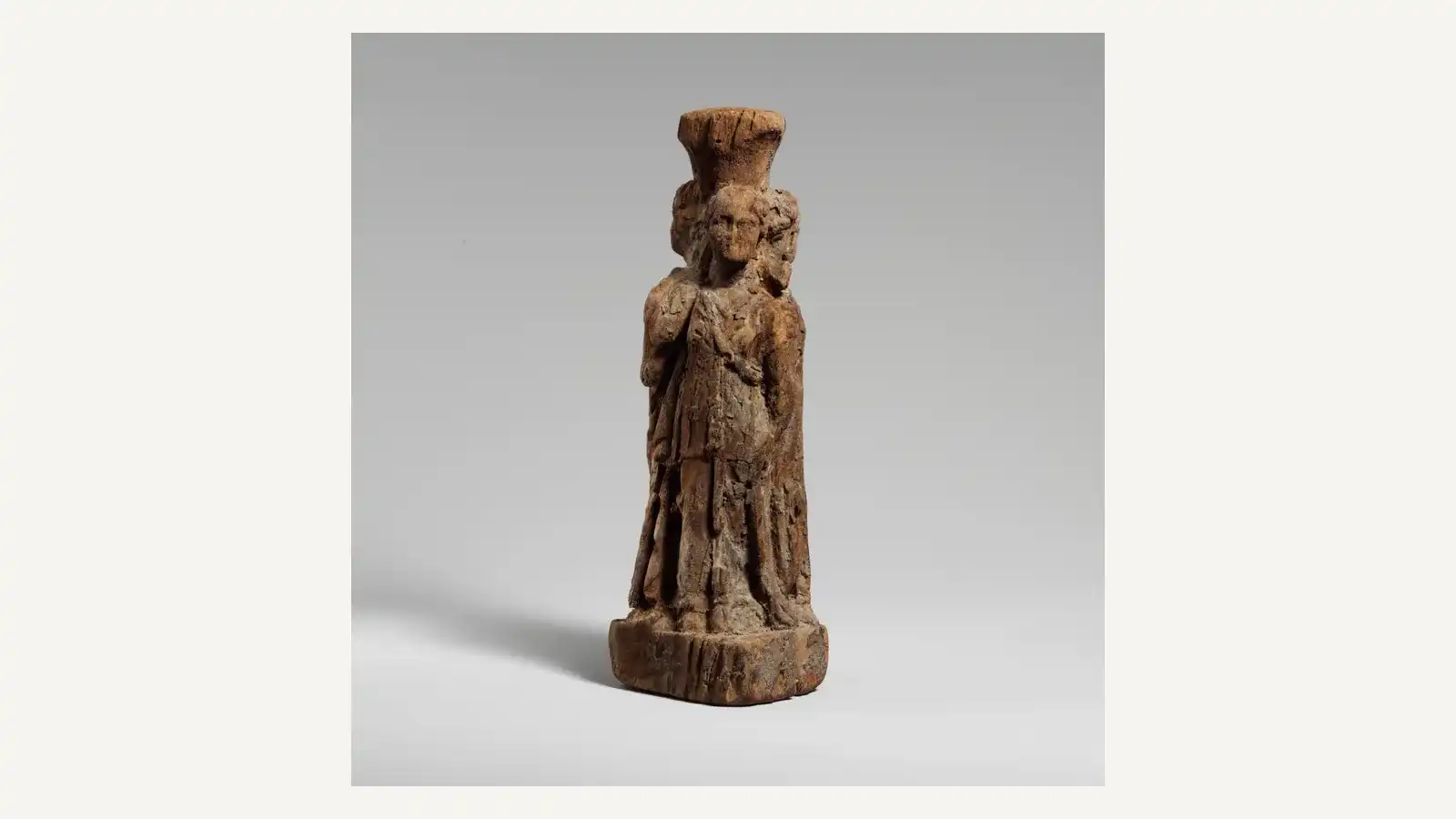
In Athens, writers of the fifth and fourth centuries BCE mention a Hekataion, a little shrine or statue of Hekate at the entrance of a house. Aristophanes mentions these little Hekate shrines standing in front of doors in his comedy Wasps (422 BCE, around line 804).
These shrines were not temples. They were part of the furniture of a household, greeted when you went out and when you came home. That is why this plan starts with a place and a minute of attention. You are copying the scale of ancient practice, not its grand festivals. Most people in antiquity met their gods in this ordinary way, through doorways, meals and the turn of the month.
Historical Ancient Greeks also expected the relationship to grow slowly. The word kharis, which you met in lesson 6, means grace, gratitude and goodwill all at once. It built up through repeated small gifts, the way a friendship builds through repeated small kindnesses. A month is a good unit for that, because the old Athenian calendar was itself lunar and every month ended with Hekate’s suppers.
Variations on the four weeks
The plan works as written, but people live very different lives. Here are tested ways to adapt it without losing its shape.
If you work nights or shifts, tie the daily minute to the start of your sleep instead of the evening. The point is a fixed moment, not a particular hour. If you share a small room, let your shrine be a box or a single card that you take out for the minute and put away again. If you are a parent, you can do the minute while a child brushes their teeth, and let a curious child fill the water cup.
Keep the explanation simple and honest: “This is my quiet minute.” If you are disabled or in pain, do every step lying down or seated, and let the gift in week 3 be a kind thought or a few words, which ancient prayers also counted as gifts.
If you already have a busy spiritual life, slot the plan into what you have rather than adding a new shelf. Many people keep several deities at one altar. Just give Hekate her own corner and her own line in the journal so you can see what this relationship is like.
Questions beginners ask
Do I need to be initiated or dedicated before I start? No. Ancient Greeks greeted their household gods without any initiation. Some modern groups offer dedications, and you can consider that much later, after a year or more, if it still feels right.
What should I write in the journal if nothing happens? Write exactly that. “Stood by the shelf, mind on dinner” is a perfectly good entry. The record shows your rhythm, and over a month you may notice moods, dreams or small coincidences that are worth noting without over-reading them.
How do I know Hekate wants me? You do not need a sign to begin respectful attention. Many devotees never receive a dramatic sign, and that is normal. If you notice something meaningful, write it down and hold it lightly, as lesson 6 suggests.
Can I start in the middle of the month? Yes. Start today, and let the first dark moon you meet be your first Deipnon.
Is it all right to feel nothing? Very much so. Ancient religion was about doing the customary thing well, not about feeling a rush. Feelings come and go. The habit is what grows.
Myths to drop: The idea that you must do a big ritual to “introduce yourself” is modern and unnecessary. The idea that skipping a day angers Hekate has no ancient basis. And the idea that a practice only counts if it costs money is simply untrue: water and time are complete offerings.
When real life gets in the way
You will forget a day. Everyone does. Missing a day, a week or a dark moon is not an offense, and nothing in the ancient evidence suggests that Hekate punishes a gap. Begin again at the next chance, with a sentence of greeting if you like. If you travel, a key on your keyring and a moment of attention at each new doorway make a complete travel practice. Hotel rooms are rarely safe places for a flame, so leave the candle at home.
If you are ill or exhausted, shrink the practice to one breath at your front door, or pause entirely. Rest is not neglect. If housemates or family object, keep it private: a small box you open and close, or just the journal. And if money is tight, remember that water is free and time is an offering. Nothing in this course needs a purchase.
A worked example
Imagine someone starting the plan on the first of the month. In week 1 she stands by her bookshelf shrine every evening while the kettle boils and writes things like “felt silly” and “nice to stop for a minute”. In week 2 she whispers the greeting, and on Saturday tries a prayer before a job interview. In week 3 she forgets the water twice, notices it, and simply refills the cup.
On Sunday of week 4 she reads all her lines in one sitting. She decides to keep the minute by the shelf and the water, and to drop the candle on weeknights because she is too tired to watch it safely. That is a successful first month. She now knows her practice instead of guessing at it.
Try this
Write the four week headings (Place, Words, Gifts, Light and review) on one page of your notebook, with a start date for each. Then do the Week 1 step tonight: one minute in front of your shelf, and one line in the journal.
Journal prompts: What time of day can I honestly protect for one minute? What do I hope this month will show me? At the end of week 4: which step felt most natural, and which felt forced?
Recap
A first month of devotion can be four small steps: a place, then words, then a simple gift, then light and a review of your journal. Each day takes a few minutes. Ancient Greek religion rested on steady custom rather than strong feelings, so ordinary attention is the right start. Gaps are normal, rest is allowed, and nothing needs to be bought. The review at the end tells you what to keep.
What next
Press “Mark as done” and continue with Prayer, offerings and a safe flame, where you learn the three-part prayer for week 2. For setting up the space, see my altar guide, and for the journal, my book of shadows guide.
Further reading: Robert Parker, On Greek Religion (Cornell University Press, 2011), is a clear introduction to how ordinary Greek worship worked. Jon D. Mikalson, Ancient Greek Religion (Wiley-Blackwell, 2nd edition 2010), has good pages on household cult.
Sources
- Hesiod, Works and Days, lines 724 to 726, translated by H. G. Evelyn-White (1914).
- Sarah Iles Johnston, Hekate Soteira (Atlanta: Scholars Press, 1990).
- Robert Von Rudloff, Hekate in Ancient Greek Religion (Victoria, BC: Horned Owl Publishing, 1999).
Quick check
Go deeper: the Hekate pages on this site, and The Novice's Guide to Witchcraft
Get the free Mini-Grimoire
A short printable starter guide to tarot and everyday witchcraft, plus my newsletter. Unsubscribe any time.
Opens Substack in a new tab to confirm. More about the newsletter · Privacy
Comments
Questions and notes from readers. Anyone with a free account can comment, and I reply when I can. Please read the community guidelines.
Comments load from Google Firebase (EU) when you ask for them. Nothing is stored on your device. Privacy