


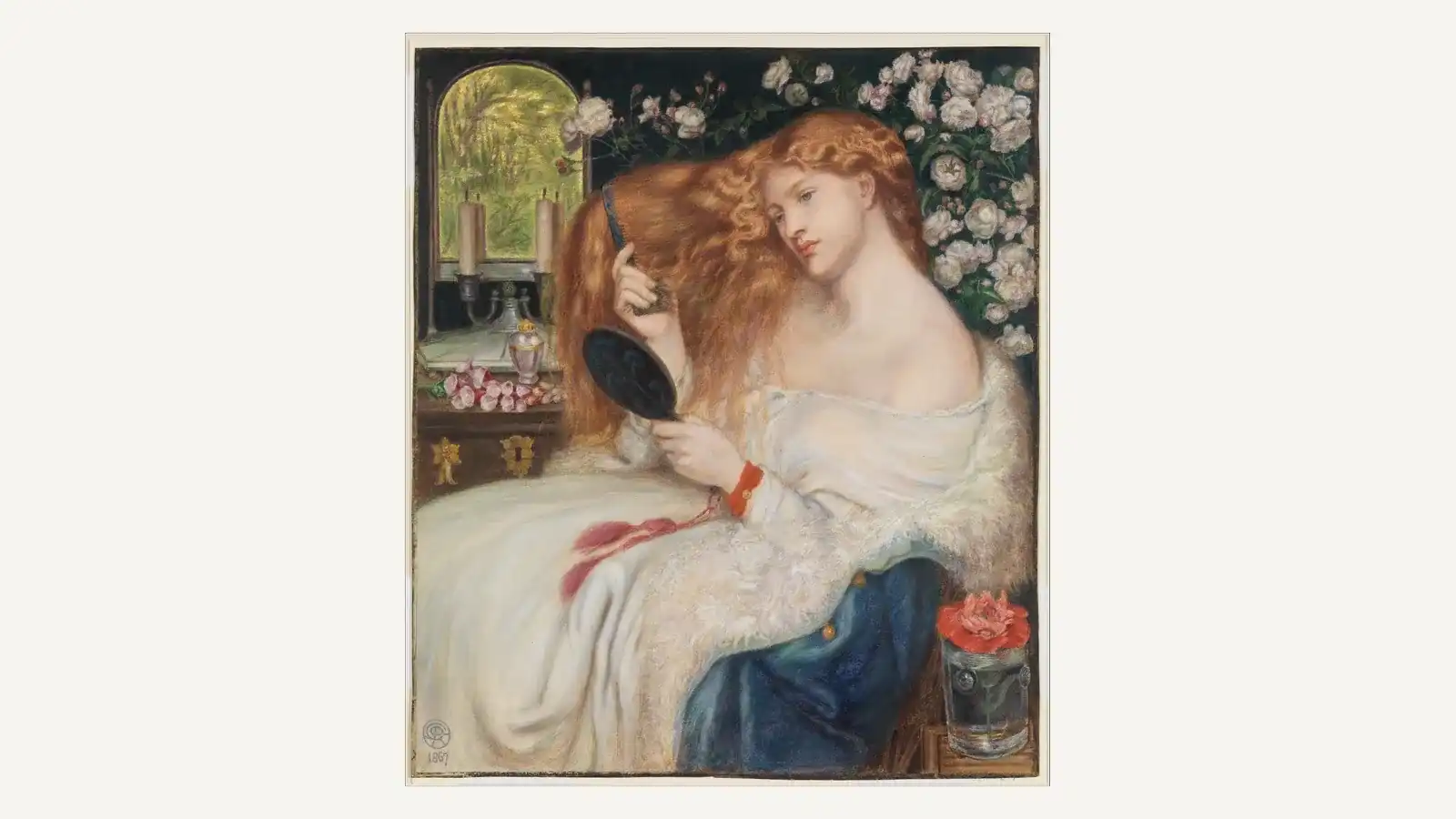
In this lesson: Goethe, Rossetti, Browning and MacDonald, Judith Plaskow and Lilith magazine, and the surprisingly recent Black Moon Lilith.
For most of her history, Lilith was feared: a spirit to keep away from mothers and babies. In the last two hundred years she has become something else entirely, a muse for poets and painters, a feminist heroine, a point in the birth chart and a goddess in modern witchcraft. This lesson follows that transformation and shows how recent it is. At the end, you will check the list you made in lesson 1.
Poets and painters
Modern In Goethe’s Faust, Part One (1808), Faust glimpses Lilith at the witches’ Walpurgis Night, and Mephistopheles warns him about her beautiful hair. That brief scene brought her into European literature.
The English painter and poet Dante Gabriel Rossetti, a founder of the Pre-Raphaelite Brotherhood, painted Lady Lilith from 1866 to 1868 and reworked the face in 1872 to 1873. It shows a woman combing her long hair before a mirror, surrounded by flowers. It is now in the Delaware Art Museum. His sonnet for it, later called “Body’s Beauty”, makes her Adam’s first wife whose hair can trap a young man’s heart.
I describe the painting in words here; you can find it on the museum’s website. Others followed: Robert Browning’s poem “Adam, Lilith, and Eve” (1883), John Collier’s painting Lilith (1887) with a great serpent, and George MacDonald’s fantasy novel Lilith (1895). In the nineteenth century, Lilith became the dangerous, fascinating woman of art.
A feminist heroine
Modern In 1972, at a conference called Women Exploring Theology at Grailville in Ohio, the Jewish theologian Judith Plaskow and other women wrote a short retelling, “The Coming of Lilith”. In it, Lilith and Eve meet across the wall Adam has built, discover how much they share and begin to rebuild the Garden together.
The piece was reprinted in Religion and Sexism (1974), in Womanspirit Rising (1979) and many times since. In 1976 the Jewish feminist magazine Lilith was founded, and from 1997 to 1999 the music festival Lilith Fair toured North America. Many of the people who reimagined Lilith as a heroine were Jewish women, working with and against their own tradition.
Black Moon Lilith and witchcraft today
Modern In 1898 the German astronomer Georg Waldemath reported a second moon of the Earth. It was never confirmed. Early in the twentieth century the astrologer Sepharial gave the name Lilith to this supposed “dark moon”. Today most astrologers who use Black Moon Lilith calculate it as the lunar apogee, the point of the Moon’s orbit farthest from the Earth. There is also an asteroid, 1181 Lilith, discovered in 1927 and named after the French composer Lili Boulanger. All of this is about a century old.
Modern Since the late twentieth century, Lilith has become a widespread figure in witchcraft, astrology, tarot and popular culture, often as a goddess of independence and the night. That is a modern practice drawing on ancient and medieval sources, and when it is honest about that, it can be a rich one.
Lilith in stories for young readers
Modern George MacDonald’s Lilith influenced C. S. Lewis. In The Lion, the Witch and the Wardrobe (1950), Mr Beaver says the White Witch descends from Lilith, Adam’s first wife. Generations of children met Lilith in that one line, as the ancestor of a villain. Since then she has turned up in comics, games and television, usually as a seductive or frightening figure.
How astrologers use her
Modern Astrologers who use Black Moon Lilith calculate it in two main ways: the “mean” position, which moves smoothly, and the “true” or “osculating” position, which wobbles. That is why two websites can give you different Lilith signs. Astrologers usually read her as the place in a chart linked with what is rejected, wild or not tamed. That meaning is drawn from the modern Lilith of art and feminism, not from Mesopotamian or Jewish sources.
Questions beginners ask
Was Lilith the first feminist? In the medieval story she claims equality with Adam. Calling her a feminist is a modern reading, made powerful by Jewish feminists in the 1970s.
Is Black Moon Lilith a real moon? No. It is a calculated point in the Moon’s orbit. The “dark moon” reported in 1898 was never confirmed.
Is it wrong to love the modern Lilith? Not at all. It is a rich modern figure. Just call it modern.
Myths to drop:
- “Lilith was always a symbol of women’s freedom.” For most of her history she was a feared spirit.
- “Rossetti painted an ancient image.” His Lady Lilith is a Victorian painting of a Victorian idea.
- “Black Moon Lilith comes from ancient astrology.” It is about a century old.
A worked example
Imagine a student who wrote in lesson 1: “Lilith is an ancient goddess of female independence.” Now she can trace that sentence. “Ancient” points back to Mesopotamian spirits, who were feared, not worshipped. “Independence” comes from the medieval Ben Sira story, where Lilith refuses to lie beneath Adam, but in that story she is still a threat to babies.
The idea of her as a heroine of women’s freedom belongs to 1972 and Grailville, and “goddess” to modern witchcraft. Her sentence is not wrong as a description of what Lilith means to many people today. It is simply modern, built from older pieces that meant something quite different.
The poems in their own words
Modern Two short quotations show how nineteenth-century writers shaped her. In Bayard Taylor’s 1870 translation of Goethe’s Faust, Mephistopheles points her out: “Tis Lilith.” Faust asks who she is, and he answers: “Adam’s first wife is she. / Beware the lure within her lovely tresses, / The splendid sole adornment of her hair!” Rossetti’s sonnet for his painting opens: “Of Adam’s first wife, Lilith, it is told / (The witch he loved before the gift of Eve,)”.
Notice what both poets take from the medieval story and what they add. They keep “Adam’s first wife” from the Alphabet of Ben Sira. They drop the danger to babies entirely. And they add something new: her hair, her beauty and her power to trap a young man. Rossetti even calls her a witch. In a few lines, the medieval demon has become the fatal beauty of Victorian art.
Reading a painting with words
Since this site describes paintings rather than showing them, here is a way to look at Lady Lilith on the Delaware Art Museum’s website. Look first at what she is doing: combing her hair and gazing into a hand mirror. Then look at the flowers around her and notice that they frame her like a garden. Finally, read Rossetti’s sonnet and ask how the words change what you see. You do not need training in art history. Slow looking and one honest question, “What does the artist want me to feel?”, are enough.
A worked example: tracing a modern Lilith
Imagine you read online: “Black Moon Lilith is the ancient Babylonian goddess of the night, revealed in your chart.” Work through it. Black Moon Lilith: an astrological point named in the early twentieth century and usually calculated as the lunar apogee. Ancient Babylonian: the Mesopotamian spirits were feared, not worshipped, and they are not the same as an astrological point. Goddess of the night: a modern way of honoring her.
Your honest version: “Black Moon Lilith is a modern astrological point named after the Lilith of legend; many astrologers read it as the untamed side of the self.” That sentence respects both astrology and history.
A study variation: one Lilith from each century
Make a short list of Liliths: one from the nineteenth century, such as Rossetti’s; one from the twentieth, such as Plaskow’s “The Coming of Lilith”; and one from today, such as a song, game or tarot deck you know. For each, write one line on what she stands for. Then compare your list with the Mesopotamian and medieval sources from earlier lessons. You will see very clearly that each age has made the Lilith it needed.
More questions beginners ask
Is the modern Lilith less real than the ancient one? No. She is a different layer, honestly named. Modern meanings matter to the people who hold them.
Why do feminists use a figure that began as a demon? Reclaiming a feared figure is a powerful way to question who did the fearing and why. Plaskow’s retelling does exactly that.
A beginner’s worry, answered. “Is it wrong to love the modern Lilith once I know she began as a feared spirit?” Not at all. Knowing her history lets you love her honestly. You can say, “My Lilith is the modern heroine, and I know where she came from.” That sentence is true, proud and respectful at once.
Try this
Take out your list from lesson 1. Label each of your five claims again: ancient, medieval or modern. How many guesses were right? Write one line about the biggest surprise.
Journal prompts: Which modern Lilith, the painter’s, the feminist’s, the astrologer’s or the witch’s, speaks to me most? What do I want to keep from the older, feared Lilith, if anything? How can I hold a modern meaning honestly?
Recap
Lilith’s modern transformation began with Goethe’s Faust in 1808 and grew in nineteenth-century art and literature, including Rossetti’s Lady Lilith, Collier’s painting and MacDonald’s novel. In 1972 Judith Plaskow and others recast her as a feminist heroine in “The Coming of Lilith”, and the magazine Lilith followed in 1976. Black Moon Lilith in astrology is about a century old, and her place in witchcraft is a modern practice drawing on older sources.
What next
Press “Mark as done” and continue with A respectful beginner’s practice. For the painters, read about the Pre-Raphaelites and witches in art.
Further reading: Judith Plaskow, The Coming of Lilith: Essays on Feminism, Judaism, and Sexual Ethics, 1972-2003 (Beacon Press, 2005). Enid Dame, Lilly Rivlin and Henny Wenkart (eds.), Which Lilith? Feminist Writers Re-Create the World’s First Woman (Jason Aronson, 1998). The Delaware Art Museum’s online collection shows Lady Lilith with notes.
Sources
- Johann Wolfgang von Goethe, Faust, Part One (1808), Walpurgis Night scene.
- Delaware Art Museum, Dante Gabriel Rossetti, Lady Lilith (1866 to 1868, altered 1872 to 1873), collection record.
- George MacDonald, Lilith (London, 1895).
- Judith Plaskow, The Coming of Lilith: Essays on Feminism, Judaism, and Sexual Ethics, 1972 to 2003 (Boston: Beacon Press, 2005).
Quick check
Go deeper: the Lilith pages on this site
Get the free Mini-Grimoire
A short printable starter guide to tarot and everyday witchcraft, plus my newsletter. Unsubscribe any time.
Opens Substack in a new tab to confirm. More about the newsletter · Privacy
Comments
Questions and notes from readers. Anyone with a free account can comment, and I reply when I can. Please read the community guidelines.
Comments load from Google Firebase (EU) when you ask for them. Nothing is stored on your device. Privacy