


In this lesson: protection that is your own, not borrowed, safe modern offerings, what never to offer and caring for a reflective altar.
Once people learn about the incantation bowls and amulets made against Lilith, many want a protective element in their own practice. Others want to know what to offer, and what not to. This lesson answers both, and ends with the small habits that keep a reflective altar pleasant and safe for years.
Protection without borrowing
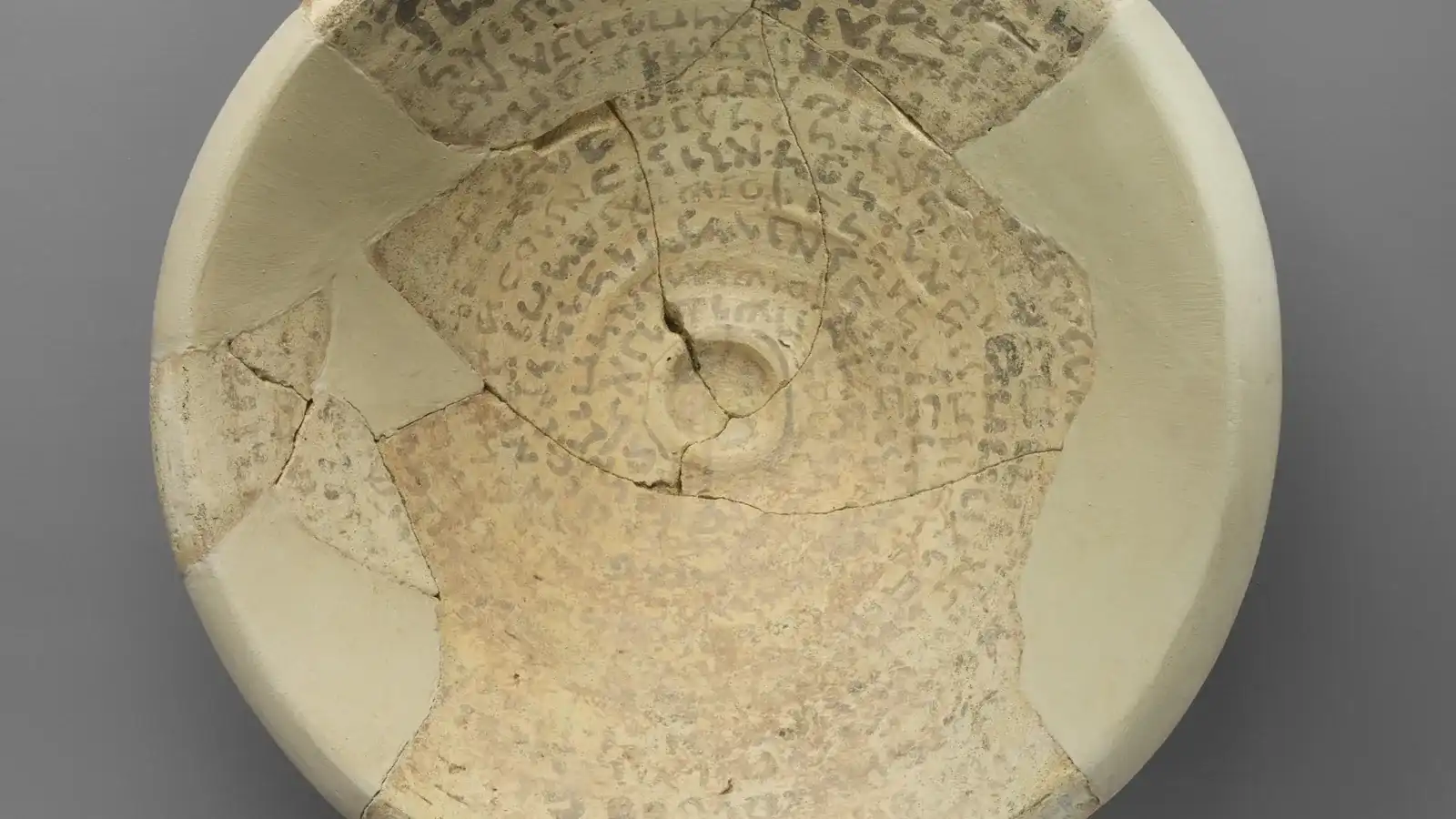
Historical From late antiquity, Jewish families in Mesopotamia buried clay bowls inscribed in Aramaic to trap or drive away demons, liliths among them. James Montgomery published many from Nippur in 1913. One of them, his Text 8, addresses her directly: “Thou Lilith, male Lili and female Lilith, Hag and Ghul”.
Two small plaques from Arslan Tash in Syria are often said to name Lilith too, but their authenticity is debated, and one key line may read “night and day” instead. Later, protective birth amulets named the three angels Sanoi, Sansanoi and Semangelof from the Alphabet of Ben Sira, a medieval work usually dated, roughly, to the eighth to tenth centuries. These are real, moving objects. They belong to a living tradition.
Modern So I suggest protection that is your own. Write a short intention on a card and keep it on your altar. Draw a simple sign that means protection to you, such as a circle, a closed door or your initials in a shape, rather than copying seals from grimoires or Jewish sources.
Make a physical routine: tidy the space, open a window before practice and close it after, wash your hands. These mark a boundary between ordinary time and practice time. And remember that locks, smoke alarms and a charged phone protect you far more reliably than any ritual. Protection as attention and boundaries fits Lilith’s modern meaning well.
How protection against Lilith worked in history
Historical It is worth being honest about a strange fact: for most of history, people did not make offerings to Lilith. They protected themselves from her. The evidence is rich. Aramaic incantation bowls from Mesopotamia, made between about the fifth and seventh centuries CE, were buried upside down under house floors to trap demons, and many name lilith or liliths among them. Some bowls even contain a get, a bill of divorce, issued to Lilith to send her away from a household, a legal formula borrowed from Jewish marriage law.
Historical Later, Jewish families hung amulets around a birthing room. The Sefer Raziel, a book of magic printed in Amsterdam in 1701 and based on older manuscripts, contains a famous amulet naming the three angels Senoy, Sansenoy and Semangelof, who, according to the Alphabet of Ben Sira, made Lilith swear not to harm any child protected by their names. Such amulets were used in some communities well into the twentieth century and can be seen today in museum collections, for example at the Israel Museum in Jerusalem and the Jewish Museum in New York.
What this means for a modern practitioner
Modern Modern devotion to Lilith reverses this history. Since the 1970s, many feminists, witches and occultists have chosen to honor her rather than ward her off. That is a legitimate modern choice, but it brings two responsibilities.
First, do not use the protective amulet texts, the names of the three angels or Hebrew bowl formulas as decorations or “Lilith sigils”. They were written to keep her away from vulnerable babies and are part of a living Jewish heritage. Second, be clear in your own journal that your offerings are a new practice, not a revival of an ancient cult.
There is also a gentle middle path. Some modern Jewish women make birthing amulets that keep the protective tradition and add new prayers. Some witches honor Lilith as a symbol of autonomy while also respecting why their ancestors feared what she stood for: the very real danger of childbirth and infant death in the past. Holding both stories makes your practice deeper.
A worked example of an altar refresh
Here is a monthly altar routine, step by step. On the dark moon, clear everything from the shelf and wipe it with a damp cloth. Look at each object and ask whether it still belongs: a candle stub can be replaced, a dried flower composted, a card that no longer speaks to you put away. Wash the offering cup. Put back only what you will actually tend over the next month. Write one line in your journal about what you kept and why. The whole routine takes ten minutes and keeps the altar alive rather than dusty.
Safe modern offerings
Modern Offerings to Lilith are a modern practice, since the ancient sources describe no cult of her. People give them as signs of respect.
- Water. A small cup, changed daily or at each practice. The simplest offering of all.
- Other drinks. Some offer red wine, pomegranate juice or dark tea. Keep it small and indoors, then pour it down the sink. Never pour alcohol or sweet drinks outdoors, and use juice or water if you are under 18 or do not drink.
- Food. An apple, a pomegranate, a few dark berries or bread. The apple draws on later Christian Eden imagery, and the pomegranate is a modern choice. Remove it within a day and keep it from pets: grapes and raisins are toxic to dogs, and chocolate to dogs and cats.
- Flowers. A single rose, or a poppy as a picture, print or paper flower. Both come from Rossetti’s sonnet on Lady Lilith. The poppy is a symbol only: never eat, drink, smoke or burn any part of it, and keep real poppies away from cats, dogs and horses.
- Words and acts. A poem, a drawing, a page of journaling, or support for a women’s shelter or survivors’ service. That idea is modern, and it suits the figure she has become.
What not to offer. No blood or bodily fluids, whatever some websites say. There is no historical basis, and it raises hygiene, safety and consent problems. No animal harm of any kind. Nothing taken from others without permission, nothing you cannot afford and no Jewish religious items. Water goes on a houseplant, drinks go down the sink, food goes in the bin or compost and faded flowers go in the compost. Do not bury food outdoors, where dogs may dig it up.
Altar care and adapting to your life
Dust the altar weekly. Change the water each time. Remove food and flowers before they spoil, check holders for cracks and wax, and put away anything that no longer feels right. An altar cared for, however simple, says more than an elaborate one gathering dust.
Practice should bend around real lives. With little energy or a chronic illness, practice lying down, or shrink the rite to one breath and one sentence. If writing or candles are hard, use voice memos and a lamp you can switch on easily. With no private space, keep the altar in a box or a phone folder of images. On a tight budget, a notebook, a cup of water and a light you already own are everything you need.
Questions beginners ask
What offerings are traditional for Lilith? None in the sense of an ancient cult, because she was not worshiped. Modern devotees often choose red wine or juice, dark chocolate, roses, apples or written words. Choose what you can afford and dispose of safely.
Is it safe to keep a Lilith altar if I am pregnant or have a baby? Many people do so without any problem. If the historical fear makes you uneasy, it is completely fine to pause the altar during this time. Your peace of mind matters more.
Do I need protection from Lilith herself? Nothing in a respectful practice calls for fear. If you feel frightened, pause, ground yourself and talk to someone you trust.
Can I use a pentagram or other symbols? Yes, if they mean something to you. Just know that the pentagram is not historically linked to Lilith.
Myths to drop: The idea that Lilith “demands” blood, sexual offerings or expensive gifts is a modern invention. The idea that an untidy altar angers her has no source. And the idea that the three angels’ names are a modern Lilith sigil gets the history backward: they were written to keep her away.
A worked example
Imagine someone who shares a flat and keeps her altar in a shoebox. Inside are an LED, a hand mirror, a printed owl and a card that reads “Clear sight and self-respect live here.” Before each practice she opens the window for a minute.
On Fridays she offers a small glass of pomegranate juice and pours it down the sink on Saturday morning. When a website tells her that Lilith “requires” blood, she notes it in her journal as “modern claim, no source, not for me”. Once a month she gives a small amount to a local women’s shelter and writes that down as her offering.
Try this
Write a protective intention for your altar in your own words, on a small card, such as “This space is for clear sight and self-respect. Only what is kind and true is welcome here.” Place it beside a fresh cup of water.
Journal prompts: How do I feel about the long history of fearing Lilith? What on my altar truly belongs there this month? What offering is honest and affordable for me?
Recap
The bowls and birth amulets against Lilith belong to Jewish tradition, so build protection that is your own: a written intention, a sign you design, a routine and real-world safety. Offerings are modern, and the safest are water, a little juice, simple food, a rose or a paper poppy, and acts of support. Never offer blood or harm animals. A cared-for altar and a practice that fits your energy and budget are what make it last.
What next
Press “Mark as done” and continue with The dark moon and letters to Lilith. For more on everyday protection, see my protection guide, and for the bowls and amulets, Lilith in the sources.
Further reading: Dan Levene, A Corpus of Magic Bowls (Kegan Paul, 2003). Joshua Trachtenberg, Jewish Magic and Superstition (1939), a classic study of amulets and folk practice.
Sources
- James A. Montgomery, Aramaic Incantation Texts from Nippur (Philadelphia: University Museum, 1913).
- Dante Gabriel Rossetti, Lady Lilith (painting, 1866 to 1868, altered 1872 to 1873) and the sonnet “Lady Lilith” (published 1870, later retitled “Body’s Beauty”).
- Raphael Patai, The Hebrew Goddess (third edition, Detroit: Wayne State University Press, 1990).
Quick check
Go deeper: the Lilith pages on this site, and The Novice's Guide to Witchcraft
Get the free Mini-Grimoire
A short printable starter guide to tarot and everyday witchcraft, plus my newsletter. Unsubscribe any time.
Opens Substack in a new tab to confirm. More about the newsletter · Privacy
Comments
Questions and notes from readers. Anyone with a free account can comment, and I reply when I can. Please read the community guidelines.
Comments load from Google Firebase (EU) when you ask for them. Nothing is stored on your device. Privacy