


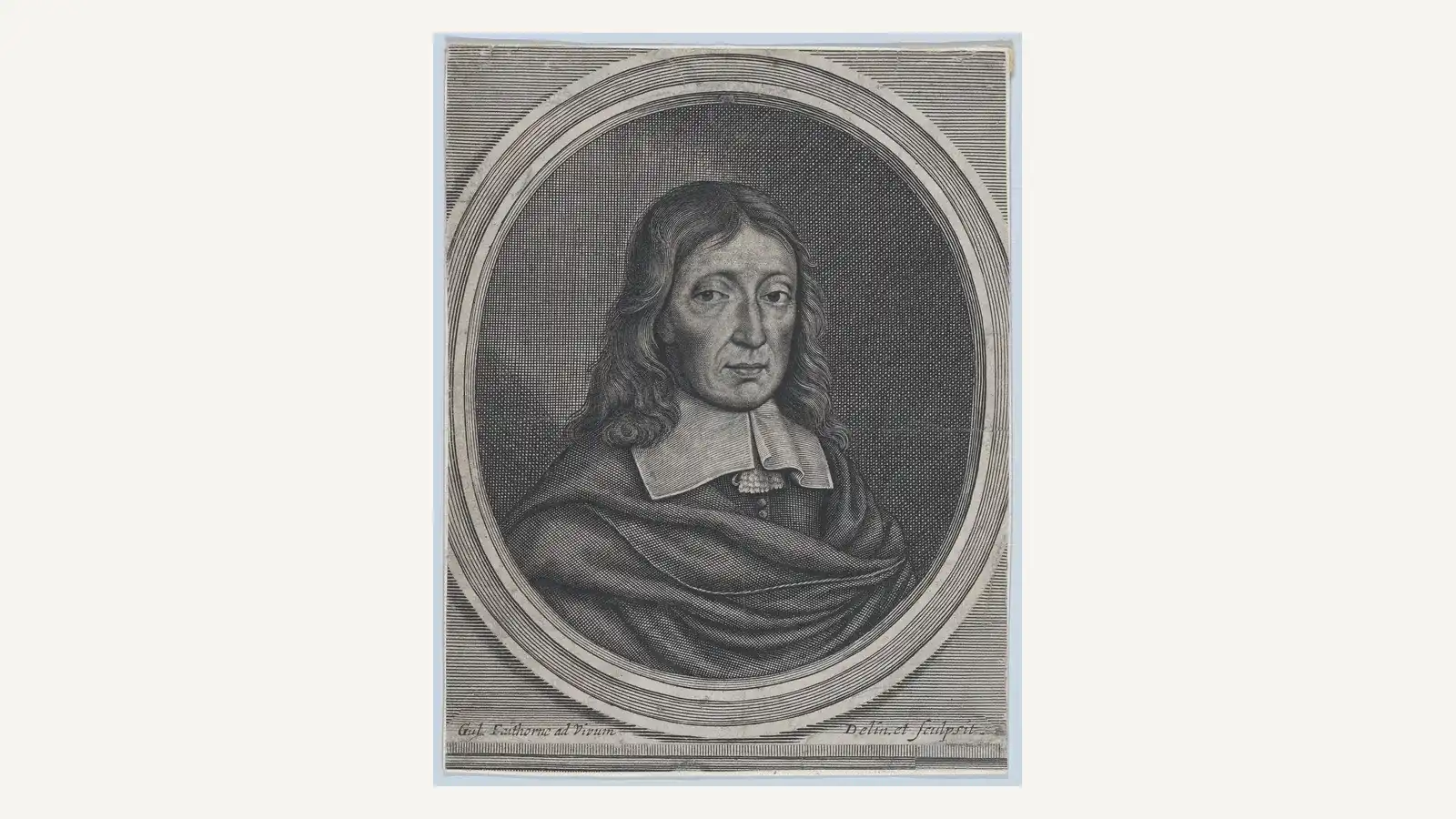
The Lucifer most people picture today, proud, eloquent and tragic, owes more to a seventeenth-century English poet than to any ancient source. Before that poet, medieval Europe imagined Lucifer as a monstrous, frozen giant, and the witch trials turned the Devil into a lord who made pacts with ordinary people. In this lesson you will follow the image from Dante’s Hell through the witch trials to Milton’s Satan and Blake’s playful reversal, and see where our modern picture really comes from.
Dante’s frozen giant
Later tradition In Dante’s Inferno, written in the early fourteenth century, Lucifer stands frozen in ice at the very bottom of Hell (Canto 34). He has three faces, red, yellowish-white and black, with two great bat-like wings under each. Their beating makes the icy wind that freezes the lake. In each mouth he chews a traitor: Judas in the middle, Brutus and Cassius at the sides. He weeps from six eyes and does not speak. Dante’s Lucifer is not glamorous at all. He is huge, stupid and stuck, the end point of betrayal.
Lucifer on the medieval stage
Later tradition Ordinary people met Lucifer less in books than in plays. English towns staged cycles of mystery plays telling the Bible story from creation to the Last Judgment. The York cycle opens with the fall of the angels: Lucifer admires his own brightness, boasts and falls. In carvings and paintings, devils had horns, tails, claws and comic faces. They were frightening, but they were also often mocked.
The pact and the witch trials
Later tradition Older European laws punished harmful magic as a crime. From the fifteenth century, many learned writers began to describe witches as an organized sect who made a pact with the Devil, renounced their baptism, worshipped him at night gatherings called sabbaths and received power to harm in return.
The Malleus Maleficarum, written by the Dominican Heinrich Kramer and first printed around 1486 to 1487, helped spread this picture, though it was one book among many. Tens of thousands of people, most of them women, were executed in the trials that followed. The devil’s pact is a product of this demonology and of confessions often extracted by torture. It is not ancient lore.
Milton’s Satan
Later tradition John Milton published Paradise Lost in 1667 and revised it into twelve books in 1674. His stated aim was to “justify the ways of God to men”. The poem opens in Hell, with the defeated rebels on a burning lake and their leader rising to speak. Milton calls him Satan and uses “Lucifer” only rarely, for the name he bore before his fall.
In Book 7 the angel Raphael tells Adam how “Lucifer from Heaven / (So call him, brighter once amidst the host / Of Angels, than that star the stars among,) / Fell with his flaming legions through the deep” (7.131 to 134). Milton’s Satan is eloquent, proud and tragic, which is exactly why readers found him so compelling.
Blake and the Romantics
Later tradition William Blake, poet and engraver, wrote The Marriage of Heaven and Hell around 1790 to 1793. It playfully gives energy and desire to “Hell” and reason and restraint to “Heaven”. Blake famously wrote that Milton “was a true poet, and of the Devil’s party without knowing it.” His “Proverbs of Hell”, such as “The road of excess leads to the palace of wisdom”, are often quoted online as occult doctrine. They are poetry, written by a deeply Christian, if unorthodox, visionary. Later Romantics such as Byron and Shelley also admired Milton’s rebel.
After Milton
Later tradition In the Romantic era, poets turned Milton’s Satan into a hero of rebellion. Percy Bysshe Shelley, in the preface to Prometheus Unbound (1820), compared his Prometheus with Milton’s Satan and found Satan the more troubling figure. Lord Byron’s play Cain (1821) gave Lucifer long speeches about knowledge and doubt. Goethe’s Faust (Part One, 1808) made Mephistopheles witty and worldly. In 1866 Gustave Doré published his famous engravings for Paradise Lost, and they still shape how many people picture Milton’s fallen angels.
Dante’s lines, in Longfellow’s translation
Later tradition Henry Wadsworth Longfellow’s translation of the Inferno (1867) is free on Project Gutenberg. In Canto 34 Dante sees him at last: “The Emperor of the kingdom dolorous / From his mid-breast forth issued from the ice.” A few lines later he reflects: “Were he as fair once, as he now is foul, / And lifted up his brow against his Maker, / Well may proceed from him all tribulation.”
Notice that Dante keeps the old idea of beauty lost through pride, the idea built from Isaiah and Ezekiel. But he gives it a bleak, almost comic ending. The once-fair angel is now an enormous, silent machine of punishment, stuck in ice. Dante’s readers were meant to feel horror and pity, not admiration.
Milton’s Satan in his own voice
Later tradition Milton’s Satan, by contrast, speaks magnificently. Just before his famous line about reigning in Hell, he says: “The mind is its own place, and in itself / Can make a Heaven of Hell, a Hell of Heaven.” Many readers find this thrilling, and Milton meant it to be. Over the poem, however, Satan shrinks: he takes the shapes of a cormorant, a toad and finally a serpent. Milton shows grandeur turning into self-deception. Reading only the opening books gives you the hero many Romantics loved; reading to the end gives you Milton’s warning.
A reading variation: two devils in one evening
Read Canto 34 of the Inferno and the first three hundred lines of Paradise Lost, Book 1, one after the other. For each, write three words for how the figure looks, three for how he speaks and one line on what the poet wants you to feel. You will see in a single evening how the medieval and early modern imaginations differ: Dante’s silent monster and Milton’s eloquent rebel.
A worked example: tracing a quotation
Imagine you see “Better to reign in Hell than serve in Heaven” on a T-shirt with the caption “Lucifer’s ancient creed”. Work through it. Who wrote it? John Milton, in Paradise Lost, Book 1, published in 1667. Who speaks it? Satan, in a poem that ultimately judges him. Is it ancient? No, it is seventeenth-century English poetry. Your honest version: “Milton gave these words to Satan in Paradise Lost (1667).” Knowing the source does not spoil the line. It lets you enjoy it as great poetry rather than as a fake scripture.
More questions beginners ask
Was Milton secretly on Satan’s side? No. Milton was a devout Protestant who wrote to justify God’s ways. Blake’s famous remark is a poet’s comment on where Milton’s imagination ran most freely, not a claim about his beliefs.
Which translation of Dante should I read? Longfellow’s is free and faithful but old-fashioned. Many readers enjoy a modern verse or prose translation with notes alongside it.
Questions beginners ask
Did Milton secretly side with Satan? Blake thought so, playfully. Most scholars think Milton meant Satan’s eloquence to be seductive and wrong, and that readers are meant to feel its pull and then see through it.
Was the Malleus Maleficarum official church teaching? No. It was influential, but it was never an official church document, and some contemporaries criticized it.
How many people died in the witch trials? Historians estimate tens of thousands of executions in Europe from about 1450 to 1750. Claims of millions are not supported.
Myths to drop:
- “Medieval people saw Lucifer as glamorous.” The glamorous rebel is mostly Milton’s and the Romantics’ creation.
- “Nine million witches were burned.” That number has no basis in the records.
- “The pact is an ancient tradition.” It belongs to medieval and early modern demonology.
A worked example
Imagine you see a popular image online: a beautiful, sorrowful winged figure with a quote underneath, “Better to reign in Hell, than serve in Heaven”, labelled “Lucifer’s ancient creed”. Trace it. The quote is from Paradise Lost, Book 1, spoken by Milton’s Satan in 1667. The beautiful, tragic rebel is Milton’s creation, admired by Blake and the Romantics. The idea that it is an “ancient creed” has no source at all. Put Dante’s three-faced giant chewing traitors in the ice next to it, and you can see how much our picture changed in three and a half centuries.
A beginner’s worry, answered. “Are these old poems too hard for me?” Not if you read them slowly and in short pieces. Read ten or twenty lines at a time, aloud if you can, with a modern summary of the canto or book beside you. Poetry meant for listeners often makes more sense heard than seen, and nobody reads Milton fast.
Try this
Write two short descriptions of Lucifer, one as Dante saw him and one as Milton saw him. Then write one line on which picture is closer to the one you grew up with, and where you think you first met it.
Journal prompts: Which Lucifer do I picture first, Dante’s, Milton’s or a modern one? Why might a defeated rebel be so attractive to readers? How does the history of the trials change the way I hear the word “pact”?
A quick self-check. Put these in order: Dante’s Inferno, the second edition of Paradise Lost, Blake’s Marriage of Heaven and Hell. (Early fourteenth century, 1674, around 1790.)
Recap
Dante’s Inferno places Lucifer frozen in ice at the bottom of Hell, a three-faced, silent giant chewing traitors. From the fifteenth century, demonologists such as the author of the Malleus Maleficarum described witches as a sect bound to the Devil by pacts, an idea that fueled deadly trials. Milton’s Paradise Lost (1667, 1674) created the eloquent, tragic Satan most people picture today, and Blake and the Romantics admired that rebel, Blake saying Milton was “of the Devil’s party without knowing it”.
What next
Press “Mark as done” and continue with Occultism and modern Luciferianism. For the trials, read the history of witchcraft, and for Blake and his age, see Romanticism.
Further reading: John Milton, Paradise Lost, edited by Gordon Teskey (Norton Critical Edition, 2nd ed. 2020). Neil Forsyth, The Satanic Epic (Princeton University Press, 2003). Brian P. Levack, The Witch-Hunt in Early Modern Europe (4th ed., Routledge, 2016).
Sources
- Dante Alighieri, Inferno, Canto 34.
- Heinrich Kramer, Malleus Maleficarum (first printed about 1486 to 1487).
- John Milton, Paradise Lost, 2nd edition (1674), books 1 and 7.
- William Blake, The Marriage of Heaven and Hell (about 1790 to 1793).
Quick check
Go deeper: the Lucifer pages on this site
Get the free Mini-Grimoire
A short printable starter guide to tarot and everyday witchcraft, plus my newsletter. Unsubscribe any time.
Opens Substack in a new tab to confirm. More about the newsletter · Privacy
Comments
Questions and notes from readers. Anyone with a free account can comment, and I reply when I can. Please read the community guidelines.
Comments load from Google Firebase (EU) when you ask for them. Nothing is stored on your device. Privacy