


How to read the labels Historical what the old sources say. Later tradition what later writers added. Modern modern practice and my own notes.
Romanticism is the movement in European art, music and literature from about 1790 to 1850 that valued emotion, imagination, nature and the individual over reason and rules. Its key painters include Caspar David Friedrich in Germany, J. M. W. Turner and John Constable in England, Francisco Goya in Spain and Eugène Delacroix and Théodore Géricault in France.
Romanticism was less a style than an attitude: wild nature over neat gardens, and the past, the exotic and the supernatural over everyday life. For a witch, this is home territory: moonlight, storms, ruins, nightmares and visions all come into art here.
Key dates
| When | What happened |
|---|---|
| 1757 | Edmund Burke publishes his essay on the sublime and the beautiful. |
| 1781 | Henry Fuseli paints The Nightmare. |
| 1799 | Goya publishes Los Caprichos, with The Sleep of Reason Produces Monsters. |
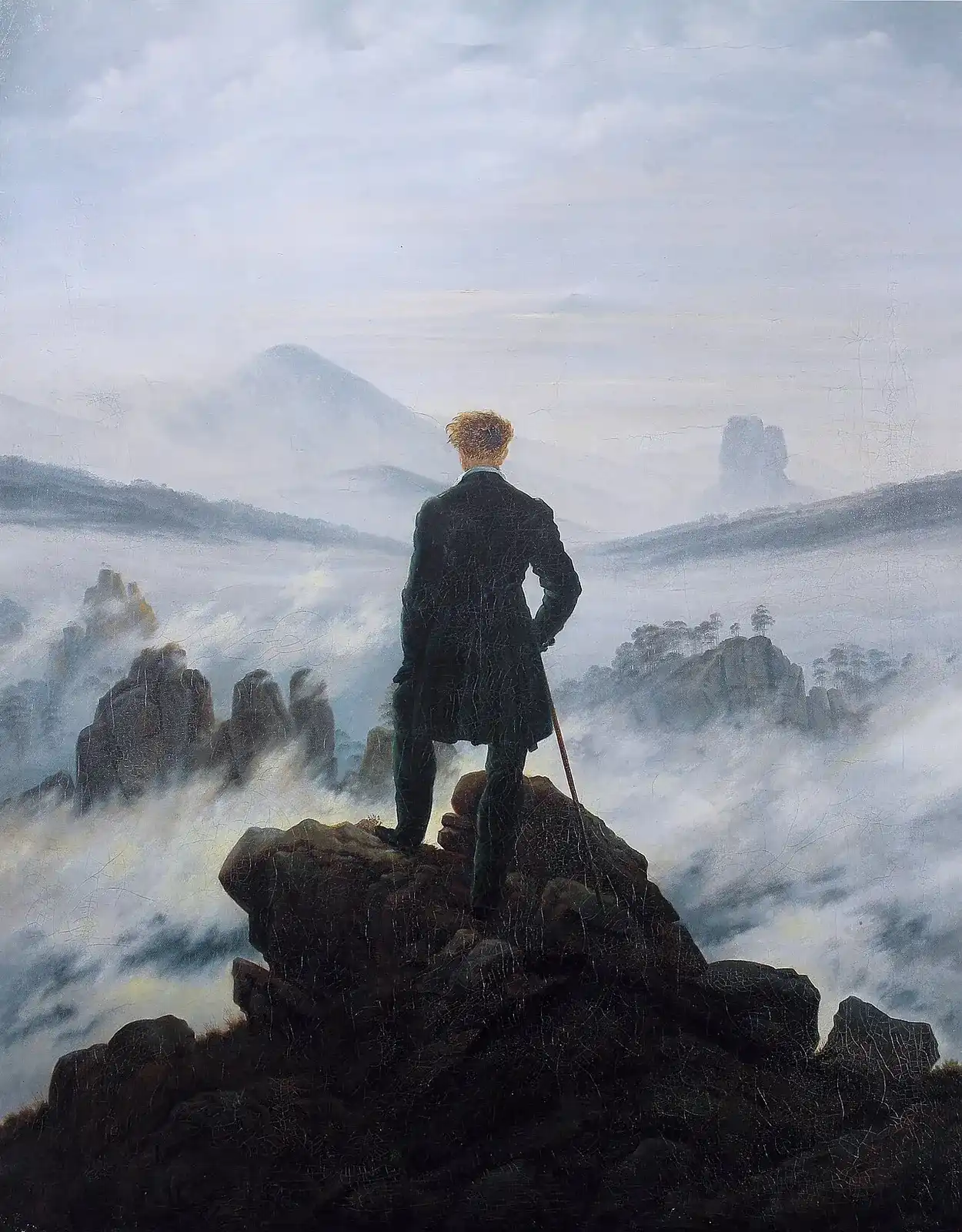
| About 1817 | Friedrich paints Wanderer above the Sea of Fog. |
| 1844 | Turner paints Rain, Steam and Speed. |
What is Romanticism?
Romanticism is art that puts feeling, wonder and the power of nature at its centre, often in reaction to Enlightenment reason and industrial change.
Throughout this page I mark three layers. Historical What the works and records show. Later tradition The myths about the artists. Modern How witches and artists use these images now.
Historical The sublime. In 1757 the Irish philosopher Edmund Burke separated the beautiful, which is small, smooth and pleasing, from the sublime, which is vast, dark and terrifying, a kind of delightful horror.
Storms, abysses and ruins became favorite subjects. At the same time, poets such as Wordsworth, Coleridge and Novalis wrote about nature as alive and full of spirit, and painters read them.
Goya. 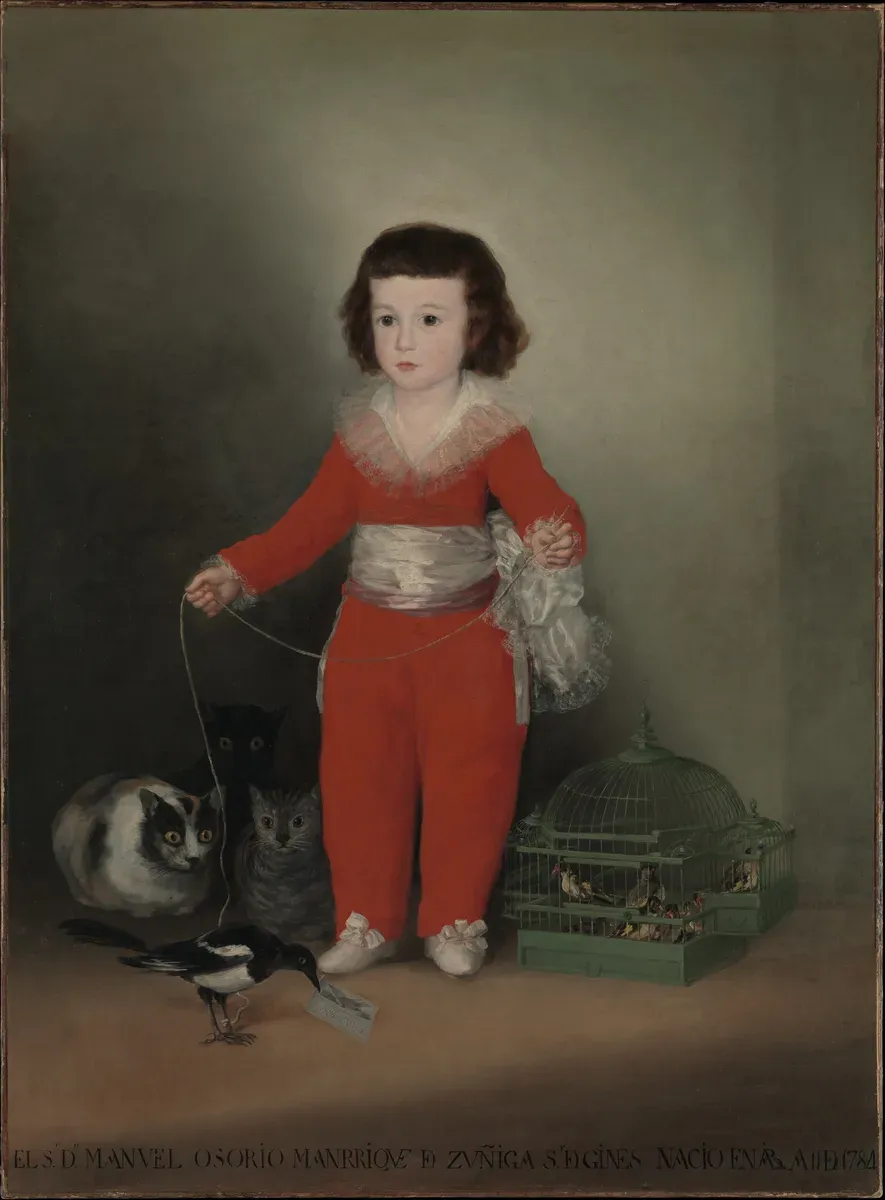
Goya, Manuel Osorio Manrique de Zuñiga (1784 to 1792), 1787 to 1788. The Metropolitan Museum of Art (49.7.41). Image: Open Access, public domain (CC0).
Historical Francisco Goya (1746 to 1828) was court painter to the Spanish kings. His portrait of the child Manuel Osorio, 1787 to 1788, shows a boy in red holding a magpie on a string while cats stare from the shadows; whether it warns about the fragility of childhood is debated.
Goya went deaf after an illness in 1792 to 1793. In 1799 he published Los Caprichos, eighty etchings mocking superstition, corruption and the Inquisition. Plate 43 shows the artist asleep while owls and bats swarm: “The sleep of reason produces monsters.”
Historical Turner and Friedrich. J. M. W. Turner (1775 to 1851) painted light and weather until his late canvases dissolved into swirling color. In Whalers, about 1845, the boat is almost lost in spray. Turner claimed he had himself tied to a mast in a storm to paint Snow Storm (1842); the story cannot be verified.
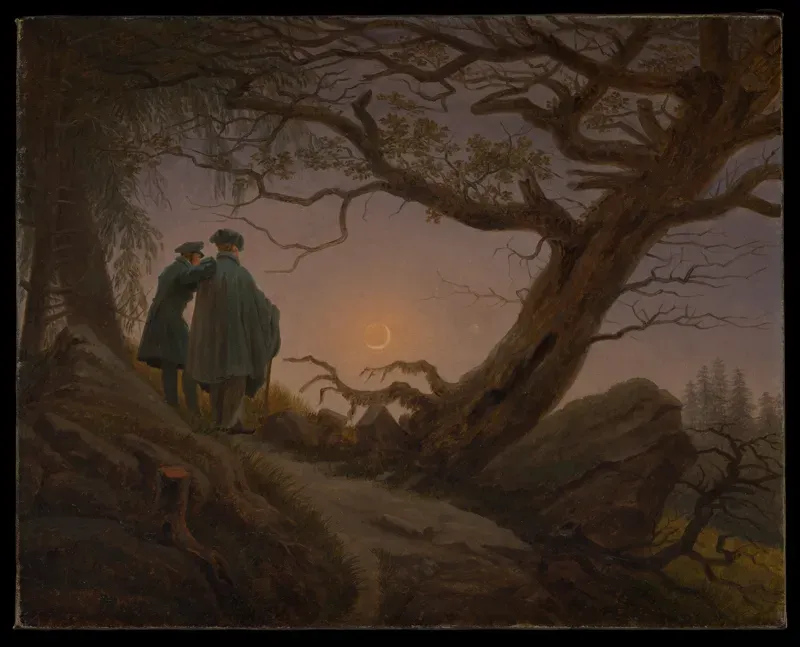
Caspar David Friedrich, Two Men Contemplating the Moon, about 1825 to 1830. The Metropolitan Museum of Art (2000.51). Image: public domain.
Caspar David Friedrich (1774 to 1840) painted solitary figures seen from behind, facing mountains, seas and moonlit skies. A devout Protestant, he is often read as a painter of spiritual meditation, though how far to read him as allegory is debated.
Historical Delacroix. Eugène Delacroix (1798 to 1863) led French Romanticism with blazing color. Liberty Leading the People (1830) celebrates the July Revolution. After a trip to Morocco in 1832 he painted North African scenes, and Linda Nochlin’s essay “The Imaginary Orient” (1983) showed how such pictures presented the region as exotic and timeless, reflecting colonial attitudes.
Key artists
| Artist | Lived | Why they matter |
|---|---|---|
| Henry Fuseli | 1741 to 1825 | The Swiss-born painter of nightmares and Shakespearean witches. |
| Francisco Goya | 1746 to 1828 | Court painter and maker of dark, satirical prints about witches and folly. |
| Caspar David Friedrich | 1774 to 1840 | The German painter of lonely figures before vast nature. |
| J. M. W. Turner | 1775 to 1851 | The English painter of storms, light and steam. |
| Eugène Delacroix | 1798 to 1863 | The French painter of passion and color. |
How do you recognise Romanticism?
Look for feeling over reason: storms, ruins, moonlight, mountains and seas that dwarf the people in them. Figures are seen from behind, looking out. Brushwork loosens and color heats up. Subjects come from dreams, folk tales, history and the supernatural.
Common misconceptions. One is that Romantic means romantic love. It comes from the medieval “romance”, a tale of adventure and imagination, and the movement is as much about storms, terror and longing as about love.
Another is that it is a single style. Turner’s swirling light, Friedrich’s still clarity and Delacroix’s colour look nothing alike. A third is that women were absent. Marie-Denise Villers, Constance Mayer and Louise-Adéone Drölling painted in France, and Mary Shelley’s Frankenstein of 1818 is a key Romantic work.
Esoteric themes
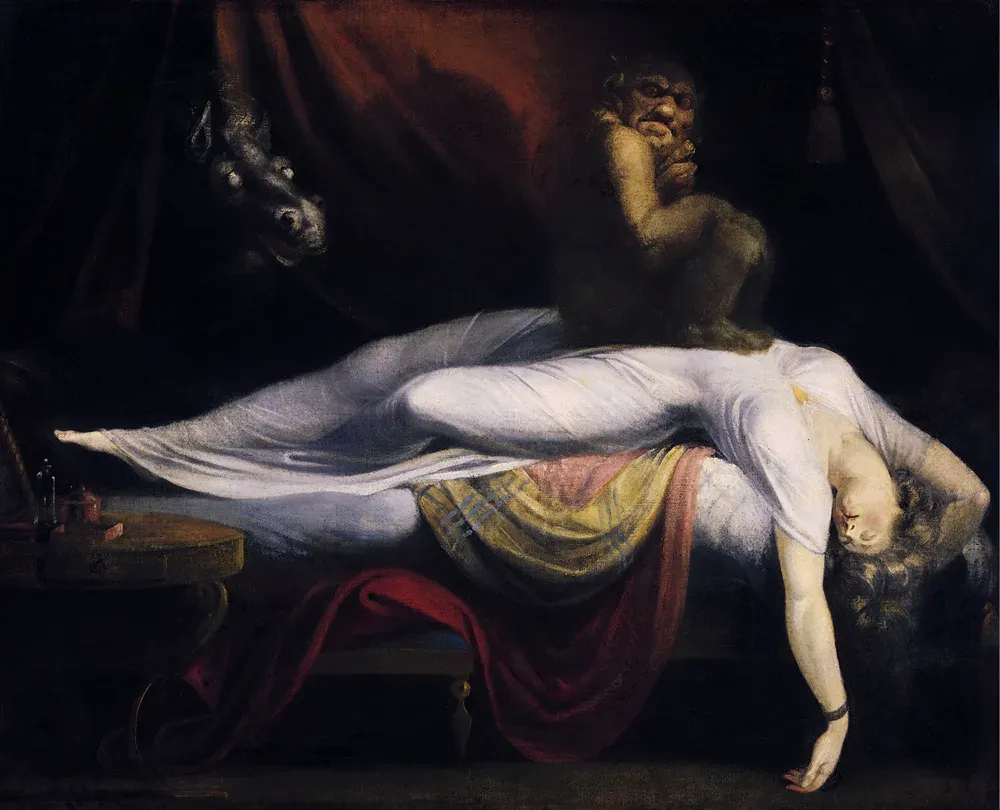
Henry Fuseli, The Nightmare, 1781. Detroit Institute of Arts (55.5.A). Image: public domain.
Historical Henry Fuseli’s The Nightmare (1781) made a sensation at the Royal Academy with its goblin crouched on a sleeper’s chest. Goya filled the Caprichos with witches, and between 1819 and 1823 he painted a witches’ sabbath among the Black Paintings on the walls of his house.
These are satire, not portraits from the inside. William Blake (1757 to 1827) made his own mythology in illuminated books printed by a method he invented, and described visions all his life. That he had them and recorded them is documented; what they were is a matter of belief.
Later tradition Stories that Goya went mad are speculation; his deafness is documented.
Modern Blake and Friedrich are beloved by modern witches. I see why, and I explore the night side in Moon and night and Witches in art.
Works to see
| Work | Artist | Date | Where to see it |
|---|---|---|---|
| Wanderer above the Sea of Fog | Caspar David Friedrich | about 1817 | Hamburger Kunsthalle, Hamburg |
| Two Men Contemplating the Moon | Caspar David Friedrich | about 1825 to 1830 | The Metropolitan Museum of Art, New York |
| The Sleep of Reason Produces Monsters | Francisco Goya | 1799 | The Metropolitan Museum of Art, New York |
| The Nightmare | Henry Fuseli | 1781 | Detroit Institute of Arts |
| Whalers | J. M. W. Turner | about 1845 | The Metropolitan Museum of Art, New York |
Every work in this list is free of nudity, so you can look them up with confidence. Works still in copyright are named but not shown here.
How to look at a Romantic painting
Look at the weather and the scale: how small are the people compared to the sky, the sea or the mountains? Then ask what feeling the painting asks of you. Awe, fear, nostalgia, longing? That feeling, the sublime, is often the real subject.
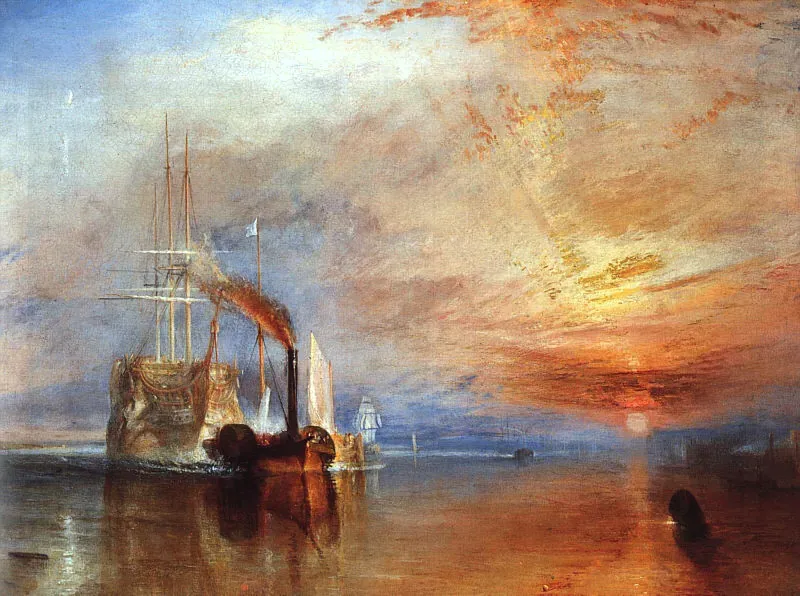
J. M. W. Turner, The Fighting Temeraire, 1839. National Gallery, London. Image: Wikimedia Commons, public domain.
J. M. W. Turner, The Fighting Temeraire, 1839. At the National Gallery in London. The Temeraire fought at Trafalgar in 1805 and was towed to be broken up in 1838. Turner painted her pale and ghostly behind a dark modern tug, with the sun going down. He took liberties: her masts had already been removed. In 2005 it was voted Britain’s greatest painting in a BBC Radio 4 poll.
Romanticism reacted against Neoclassicism while overlapping with it, inspired National Romanticism and the Pre-Raphaelites, and was followed by Realism. Its dreams and visions came back in Symbolism and Surrealism.
Try this
Look at Goya’s Caprichos plate 43 on the Prado or Met website. Write down every creature you see. Then write one sentence: what monster does your own “sleep of reason” produce?
What next
Before this: Neoclassicism.
After this: Pre-Raphaelites.
Also worth reading alongside it: Symbolism.
See every movement in order on the art movements timeline, or learn to look step by step in the free Art History for Beginners course.
If you want to carry this into tarot and practice, these pages connect to it: The Hermit, the lone figure on the height, looking inward and outward; The Moon, night, dreams and the uncanny; A close reading of The Nightmare; and The sublime and the witch in Romantic art.
Sources
- Edmund Burke, A Philosophical Enquiry into the Origin of Our Ideas of the Sublime and Beautiful (1757).
- Francisco Goya, Los Caprichos (1799).
- Linda Nochlin, The Imaginary Orient (1983).
- The Metropolitan Museum of Art, Whalers, 96.29. Open the record
- The Metropolitan Museum of Art, Manuel Osorio Manrique de Zuñiga, 49.7.41. Open the record
- E. H. Gombrich, The Story of Art (1950).
- Wikimedia Commons, Wanderer above the Sea of Fog (hero image record). Open the record
- Hugh Honour, Romanticism (1979).

Questions
What is the sublime?
In 1757 Edmund Burke separated the beautiful, small and pleasing, from the sublime, vast, dark and terrifying, which gives a kind of delightful horror. Storms, mountains and ruins became Romantic favorites.
Did Goya believe in witches?
His witches are Enlightenment satire. They mock superstition, ignorance and the cruelty of the Inquisition rather than show witchcraft from the inside.
Where can I see works of Romanticism in person?
Good places to start are Madrid (the Prado), London (Tate Britain), Berlin, Hamburg, Paris, Detroit, and the Met. Museums change their displays, so check the collection page before you travel.
Who are the main Romantic painters?
Caspar David Friedrich, J. M. W. Turner, John Constable, Francisco Goya, Eugène Delacroix, Théodore Géricault, William Blake and Philipp Otto Runge.
What is the sublime in Romantic art?
The sublime is the feeling of awe mixed with fear before something vast or powerful, such as storms, mountains or the sea. Edmund Burke described it in 1757, and Romantic painters made it a central theme.
Where can I see Romantic paintings?
The National Gallery and Tate Britain in London for Turner and Constable, the Louvre in Paris for Delacroix and Géricault, the Prado in Madrid for Goya, and the Alte Nationalgalerie in Berlin and the Hamburger Kunsthalle for Friedrich.
Is Goya a Romantic painter?
Often, yes. Goya worked as a court painter in Madrid, but his prints Los Caprichos of 1799 and his late Black Paintings, now in the Prado, share the Romantic fascination with dreams, terror and the irrational. Some historians prefer to see him as a unique figure between eras.
Get the free Mini-Grimoire
A short printable starter guide to tarot and everyday witchcraft, plus my newsletter. Unsubscribe any time.
Opens Substack in a new tab to confirm. More about the newsletter · Privacy