


| Arcana | Minor Arcana: Cups |
|---|---|
| Image | RWS 1909 (PD) |
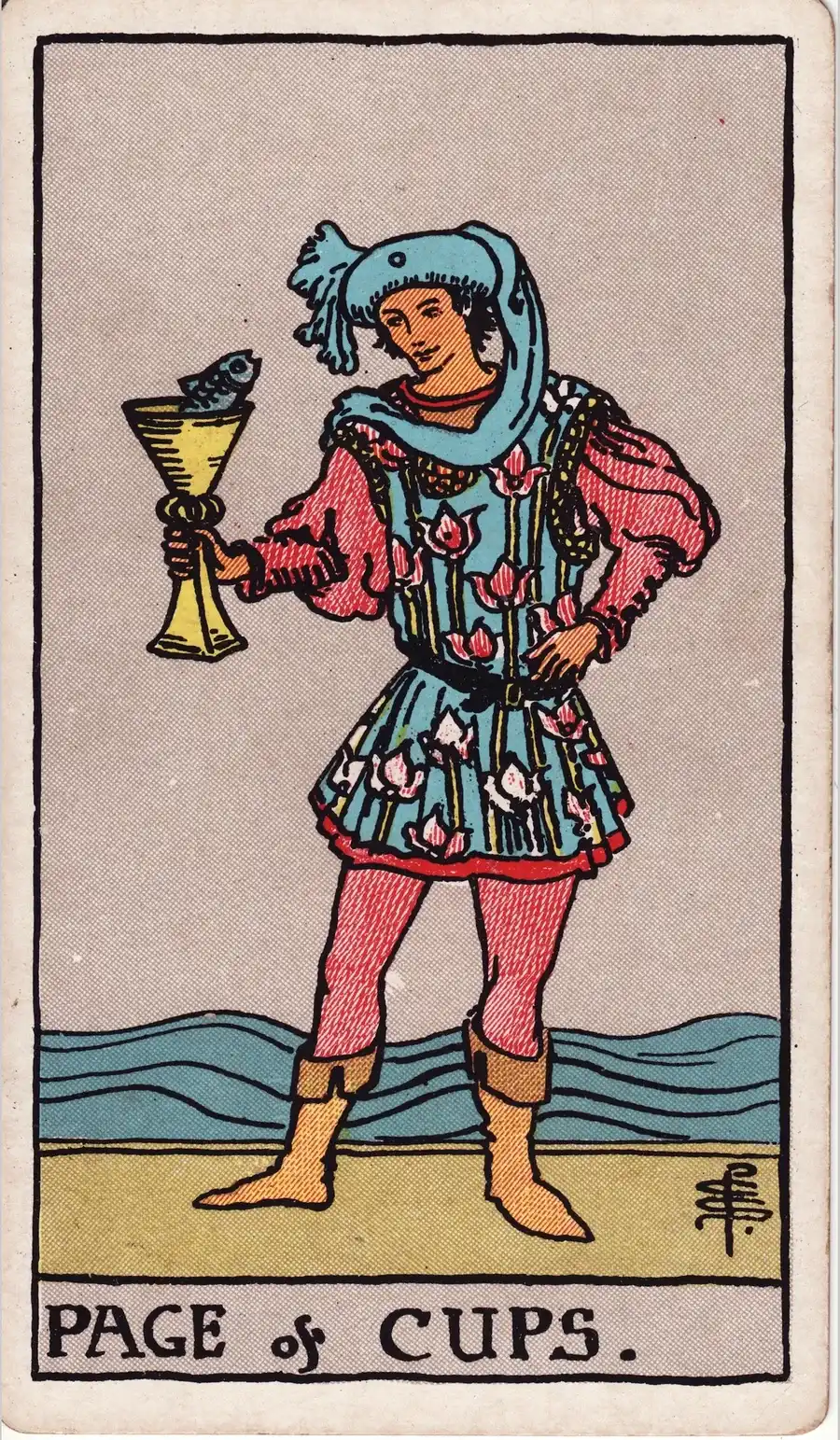
The Page of Cups stands by the sea holding a cup, and a small fish pokes its head out of it to look at them. The Page looks back, curious and not at all alarmed.
It is the student of the water suit: intuition, creativity and an open heart. This page covers what the Page of Cups means upright and reversed, the symbols in the 1909 card and how to read the Page as a person or an energy.
Here is the Page of Cups at a glance.
| At a glance | This card |
|---|---|
| Upright keywords | intuition, creativity, emotional openness |
| Reversed keywords | emotional immaturity, insecurity, disappointment |
| Rank | Page, one of the four court cards of Cups |
| Golden Dawn title | Princess of the Waters and the Lotus Later tradition |
| Golden Dawn rank | Princess in both the Golden Dawn and the Thoth deck Later tradition |
| Element within the suit | Earth of Water Later tradition |
| Astrology | In Book T, a quarter of the heavens: Libra, Scorpio and Sagittarius, centered on Scorpio Later tradition |
| Tree of Life | Malkuth (10), the Kingdom Later tradition |
| Astrology printed on my first deck | Venus, Pisces Modern |
| Suit and element | Cups, Water Later tradition |
| Yes or no | Maybe Modern |
In Book T the Page is the Princess of the Waters and the Lotus, Earth of Water, on Malkuth. Like the other Princesses she rules a quarter of the heavens around the North Pole, here the one centered on Scorpio, and serves as the throne of the Ace of Cups. The astrology printed on my first deck is a separate, later system.
The card: what Pamela Colman Smith drew
Waite described “a fair, pleasing, somewhat effeminate page, of studious and intent aspect” who “contemplates a fish rising from a cup to look at him. It is the pictures of the mind taking form.” That last sentence is a lovely description of imagination.
The fish in the cup. A fish has appeared where you would expect a drink. It is surprising, a little funny and full of meaning. Ideas and feelings often arrive this way, out of nowhere.
The lotus tunic. The Page’s tunic is patterned with lotus flowers, which grow out of water and open to the light. Feeling is the Page’s soil.
The gentle sea. Behind the Page the sea is calm, with small waves. The emotional world is close and safe enough to explore.
Upright meaning
Upright, the Page of Cups is emotional curiosity. A young person stands by the sea, holding a cup from which a small fish peeks out. The Page looks at it with interest rather than alarm. It is the card of imagination, intuition, sensitivity and surprises from the heart.
The fish is something unexpected coming out of the cup, a feeling, an idea or a message you did not plan for. In readings it often brings news of love, an invitation, a creative idea or a new emotional beginning. It also speaks of artistic and intuitive gifts that are just starting to show.
The Page asks you to stay open, playful and curious about your own feelings. Let them surprise you.
Reversed meaning
Reversed, the Page of Cups can show emotional immaturity, moodiness, or a creative block. It may also show disappointment, a message that is not what you hoped for, or a crush that turns out to be a fantasy.
Ask whether you are taking your feelings seriously or letting them rule you. A reversed Page often needs gentleness and some time to grow.
Reversed, the Page can also be an inner child who feels unheard. If an old sensitivity has flared up recently, treat it the way you would treat a young person who came to you upset: listen first, explain later, and do not laugh at the fish.
In love, work and spirituality
In love. Upright: A sweet new crush, a romantic message or tender feelings. Reversed: Emotional immaturity, or a crush that does not develop.
At work. Upright: A creative idea, or work in art, care or imagination. Reversed: A creative block, or sensitivity making work harder.
With money. Upright: Small creative earnings, or money linked to art. Reversed: Impulsive emotional spending.
In spiritual practice. Upright: Intuition, dreams and messages from the unconscious. Reversed: Doubting your own intuition.
As feelings. Shy affection and curiosity. They may have feelings but be unsure how to show them.
As a person. A sensitive, imaginative and gentle young person, or someone young at heart.
As advice. Stay open to surprises from your own heart.
Reading the Page of Cups: positions and yes or no
In the past position: A creative or emotional beginning set you on this path. In the present position: A new feeling or idea is surfacing. Follow it gently.
In the future position: A sweet message or creative chance is coming. As advice: Trust the small, strange idea.
In modern yes or no readings, the Page of Cups is a maybe. It is gentle and hopeful, but still young, so it is a maybe.
The page in the tarot court, and the history behind the card
As the youngest member of the water court, the Page carries feeling as a fresh impulse. In the Golden Dawn scheme, Princesses are the element made physical, so this Page is water taking shape.
Here is how the Page looks across the four suits:
- Page of Wands: curiosity, enthusiasm, new opportunities
- Page of Cups (this card): intuition, creativity, emotional openness
- Page of Swords: curiosity, mental agility, sharp questions
- Page of Pentacles: ambition, new ventures, learning
When A. E. Waite published The Pictorial Key to the Tarot in 1910, he listed these divinatory meanings for the Page of Cups: “Fair young man, one impelled to render service and with whom the Querent will be connected; a studious youth; news, message; application, reflection, meditation; also these things directed to business.”
Reversed, he gave: “Taste, inclination, attachment, seduction, deception, artifice.”
Common questions
Is the Page of Cups a yes or no card? It is a maybe that leans hopeful. It is gentle and still young.
Who is the Page of Cups as a person? Often a sensitive, imaginative, kind person, or a beginner in art or feeling. It can be any gender or age.
What does the Page of Cups mean in love? A sweet message, a crush or new tender feelings.
Try this
Try this small spread for the Page of Cups. Use it when a feeling or idea surprises you.
| Card | Question | What it shows |
|---|---|---|
| 1 | What is surfacing? | The feeling, dream or idea arriving. |
| 2 | What does it want? | Its message for me. |
| 3 | How do I explore it? | A gentle first step. |
Affirmation: I welcome fresh feeling and give it a simple first step.
Reversed affirmation: I grow past sulking into clearer emotional honesty.
If you keep a tarot journal, take one of these questions to it: What surprising feeling or idea has come to me lately? Where could I be more playful with my creativity? What did my last dream try to tell me?
What next
Cards that sit close to this one are Ace of Cups (the raw feeling the Page is learning to carry), The High Priestess (the Major Arcana card of intuition) and Page of Wands (the fire Page, curious about action instead of feeling).
The Page of Cups is part of the lesson Meet the court in my free Tarot for Beginners course. To see the whole suit on one page, go to the suit of Cups.
To keep walking the suit, read the card before it, Ten of Cups or the card after it, Knight of Cups, or go back to all the card meanings.
For more on the court, see Tarot court cards without confusion. For every card with keywords, affirmations and examples, see my book The Novice’s Guide to Tarot. If you would like a printable cheat sheet for all 78 cards, my 45-page Tarot Workbook is on Etsy.
Sources
- A. E. Waite, The Pictorial Key to the Tarot (London: Rider, 1910), Part III, sections 1 and 2.
- Pamela Colman Smith and A. E. Waite, the Rider-Waite-Smith tarot (London: Rider, 1909).
- Nicolas Conver, Tarot de Marseille (Marseille, 1760).
- Lauri Mukkala, The Novice’s Guide to Tarot, entry for the Page of Cups.
- Aleister Crowley, 777 (London: Walter Scott, 1909), columns of the decans, the Minor Arcana and the court cards.
- Israel Regardie, ed., The Golden Dawn (Chicago: Aries Press, 1937 to 1940), “Book T”, titles and attributions of the small cards and the court.
All 78 cards
Major Arcana
- The Fool
- The Magician
- The High Priestess
- The Empress
- The Emperor
- The Hierophant
- The Lovers
- The Chariot
- Strength
- The Hermit
- Wheel of Fortune
- Justice
- The Hanged Man
- Death
- Temperance
- The Devil
- The Tower
- The Star
- The Moon
- The Sun
- Judgement
- The World
Wands
- Ace of Wands
- Two of Wands
- Three of Wands
- Four of Wands
- Five of Wands
- Six of Wands
- Seven of Wands
- Eight of Wands
- Nine of Wands
- Ten of Wands
- Page of Wands
- Knight of Wands
- Queen of Wands
- King of Wands
Cups
- Ace of Cups
- Two of Cups
- Three of Cups
- Four of Cups
- Five of Cups
- Six of Cups
- Seven of Cups
- Eight of Cups
- Nine of Cups
- Ten of Cups
- Page of Cups
- Knight of Cups
- Queen of Cups
- King of Cups
Swords
- Ace of Swords
- Two of Swords
- Three of Swords
- Four of Swords
- Five of Swords
- Six of Swords
- Seven of Swords
- Eight of Swords
- Nine of Swords
- Ten of Swords
- Page of Swords
- Knight of Swords
- Queen of Swords
- King of Swords
Pentacles
Get the free Mini-Grimoire
A short printable starter guide to tarot and everyday witchcraft, plus my newsletter. Unsubscribe any time.
Opens Substack in a new tab to confirm. More about the newsletter · Privacy