


| Arcana | Minor Arcana: Swords |
|---|---|
| Image | RWS 1909 (PD) |
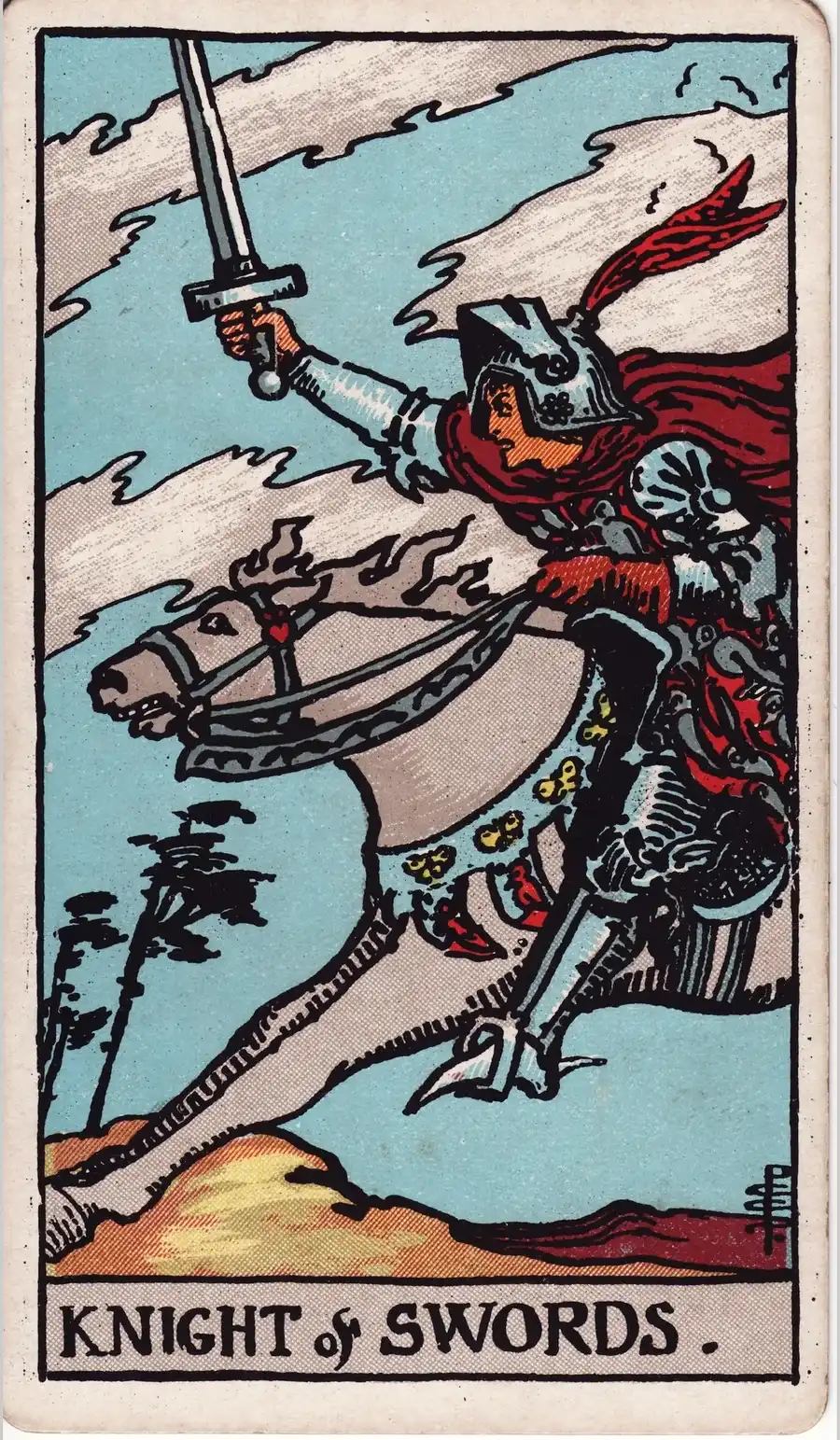
The Knight of Swords charges across the card on a galloping white horse, sword raised, cloak flying. The wind bends the trees and tears the clouds. He is the fastest Knight in tarot: driven, ambitious and sure he is right.
Here is what the Knight of Swords means upright and reversed, the symbols in the 1909 card and how to read him as a person or an energy.
Here is the Knight of Swords at a glance.
| At a glance | This card |
|---|---|
| Upright keywords | action, ambition, drive |
| Reversed keywords | impulsiveness, recklessness, haste |
| Rank | Knight, one of the four court cards of Swords |
| Golden Dawn title | Lord of the Winds and the Breezes; King of the Spirits of Air Later tradition |
| Golden Dawn rank | King in the Golden Dawn, Knight in Crowley’s Thoth deck Later tradition |
| Element within the suit | Fire of Air Later tradition |
| Astrology | In Book T, 20° Taurus to 20° Gemini Later tradition |
| Tree of Life | Chokmah (2), Wisdom Later tradition |
| Astrology printed on my first deck | Mars, Gemini Modern |
| Suit and element | Swords, Air Later tradition |
| Yes or no | No Modern |
The Golden Dawn’s King of Swords is the figure on horseback that Waite called the Knight. His title is Lord of the Winds and the Breezes, King of the Spirits of Air, and he is Fire of Air on Chokmah, ruling 20° Taurus to 20° Gemini. Crowley’s Thoth deck calls him the Knight, which is closer to Waite’s name.
The card: what Pamela Colman Smith drew
Waite wrote: “He is riding in full course, as if scattering his enemies. In the design he is really a proto-typical hero of romantic chivalry. He might almost be Galahad, whose sword is swift and sure because he is clean of heart.” Galahad is the pure knight of the Grail legends.
The galloping horse. The horse is at full speed. Nothing slows this Knight down.
The raised sword. His sword is raised for action. He will say it, do it and defend it.
The torn clouds. The sky is wild. Fast action can create its own storm.
Upright meaning
Upright, the Knight of Swords is speed and conviction. He charges across the card on a galloping white horse, sword raised, cloak flying, while the wind tears the clouds and bends the trees. He is the fastest Knight in tarot, sure he is right and determined to get there first.
Knights carry the energy of their suit into the world, and this one carries ideas, arguments and decisions. He is brave, direct and ambitious. In readings he can show swift action, a bold decision or a person who speaks their mind without hesitation.
His speed is his strength and his weakness. He gets things done, but he may run over people and details on the way.
Reversed meaning
Reversed, the Knight of Swords can show recklessness, impatience, harsh words or charging into a fight without thinking. It can also show scattered energy, too many ideas at once.
Ask whether you are rushing because you are right or because you have stopped listening. Slow down enough to check your aim.
In a reading about a conflict, the reversed Knight warns against sending the angry message tonight. Write it, then wait until morning. If it is still true and still needed after sleep, you can send it with a clearer head and fewer regrets.
In love, work and spirituality
In love. Upright: A fast-moving romance, or a direct, honest partner. Reversed: Arguments, impatience or carelessness.
At work. Upright: Swift action, ambition and decisive leadership. Reversed: Rash decisions, or running over colleagues.
With money. Upright: Quick, decisive action on finances. Reversed: Impulsive financial decisions.
In spiritual practice. Upright: Passion for ideas or debate about spirituality. Reversed: Arguing more than practicing.
As feelings. Intensely interested and eager to move fast.
As a person. An ambitious, direct and fast-thinking person, sometimes impatient.
As advice. Move fast, but look before you charge.
Reading the Knight of Swords: positions and yes or no
In the past position: A quick, decisive move brought you here. In the present position: Act now and speak clearly.
In the future position: Fast change or a direct person is coming. As advice: Move fast, but look first.
In modern yes or no readings, the Knight of Swords leans no. Haste can backfire, so it leans no.
The knight in the tarot court, and the history behind the card
Knights are the movement of the court, and in Swords the movement is a charge toward an idea. The Golden Dawn’s Lord of the Winds and the Breezes captures how fast he travels.
Here is how the Knight looks across the four suits:
- Knight of Wands: energy, passion, impulsiveness
- Knight of Cups: romance, charm, idealism
- Knight of Swords (this card): action, ambition, drive
- Knight of Pentacles: hard work, responsibility, routine
Of the four Knights, this one moves fastest. His horse is at full gallop, the trees behind him bend in the wind and the clouds race across the sky. Compare him with the Knight of Pentacles, whose horse stands still, and you have the two ends of the range.
The Knight of Swords charges toward an idea or a cause with total conviction. The card asks whether you are rushing because you are right, or because you have stopped listening.
When A. E. Waite published The Pictorial Key to the Tarot in 1910, he listed these divinatory meanings for the Knight of Swords: “Skill, bravery, capacity, defense, address, enmity, wrath, war, destruction, opposition, resistance, ruin. There is therefore a sense in which the card signifies death, but it carries this meaning only in its proximity to other cards of fatality.”
Reversed, he gave: “Imprudence, incapacity, extravagance.”
Common questions
Is the Knight of Swords a yes or no card? It leans no, because haste can backfire, even though it shows strong action.
Who is the Knight of Swords as a person? Often someone sharp, ambitious, direct and impatient. It can be any gender.
What does the Knight of Swords mean in love? Fast-moving, direct romance. Reversed, arguments or carelessness.
Try this
Try this small spread for the Knight of Swords. Use it when you want to act fast.
| Card | Question | What it shows |
|---|---|---|
| 1 | What do I want to charge toward? | The goal. |
| 2 | What might I miss? | The person or detail in my path. |
| 3 | How do I act boldly and wisely? | One way to aim. |
Affirmation: I act on clear aims without mistaking speed for wisdom.
Reversed affirmation: I rein in haste and repair what my rush damaged.
If you keep a tarot journal, take one of these questions to it: Where do I need to act decisively? Who might I run over if I rush? What do I believe strongly enough to defend?
What next
Cards that sit close to this one are Knight of Wands (another fast Knight, driven by passion), The Chariot (the Major Arcana card of driving forward) and Eight of Wands (speed and movement).
The Knight of Swords is part of the lesson Meet the court in my free Tarot for Beginners course. To see the whole suit on one page, go to the suit of Swords.
To keep walking the suit, read the card before it, Page of Swords or the card after it, Queen of Swords, or go back to all the card meanings.
For more on the court, see Tarot court cards without confusion. For every card with keywords, affirmations and examples, see my book The Novice’s Guide to Tarot. If you would like a printable cheat sheet for all 78 cards, my 45-page Tarot Workbook is on Etsy.
Sources
- A. E. Waite, The Pictorial Key to the Tarot (London: Rider, 1910), Part III, sections 1 and 2.
- Pamela Colman Smith and A. E. Waite, the Rider-Waite-Smith tarot (London: Rider, 1909).
- Nicolas Conver, Tarot de Marseille (Marseille, 1760).
- Lauri Mukkala, The Novice’s Guide to Tarot, entry for the Knight of Swords.
- Aleister Crowley, 777 (London: Walter Scott, 1909), columns of the decans, the Minor Arcana and the court cards.
- Israel Regardie, ed., The Golden Dawn (Chicago: Aries Press, 1937 to 1940), “Book T”, titles and attributions of the small cards and the court.
All 78 cards
Major Arcana
- The Fool
- The Magician
- The High Priestess
- The Empress
- The Emperor
- The Hierophant
- The Lovers
- The Chariot
- Strength
- The Hermit
- Wheel of Fortune
- Justice
- The Hanged Man
- Death
- Temperance
- The Devil
- The Tower
- The Star
- The Moon
- The Sun
- Judgement
- The World
Wands
- Ace of Wands
- Two of Wands
- Three of Wands
- Four of Wands
- Five of Wands
- Six of Wands
- Seven of Wands
- Eight of Wands
- Nine of Wands
- Ten of Wands
- Page of Wands
- Knight of Wands
- Queen of Wands
- King of Wands
Cups
- Ace of Cups
- Two of Cups
- Three of Cups
- Four of Cups
- Five of Cups
- Six of Cups
- Seven of Cups
- Eight of Cups
- Nine of Cups
- Ten of Cups
- Page of Cups
- Knight of Cups
- Queen of Cups
- King of Cups
Swords
- Ace of Swords
- Two of Swords
- Three of Swords
- Four of Swords
- Five of Swords
- Six of Swords
- Seven of Swords
- Eight of Swords
- Nine of Swords
- Ten of Swords
- Page of Swords
- Knight of Swords
- Queen of Swords
- King of Swords
Pentacles
Get the free Mini-Grimoire
A short printable starter guide to tarot and everyday witchcraft, plus my newsletter. Unsubscribe any time.
Opens Substack in a new tab to confirm. More about the newsletter · Privacy