


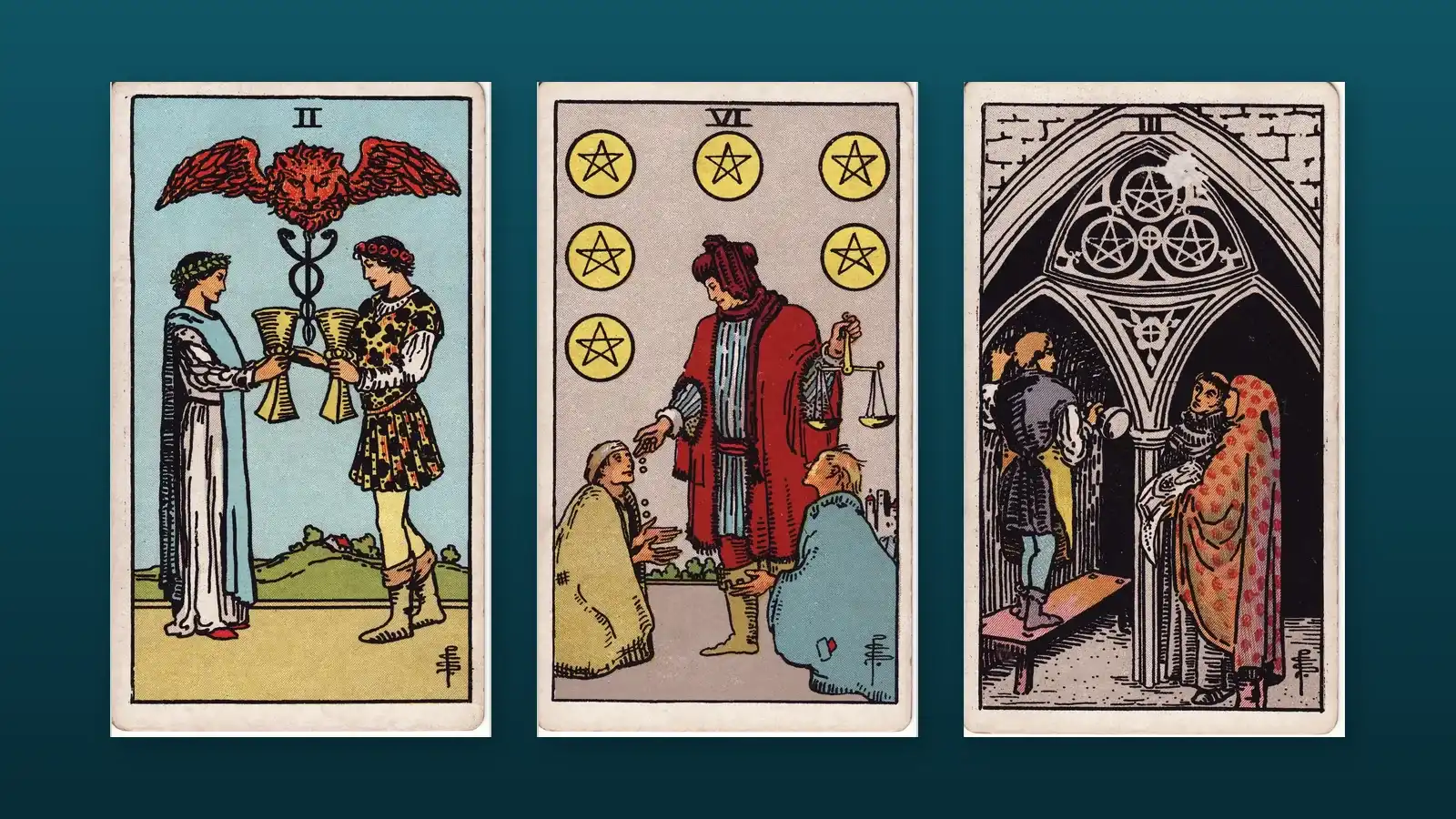
In this lesson: how to read cards together, with repeating suits, Major and Minor balance, numbers and pairs that change each other.
Cards talk to each other. A single card has a meaning, but in a spread the cards around it change the conversation. Learning to hear that conversation is what turns a list of meanings into a reading, and it is the skill most beginners say finally made tarot “click”. This lesson gives you a simple way to listen.
Look at the whole table first
Before you read any single card, take thirty seconds to look at the spread as a whole. This first glance often tells you half the story.
Start with the suits. When a spread is full of one suit, that tells you the tone of the situation: many Cups suggest feelings and relationships, many Swords thoughts and conflict, many Pentacles work and money, many Wands energy and projects. Then count the Majors. Many Major cards suggest big life themes are moving, while mostly Minors suggest everyday matters.
Look for repeated numbers, which rhyme: three Aces suggest many beginnings, two Fives friction from more than one side. Notice whether there are many court cards, which often means other people play a big role. Finally, notice the mood of the pictures. Are they bright or dark, still or moving?
The same card in different company
Neighbors change a card. A Tower among many Pentacles often points to upheaval in work, money or a home, something you built. The same Tower among several Swords might point to a sudden revelation in how you think, or in what you have been telling yourself. The Empress next to the Ten of Cups leans towards fertile belonging and family warmth, while the Empress next to the Five of Pentacles may ask how care can meet scarcity.
These are examples, not rules. A useful habit is to let the Major name the chapter theme and the Minors show how it appears in emails, moods, money and conversations.
Elemental dignities, a later tradition
Later tradition The Golden Dawn developed a method for how cards affect each other called elemental dignities. Cards of the same element strengthen each other. Fire and air are friendly, as are water and earth. Fire and water weaken each other, as do air and earth.
So a Wands card next to a Cups card might be read as passion dampened by feeling, or feeling heated by passion, while a Wands card next to a Swords card might be read as ideas fueling action. Some readers use dignities instead of reversals. You do not need them, but they are a useful extra lens when cards seem to argue.
Reading the gaze
Another simple habit is to notice where the figures look. In the 1909 deck, many figures face left or right. If the person in one card looks toward the next card, you can read them as connected, as if the first is looking at, moving toward or thinking about the second. If they look away, there may be avoidance. The Five of Cups figure, for example, looks at the spilled cups and turns his back on the two standing ones. Placed next to another card, his gaze can tell you a lot.
When two Majors meet
When two Major cards appear side by side, name both themes before you force a single message. The Hermit next to the Lovers might be about choosing time alone, or about finding yourself before committing to a relationship. Death next to the Star might be an ending followed by real hope. Say both themes out loud, then ask how they fit your question.
Sometimes two cards seem to contradict each other, such as the Sun and the Nine of Swords. That is not a mistake. Life holds both. Maybe things are going well and you are still worrying. Maybe the worry is about to lift. The positions will help you decide.
A worked example
Imagine someone asks, “What do I need to know about moving to a new city?” and draws the Eight of Cups, the Tower and the Page of Pentacles. First glance: one Major, the Tower, names the chapter theme of upheaval. The suits move from Cups to Pentacles, from feeling to practical life.
Now the conversation: the Eight of Cups shows walking away from what no longer fills you, the Tower says the old structure is coming down, and the Page of Pentacles suggests a practical new beginning, a fresh start in work or study. Together, they say: this move is a real break with the past, and it will feel unsettling, but it opens a grounded new chapter. None of the three cards says that alone.
Do not overdo it
Card combinations are fun, and lists of “card pairs” are everywhere online. Use them as inspiration, not as rules. The question and the positions decide what a pair means in your reading.
A practice variation: pairs
Shuffle and draw two cards at a time, five times. For each pair, write one sentence that joins them, using the word “and”, “but” or “so”. “The Hermit and the Three of Cups: time alone, and then time with friends.” “The Hermit but the Three of Cups: you want to be alone, but friends are calling.” “The Hermit so the Three of Cups: time alone leads to better friendships.” Choosing the joining word trains you to hear how cards talk to each other.
A second worked example in prose
Imagine someone asking about a creative project draws the Six of Wands, the Moon and the Page of Pentacles. On their own: victory, uncertainty and careful study. In conversation: the triumphant rider of the Six of Wands is followed directly by the Moon, as if riding out of the parade into the night; success is being sought in an unclear place.
The Page of Pentacles at the end, looking at his coin, suggests that patient, practical learning is the way through. Her note: “I want recognition, but I am unsure of the path; slow study will light the way.” That story is richer than three separate meanings.
An old table of repeated cards
Historical Readers have always noticed when several cards of the same number or rank appear together. Waite’s The Pictorial Key to the Tarot (1910) includes a short section called “The Recurrence of Cards in Dealing”, a list he took from older French fortune-telling. A few lines give its flavor: “4 Kings = great honour; 3 Kings = consultation; 2 Kings = minor counsel.” “4 Sixes = abundance; 3 Sixes = success”. “3 Tens = new condition; 2 Tens = change.”
The list is a curiosity rather than a rule. Many of its meanings are fortune-telling predictions, and it gives different meanings again for reversed cards. But the idea behind it is sound and still used: when a number or rank repeats, its theme grows louder. Three Kings on the table really do suggest a situation full of authority, decisions or advice, even if you would not call it “consultation”.
A modern way to read repeats
When you notice a repeat, try this simple approach. Name the shared number or rank and its keyword. Then look at which suits carry it. Three Fives in Wands, Cups and Swords, for example, all speak of conflict or loss, but in action, feeling and thought. A reading like that might say the difficulty is touching several parts of life at once, and that recovery needs attention in each.
Repeated suits work the same way, as you saw in module 4. Repeated Majors, especially more than half the cards, suggest a situation with big themes that are larger than everyday choices.
Practice variations
The bridge card. Draw two cards that seem to clash, such as the Sun and the Five of Pentacles. Then draw one more card and place it between them as a “bridge”. Ask how this third card might connect the two. Often it shows the step that leads from one situation to the other.
Tell it as a sentence. Lay out three cards and write one sentence that uses all three, joined by words like “but”, “so” and “because”. For example: “The Two of Cups, but the Seven of Swords, so the Queen of Swords.” Turning cards into grammar forces you to see how they relate.
Looking lines. In Smith’s deck, many figures face left or right. Lay out five cards and draw arrows on a notebook sketch showing where each figure is looking. Do any of them look at each other, or away? This simple map often shows connections you would otherwise miss.
A worked example: three Kings
Imagine someone asks, “How should I approach my family’s decision about caring for an older relative?” and draws the King of Pentacles, the King of Cups and the King of Swords. Three Kings, as the old table noticed, bring many voices of authority. Here they might stand for three ways of deciding: practical resources, emotional care and clear reasoning. The reading suggests that the family needs all three, and that the person asking might help by making sure each voice is heard. The cards do not make the decision. They offer a structure for a kind and fair conversation.
A quick habit: before reading any single card, say aloud one thing the cards share and one thing that sets them apart. That small pause trains you to hear the conversation first.
Questions beginners ask
Do I have to use elemental dignities? No. They are one later tradition among several.
What if two cards seem to contradict each other? Contradictions often show real tensions in a situation. Name them.
How many cards can talk to each other? Any number, but start with pairs and threes.
Myths to drop: Card meanings are not fixed boxes. Reading combinations is not only for experts. And there is no single correct combination meaning.
Try this
Draw two cards. First read each one alone in one sentence. Then write a third sentence that begins, “Together, they say…” Do this every day for a week and you will feel the difference.
Recap
Look at the whole spread before any single card: suits, Majors and Minors, repeated numbers, courts and mood. A spread full of one suit tells you the tone of the situation. Neighbors change a card, so a Tower among Pentacles often points to upheaval in work, money or home. When two Majors meet, name both themes first. Apparent contradictions are often true to life.
What next
Press “Mark as done” and continue with Five and seven cards. Browse all spreads for layouts to practice with.
Further reading: Rachel Pollack, Seventy-Eight Degrees of Wisdom, on reading cards together.
Sources
- Lauri Mukkala, The Novice’s Guide to Tarot, “Reading cards together”.
Quick check
Go deeper: The Novice's Guide to Tarot: Reading cards together
Get the free Mini-Grimoire
A short printable starter guide to tarot and everyday witchcraft, plus my newsletter. Unsubscribe any time.
Opens Substack in a new tab to confirm. More about the newsletter · Privacy
Comments
Questions and notes from readers. Anyone with a free account can comment, and I reply when I can. Please read the community guidelines.
Comments load from Google Firebase (EU) when you ask for them. Nothing is stored on your device. Privacy