


| Arcana | Minor Arcana: Wands |
|---|---|
| Image | RWS 1909 (PD) |
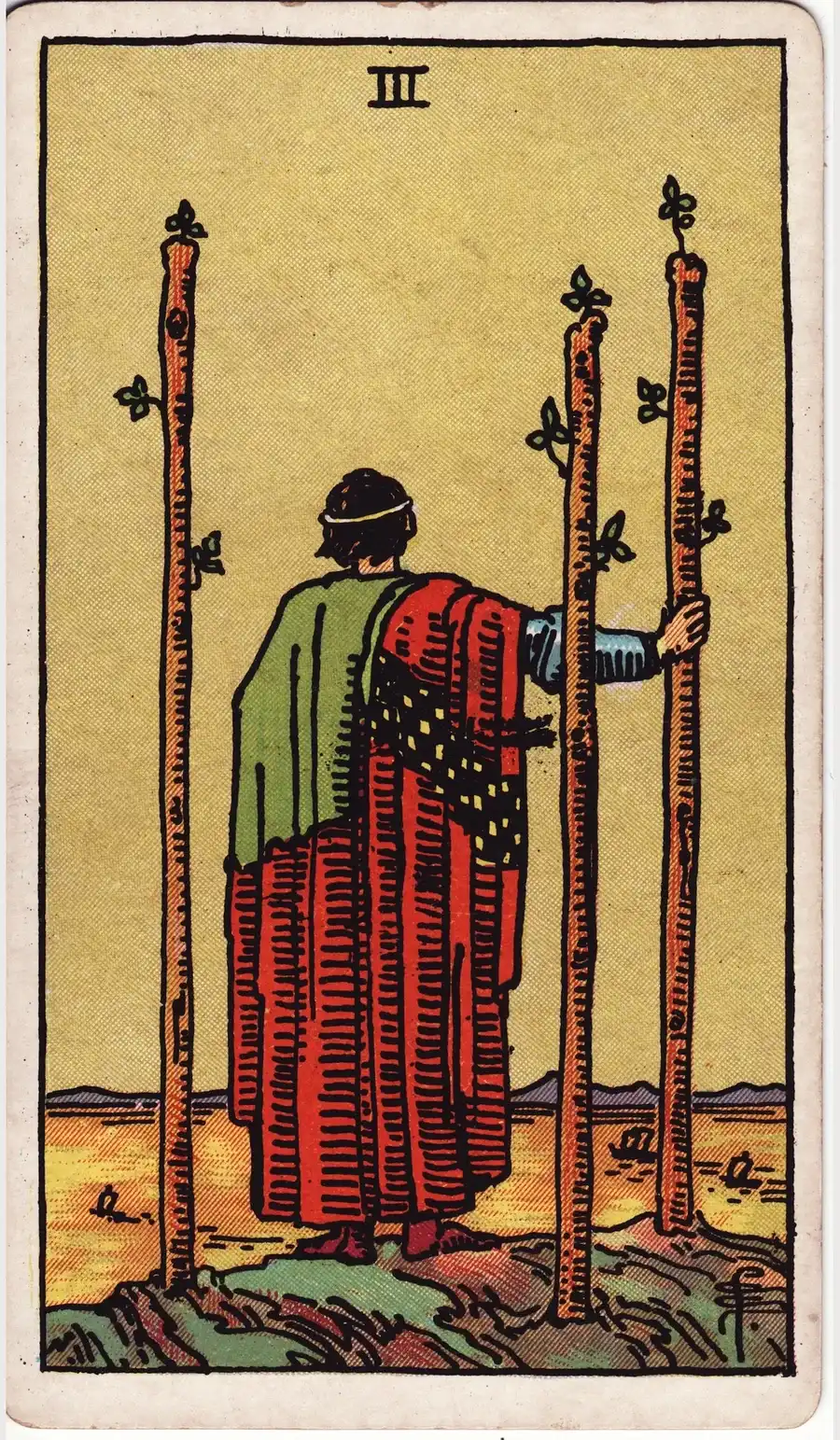
The Three of Wands shows a figure on a cliff, his back to us, watching ships sail across a golden sea. The plans are made and the boats have left harbor.
Now he waits, watches and prepares the next stage. This page explains what the Three of Wands means upright and reversed, what is in the 1909 picture and how to read it in love, work and spirituality.
Here is the Three of Wands at a glance.
| At a glance | This card |
|---|---|
| Upright keywords | progress, foresight, exploration |
| Reversed keywords | delays, lack of foresight, obstacles |
| Number | 3 in the suit of Wands |
| Golden Dawn title | Lord of Established Strength Later tradition |
| Astrology | Sun in Aries, second decan (10° to 20° Aries) Later tradition |
| Tree of Life | Binah (3), Understanding Later tradition |
| Suit and element | Wands, Fire Later tradition |
| Yes or no | Yes Modern |
The Golden Dawn named this card the Lord of Established Strength and gave it the Sun in Aries, the second decan of the sign, on Binah, the third sephira. The Sun is exalted in Aries in traditional astrology, which suits a card where the first plans have taken hold and the ships are already out at sea.
Later tradition The Golden Dawn also gave each decan two of the 72 Goetic spirits, one for the day and one for the night. For the second decan of Aries, and so for the Three of Wands, they are Agares (spirit 2, day) and Halphas (spirit 38, night). Their pages read the old entries as history; see the spirit directory for all 72.
The card: what Pamela Colman Smith drew
Waite described “a calm, stately personage, with his back turned, looking from a cliff’s edge at ships passing over the sea. Three staves are planted in the ground, and he leans slightly on one of them.” The sky and the water glow yellow. It is a hopeful, patient card.
The figure from behind. We see only his back, so we stand where he stands and look where he looks. Smith often used this trick to put the reader inside the card. The question becomes: what are you watching for?
The ships on the sea. Ships carry goods out and bring news and profit back. They are a picture of efforts already sent into the world: applications, launches, messages, investments of time. They are out of your hands now, at least for a while.
Three planted wands. Three staves stand firmly in the ground and he leans on one. The work so far is solid enough to support him. He is not starting from nothing anymore.
Upright meaning
Upright, the Three of Wands is the stage where the plans are made and things are already moving without you having to push. The figure on the cliff watches ships he has sent out, and the golden sea suggests that conditions are good. This is foresight, patience and the confidence of someone who has done the groundwork.
The card often shows expansion: travel, trade, a business reaching new customers, a project spreading beyond its first circle. It also asks you to keep your eyes on the horizon. Opportunities will arrive from further away than you expect, so stay ready to receive them.
There is a calm in this card that is easy to miss. The figure is not running after the ships. He trusts what he has started and gives it time to come back to him.
Reversed meaning
Reversed, the Three of Wands shows ships that are late or plans that have stalled at sea. You may have expected results by now and feel frustrated that the horizon is empty. Sometimes this is a real obstacle, such as a delayed shipment, a slow reply, or a partner who did not deliver.
Sometimes the reversal points to a lack of foresight: you launched before checking the weather. Review what you sent out, adjust what you can, and do not abandon the voyage only because it is slower than you hoped.
In love, work and spirituality
In love. Upright: A relationship growing beyond its first phase, or love connected with travel or distance. Reversed: Waiting for someone who is slow to commit, or a long-distance relationship under strain.
At work. Upright: Exports, expansion, a project that has launched and is gaining reach. Leadership with a long view. Reversed: Delays in delivery, or a team that planned well but did not prepare for setbacks.
With money. Upright: Returns on earlier investments start to appear. Think in years, not weeks. Reversed: Money tied up longer than expected. Check your contingency plans.
In spiritual practice. Upright: Seeing your practice from a wider view: learning a tradition from another culture with respect, or planning a pilgrimage. Reversed: Impatience with slow spiritual growth.
As feelings. Hopeful, looking ahead and thinking about what you could build together.
As a person. An entrepreneur or traveler with a long view, steady and quietly confident.
As advice. Trust what you have already set in motion and keep watching for what comes back.
Reading the Three of Wands: positions and yes or no
In the past position: Plans you set in motion earlier are now shaping things. In the present position: Your efforts are out in the world. Watch, wait and prepare.
In the future position: Results, news or a wider opportunity are on their way. As advice: Keep a simple log of what you sent out and what comes back.
In modern yes or no readings, the Three of Wands leans yes. It favors progress that is already in motion, though it may take patience.
What the Three means, and the history behind the card
Three in the fire suit means the will has found a form that can stand on its own. Established Strength is the right name: the first effort has worked, and the energy now travels further than the person who started it.
Here is how the Three looks across the four suits:
- Three of Wands (this card): progress, foresight, exploration
- Three of Cups: celebration, friendship, creativity
- Three of Swords: heartbreak, sorrow, betrayal
- Three of Pentacles: collaboration, skill, teamwork
When A. E. Waite published The Pictorial Key to the Tarot in 1910, he listed these divinatory meanings for the Three of Wands: “He symbolizes established strength, enterprise, effort, trade, commerce, discovery; those are his ships, bearing his merchandise, which are sailing over the sea.”
Reversed, he gave: “The end of troubles, suspension or cessation of adversity, toil and disappointment.”
Common questions
Is the Three of Wands a yes or no card? It leans yes. Things are moving in your favor, but they may need time and attention.
Does the Three of Wands mean travel? It can. The ships and the wide view often point to travel, work abroad or long-distance connections, but read it with the rest of the spread.
What does the Three of Wands mean in love? Upright, a relationship with room to grow, sometimes across distance. Reversed, waiting for the other person to do all the work.
Try this
Try this small spread for the Three of Wands. Use it when something is in motion and you are waiting to see how it lands.
| Card | Question | What it shows |
|---|---|---|
| 1 | What have I set in motion? | The effort that is out of my hands now. |
| 2 | What should I watch for? | The signal or obstacle to notice early. |
| 3 | How do I prepare for the next stage? | What to get ready while I wait. |
Affirmation: I stay with what I launched and adjust as the horizon changes.
Reversed affirmation: I face delays squarely and correct what poor foresight missed.
If you keep a tarot journal, take one of these questions to it: What have I already sent out into the world that I am waiting on? What signals are coming back, and am I reading them honestly? What is my next stage once the ships return?
What next
Cards that sit close to this one are Two of Wands (the plan before it set sail), Eight of Wands (news and movement arriving fast) and The Star (another card of patient hope and looking ahead).
The Three of Wands is part of the lesson Wands in my free Tarot for Beginners course. To see the whole suit on one page, go to the suit of Wands. To keep walking the suit, read the card before it, Two of Wands or the card after it, Four of Wands, or go back to all the card meanings.
For the suits and numbers in one place, see The Minor Arcana: suits and numbers made simple. For every card with keywords, affirmations and examples, see my book The Novice’s Guide to Tarot. If you would like a printable cheat sheet for all 78 cards, my 45-page Tarot Workbook is on Etsy.
Sources
- A. E. Waite, The Pictorial Key to the Tarot (London: Rider, 1910), Part III, sections 1 and 2.
- Pamela Colman Smith and A. E. Waite, the Rider-Waite-Smith tarot (London: Rider, 1909).
- Nicolas Conver, Tarot de Marseille (Marseille, 1760).
- Lauri Mukkala, The Novice’s Guide to Tarot, entry for the Three of Wands.
- Aleister Crowley, 777 (London: Walter Scott, 1909), columns of the decans, the Minor Arcana and the court cards.
- Israel Regardie, ed., The Golden Dawn (Chicago: Aries Press, 1937 to 1940), “Book T”, titles and attributions of the small cards and the court.
All 78 cards
Major Arcana
- The Fool
- The Magician
- The High Priestess
- The Empress
- The Emperor
- The Hierophant
- The Lovers
- The Chariot
- Strength
- The Hermit
- Wheel of Fortune
- Justice
- The Hanged Man
- Death
- Temperance
- The Devil
- The Tower
- The Star
- The Moon
- The Sun
- Judgement
- The World
Wands
- Ace of Wands
- Two of Wands
- Three of Wands
- Four of Wands
- Five of Wands
- Six of Wands
- Seven of Wands
- Eight of Wands
- Nine of Wands
- Ten of Wands
- Page of Wands
- Knight of Wands
- Queen of Wands
- King of Wands
Cups
- Ace of Cups
- Two of Cups
- Three of Cups
- Four of Cups
- Five of Cups
- Six of Cups
- Seven of Cups
- Eight of Cups
- Nine of Cups
- Ten of Cups
- Page of Cups
- Knight of Cups
- Queen of Cups
- King of Cups
Swords
- Ace of Swords
- Two of Swords
- Three of Swords
- Four of Swords
- Five of Swords
- Six of Swords
- Seven of Swords
- Eight of Swords
- Nine of Swords
- Ten of Swords
- Page of Swords
- Knight of Swords
- Queen of Swords
- King of Swords
Pentacles
Get the free Mini-Grimoire
A short printable starter guide to tarot and everyday witchcraft, plus my newsletter. Unsubscribe any time.
Opens Substack in a new tab to confirm. More about the newsletter · Privacy