


How to read the labels Historical what the old sources say. Later tradition what later writers added. Modern modern practice and my own notes.
Futurism was an Italian avant-garde movement launched by the poet Filippo Tommaso Marinetti with his manifesto in the Paris newspaper Le Figaro on 20 February 1909. Its painters, Umberto Boccioni, Giacomo Balla, Luigi Russolo, Carlo Carrà and Gino Severini, tried to paint speed, noise, electricity and the modern city. Futurism glorified machines and war, and its first, most inventive phase ended with the First World War.
Most art movements are named by critics. Futurism named itself, loudly, on the front page of a newspaper: Marinetti announced that a roaring racing car was more beautiful than an ancient Greek statue, and that museums should be flooded. It is thrilling art, and it carries a warning.
Key dates
| When | What happened |
|---|---|
| 20 February 1909 | Filippo Tommaso Marinetti publishes the Futurist manifesto in Le Figaro. |
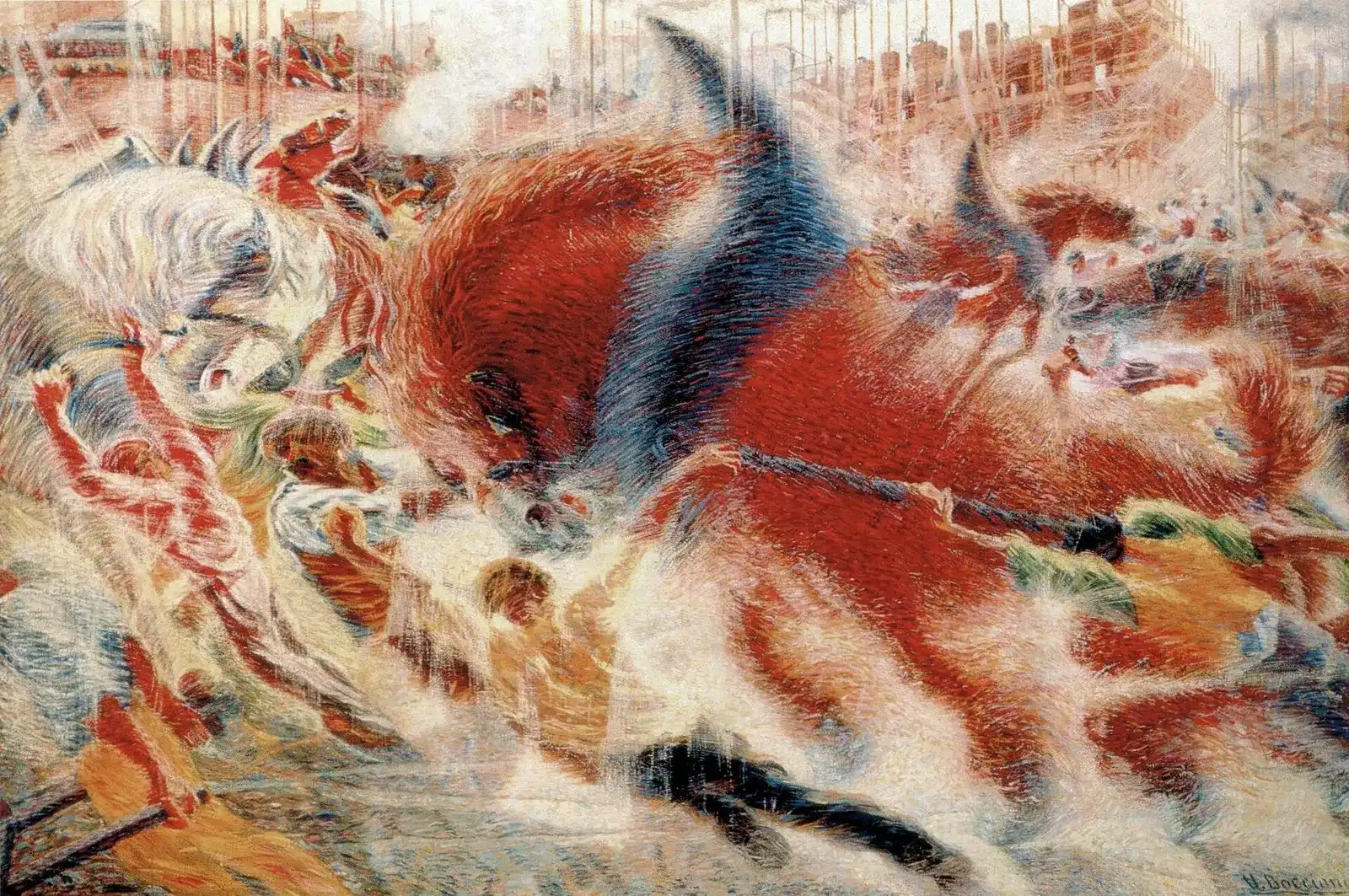
| 1910 | The Manifesto of Futurist Painters; Boccioni paints The City Rises. |
| 1912 | The Futurists exhibit in Paris at the Bernheim-Jeune gallery. |
| 1913 | Luigi Russolo publishes The Art of Noises; Boccioni sculpts Unique Forms of Continuity in Space. |
| 1916 | Boccioni dies after a fall from a horse during military training. |
What is Futurism?
Futurism is an art of motion and modern life that broke objects into lines of force and repeated forms to show speed, sound and energy, and that rejected the past outright.
Throughout this page I mark three layers. Historical What the works and records show. Later tradition The legends. Modern How we see it now.
Historical The manifesto. Marinetti’s Founding and Manifesto of Futurism appeared in Le Figaro on 20 February 1909. It praised speed, machines, the city and youth, and in the same breath praised war as “the world’s only hygiene” and declared scorn for women.
A year later the painters published their own manifestos. Futurism was a movement of manifestos: about painting, music, cooking, clothing and even lust.
Painting speed. 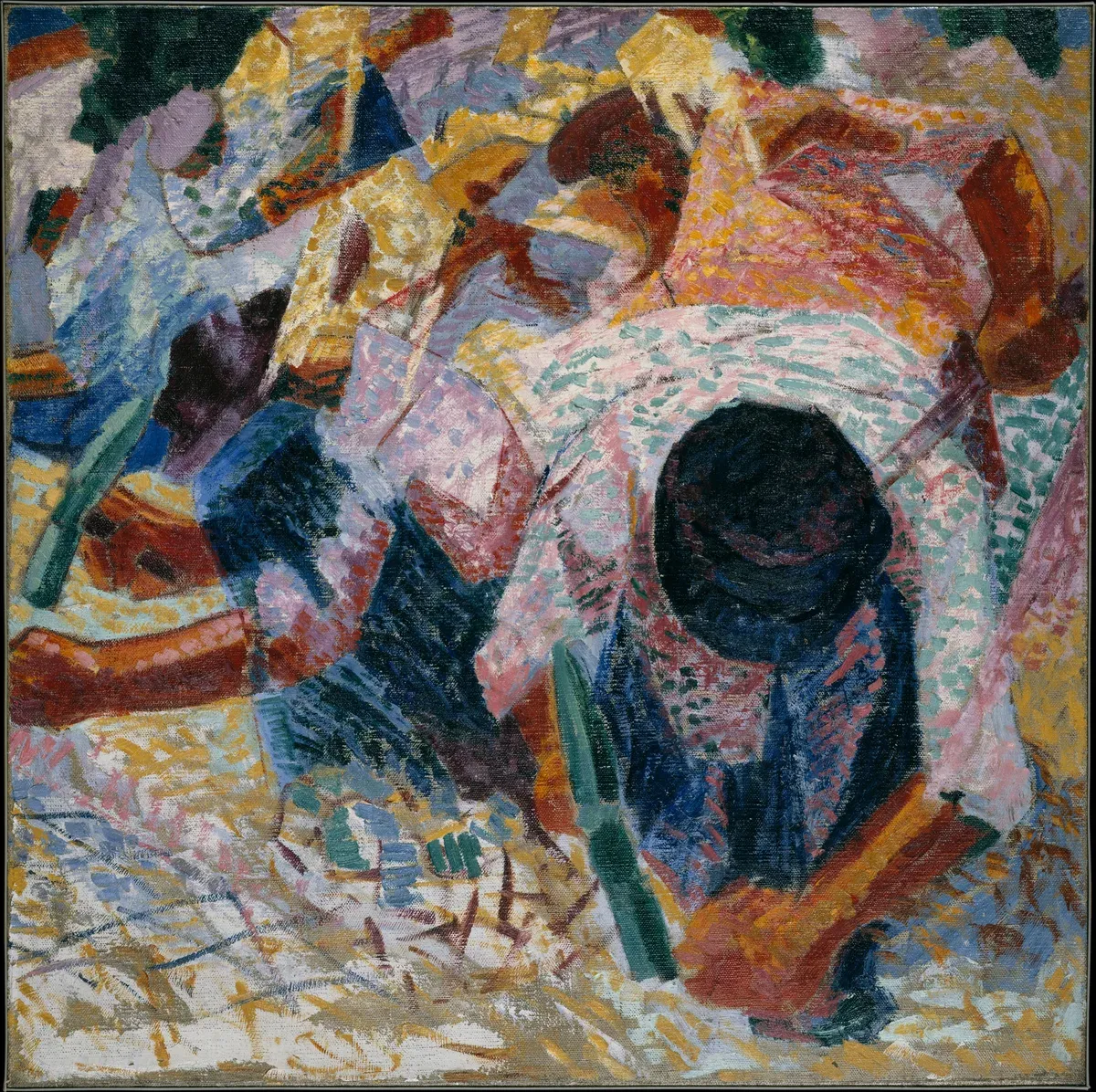
Umberto Boccioni, The Street Pavers, 1914. The Metropolitan Museum of Art (1990.38.5). Image: Open Access, public domain (CC0).
Historical Umberto Boccioni (1882 to 1916) learned from Cubism how to break forms, and added movement and energy. In The Street Pavers (1914), at the Met, the workers bend and strike until their bodies dissolve into the rhythm of their work.
His bronze Unique Forms of Continuity in Space (1913), a striding figure pulled by wind, now appears on the Italian 20 cent coin. In Dynamism of a Dog on a Leash (1912), Giacomo Balla painted a dachshund whose legs blur into dozens as it trots, and studied the flicker of electric streetlights.
Historical Noise and Russia. Luigi Russolo wrote The Art of Noises (1913) and built noise machines, an ancestor of electronic music. In Russia, painters like Natalia Goncharova and Kazimir Malevich mixed Cubism and Futurism into Cubo-Futurism.
In 1913 Malevich designed the opera Victory over the Sun, in which the sun is captured; one of his stage designs contained a black square.
Historical Women and Futurism. Despite the first manifesto, women answered back. In 1912 the dancer and poet Valentine de Saint-Point published a Manifesto of the Futurist Woman, arguing that women too had strength and wildness.
Later Benedetta Cappa, who married Marinetti, painted dreamy aerial views and in 1933 and 1934 created five large murals on communication for the post office in Palermo, which are still there today.
Key artists
| Artist | Lived | Why they matter |
|---|---|---|
| Filippo Tommaso Marinetti | 1876 to 1944 | Poet, founder and noisy publicist of the movement. |
| Umberto Boccioni | 1882 to 1916 | The movement’s leading painter and sculptor. |
| Giacomo Balla | 1871 to 1958 | The painter of speed, light and movement. |
| Luigi Russolo | 1885 to 1947 | Painter and inventor of noise-making instruments. |
| Gino Severini | 1883 to 1966 | The Futurist in Paris, painter of dancers. |
| Natalia Goncharova | 1881 to 1962 | Leader of Russian Cubo-Futurism and Rayonism. |
How do you recognise Futurism?
Look for speed: repeated limbs, lines of force, blurred motion and splintered light. Subjects are cars, trains, crowds, factories and the modern city. The style borrows Cubist fragments and adds bright color and movement.
Common misconceptions. One is that Futurism was only painting. It included poetry, music, theatre, architecture, cooking, fashion and photography; Russolo built noise machines and wrote The Art of Noises in 1913.
Another is that it ended in 1916, when Boccioni died. A second wave of Futurism continued into the 1930s and 1940s, including aeropittura, painting of the view from aeroplanes. A third is that all Futurists ignored women. The movement’s manifestos were openly misogynist, yet Valentine de Saint-Point answered with her Manifesto of the Futurist Woman in 1912, and Benedetta Cappa became one of the best painters of the second wave.
Esoteric themes
Historical Futurism looked like pure machine worship, but the scholar Simona Cigliana has shown an esoteric strand. Balla and others read Theosophy, and the brothers Arnaldo Ginna and Bruno Corra experimented with abstract film and color music while writing about occult ideas. Boccioni’s paintings of “states of mind” tried to show invisible forces between people.
Later tradition Boccioni volunteered for the war the movement had praised and died in 1916 after a fall from a horse during military training. Many Futurists, Marinetti above all, later supported Mussolini’s Fascism. The 2014 Guggenheim exhibition was one of the first large shows in the US to face that history directly.
Modern Futurism reminds me that a beautiful style can carry an ugly message. I try to look at both.
Works to see
| Work | Artist | Date | Where to see it |
|---|---|---|---|
| The City Rises | Umberto Boccioni | 1910 | The Museum of Modern Art, New York |
| States of Mind: The Farewells | Umberto Boccioni | 1911 | The Museum of Modern Art, New York |
| Unique Forms of Continuity in Space | Umberto Boccioni | 1913 | The Museum of Modern Art, New York, and other casts |
| Dynamism of a Car | Luigi Russolo | 1912 to 1913 | Centre Pompidou, Paris |
Every work in this list is free of nudity, so you can look them up with confidence. Works still in copyright are named but not shown here.
How to look at a Futurist painting
Look for repetition. Futurists painted the same leg, wheel or arm several times in a row to show movement, a trick learned from early motion photography. Then look for “lines of force”, the diagonal arrows and wedges that push across the canvas, and imagine the sound the picture would make.
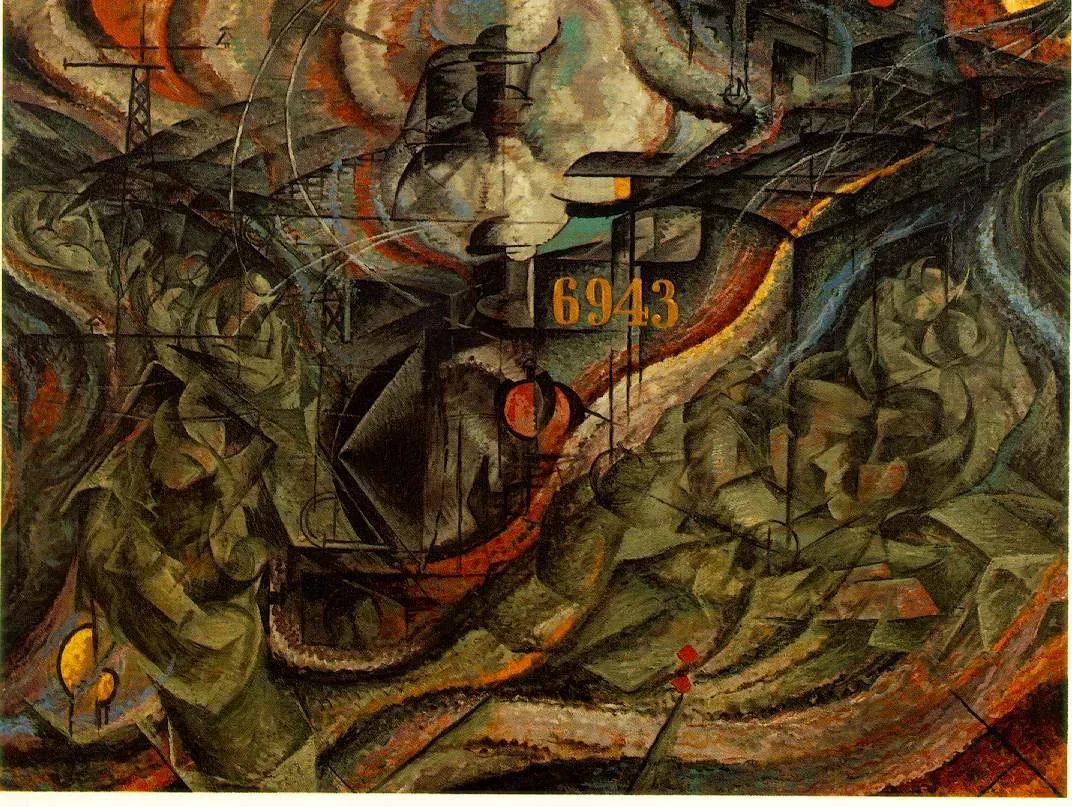
Umberto Boccioni, States of Mind I: The Farewells, 1911. Museum of Modern Art, New York. Image: Wikimedia Commons, public domain.
Umberto Boccioni, States of Mind I: The Farewells, 1911. At the Museum of Modern Art in New York. Part of a series about a railway station: those who leave, those who stay. Find the stencilled number of the engine, then the waves of embracing couples. The painting is about feeling as much as speed.
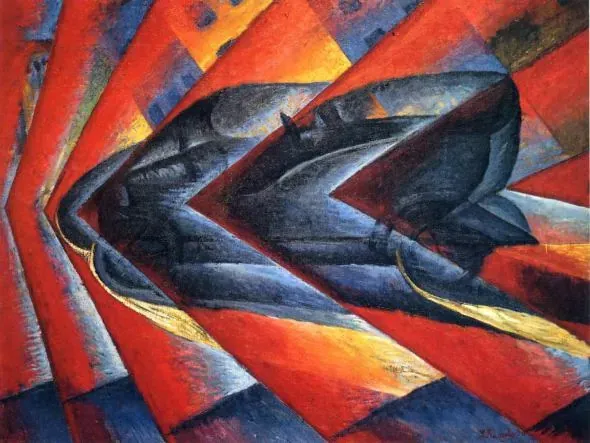
Luigi Russolo, Dynamism of a Car, 1912 to 1913. Centre Pompidou, Paris. Image: Wikimedia Commons, public domain.
Luigi Russolo, Dynamism of a Car, 1912 to 1913. At the Centre Pompidou in Paris. The car is barely there; what you see is its effect on the air, a series of red chevrons slicing forward. Russolo was a painter and the inventor of noise music.
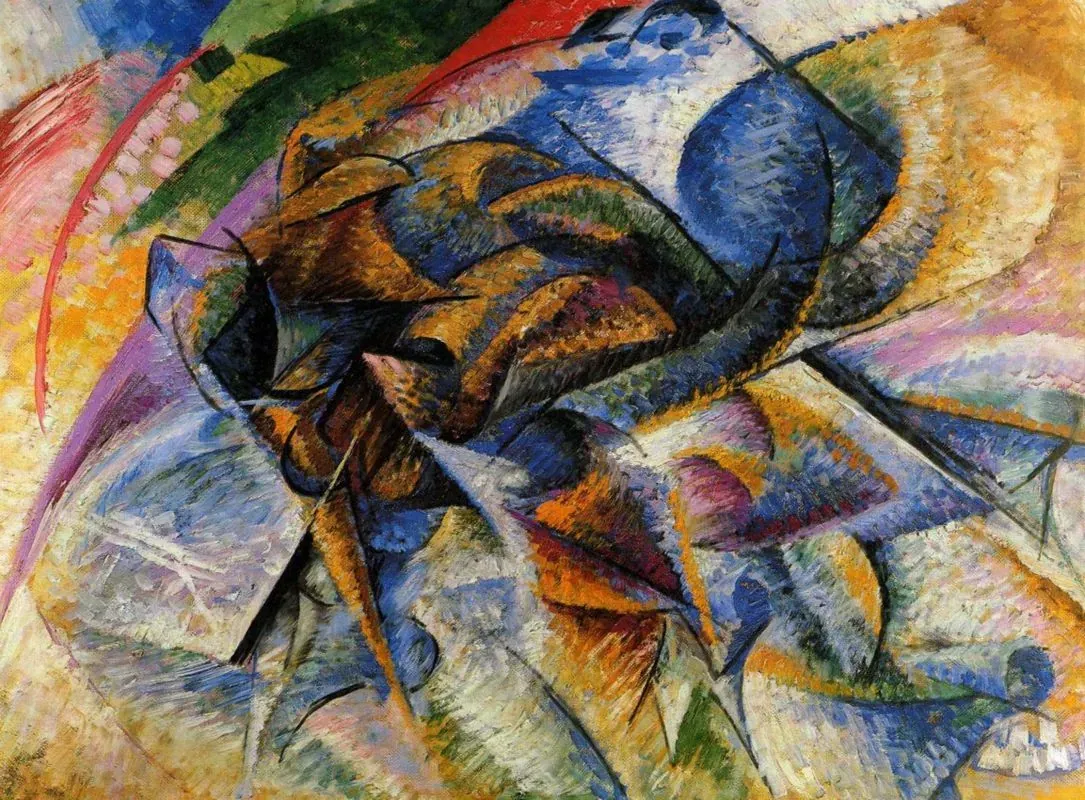
Umberto Boccioni, Dynamism of a Cyclist, 1913. Peggy Guggenheim Collection, Venice (Mattioli Collection). Image: Wikimedia Commons, public domain.
Umberto Boccioni, Dynamism of a Cyclist, 1913. In the Mattioli Collection, shown at the Peggy Guggenheim Collection in Venice. Can you find the wheel, the back, the head? Boccioni wanted to paint not a cyclist, but the experience of cycling.
Futurism took the broken forms of Cubism and set them in motion. Its noise, provocations and manifestos inspired Dada, and its colour and energy influenced Russian art and early abstraction.
Try this
Take a photo of something moving, a dog, a bicycle, a hand waving, with a slow shutter or just a shaky phone. Then draw it, keeping the blur. Where does the movement live: in the object, or in the space around it?
What next
Before this: Cubism.
After this: Early abstraction.
Also worth reading alongside it: Dada.
See every movement in order on the art movements timeline, or learn to look step by step in the free Art History for Beginners course.
If you want to carry this into tarot and practice, these pages connect to it: The Chariot, speed, will and forward drive; Eight of Wands, swift movement and news arriving; The occult side of the machine age; and Reading claims about modern movements critically.
Sources
- Filippo Tommaso Marinetti, The Founding and Manifesto of Futurism, Le Figaro, 20 February 1909 (1909).
- Simona Cigliana, Futurismo esoterico (2002).
- Solomon R. Guggenheim Museum, Italian Futurism 1909 to 1944: Reconstructing the Universe (exhibition) (2014).
- The Metropolitan Museum of Art, The Street Pavers, 1990.38.5. Open the record
- E. H. Gombrich, The Story of Art (1950).
- Wikimedia Commons, The City Rises (hero image record). Open the record
- Caroline Tisdall and Angelo Bozzolla, Futurism (1977).

Questions
When did Futurism start?
On 20 February 1909, when the Italian poet Filippo Tommaso Marinetti published The Founding and Manifesto of Futurism on the front page of the Paris newspaper Le Figaro.
Was Futurism Fascist?
Not at first, but many Futurists, including Marinetti, later supported Mussolini. Its love of violence and war was there from the first manifesto.
Where can I see works of Futurism in person?
Good places to start are Milan (the Museo del Novecento), Rome, New York (MoMA, the Met), and the Estorick Collection in London. Museums change their displays, so check the collection page before you travel.
What is the Futurist Manifesto?
It is a text by Filippo Tommaso Marinetti, published on the front page of Le Figaro on 20 February 1909. It praised speed, machines, youth and violence and called for the destruction of museums and libraries.
Who were the women of Futurism?
Valentine de Saint-Point, Benedetta Cappa, Rosa Rosà and, in Russia, Natalia Goncharova and Olga Rozanova are among the women linked to Futurism.
What is Unique Forms of Continuity in Space?
It is Umberto Boccioni's sculpture of a striding figure, modelled in plaster in 1913. Bronze casts made after his death are in the Museum of Modern Art, Tate and the Metropolitan Museum, and it appears on the Italian 20-cent euro coin.
Get the free Mini-Grimoire
A short printable starter guide to tarot and everyday witchcraft, plus my newsletter. Unsubscribe any time.
Opens Substack in a new tab to confirm. More about the newsletter · Privacy