


How to read the labels Historical what the old sources say. Later tradition what later writers added. Modern modern practice and my own notes.
Cubism is the movement begun in Paris around 1907 to 1908 by Pablo Picasso and Georges Braque, which broke objects into facets and showed them from several viewpoints at once. It lasted as a core movement until about 1914 and was developed by Juan Gris, Fernand Léger, Robert and Sonia Delaunay and many others. It changed the rules of Western painting more than any movement since the Renaissance.
Look at a cup on your table. Now walk around it, look into it from above, pick it up and feel its weight. You know far more about the cup than any single view can show. Between about 1907 and 1914, Pablo Picasso and Georges Braque tried to paint that knowledge.
Key dates
| When | What happened |
|---|---|
| 1907 | A Cézanne retrospective in Paris; Picasso paints Les Demoiselles d’Avignon. |
| 1908 | Vauxcelles writes that Braque reduces everything to “cubes”. |
| 1911 | The Cubists show together in Room 41 of the Salon des Indépendants. |
| 1912 | Picasso and Braque begin collage and papier collé. |
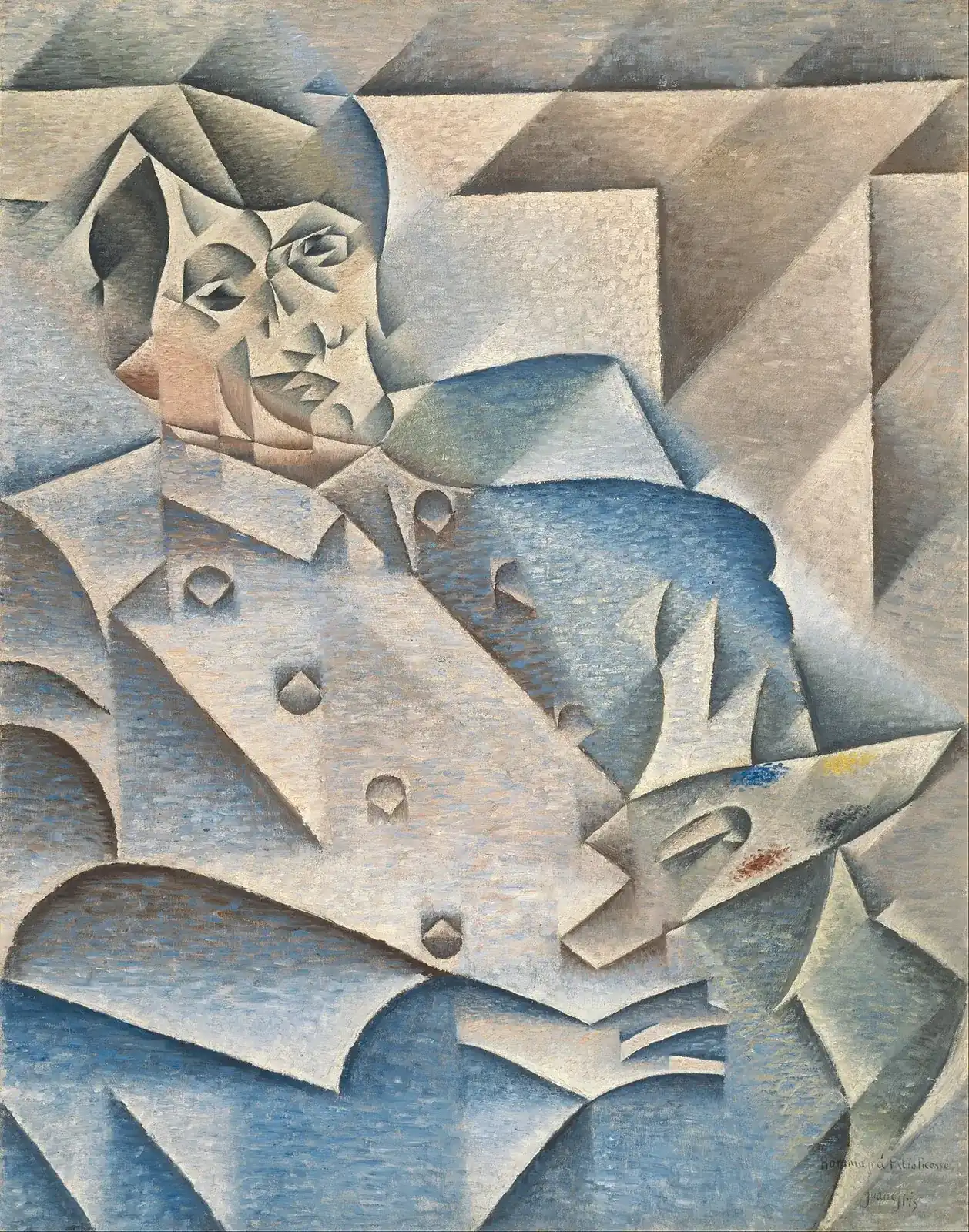
| 1912 | Juan Gris paints his Portrait of Pablo Picasso. |
What is Cubism?
Cubism is a way of painting that rejects single-point perspective and rebuilds objects from fragments, flat planes and multiple angles.
Throughout this page I mark three layers. Historical What the works and records show. Later tradition The myths. Modern How we see it now.
Historical From Cézanne to the Demoiselles. Cubism started from Cézanne, who had built forms from patches of color and shown objects from more than one angle. A big Cézanne memorial exhibition in Paris in 1907 hit young painters hard.
In the same year Picasso visited the ethnographic museum at the Trocadéro and saw African and Oceanic sculpture. His Les Demoiselles d’Avignon (1907), at MoMA, shows five women with angular, fractured bodies, two with faces like masks. I describe it in words, since it is a nude.
Historical Primitivism. The modernists admired African and Oceanic works and borrowed their forms, but they rarely knew their makers, meanings or uses, and they called them “primitive”, a word that implied a lower stage of civilization.
In 1984 a MoMA exhibition on “Primitivism” was sharply criticized, notably by Thomas McEvilley, for treating non-Western objects mainly as inspirations for Europeans. That criticism changed how museums talk about these exchanges.
Historical Analytic and Synthetic. In Analytic Cubism, from about 1909 to 1912, Picasso and Braque broke a guitarist, a bottle or a newspaper into small faceted planes in browns and grays, until the subject is barely legible.
In Synthetic Cubism, from 1912, they built images from flat shapes and invented papier collé, gluing newspaper, wallpaper and other materials to the surface. Collage became one of the key techniques of the century.
Historical Juan Gris. The Spanish painter Juan Gris (1887 to 1927) moved to Paris and lived in the same studio building as Picasso, the Bateau-Lavoir.
In 1912 he painted this Portrait of Pablo Picasso, now in Chicago, as a homage to his friend: the figure holds a palette, his body cut by a clear diagonal grid. Gris made Cubism cooler and more ordered, with crisp planes and brighter colors. He died at forty.
Key artists
| Artist | Lived | Why they matter |
|---|---|---|
| Pablo Picasso | 1881 to 1973 | Co-inventor of Cubism. |
| Georges Braque | 1882 to 1963 | Co-inventor of Cubism, the quieter partner. |
| Juan Gris | 1887 to 1927 | The clearest and most colorful of the Cubists. |
| Fernand Léger | 1881 to 1955 | The painter of tubes and machines. |
| Robert Delaunay | 1885 to 1941 | The painter of the Eiffel Tower in fractured color. |
| Sonia Delaunay | 1885 to 1979 | Painter and designer of colorful textiles. |
How do you recognise Cubism?
Look for objects broken into flat planes and shown from several viewpoints at once. Early Cubism uses browns and greys; later work adds bright color, letters and pasted paper. Subjects are simple: guitars, bottles, newspapers, faces.
Common misconceptions. Cubism is not about cubes. The name came from a critic, Louis Vauxcelles, who in 1908 described Braque’s landscapes as reducing everything to “cubes”.
Another is that Cubism is abstract. Nearly every Cubist painting has a subject, often a guitar, a bottle, a newspaper or a café table, and the fun is finding it. A third is that it was only Picasso and Braque. The so-called Salon Cubists, including Albert Gleizes and Jean Metzinger, made it public at the Salon des Indépendants of 1911, and women such as Sonia Delaunay, Marie Laurencin and María Blanchard worked within or beside it.
Esoteric themes
Historical Around 1910 the idea of a fourth dimension of space fascinated artists and occultists alike. The mathematician Maurice Princet talked about it with the Cubists, and Theosophists wrote about higher spaces visible to the spirit.
The art historian Linda Dalrymple Henderson showed in 1983 how strongly these ideas shaped modern art. In 1912 a group of painters exhibited in Paris as the Section d’Or, the Golden Section, named after the ancient proportion believed to underlie harmony.
Later tradition A saying credited to Picasso, “Good artists copy; great artists steal”, cannot be traced to him. Something similar appears in T. S. Eliot’s The Sacred Wood (1920).
Modern Cubist collage feels very close to the vision boards and collage spells many witches make today.
Works to see
| Work | Artist | Date | Where to see it |
|---|---|---|---|
| Portrait of Pablo Picasso | Juan Gris | 1912 | The Art Institute of Chicago |
| Still Life with Checked Tablecloth | Juan Gris | 1915 | The Metropolitan Museum of Art, New York |
| Eiffel Tower | Robert Delaunay | 1911 | Solomon R. Guggenheim Museum, New York |
| The City | Fernand Léger | 1919 | Philadelphia Museum of Art |
Every work in this list is free of nudity, so you can look them up with confidence. Works still in copyright are named but not shown here.
How to look at a Cubist painting
Look for a clue first: a word, a curve of a guitar, a pipe, a bunch of grapes. Hold that, then let the other pieces fall into place around it. Then notice how many viewpoints you are given at once, a tabletop from above, a glass from the side.
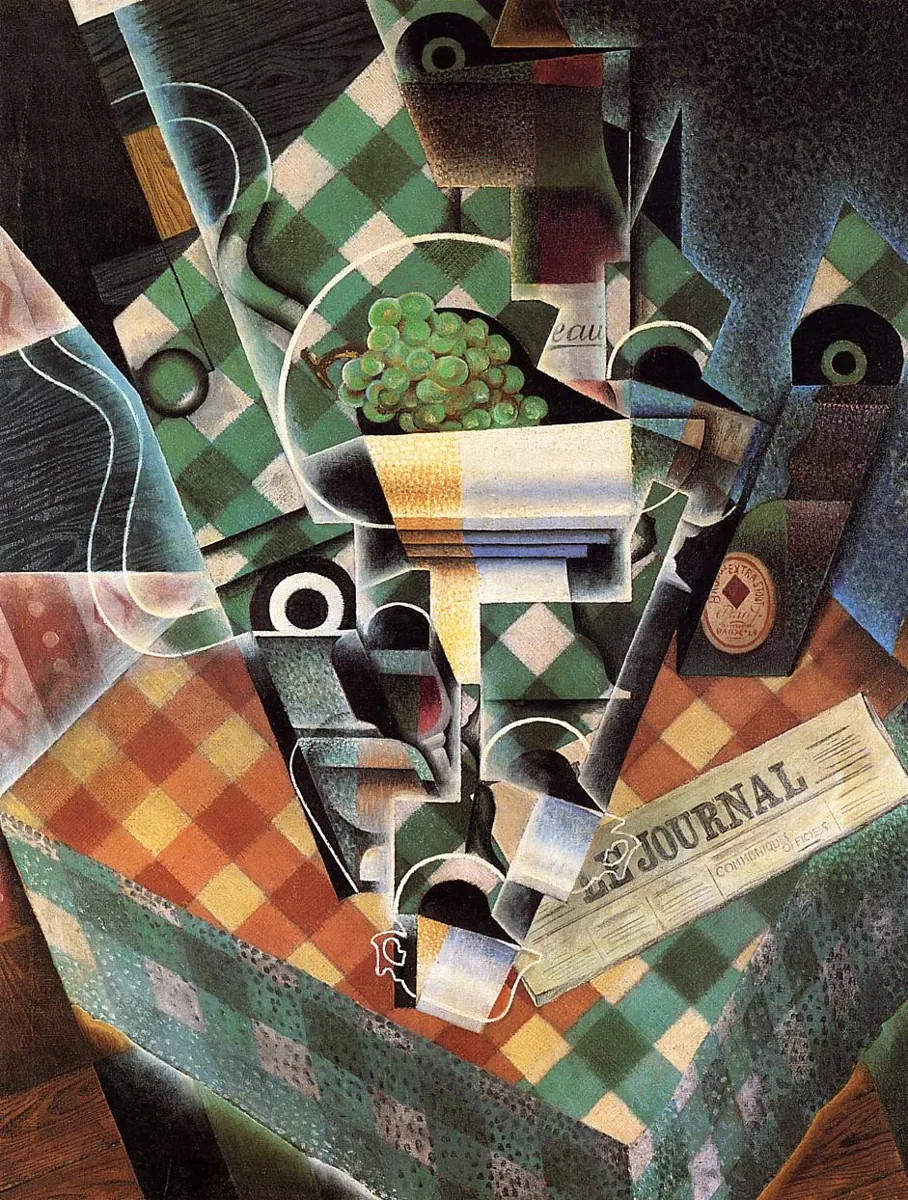
Juan Gris, Still Life with Checked Tablecloth, 1915. The Metropolitan Museum of Art, New York. Image: Wikimedia Commons, public domain.
Juan Gris, Still Life with Checked Tablecloth, 1915. At the Metropolitan Museum of Art. This is Synthetic Cubism: clear shapes and bright colours rather than brown facets. Find the checked cloth, then the bottle, then the newspaper, and see how each is cut by a vertical band of a different view.
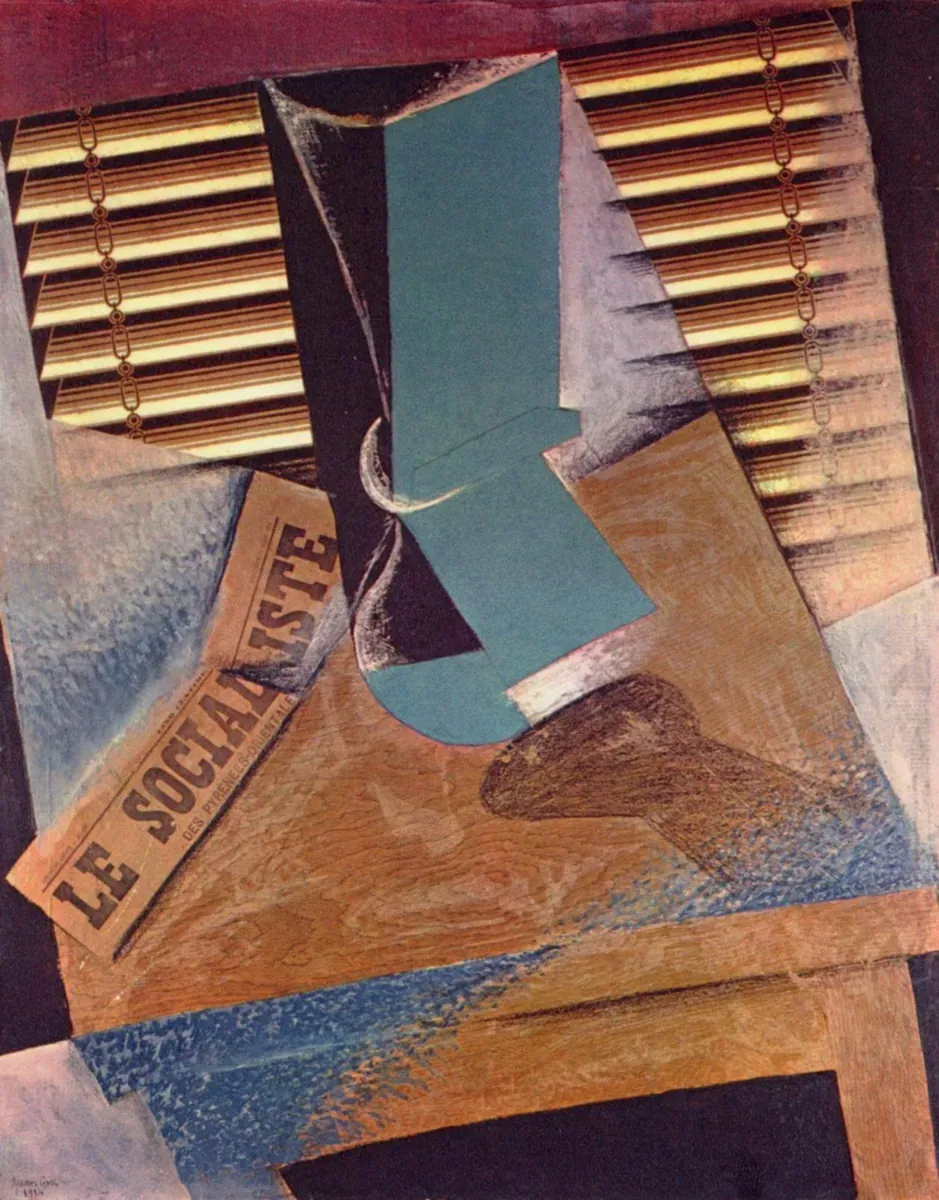
Juan Gris, The Sunblind, 1914. Tate, London. Image: Wikimedia Commons, public domain.
Juan Gris, The Sunblind, 1914. At Tate in London. Gris glued real paper onto the canvas and painted around it. Collage, invented by Braque and Picasso in 1912, let actual pieces of the world into the picture.
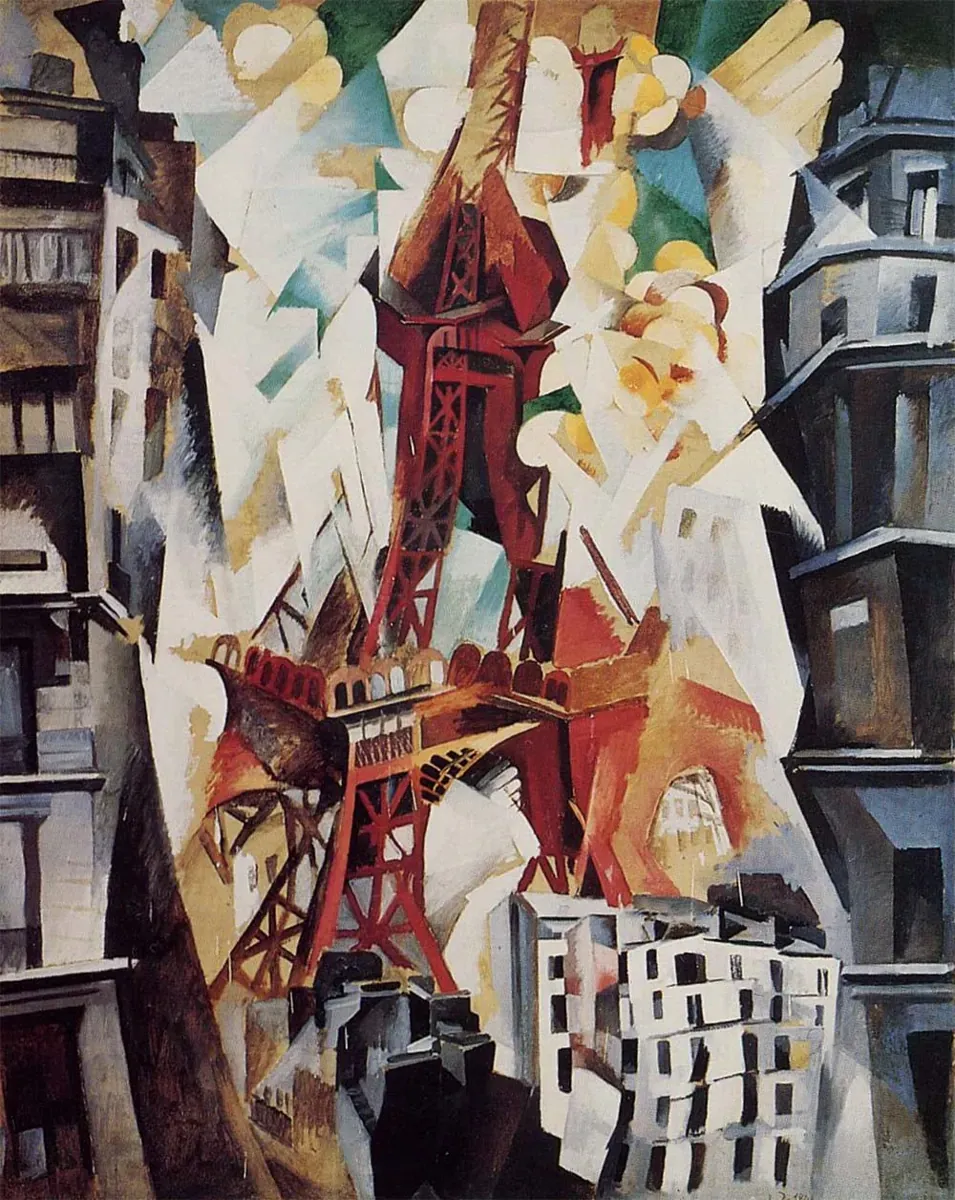
Robert Delaunay, Eiffel Tower (Tour Eiffel), 1911. Art Institute of Chicago. Image: Wikimedia Commons, public domain.
Robert Delaunay, Eiffel Tower, 1911. At the Art Institute of Chicago. Delaunay painted the tower many times, shattering it as if seen from many angles while walking past. Look at the warm red against the cool grey: colour leads toward the Orphism of Robert and Sonia Delaunay.
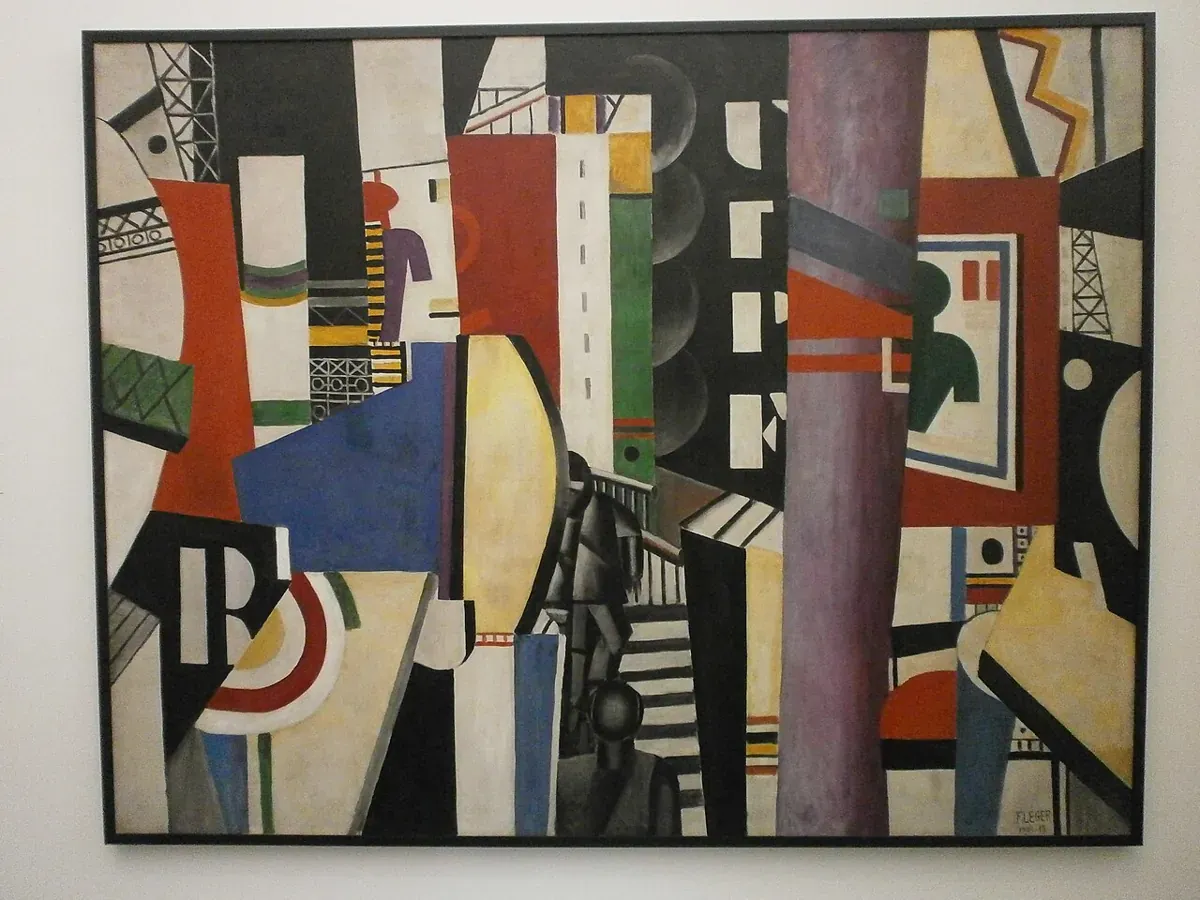
Fernand Léger, The City, 1919. Philadelphia Museum of Art. Image: Wikimedia Commons, public domain.
Fernand Léger, The City, 1919. At the Philadelphia Museum of Art. After the war Léger turned Cubism toward the machine age. Look for the stencilled letters, the staircase and the faceless figures.
Cubism drew on Post-Impressionism, above all Cézanne. It fed Futurism, Dada collage and early abstraction, and later Pop Art borrowed its love of printed words.
Try this
Put a cup or a bottle on a table. Draw it from the front, from above and from the side. Then cut the three drawings into pieces and glue them together into one picture. What do you know about the object now that one view could not show?
What next
Before this: Expressionism.
After this: Futurism.
Also worth reading alongside it: Fauvism.
See every movement in order on the art movements timeline, or learn to look step by step in the free Art History for Beginners course.
If you want to carry this into tarot and practice, these pages connect to it: Two of Swords, seeing two sides at once; The Hanged Man, looking from a new angle; Cubism and the fourth dimension; and How to read form and space.
Sources
- Linda Dalrymple Henderson, The Fourth Dimension and Non-Euclidean Geometry in Modern Art (1983).
- Thomas McEvilley, Artforum, Doctor Lawyer Indian Chief: “Primitivism” in 20th Century Art at the Museum of Modern Art (1984).
- T. S. Eliot, The Sacred Wood (1920).
- Art Institute of Chicago, Portrait of Pablo Picasso. Open the record
- E. H. Gombrich, The Story of Art (1950).
- Wikimedia Commons, Portrait of Pablo Picasso (hero image record). Open the record
- John Golding, Cubism: A History and an Analysis, 1907 to 1914 (1959).

Questions
What is the difference between Analytic and Synthetic Cubism?
Analytic Cubism (about 1909 to 1912) broke objects into small faceted planes in muted colors. Synthetic Cubism (from 1912) built images from flat shapes and pasted materials, which is where collage begins.
Did Picasso say good artists copy, great artists steal?
No reliable source traces it to him. A similar idea appears in T. S. Eliot's The Sacred Wood (1920): immature poets imitate; mature poets steal.
Where can I see works of Cubism in person?
Good places to start are New York (MoMA, the Met), Paris (the Centre Pompidou, the Musée Picasso), Chicago, and Philadelphia. Museums change their displays, so check the collection page before you travel.
Who invented Cubism?
Pablo Picasso and Georges Braque developed it together in Paris from about 1907 to 1914, working so closely that some of their paintings are hard to tell apart.
What is the most famous Cubist painting?
Picasso's Les Demoiselles d'Avignon (1907, Museum of Modern Art, New York) is usually called the first step toward Cubism, and Picasso's Guernica (1937, Reina Sofía, Madrid) is its most famous late descendant. Both are still in copyright.
Get the free Mini-Grimoire
A short printable starter guide to tarot and everyday witchcraft, plus my newsletter. Unsubscribe any time.
Opens Substack in a new tab to confirm. More about the newsletter · Privacy