


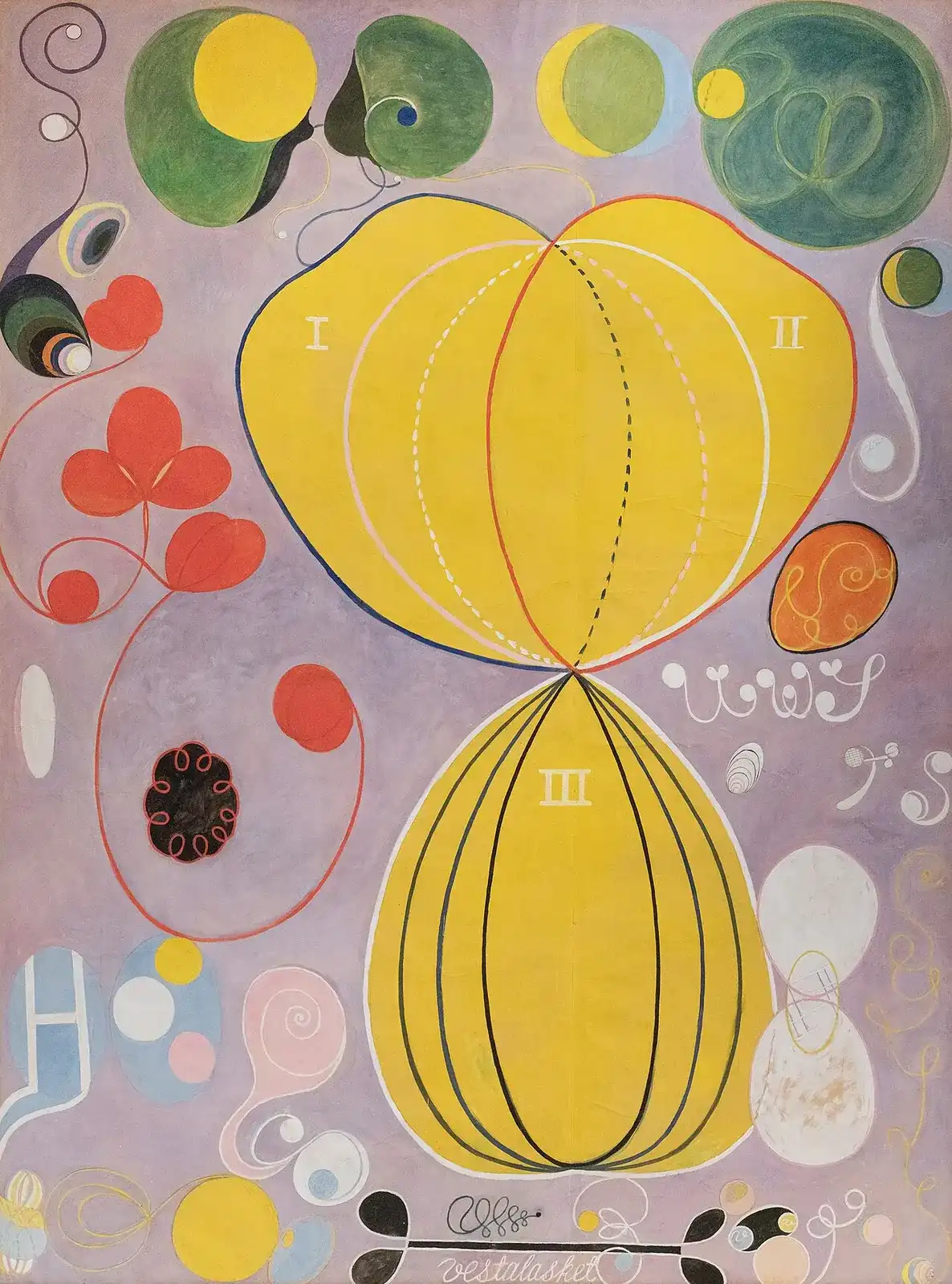
How to read the labels Historical what the old sources say. Later tradition what later writers added. Modern modern practice and my own notes.
Early abstraction is the first wave of fully non-representational painting in Europe, from about 1906 to the early 1920s. Hilma af Klint in Stockholm, Wassily Kandinsky in Munich, František Kupka in Paris, Kazimir Malevich in Moscow and Piet Mondrian in Paris all arrived at abstraction, often through spiritual ideas such as Theosophy. It is the moment painting stopped needing a visible subject.
Many of them did it for the same surprising reason. They were not rebelling against meaning. They were trying to paint the spirit. Abstract art was born partly in séance rooms and Theosophical lodges.
Key dates
| When | What happened |
|---|---|
| 1906 | Hilma af Klint begins The Paintings for the Temple in Stockholm. |
| 1907 | Af Klint paints The Ten Largest. |
| 1911 | Kandinsky publishes On the Spiritual in Art. |
| 1912 | František Kupka shows abstract works at the Salon d’Automne. |
| 1915 | Kazimir Malevich shows Black Square in Petrograd. |
| 1917 | Mondrian and Theo van Doesburg found De Stijl. |
What is early abstraction?
Early abstraction is painting that does not depict recognisable objects, made by a group of pioneers in the 1900s and 1910s who believed colour and form could express inner or spiritual realities.
Throughout this page I mark three layers. Historical What the works and records show. Later tradition The legends. Modern How we see it now.
Historical Thought forms. In 1901 the Theosophists Annie Besant and Charles Leadbeater published Thought-Forms, with color plates showing what they believed emotions and thoughts looked like on the astral plane: clouds, spirals and rays of color.
Several pioneers of abstraction knew this kind of writing. I cover Hilma af Klint, who began her abstract Paintings for the Temple in Stockholm in 1906, in lesson 7 of the course.
Kandinsky. 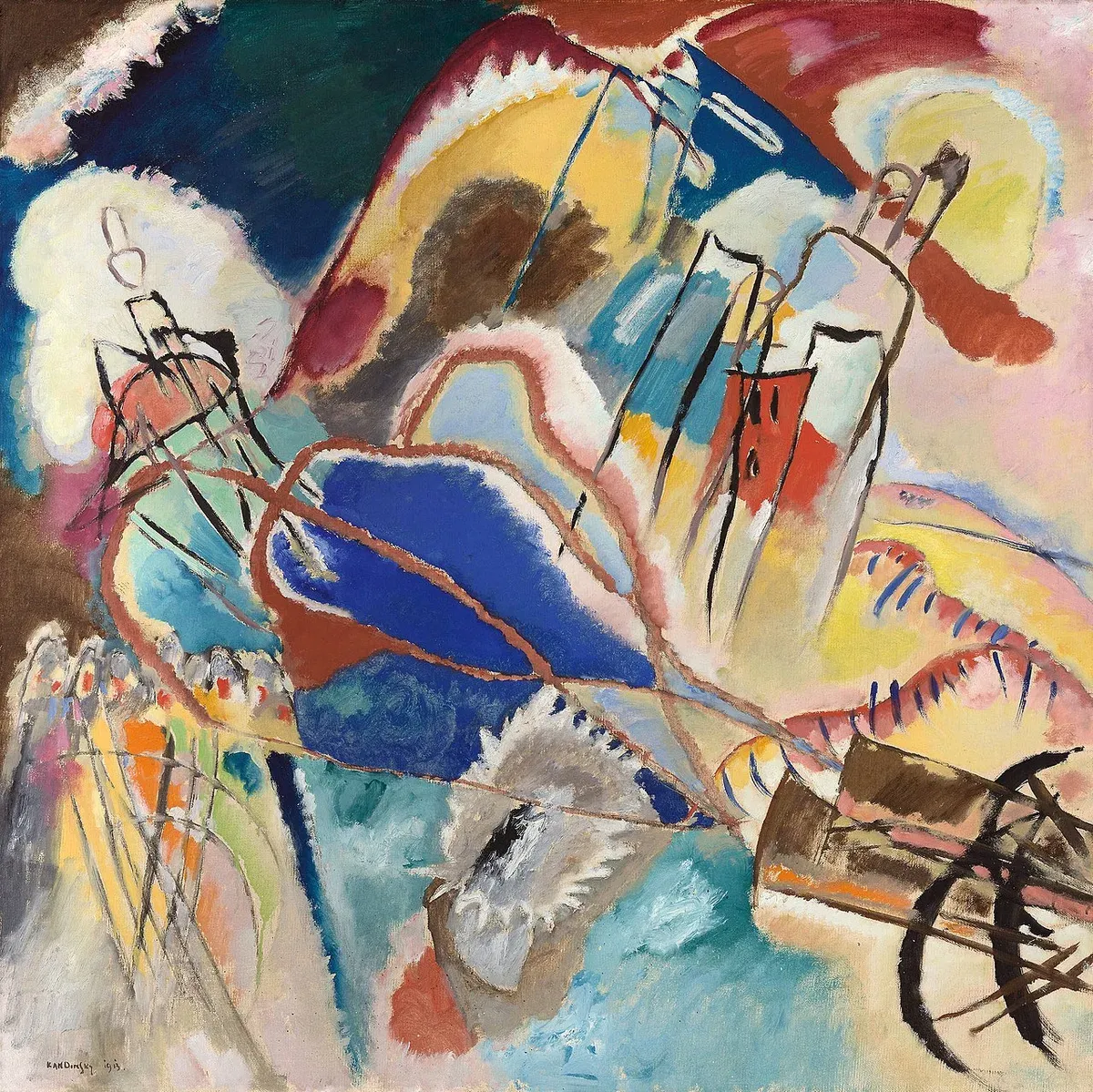
Vasily Kandinsky, Improvisation No. 30 (Cannons), 1913. Art Institute of Chicago (1931.511). Image: Wikimedia Commons, public domain.
Historical Wassily Kandinsky (1866 to 1944) believed colors have an inner sound. His book Concerning the Spiritual in Art appeared in late 1911, dated 1912, and names Madame Blavatsky. Improvisation No. 30 (Cannons) (1913), in Chicago, still has cannons and buildings in it, but they are dissolving into pure color.
A watercolor in Paris long called the first abstract painting and dated 1910 is now dated 1913 by the Centre Pompidou.
Historical Kupka and Orphism. The Czech painter Frantisek Kupka (1871 to 1957) worked as a spiritualist medium as a young man in Prague and Vienna. In Paris in 1912 he exhibited large abstract paintings of circles and planes.
The poet Guillaume Apollinaire called the color abstraction of Robert and Sonia Delaunay “Orphism”, after Orpheus, the mythical singer. Sonia Delaunay carried it into fabrics and fashion.
Historical Malevich’s Black Square. In December 1915, at an exhibition in Petrograd called 0,10, Kazimir Malevich hung a painting of a black square high in the corner of the room, where Russian homes placed an icon.
He called his art Suprematism, the supremacy of pure feeling. He had read P. D. Ouspensky’s Tertium Organum (1911), about the fourth dimension and higher consciousness. In 2015 researchers found a racist joke written under the paint, a reminder that even icons have messy histories.
Mondrian and De Stijl. 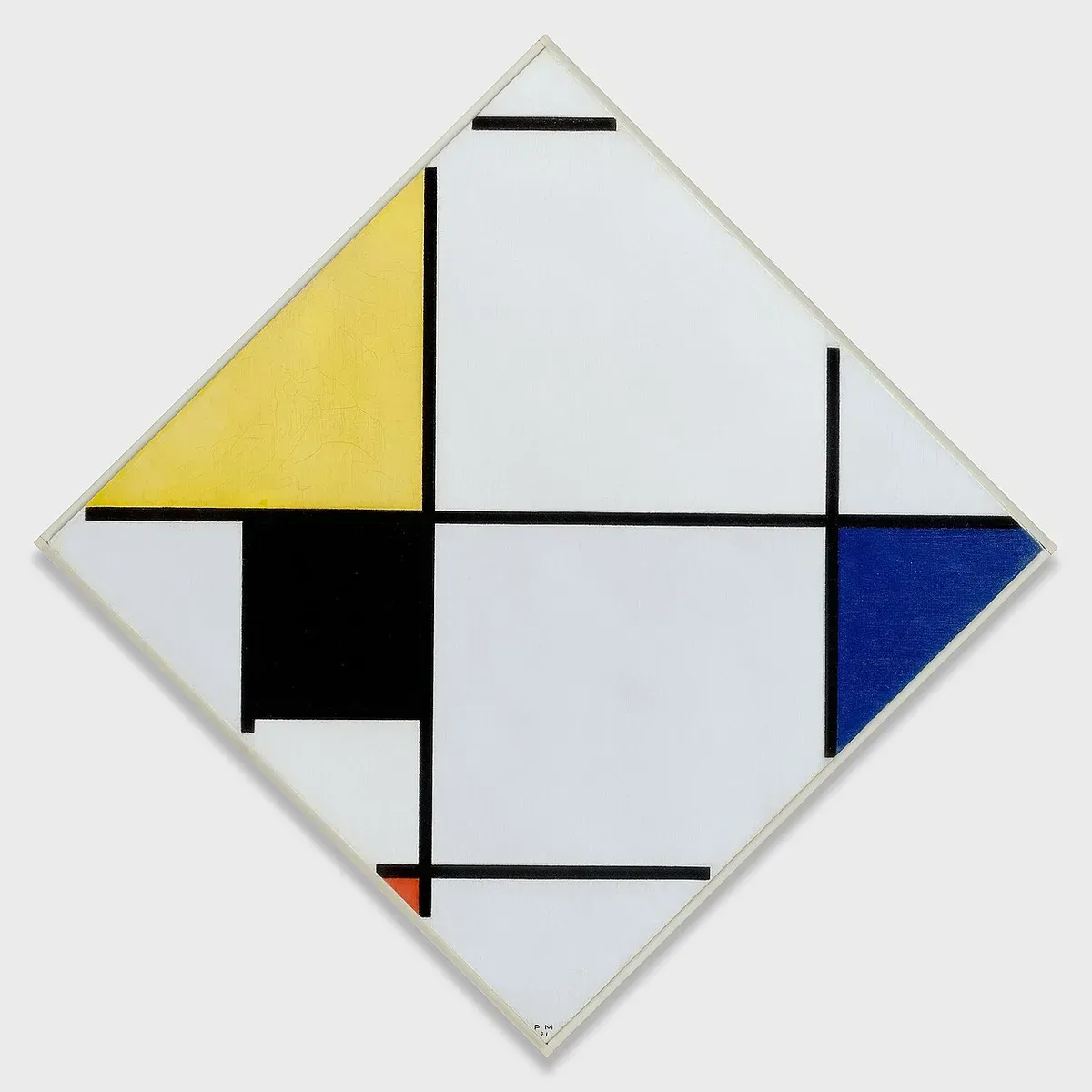
Piet Mondrian, Lozenge Composition with Yellow, Black, Blue, Red, and Gray, 1921. Art Institute of Chicago (1957.307). Image: Wikimedia Commons, public domain.
Historical Piet Mondrian (1872 to 1944) joined the Theosophical Society in 1909. Over the next decade his trees became grids, and by the 1920s his paintings were black lines and primary colors, like this diamond-shaped Lozenge Composition (1921) in Chicago.
He saw them as a balance of opposites, a picture of universal harmony. In 1917 he and Theo van Doesburg founded the journal De Stijl.
Key artists
| Artist | Lived | Why they matter |
|---|---|---|
| Hilma af Klint | 1862 to 1944 | The Swedish painter who made abstract works for a temple of the spirit, years before Kandinsky. |
| Wassily Kandinsky | 1866 to 1944 | The Russian painter and theorist of spiritual abstraction. |
| František Kupka | 1871 to 1957 | The Czech painter, a former medium, of color discs and vertical planes. |
| Kazimir Malevich | 1879 to 1935 | The founder of Suprematism. |
| Piet Mondrian | 1872 to 1944 | The Dutch Theosophist painter of grids and primary colors. |
| Georgiana Houghton | 1814 to 1884 | The British Spiritualist medium whose abstract watercolors date from the 1860s. |
How do you recognise early abstraction?
Look for paintings with no recognisable objects: circles, spirals, grids, bands of color. Titles talk about the spirit, music or the cosmos. Many of these painters read Theosophy and believed that color and form could show the invisible.
Common misconceptions. The best-known one is that Kandinsky made “the first abstract painting” in 1910 or 1911. Hilma af Klint’s abstract series The Paintings for the Temple began in 1906, though she showed them to almost no one, and the medium Georgiana Houghton exhibited abstract-looking spirit drawings in London in 1871.
Another is that abstraction is cold and mathematical. Most of the pioneers saw it as spiritual, even mystical. A third is that af Klint wanted her work hidden for twenty years after her death. That story comes from a note in her papers and from family accounts; scholars still discuss what exactly she intended.
Esoteric themes
Historical At the Bauhaus school in Germany (1919 to 1933), the teacher Johannes Itten followed Mazdaznan, a religion mixing Zoroastrian ideas with diet and breathing, and began classes with breathing exercises. In 1937 the Nazis attacked abstract art as degenerate.
Later tradition For decades, museums told abstraction as a story of pure form, leaving out the spirit. A 1986 exhibition in Los Angeles, The Spiritual in Art, helped put it back.
Modern See also esoteric art.
Works to see
| Work | Artist | Date | Where to see it |
|---|---|---|---|
| The Ten Largest, No. 7, Adulthood | Hilma af Klint | 1907 | Hilma af Klint Foundation, Stockholm |
| Improvisation 28 (second version) | Wassily Kandinsky | 1912 | Solomon R. Guggenheim Museum, New York |
| Black Square | Kazimir Malevich | 1915 | State Tretyakov Gallery, Moscow |
| Lozenge Composition with Yellow, Black, Blue, Red, and Gray | Piet Mondrian | 1921 | The Art Institute of Chicago |
Every work in this list is free of nudity, so you can look them up with confidence. Works still in copyright are named but not shown here.
How to look at an early abstract painting
Do not look for objects. Look for relationships: which colour advances and which retreats, where the eye rests, whether the shapes feel heavy or light, still or moving. Kandinsky compared his paintings to music, so try listening with your eyes.
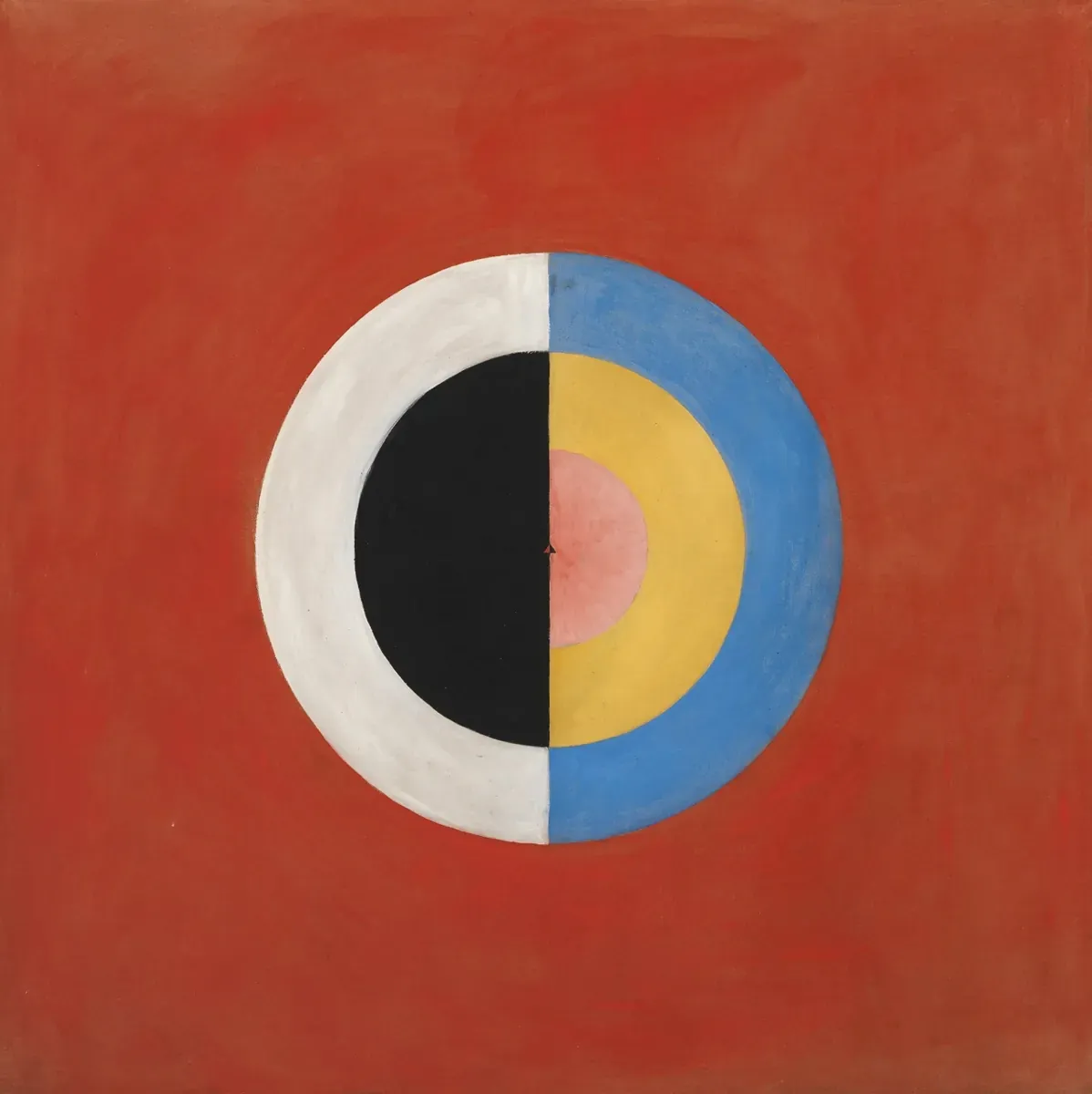
Hilma af Klint, The Swan, No. 17, Group IX/SUW, 1915. Hilma af Klint Foundation, Stockholm (shown at Moderna Museet). Image: Wikimedia Commons, public domain.
Hilma af Klint, The Swan, No. 17, Group IX/SUW, 1915. Owned by the Hilma af Klint Foundation and shown at Moderna Museet in Stockholm. The Swan series begins with two birds, one black and one white, and ends in pure geometry like this. Look at how every opposite, dark and light, warm and cool, is balanced. Af Klint saw the series as a study of duality and its union.
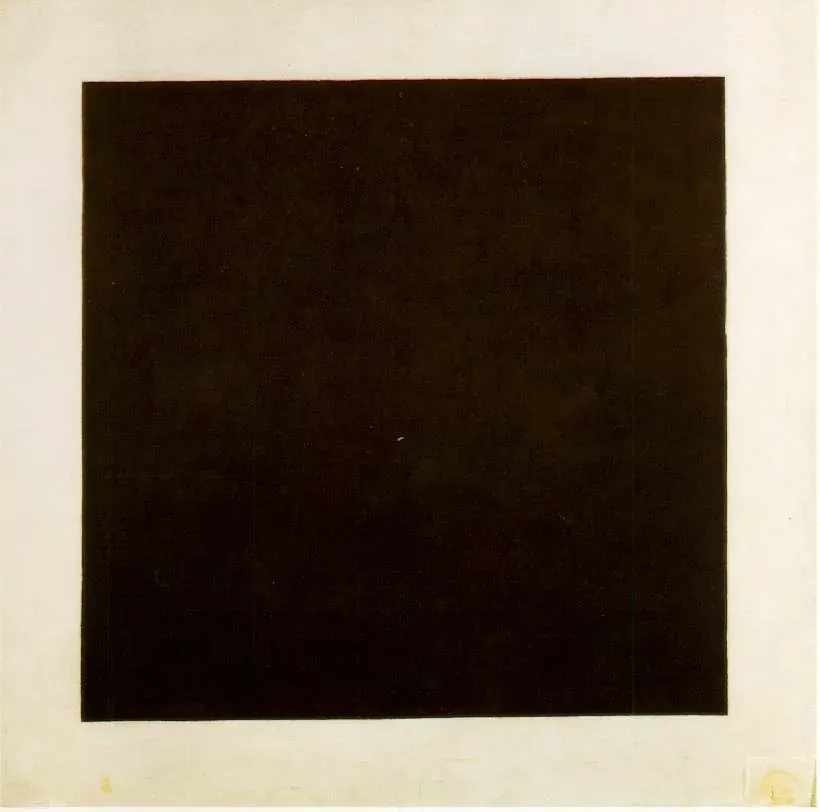
Kazimir Malevich, Black Square, 1915. State Tretyakov Gallery, Moscow. Image: Wikimedia Commons, public domain.
Kazimir Malevich, Black Square, 1915. At the Tretyakov Gallery in Moscow. Malevich hung it high in a corner at the 0.10 exhibition in Petrograd in December 1915, where a Russian Orthodox icon would normally hang. Look at the cracks, which show the earlier layers underneath, and at the edges, which are painted by hand rather than ruled.
Early abstraction grew from Symbolism, Post-Impressionism, Fauvism and Cubism, shared its years with Expressionism, and was taken up after 1945 by Abstract Expressionism.
Try this
Without drawing any objects, paint or color three small squares: one for calm, one for anger, one for hope. Use only color, line and shape. Show them to someone without the labels. Can they guess which is which?
What next
Before this: Futurism.
After this: Dada.
Also worth reading alongside it: Expressionism, Abstract Expressionism.
See every movement in order on the art movements timeline, or learn to look step by step in the free Art History for Beginners course.
If you want to carry this into tarot and practice, these pages connect to it: The World, the whole cosmos as a pattern; The High Priestess, hidden knowledge and the veil between seen and unseen; Theosophy and the first abstract paintings; and Where Theosophy came from.
Sources
- Wassily Kandinsky, Concerning the Spiritual in Art (Munich: Piper, dated 1912) (1911).
- Julia Voss, Hilma af Klint: A Biography (2022).
- P. D. Ouspensky, Tertium Organum (1911).
- Maurice Tuchman (ed.), Los Angeles County Museum of Art, The Spiritual in Art: Abstract Painting 1890 to 1985 (exhibition catalogue) (1986).
- Art Institute of Chicago, Improvisation No. 30 (Cannons), 1931.511. Open the record
- Art Institute of Chicago, Lozenge Composition with Yellow, Black, Blue, Red, and Gray, 1957.307. Open the record
- E. H. Gombrich, The Story of Art (1950).
- Wikimedia Commons, The Ten Largest, No. 7, Adulthood (hero image record). Open the record
- Tracey Bashkoff (ed.), Hilma af Klint: Paintings for the Future (2018).
- Maurice Tuchman (ed.), The Spiritual in Art: Abstract Painting 1890 to 1985 (1986).

Questions
Who made the first abstract painting?
Kandinsky was long given the honor for a watercolor dated 1910, but it is now dated 1913. Hilma af Klint was painting abstract works in Stockholm by 1906, and Frantisek Kupka exhibited abstract paintings in Paris in 1912. There was no single first.
What did Theosophy have to do with abstract art?
A great deal. Kandinsky, Mondrian and af Klint all read Theosophical writers, who taught that thoughts and spiritual forces had colors and shapes. Abstraction was, for them, a way to paint the invisible.
Where can I see works of Early abstraction in person?
Good places to start are Stockholm (the Moderna Museet), Chicago, New York (MoMA, the Guggenheim), Amsterdam (the Stedelijk), and The Hague (the Kunstmuseum). Museums change their displays, so check the collection page before you travel.
What is Suprematism?
Suprematism is the movement Kazimir Malevich launched in 1915, based on simple geometric shapes such as squares and circles. He wanted to reach what he called the supremacy of pure feeling in art.
Where can I see Hilma af Klint's paintings?
Her works belong to the Hilma af Klint Foundation and are often shown at Moderna Museet in Stockholm, which has a long-term collaboration with the foundation, and in touring exhibitions.
Get the free Mini-Grimoire
A short printable starter guide to tarot and everyday witchcraft, plus my newsletter. Unsubscribe any time.
Opens Substack in a new tab to confirm. More about the newsletter · Privacy