


In this lesson: Impressionist light, wild color, Kandinsky and Theosophy, Hilma af Klint, Mondrian and the Surrealist women who studied magic.
It is easy to assume that modern art left magic behind, but the opposite is closer to the truth. Some of the first painters to give up recognizable pictures did so partly for spiritual reasons, inspired by Theosophy, Spiritualism and ideas about color sounding in the soul. And the Surrealists, along with women artists such as Leonora Carrington and Remedios Varo, filled their work with alchemy and tarot. This lesson follows art from Impressionist light to abstraction and the dream, and shows how spiritual ideas helped painters let go of the visible world.
Light, then color
Historical On 15 April 1874, a group of artists outside the official Salon opened their own exhibition in Paris. A critic mocked Claude Monet’s Impression, Sunrise, and the name “Impressionists” stuck. They painted modern life and changing outdoor light with visible brushstrokes; Berthe Morisot and Edgar Degas were among them. In 1910 the English critic Roger Fry grouped the painters who came next, Cézanne, Seurat, Van Gogh and Gauguin, as “Post-Impressionists”.
At the Salon d’Automne of 1905, Henri Matisse, André Derain and others showed paintings with green shadows and red trees. The critic Louis Vauxcelles called them fauves, wild beasts. In Germany, Expressionists used distortion and color for inner feeling. Color no longer had to match nature.
Kandinsky and the inner sound
Historical Wassily Kandinsky published Concerning the Spiritual in Art in December 1911, with the date 1912 on the title page. He cited Madame Blavatsky and the Theosophical movement, and he believed colors and forms had an inner sound that touched the soul. In Michael Sadler’s 1914 translation he writes: “Colour is the keyboard, the eyes are the hammers, the soul is the piano with many strings.” His Improvisation No. 30 (Cannons) of 1913 still holds cannons and buildings dissolving in a storm of color.
Historical Piet Mondrian joined the Theosophical Society in 1909. Over the next decade his trees and church facades became grids of black lines and primary colors, which he saw as a path toward universal harmony.
Other spiritual pioneers
Historical Kandinsky and Mondrian were not alone. The Czech painter František Kupka had worked as a spiritualist medium as a young man, and in Paris around 1912 he showed some of the first purely abstract paintings. In Russia, Kazimir Malevich exhibited his Black Square in December 1915, hung high in the corner of the room where an Orthodox icon would traditionally hang in a home. He called his movement Suprematism and wrote about the “supremacy of pure feeling”. The link between the new abstract art and spiritual ideas was widespread, not an exception.
Hilma af Klint
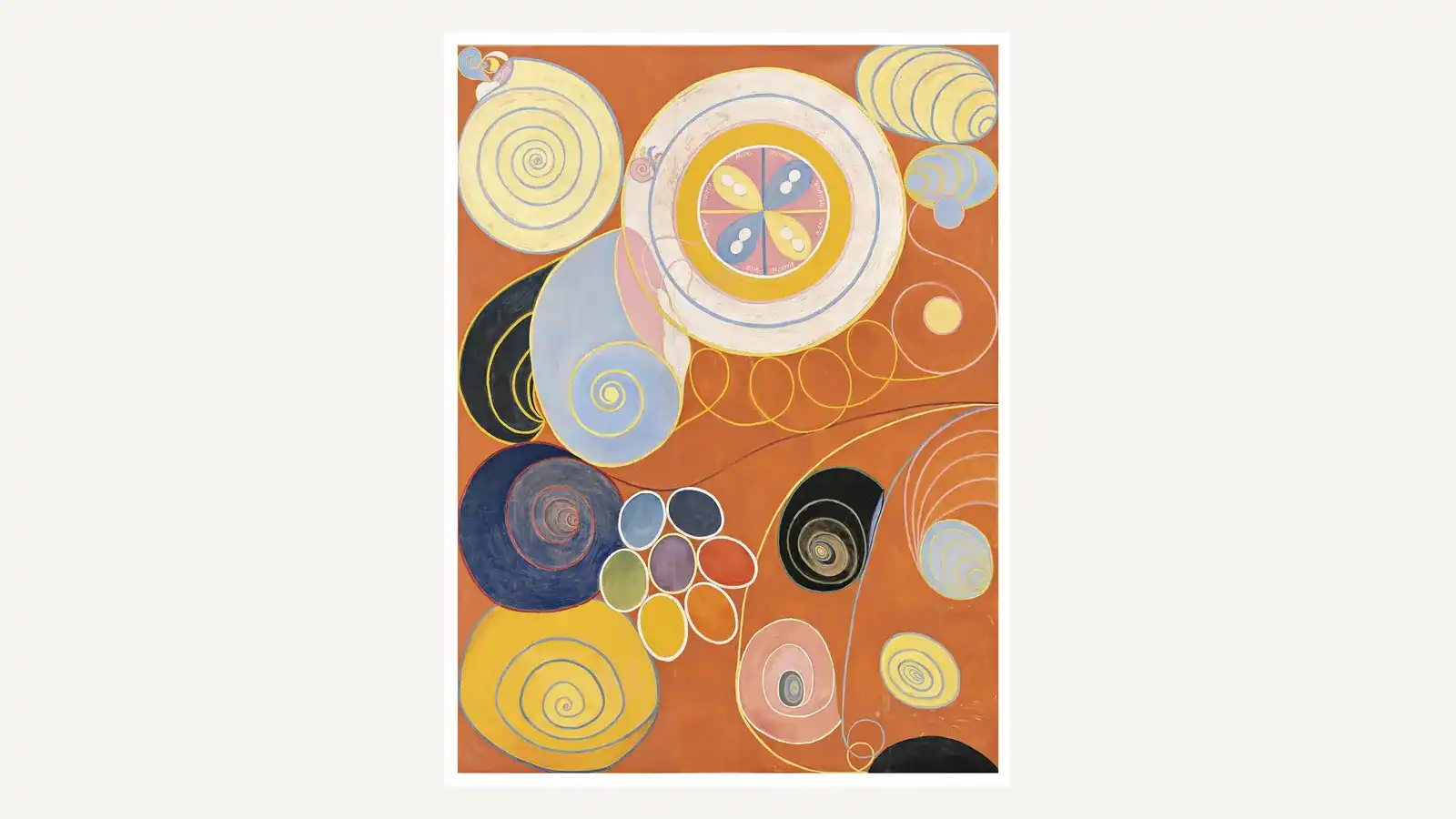
Historical The Swedish painter Hilma af Klint (1862 to 1944) was a trained, respected artist who also took part in Spiritualist séances with a group of women called The Five. In 1906 she began a vast cycle she called The Paintings for the Temple, about 193 works made by 1915, which she said were commissioned by spiritual guides. She asked that they not be shown until years after her death, and they became widely known only from the 1980s.
Later tradition Was she “the first abstract artist”? The question is less useful than it seems. She did not use the word “abstract”, and several painters were moving the same way around 1910 to 1915. It is enough to say that spiritual practice was one of the doors into abstraction.
Af Klint’s afterlife
Historical Af Klint’s paintings were barely seen for decades after her death. A turning point came in 1986, when some were shown in the exhibition The Spiritual in Art: Abstract Painting 1890 to 1985 at the Los Angeles County Museum of Art.
In 2018 and 2019, Hilma af Klint: Paintings for the Future at the Guggenheim Museum in New York became the most visited exhibition in that museum’s history. Her series The Ten Largest (1907), huge paintings about the stages of human life from childhood to old age, are now among the most admired works of the early twentieth century.
Surrealism and the women of magic
Historical André Breton’s Manifesto of Surrealism (1924) called for art from dreams and the unconscious. Leonora Carrington joined the Surrealists in Paris in the late 1930s and settled in Mexico City in 1942, where she and her friend Remedios Varo studied alchemy, tarot and myth and painted their own mysterious worlds. Most of these works are still in copyright, so the Surrealism page describes them and links museums instead of showing them, and that is also why some later movement pages on this site have no picture.
Surrealists and the history of magic
Historical Surrealists also read and wrote about magic. The Swiss-born painter Kurt Seligmann, who joined the Surrealists in Paris, wrote The Mirror of Magic (1948), a popular illustrated history of Western magic. Breton himself wrote L’Art magique (1957). Remedios Varo’s paintings are full of alchemical flasks, towers, cloaks and journeys, and Leonora Carrington wrote stories and a novel, The Hearing Trumpet, full of witches, goddesses and old women. Their work is still protected by copyright, so look at it on museum websites rather than copying it.
Kandinsky’s colors, in his words
Historical Concerning the Spiritual in Art opens with a sentence that sums up a whole way of thinking about art: “Every work of art is the child of its age and, in many cases, the mother of our emotions.” Kandinsky goes on to argue that copying the art of the past produces work that is “still-born”, and that each age must find its own forms.
Later in the book he describes individual colors as if they were voices or temperaments. “Blue is the typical heavenly colour,” he writes, and its “ultimate feeling” is “one of rest”. Yellow, by contrast, “is the typically earthly colour”, restless and loud. These are not scientific claims. They are one artist’s attempt to describe the emotional effect of color, and they were influenced by Theosophical writings about auras and thought-forms.
You can test his ideas in a simple way. Look at a deep blue square and a bright yellow one, each for a minute, on a screen or with paint samples. Write three words for each. Do your words agree with Kandinsky’s? Many people agree about the blue and disagree about the yellow, which is a good reminder that color meanings are partly personal and partly cultural, exactly as lesson 2 warned.
Looking at abstract art without panic
Many beginners freeze in front of abstract paintings because there is “nothing to see”. The slow-looking method still works; it just shifts its attention.
Instead of objects, list forces. Write down directions (rising, falling, spiralling), weights (heavy at the bottom, light at the top) and temperatures (warm patches, cool patches).
Notice edges. Are the forms crisp or blurred? Do colors meet sharply or melt into each other?
Ask about the title. Kandinsky called many works Improvisation or Composition, borrowing words from music. Af Klint gave her series titles like The Ten Largest and numbered stages of life. A title is often the artist’s only spoken clue.
Give it time. Abstract works often need longer than a figure painting before they begin to speak, so use the full ten minutes.
A question beginners ask: “Is an abstract painting just whatever I feel?” Your feelings are part of the response, but you can still point to what you see that makes you feel it, which is the same rule from Visual Thinking Strategies that you met in lesson 1.
Questions beginners ask
Do I need to believe in Theosophy to enjoy Kandinsky? No. Knowing his beliefs helps you understand his aims, but the paintings speak in color and form to anyone.
Was af Klint really guided by spirits? That is what she said. Historians record her account; you can make up your own mind.
Why is modern art so hard to “read”? Many modern artists wanted to bypass stories and symbols to reach feeling directly, so the ten-minute method and attention to color, line and rhythm work better than looking for a code.
Myths to drop: Modern art was not purely secular. Abstraction was not invented by one person. And the women of Surrealism were not muses only; they were major artists.
A worked example
Imagine opening Kandinsky’s Improvisation No. 30 (Cannons) for the first time. For the first five minutes you hunt for things you recognize: two cannons in the lower right, firing; leaning buildings at the top; a few small figures. For the next five minutes you set recognition aside and look only at color. A deep blue in the center feels quiet and heavy.
A red stroke near the cannons feels loud, almost like a shout. Black lines cut through like sharp sounds. You write this down and then read Kandinsky’s own words about color as a keyboard. You do not have to believe he was right about the soul to notice that the painting really does feel like music with loud and quiet passages.
Try this
Open Kandinsky’s Improvisation No. 30 (Cannons) on the Art Institute of Chicago website. Spend five minutes finding anything you can recognize, then five minutes only on color. Write which colors felt loud, which quiet, and why.
A variation: listen to a piece of music for three minutes and draw only lines and colors while listening. Then read Kandinsky’s quotation again and see whether it rings true.
Recap
Impressionism, from 1874, painted changing light; Post-Impressionists, Fauves and Expressionists freed color from nature. Kandinsky’s 1911 book drew on Theosophy and described colors as an inner sound, Mondrian joined the Theosophical Society in 1909, and Hilma af Klint began The Paintings for the Temple in 1906 after Spiritualist practice. Breton’s 1924 manifesto launched Surrealism, and Carrington and Varo studied alchemy and tarot in Mexico City. Spiritual ideas were one of the doors into modern abstraction.
What next
Press “Mark as done” and continue with Witches in prints: a slow-looking practice. Each movement in this lesson has its own page: Impressionism, Post-Impressionism, Fauvism, Expressionism, early abstraction and Surrealism. For the bigger picture, read about esoteric art, and for the ideas behind Theosophy and Spiritualism, take Occult History for Beginners.
Further reading: Wassily Kandinsky, Concerning the Spiritual in Art, translated by Michael Sadler (1914), free online. Kurt Seligmann, The Mirror of Magic (1948).
Sources
- Wassily Kandinsky, Concerning the Spiritual in Art (Munich: Piper, 1911, dated 1912), translated by Michael T. H. Sadler as The Art of Spiritual Harmony (London: Constable, 1914).
- Julia Voss, Hilma af Klint: A Biography (Chicago: University of Chicago Press, 2022).
- André Breton, Manifesto of Surrealism (Paris, 1924).
- E. H. Gombrich, The Story of Art (London: Phaidon, 1950).
- Art Institute of Chicago, Improvisation No. 30 (Cannons), Vasily Kandinsky, 1913, 1931.511.
Quick check
Go deeper: the art movements timeline and art history pages on this site
Get the free Mini-Grimoire
A short printable starter guide to tarot and everyday witchcraft, plus my newsletter. Unsubscribe any time.
Opens Substack in a new tab to confirm. More about the newsletter · Privacy
Comments
Questions and notes from readers. Anyone with a free account can comment, and I reply when I can. Please read the community guidelines.
Comments load from Google Firebase (EU) when you ask for them. Nothing is stored on your device. Privacy