


| Arcana | Major Arcana |
|---|---|
| Number | VII |
| Image | RWS 1909 (PD) |
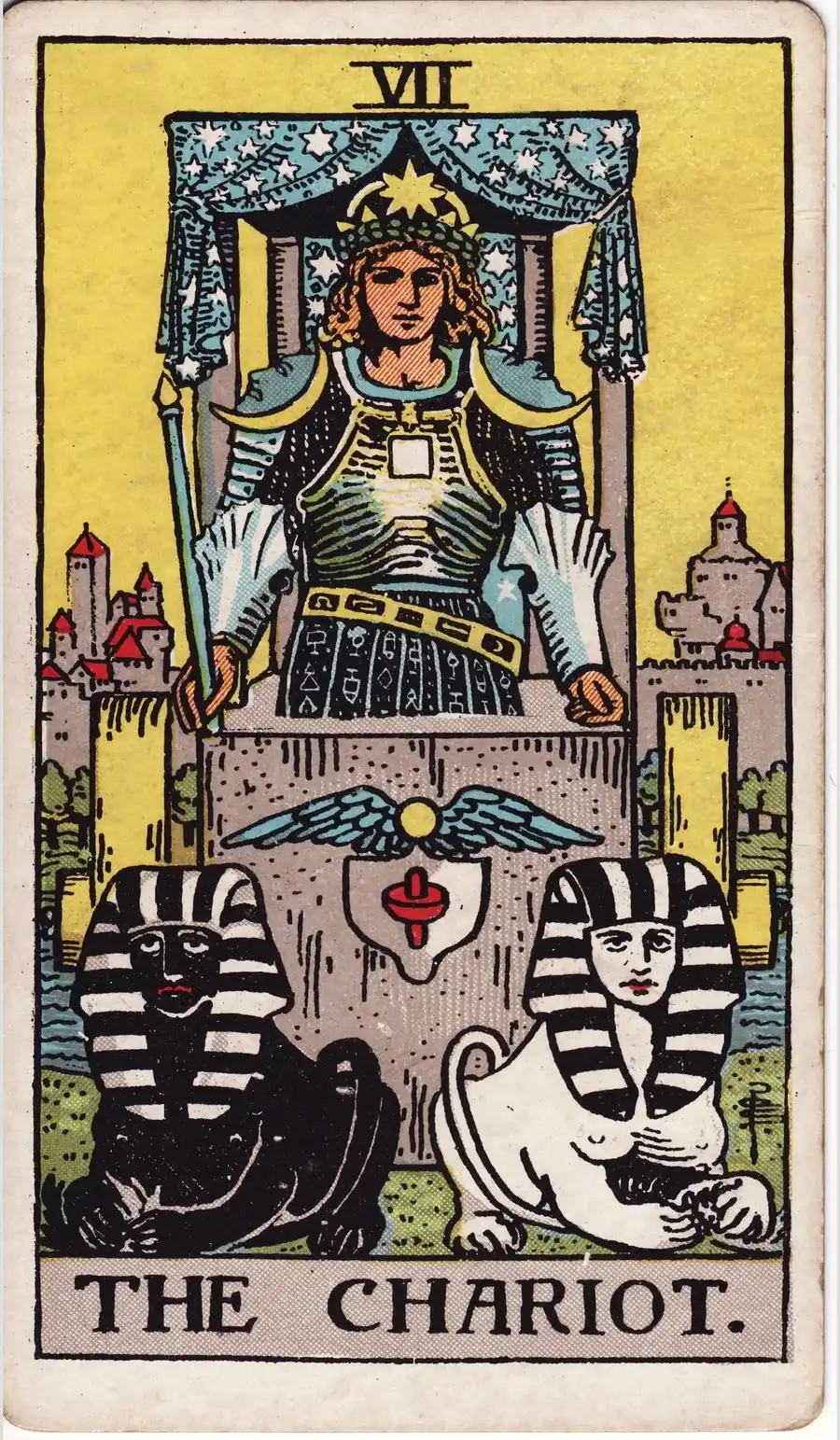
The Chariot is card VII of the Major Arcana, the card of moving forward on purpose. A young warrior stands in a chariot drawn by two sphinxes, one black and one white.
There are no reins. He steers by will alone. Here is what the Chariot means upright and reversed, the symbols in the 1909 card and where those sphinxes came from.
Here is the Chariot at a glance.
| At a glance | This card |
|---|---|
| Upright keywords | willpower, direction, determination, victory |
| Reversed keywords | loss of control, aggression, self-doubt |
| Number | VII (7) in the Major Arcana |
| Golden Dawn title | The Child of the Powers of the Waters; the Lord of the Triumph of Light Later tradition |
| Hebrew letter | Cheth (ח), “fence” or “enclosure” Later tradition |
| Tree of Life path | 18, from Binah to Geburah Later tradition |
| Astrology | Cancer Later tradition |
| Element | Water Later tradition |
| Yes or no | Yes Modern |
The Golden Dawn gave the Chariot the sign Cancer and the letter Cheth, the “fence” or enclosure. Cancer is a water sign with a hard shell, and the charioteer in his armor fits that image: protection that lets a sensitive core move forward. Waite replaced the horses of older decks with two sphinxes, one black and one white, an idea he took from Éliphas Lévi.
The card: what Pamela Colman Smith drew
Smith drew a proud, upright figure leaving a walled city behind. Waite called him “an erect and princely figure carrying a drawn sword” and said that “he is above all things triumph in the mind”.
The two sphinxes. A black sphinx and a white sphinx pull the chariot. They seem to pull in different directions. The card is about holding opposite forces under one direction: ambition and care, speed and safety, two competing duties.
No reins. The charioteer holds a wand, not reins. He steers by focus and will. That is the hard part of the card: no one else will drive for you.
The starry canopy and the armor. Above him is a canopy of stars, and on his armor are crescent moons. The moons link the card to Cancer, the sign the Golden Dawn gave it, ruled by the Moon. Waite said the shoulder pieces stood for the Urim and Thummim, the oracle stones of the Bible.
The city behind. Behind the chariot is a walled town. He has left the safe place behind him and is heading out. Victory here means progress, not only winning.
Upright meaning
Upright, the Chariot is progress won through focus. A charioteer stands in a stone chariot under a canopy of stars, crowned and armored, holding a wand but no reins. Two sphinxes, one black and one white, sit in front, facing slightly different ways. They are not harnessed. What keeps them on course is the driver’s will.
In a reading this is the card of determination, travel and victory after effort. It turns up when you are pulling something through: a move, an exam, a recovery, a hard project. It says you can, but only if you keep both forces moving the same way, whether they are emotion and reason, ambition and caution or two people who disagree.
The armor matters too. The Chariot often asks you to protect what is tender while you move, so that you are not stopped by every criticism on the road.
Reversed meaning
Reversed, the sphinxes pull apart. Plans stall, direction is lost or effort goes everywhere at once. The card can describe a project with no clear goal, or a person trying to win on every front and making progress on none.
It can also describe control turned into force: driving others hard, refusing to stop, treating every disagreement as a battle. The armor becomes a wall, and the charioteer forgets why the journey mattered.
Ask where you are trying to go, in one sentence. If you cannot say it, stop and choose. If you can, ask which of your two sphinxes has wandered, and bring it back gently.
In love, work and spirituality
In love. Upright: Moving a relationship forward with purpose; overcoming distance or obstacles together. Reversed: Power struggles, or one partner pulling the relationship in their own direction.
At work. Upright: Ambition rewarded, a successful push, competition won through discipline. Good for travel for work. Reversed: Lack of direction, a stalled project, or burnout from driving too hard.
With money. Upright: Disciplined saving towards a goal, or money from determined effort. Reversed: Impulsive spending, or financial plans that keep changing course.
In spiritual practice. Upright: A practice that builds will and focus; mastery of attention. Reversed: Spiritual ambition, or forcing results instead of letting the practice work.
As feelings. Determination and drive. The person is pursuing you or a shared goal with energy.
As a person. Driven, competitive and self-disciplined; protective of their inner life.
As advice. Choose one direction and steer both of your forces towards it.
Reading the Chariot: positions, pairs and yes or no
In the past position: A time you pushed through and won. In the present position: Take the reins. Progress is possible if you steer.
In the future position: Movement, travel or a hard-won success ahead. As advice: Set one clear direction and keep your opposing forces in line.
When the Chariot shows up among mostly Minor cards, give it extra weight: the theme of willpower runs under the whole question.
Pairs matter too. Next to The Lovers, it can mean a decision made and then acted on. Choose, then drive. Next to The Tower, it can mean moving too fast toward a collapse. Slow down and check the road. Next to The Star, it can mean steady progress toward a hope you can finally see.
In modern yes or no readings, the Chariot leans yes. It is a card of forward motion and earned success, so it says yes when you are willing to steer.
The history and art behind the card
In the Tarot de Marseille pattern the card is called Le Chariot, the Chariot. Early Italian cards show a triumphal chariot, often driven by a woman, in the style of Renaissance victory parades. Marseille decks show a crowned figure in a chariot pulled by two horses.
The sphinxes are a nineteenth century idea. The French occultist Éliphas Lévi drew the chariot with two sphinxes, and Waite wrote that he had “accepted the variation of Eliphas Lévi” for the 1909 deck. It is a good example of how one writer’s design can become the standard image a century later.
Waite also warned that the charioteer’s victory is outward. If he came to the High Priestess’s temple, Waite wrote, he could not open her scroll. That is a useful note for readers: the Chariot wins battles in the world, and inner questions may need another card’s kind of wisdom.
When A. E. Waite published The Pictorial Key to the Tarot in 1910, he listed these divinatory meanings for the card: “Succor, providence; also war, triumph, presumption, vengeance, trouble.”
Reversed, he gave: “Riot, quarrel, dispute, litigation, defeat.” Waite himself called the fortune-telling meanings of the trumps “artificial and arbitrary”, and on this site I read the picture first and treat lists like this as history.
The Chariot closes the first stage of the modern Fool’s Journey. The traveler has gathered tools, intuition, care, structure, teaching and a chosen value, and now harnesses them all to move forward under their own will.
Common questions
Is the Chariot a yes? Yes, in most readings. It means progress and success through focus and effort.
Can the Chariot mean travel? It can. A move, a trip or a new direction are all common readings.
What does the Chariot reversed mean? Loss of direction, scattered energy or forcing things too hard. Stop, regroup and set one clear aim.
Try this
Try this small spread for the Chariot. Use it when you need to move forward on a goal.
| Card | Question | What it shows |
|---|---|---|
| 1 | Where am I heading? | The goal, stated clearly. |
| 2 | What pulls me off course? | The opposing force to manage. |
| 3 | How do I take the reins? | The focus or discipline that keeps me moving. |
Affirmation: I steer opposing forces toward a clear destination.
Reversed affirmation: I recover direction without mistaking force for control.
If you keep a tarot journal, take one of these questions to it: Where am I going, in one sentence? Which two forces in me pull in different directions? What is one stretch of road I can finish this week?
What next
Cards that sit close to this one are The Magician (will and skill at the start of the journey), Strength (a softer kind of control, the next card) and The Emperor (discipline and structure in the world).
The Chariot is part of the lesson The Fool to the Chariot in my free Tarot for Beginners course. To keep walking the Major Arcana, read the card before it, The Lovers or the card after it, Strength, or go back to all the card meanings.
For every card with keywords, affirmations and examples, see my book The Novice’s Guide to Tarot. If you would like a printable cheat sheet for all 78 cards, my 45-page Tarot Workbook is on Etsy.
Sources
- A. E. Waite, The Pictorial Key to the Tarot (London: Rider, 1910), Part II and Part III, section 3.
- Pamela Colman Smith and A. E. Waite, the Rider-Waite-Smith tarot (London: Rider, 1909).
- Nicolas Conver, Tarot de Marseille (Marseille, 1760).
- Eden Gray, A Complete Guide to the Tarot (New York: Crown, 1970), epilogue “The Fool’s Journey”.
- Lauri Mukkala, The Novice’s Guide to Tarot, entry for The Chariot.
- Aleister Crowley, 777 (London: Walter Scott, 1909), columns of the Hebrew letters, paths and Tarot trumps.
- Israel Regardie, ed., The Golden Dawn (Chicago: Aries Press, 1937 to 1940), “Book T” and the titles of the trumps.
All 78 cards
Major Arcana
- The Fool
- The Magician
- The High Priestess
- The Empress
- The Emperor
- The Hierophant
- The Lovers
- The Chariot
- Strength
- The Hermit
- Wheel of Fortune
- Justice
- The Hanged Man
- Death
- Temperance
- The Devil
- The Tower
- The Star
- The Moon
- The Sun
- Judgement
- The World
Wands
- Ace of Wands
- Two of Wands
- Three of Wands
- Four of Wands
- Five of Wands
- Six of Wands
- Seven of Wands
- Eight of Wands
- Nine of Wands
- Ten of Wands
- Page of Wands
- Knight of Wands
- Queen of Wands
- King of Wands
Cups
- Ace of Cups
- Two of Cups
- Three of Cups
- Four of Cups
- Five of Cups
- Six of Cups
- Seven of Cups
- Eight of Cups
- Nine of Cups
- Ten of Cups
- Page of Cups
- Knight of Cups
- Queen of Cups
- King of Cups
Swords
- Ace of Swords
- Two of Swords
- Three of Swords
- Four of Swords
- Five of Swords
- Six of Swords
- Seven of Swords
- Eight of Swords
- Nine of Swords
- Ten of Swords
- Page of Swords
- Knight of Swords
- Queen of Swords
- King of Swords
Pentacles
Get the free Mini-Grimoire
A short printable starter guide to tarot and everyday witchcraft, plus my newsletter. Unsubscribe any time.
Opens Substack in a new tab to confirm. More about the newsletter · Privacy