


| Arcana | Minor Arcana: Swords |
|---|---|
| Image | RWS 1909 (PD) |
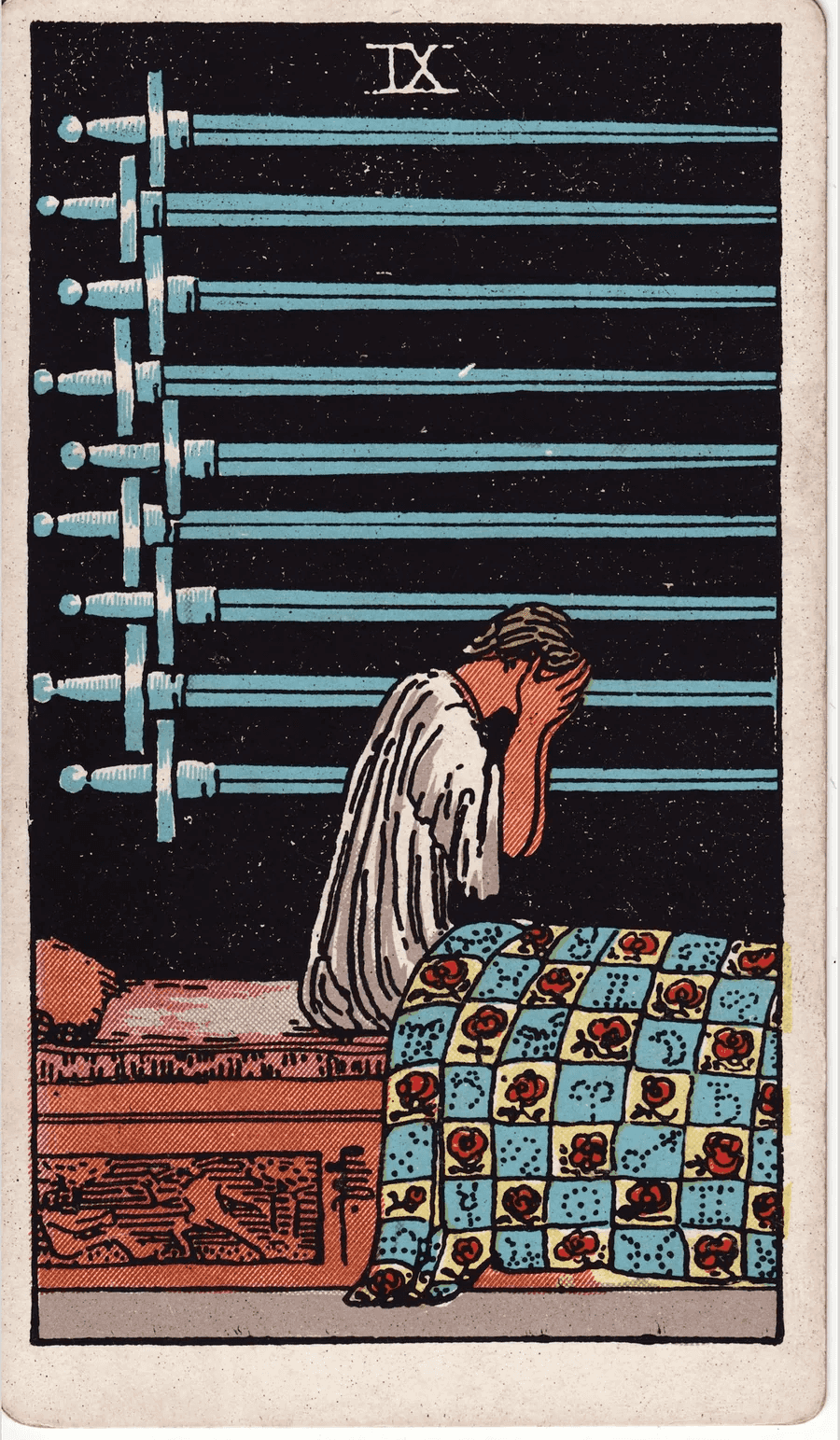
The Nine of Swords shows a woman sitting up in bed in the dark, her face in her hands. Nine swords hang in rows on the black wall behind her. It is the card of the 3 a.m. mind: anxiety, worry and fear. This page covers what the Nine of Swords means upright and reversed, the symbols Pamela Colman Smith drew and a gentle spread for worry.
At a glance
- Upright keywords: anxiety, worry, fear
- Reversed keywords: overcoming fear, recovery, healing
- Number: 9 in the suit of Swords
- Suit and element: Swords, Air Later tradition
- Astrology: Mars in Gemini Later tradition
- Yes or no: No Modern
The element and the planet in a sign (one of the 36 ten-degree slices of the zodiac called decans) come from the Golden Dawn system of the 1880s and 1890s, not from the first tarot decks. The yes or no lean is a modern reading habit. Use these layers if they help you remember the card, and skip them if they get in the way.
The card: what Pamela Colman Smith drew
Waite wrote: “One seated on her couch in lamentation, with the swords over her. She is as one who knows no sorrow which is like unto hers. It is a card of utter desolation.” Smith decorated her quilt with roses and astrological signs and carved a scene of a fight on the side of the bed.
Face in her hands
She cannot look. Worry often feels worst in the dark, alone, when there is nothing to do but think.
The swords on the wall
The swords hang over her, but none of them touches her. They are thoughts, not wounds.
The quilt
Her quilt has roses and zodiac signs. Even in the dark, the world is still full of beauty and order she cannot see right now.
Upright meaning
Upright, the Nine of Swords is night-mind anxiety: looping worry, dread and the kind of fear that thrives at 3 a.m. The suffering is real even when the catastrophe has not arrived. This card makes room for mental anguish without calling it destiny.
Turn on a light, literally or not. Write the worry down, talk to someone and look at it again in daylight. Ask what is a fact and what is a fear. If your thoughts ever turn to harming yourself, please contact a crisis line or emergency services where you live, or tell someone you trust today. A card is never a reason to wait.
Reversed meaning
Reversed, the Nine of Swords can show overcoming fear, recovery and healing. Morning comes. It can also show worry so deep that it has become hidden or hard to speak about.
Keep doing what helps. If worry is constant, a doctor, counselor or support line can help, and asking is a strength.
Reversals are optional. Many readers never use them and read every card upright, and that is a complete way to read. If you do use them, decide before you shuffle what a reversed card will mean for you, and keep to that choice for the whole reading.
In love, work and spirituality
Love
Upright, anxiety about a relationship, or guilt. Reversed, worries easing after an honest talk.
Work and money
Stress, sleepless nights over work, fear of failure. Reversed, the pressure lifting.
Spirituality
Night fears, or a practice that becomes anxious. Reversed, finding peace in simple routines.
As feelings
As someone’s feelings, the Nine of Swords shows anxiety or guilt. They may be worrying a lot, perhaps about you or about what happened.
The Nine of Swords as past, present, future and advice
- Past: A time of worry left its mark.
- Present: Worry is loud right now. Look at it in daylight.
- Future: Anxiety may come up, and it can be met.
- Advice: Talk to someone about what keeps you awake.
A Minor Arcana card usually describes the everyday texture of a situation: a mood, a conversation, a task or a step. If the Nine of Swords appears next to a Major Arcana card, let the Major name the big theme and let this card show how it is playing out in thought and the other things Swords rule. If it keeps coming back over several days, write down what was happening each time.
Is the Nine of Swords a yes or a no?
In modern yes or no readings, the Nine of Swords leans no. Worry points to no, but much of it may be fear rather than fact. Tarot is better at showing the shape of a situation than at handing down verdicts, so if the question really matters, turn it into an open question such as “What do I need to know about this?” and draw again.
Affirmation and journal prompts
Affirmation: I meet anxiety with care, facts, and support when I need it.
Reversed affirmation: I notice relief as it grows and keep the habits that help.
Journal prompts:
- What is my worry saying, and what are the facts?
- Who could I tell about this?
- What helps me when I cannot sleep?
What the Nine means in tarot
Nine is the suit’s theme at its most personal and intense, close to fullness. In my book I keep the Nine and the Ten apart: the Nine is a personal culmination, a vigil or a private saturation, while the Ten is a completed structure or a shared load.
Here is how the Nine looks across the four suits:
- Nine of Wands: resilience, persistence, last stand
- Nine of Cups: satisfaction, contentment, emotional fulfillment
- Nine of Swords (this card): anxiety, worry, fear
- Nine of Pentacles: self-sufficiency, luxury, abundance
Learning a rank across the suits is one of the fastest ways to learn the Minor Arcana: the number or court rank gives you the shape, and the suit gives you the setting.
The history and art behind the card
In most decks before 1909, the number cards showed only a pattern of suit symbols, the way a playing card does. The Sola Busca deck from late 1400s Italy is the famous exception. Pamela Colman Smith gave every Minor Arcana card a scene with people in it, and that choice is a big reason the Rider-Waite-Smith deck is still the easiest deck for beginners. In Italian decks the suit is Spade and in the Tarot de Marseille it is Épées, curved blades woven into patterns. Smith drew straight swords and big skies full of wind and cloud. Air is the element of the mind, and her Swords scenes are often about what we think and say more than what we physically do.
When A. E. Waite published The Pictorial Key to the Tarot in 1910, he listed these divinatory meanings for the Nine of Swords: “Death, failure, miscarriage, delay, deception, disappointment, despair.” Reversed, he gave: “Imprisonment, suspicion, doubt, reasonable fear, shame.” Waite said he was offering “a harmony of their meanings” gathered “from all sources”, which means older fortune-telling lists, not his own reading of the picture. On this site I read the picture first and treat lists like this as history.
A spread for the Nine of Swords
Use this gentle spread when worry keeps you awake.
- What am I afraid of? The fear, named plainly.
- What is actually true? The facts in daylight.
- What would help? One step or person to turn to.
Lay the three cards in a row, read each one on its own first, then read them together as a short story. Write one sentence for each position and one small action you will take.
Common questions
Is the Nine of Swords a yes or no card?
It leans no, but it often shows fear that is bigger than the facts.
What does the Nine of Swords mean in love?
Anxiety, guilt or sleepless worry about a relationship.
Is the Nine of Swords a bad omen?
No. It shows worry, not fate. The swords on the wall never touch her.
Related cards
- Eight of Swords: the fear that comes before
- The Moon: the Major Arcana card of night fears
- Ten of Swords: the end of the suit, where the worst is over
Keep learning
The Nine of Swords is part of the lesson Swords in my free Tarot for Beginners course. To see the whole suit on one page, go to the suit of Swords. To keep walking the suit, read the card before it, Eight of Swords or the card after it, Ten of Swords, or go back to all the card meanings. For the suits and numbers in one place, see The Minor Arcana: suits and numbers made simple. For every card with keywords, affirmations and examples, see my book The Novice’s Guide to Tarot. If you would like a printable cheat sheet for all 78 cards, my 45-page Tarot Workbook is on Etsy.
Sources
- A. E. Waite, The Pictorial Key to the Tarot (London: Rider, 1910), Part III, sections 1 and 2.
- Pamela Colman Smith and A. E. Waite, the Rider-Waite-Smith tarot (London: Rider, 1909).
- Nicolas Conver, Tarot de Marseille (Marseille, 1760).
- Lauri Mukkala, The Novice’s Guide to Tarot, entry for the Nine of Swords.
All 78 cards
Major Arcana
- The Fool
- The Magician
- The High Priestess
- The Empress
- The Emperor
- The Hierophant
- The Lovers
- The Chariot
- Strength
- The Hermit
- Wheel of Fortune
- Justice
- The Hanged Man
- Death
- Temperance
- The Devil
- The Tower
- The Star
- The Moon
- The Sun
- Judgement
- The World
Wands
- Ace of Wands
- Two of Wands
- Three of Wands
- Four of Wands
- Five of Wands
- Six of Wands
- Seven of Wands
- Eight of Wands
- Nine of Wands
- Ten of Wands
- Page of Wands
- Knight of Wands
- Queen of Wands
- King of Wands
Cups
- Ace of Cups
- Two of Cups
- Three of Cups
- Four of Cups
- Five of Cups
- Six of Cups
- Seven of Cups
- Eight of Cups
- Nine of Cups
- Ten of Cups
- Page of Cups
- Knight of Cups
- Queen of Cups
- King of Cups
Swords
- Ace of Swords
- Two of Swords
- Three of Swords
- Four of Swords
- Five of Swords
- Six of Swords
- Seven of Swords
- Eight of Swords
- Nine of Swords
- Ten of Swords
- Page of Swords
- Knight of Swords
- Queen of Swords
- King of Swords
Pentacles
Get the free Mini-Grimoire
A short printable starter guide to tarot and everyday witchcraft, plus my newsletter. Unsubscribe any time.
Opens Substack in a new tab to confirm. More about the newsletter · Privacy