


How to read the labels Historical what the old sources say. Later tradition what later writers added. Modern modern practice and my own notes.
The Pre-Raphaelite Brotherhood was founded in London in 1848 by William Holman Hunt, John Everett Millais and Dante Gabriel Rossetti, young painters who rejected the academic rules they traced back to Raphael. They painted with bright, jewel-like colour, close detail from nature and serious subjects from the Bible, Shakespeare, Dante and medieval legend. Women such as Elizabeth Siddal, Marie Spartali Stillman and Evelyn De Morgan were artists in the wider circle, not only models.
The three were students at the Royal Academy, formed a secret society in the year of revolutions and signed their paintings with the initials PRB. What they started became one of the best-loved movements in British art, and one of the most important for witches, because it gave us so many of our enchantresses.
Key dates
| When | What happened |
|---|---|
| 1848 | Hunt, Millais and Rossetti found the Pre-Raphaelite Brotherhood. |
| 1851 to 1852 | Millais paints Ophelia, with Elizabeth Siddal as the model. |
| 1866 to 1868 | Rossetti paints Lady Lilith. |
| 1886 | Waterhouse paints The Magic Circle. |
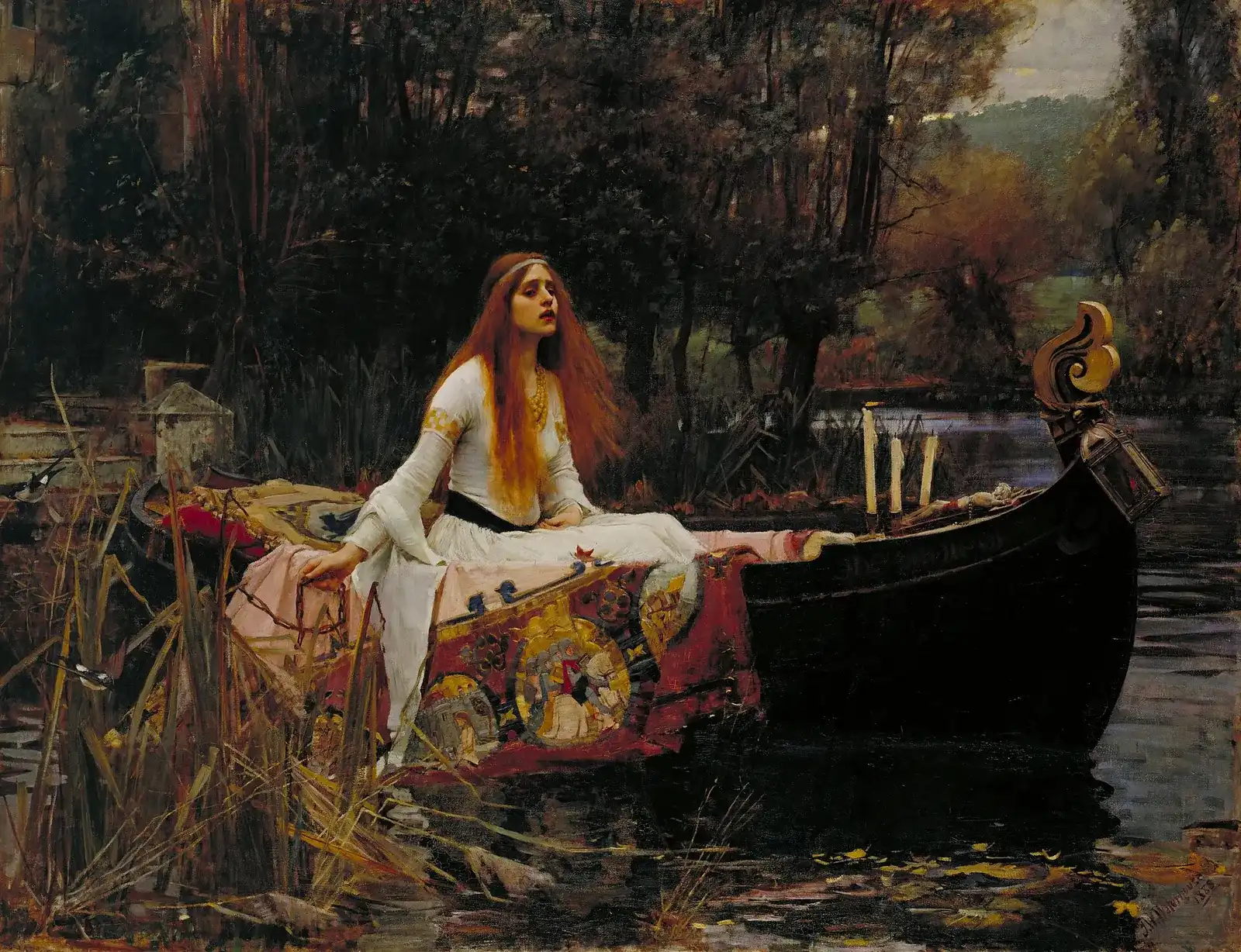
| 1888 | Waterhouse paints The Lady of Shalott. |
What is the Pre-Raphaelites?
The Pre-Raphaelites were a Victorian brotherhood that aimed at truth to nature and the sincerity they saw in art before Raphael.
Throughout this page I mark three layers. Historical What the works and records show. Later tradition The legends around the circle. Modern How witches use their images today.
Historical Truth to nature. The Brotherhood was attacked at first, until the critic John Ruskin defended them in letters to The Times in 1851. They painted outdoors and in detail, leaf by leaf. Millais’s Ophelia (1851 to 1852), at Tate Britain, shows Shakespeare’s drowning heroine floating among flowers painted on the banks of a real river in Surrey.
I describe it in words; the Tate website has it in high resolution. William Holman Hunt painted The Light of the World (1851 to 1853), now at Keble College, Oxford, with Christ knocking at an overgrown door by lantern light. He worked on it at night, outdoors, to get the moonlight right, and a later version toured the world.
Historical Elizabeth Siddal. Elizabeth Siddal modeled for Ophelia, lying for hours in a bath of water. She was also a painter and poet in her own right, encouraged by Ruskin, and she married Rossetti in 1860. She died in 1862. Too often she is remembered only as a face; I prefer to remember her own watercolors and poems.
Historical Rossetti and Lady Lilith. Rossetti painted Lady Lilith from 1866 to 1868, a woman combing her long hair before a mirror among flowers; it is now in the Delaware Art Museum, and the Met has a watercolor version.
His sonnet for it, later called “Body’s Beauty”, makes her Adam’s first wife. I explore that story in the Lilith course.
Burne-Jones and the second wave. 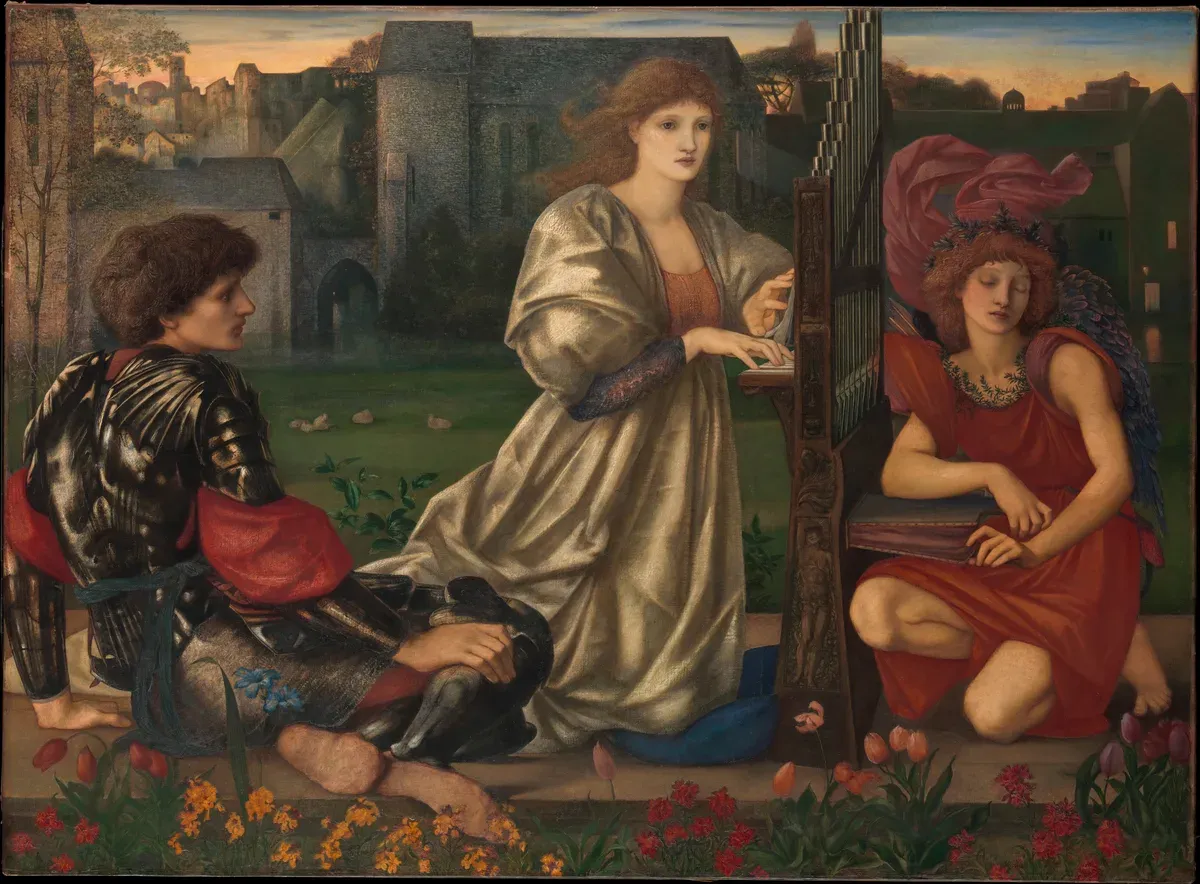
Sir Edward Burne-Jones, The Love Song, 1868 to 1877. The Metropolitan Museum of Art (47.26). Image: Open Access, public domain (CC0).
Historical A second wave in the late 1850s included Edward Burne-Jones and his friend William Morris, who met as students at Oxford. Burne-Jones painted dreamy, long-limbed figures from legend. The Love Song, 1868 to 1877, at the Met, shows a knight, a woman playing a small organ and a winged figure in a twilight garden.
It is a mood more than a story, which is exactly what he wanted. Burne-Jones also designed stained glass and tapestries for Morris’s firm, so his angels still glow in church windows across Britain.
Key artists
| Artist | Lived | Why they matter |
|---|---|---|
| Dante Gabriel Rossetti | 1828 to 1882 | Poet and painter of dreamy, powerful women. |
| John Everett Millais | 1829 to 1896 | The most technically brilliant of the founders. |
| William Holman Hunt | 1827 to 1910 | The most faithful to the group’s first ideals. |
| Elizabeth Siddal | 1829 to 1862 | Painter and poet, not only a model. |
| Edward Burne-Jones | 1833 to 1898 | Leader of the second wave, painter of myths and legends. |
| John William Waterhouse | 1849 to 1917 | A later follower, painter of enchantresses and witches. |
How do you recognise the Pre-Raphaelites?
Look for bright, jewel-like color on a white ground, every leaf painted from life, and subjects from medieval legend, Shakespeare, Tennyson and the Bible. Women with long, loose hair dominate. Later work grows dreamier and moves toward Symbolism.
Common misconceptions. One is that they wanted to copy medieval art. They admired its sincerity, but their method was modern: painting outdoors, on a wet white ground, from real plants and models.
Another is that the brotherhood lasted long. It broke up in the early 1850s, though “Pre-Raphaelite” style lived on through Burne-Jones, Morris and later followers. A third is that the women were only muses. Elizabeth Siddal painted and wrote poetry, and Ruskin paid her an annual allowance for her work; Marie Spartali Stillman and Evelyn De Morgan had long professional careers.
Esoteric themes
Historical The Pre-Raphaelites painted enchantresses again and again: Morgan le Fay, Circe, Medea, the Lady of Shalott. John William Waterhouse, of the next generation, painted The Magic Circle in 1886: a woman draws a circle of fire around herself with a wand while ravens and a toad wait outside.
In the same London decades, the Hermetic Order of the Golden Dawn was founded, in 1888, and artists and occultists moved in overlapping circles.
Later tradition The circle’s private lives became legends: Rossetti buried his poems with Siddal in 1862 and had them dug up in 1869. The story is true and often told with gothic relish.
Modern Many witches use Waterhouse’s sorceress as an image of a woman drawing her own boundaries. That is a modern reading, and one I share. See Witches in art.
Works to see
| Work | Artist | Date | Where to see it |
|---|---|---|---|
| The Lady of Shalott | John William Waterhouse | 1888 | Tate Britain, London |
| Ophelia | John Everett Millais | 1851 to 1852 | Tate Britain, London |
| The Magic Circle | John William Waterhouse | 1886 | Tate Britain, London |
| The Love Song | Edward Burne-Jones | 1868 to 1877 | The Metropolitan Museum of Art, New York |
Every work in this list is free of nudity, so you can look them up with confidence. Works still in copyright are named but not shown here.
How to look at a Pre-Raphaelite painting
Start with nature: every leaf and flower is usually a real, named species. Then find the story and its symbols, often taken from a poem. Finally, look at the colour, which they made brighter by painting on a white ground.
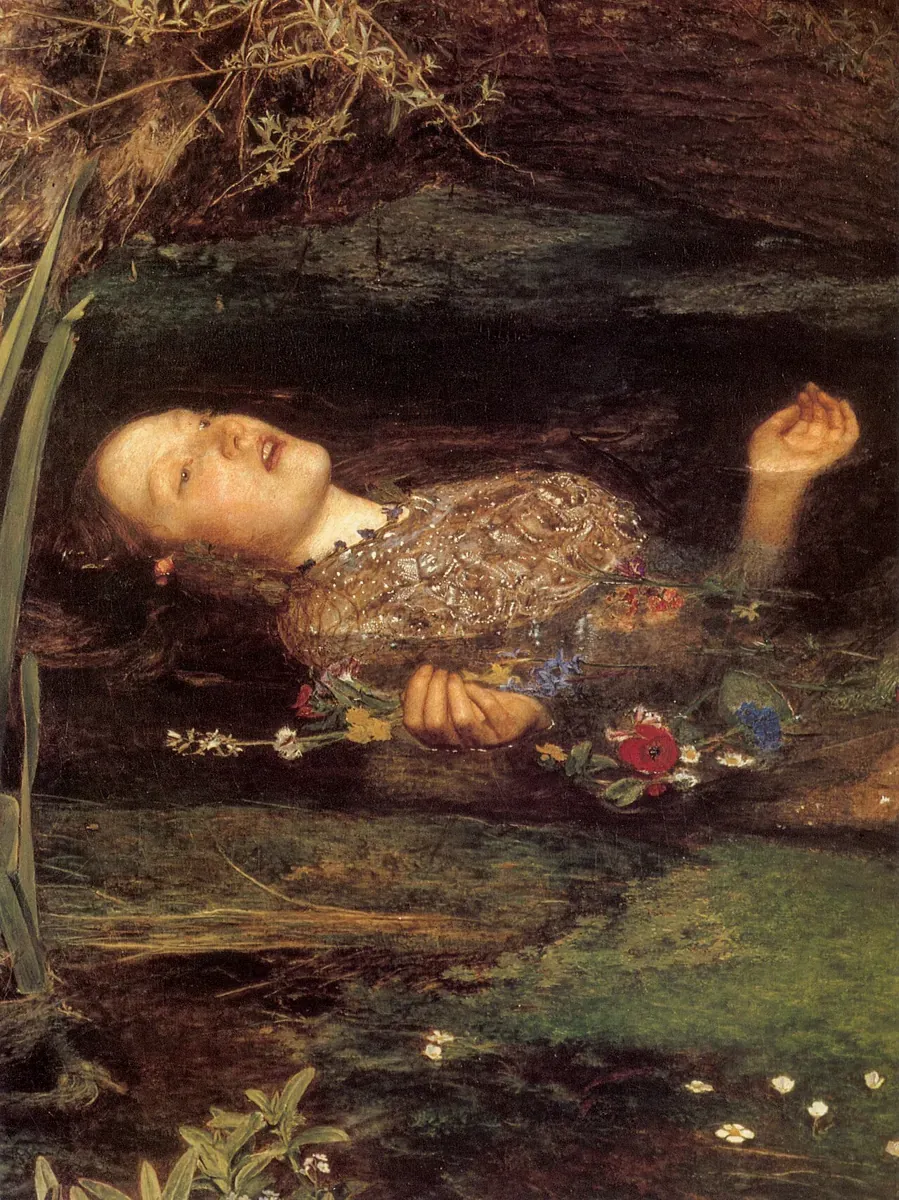
John Everett Millais, Ophelia, 1851 to 1852. Tate Britain, London. Image: Wikimedia Commons, public domain.
John Everett Millais, Ophelia, 1851 to 1852. At Tate Britain. The river was painted outdoors on the Hogsmill River in Surrey; the figure was painted later in the studio, with Elizabeth Siddal posing in a bath. The flowers carry meanings from Shakespeare’s Hamlet.
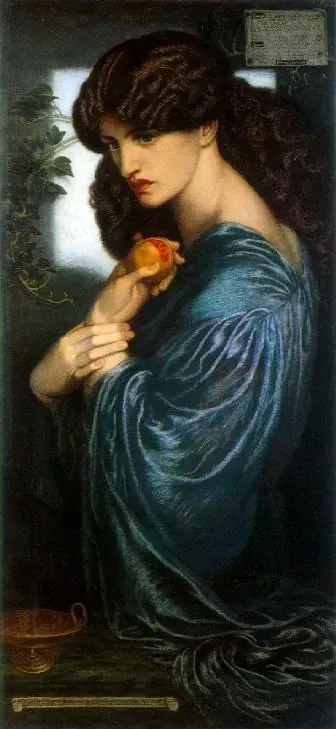
Dante Gabriel Rossetti, Proserpine, 1874. Tate Britain, London. Image: Wikimedia Commons, public domain.
Dante Gabriel Rossetti, Proserpine, 1874. At Tate Britain. Jane Morris posed. Proserpine ate pomegranate seeds in the underworld and so must return there each year. Rossetti painted several versions.
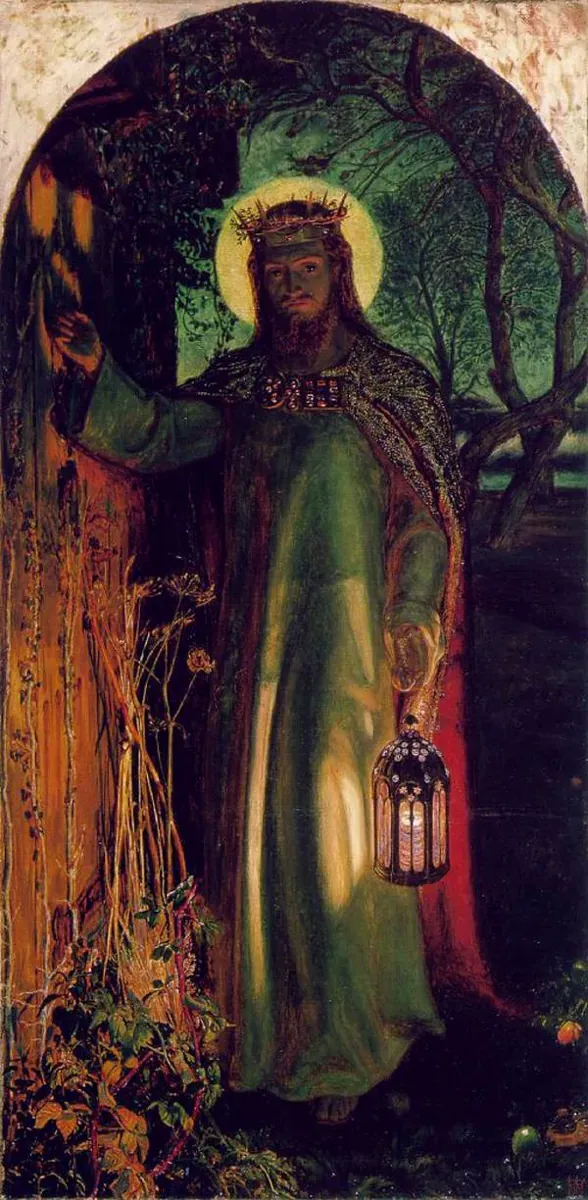
William Holman Hunt, The Light of the World, 1851 to 1853. Keble College, Oxford. Image: Wikimedia Commons, public domain.
William Holman Hunt, The Light of the World, 1851 to 1853. At Keble College, Oxford, with a later large version in St Paul’s Cathedral. The door has no handle on the outside: it can only be opened from within.
The Pre-Raphaelites looked back to the Early Renaissance, International Gothic and illuminated manuscripts, inspired the Arts and Crafts movement and Aestheticism, and led into Symbolism.
Try this
Pick one Pre-Raphaelite painting on the Tate website. Zoom in and list five plants or flowers you can identify. Then look up what one of them meant in Victorian flower language. Did the painter choose it on purpose?
What next
Before this: Romanticism.
After this: Realism.
Also worth reading alongside it: Aestheticism, Arts and Crafts.
See every movement in order on the art movements timeline, or learn to look step by step in the free Art History for Beginners course.
If you want to carry this into tarot and practice, these pages connect to it: The High Priestess, the woman between worlds, weaving and watching; The Magician, the enchantress drawing her circle; A close reading of The Magic Circle; and The occult revival and the art around it.
Sources
- Tim Barringer, Jason Rosenfeld and Alison Smith, Pre-Raphaelites: Victorian Avant-Garde (exhibition catalogue) (2012).
- The Metropolitan Museum of Art, The Love Song, 47.26. Open the record
- Delaware Art Museum, Lady Lilith. Open the record
- Tate, The Magic Circle. Open the record
- E. H. Gombrich, The Story of Art (1950).
- Wikimedia Commons, The Lady of Shalott (hero image record). Open the record
- Tim Barringer, Reading the Pre-Raphaelites (1998).

Questions
Why are they called Pre-Raphaelites?
Because the young founders in 1848 rejected the smooth academic style they blamed on Raphael's followers and looked back to art made before Raphael, in the late Middle Ages and early Renaissance.
Is Waterhouse a Pre-Raphaelite?
He came a generation later, but his subjects and style are so close to theirs that he is usually counted among the later Pre-Raphaelites.
Where can I see works of the Pre-Raphaelites in person?
Good places to start are London (Tate Britain), Birmingham, Manchester, Liverpool, Delaware, and the Met. Museums change their displays, so check the collection page before you travel.
Who were the original Pre-Raphaelite Brotherhood?
Seven men: William Holman Hunt, John Everett Millais, Dante Gabriel Rossetti, William Michael Rossetti, James Collinson, Frederic George Stephens and Thomas Woolner.
Where can I see Pre-Raphaelite paintings?
Tate Britain in London, Birmingham Museum and Art Gallery, the Walker Art Gallery in Liverpool, Manchester Art Gallery and the Delaware Art Museum.
What does Pre-Raphaelite mean?
It means before Raphael. The young painters believed art had become formulaic after the High Renaissance master Raphael, who died in 1520, and wanted to recover the directness of earlier painters.
Get the free Mini-Grimoire
A short printable starter guide to tarot and everyday witchcraft, plus my newsletter. Unsubscribe any time.
Opens Substack in a new tab to confirm. More about the newsletter · Privacy