


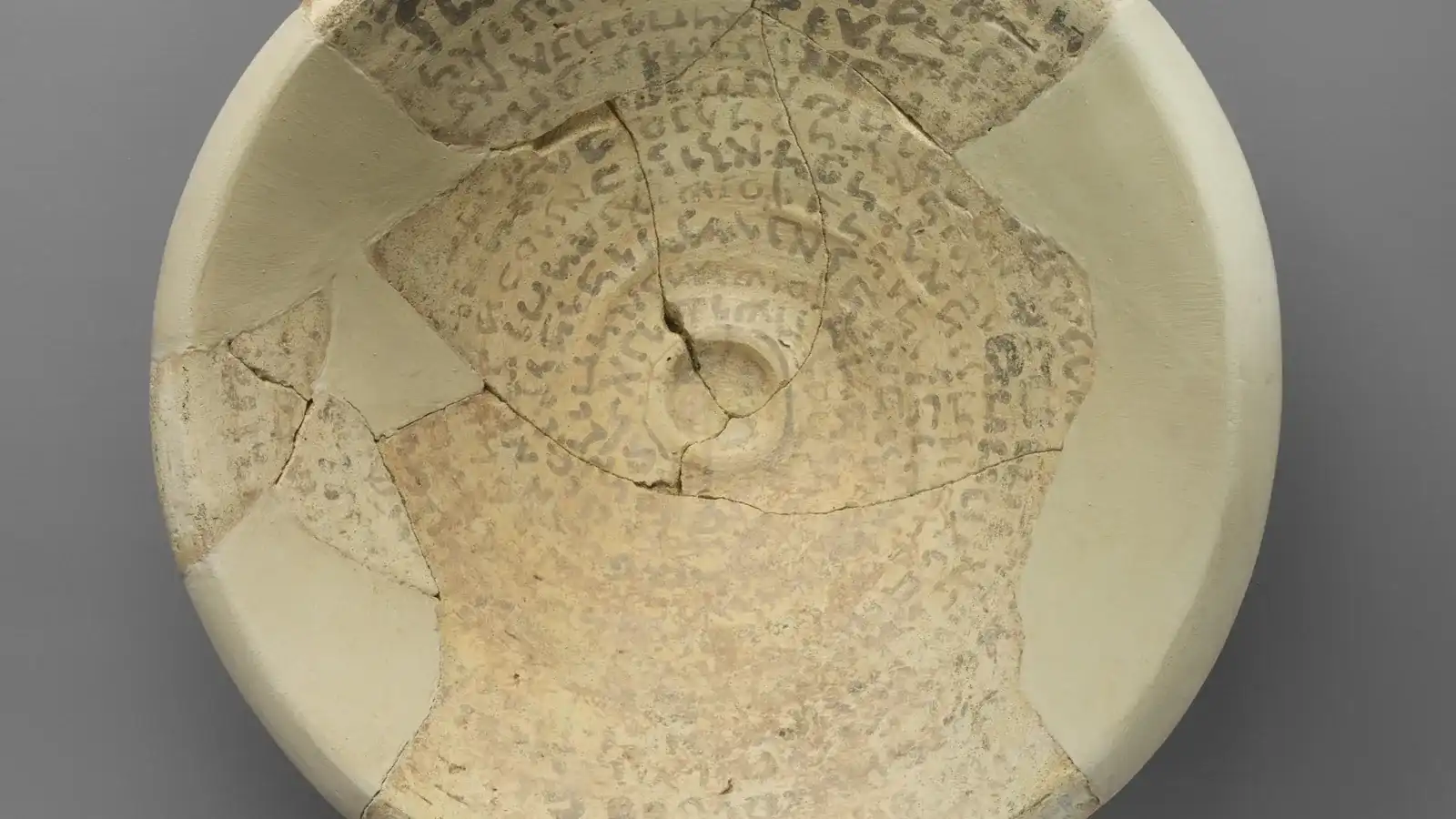
In this lesson: what Black Moon Lilith is in the sky, how the name entered astrology and how to read a placement without fear.
Many people first meet the name Lilith in a birth chart. This lesson explains what Black Moon Lilith is, where the name came from and how to read a placement as a question rather than a verdict. All of it is modern practice. Astrology is a symbolic practice, not a science, so it belongs in your journal, not in health, money or relationship decisions.
What it is astronomically
Modern Black Moon Lilith is not a moon, a planet or anything you can see. The Moon’s orbit is an ellipse with the Earth at one focus. The point of the orbit farthest from Earth is the apogee, and astrologers call the zodiac degree of that point Black Moon Lilith.
The Sun’s pull stretches and turns the orbit, so the apogee wanders, and it is calculated in two ways. Mean Lilith follows the average position: it moves steadily, circles the zodiac in a little under nine years and spends about nine months in each sign. It is the default in most software. True, or osculating, Lilith follows the moment-to-moment position and swings by tens of degrees around the mean.
Two other things share the name. One is the “Dark Moon”, a second moon of Earth that Georg Waldemath reported in 1898 and no one has found since. The other is the asteroid 1181 Lilith, discovered in 1927 and named after the French composer Lili Boulanger, not the mythic figure. “Your Lilith placement” almost always means Black Moon Lilith.
How the name entered astrology
Historical Ancient and medieval astrologers knew the Moon’s motion was uneven and calculated its nodes, but they gave the apogee no mythic name. Modern The name Lilith arrived around the turn of the twentieth century, when the English astrologer known as Sepharial took up Waldemath’s supposed moon under that name.
From the mid-twentieth century it was used mainly for the lunar apogee, and from the 1970s and 1980s astrologers increasingly read it through the feminist and occult Lilith of the time. Astrological Lilith borrowed its meanings from her twentieth-century reputation, not from ancient sources. Knowing that lets you use it as one more modern layer.
A short history of the Moon’s wandering apogee
Historical Astronomers have known for a very long time that the Moon’s speed changes through the month. The Greek astronomer Hipparchus, in the second century BCE, measured this unevenness, and Ptolemy described it in his Almagest around 150 CE. The motion of the apogee itself, which turns around the zodiac in about 8.85 years, was well known to medieval astronomers too. So the point was not discovered by astrologers. They took an old astronomical fact and gave it a new mythic name.
Historical The 1898 “second moon” claim came from Georg Waldemath of Hamburg, who said he had seen a small dark body crossing the Sun. Astronomers checked and never confirmed it. Sepharial, the pen name of Walter Gorn Old (1864 to 1929), published an ephemeris for this hypothetical moon and called it Lilith. When it became clear that the body did not exist, the name drifted to the lunar apogee. This is a good example of how names in esoteric traditions can survive the disappearance of the thing they first named.
How to read a placement, step by step
Here is a method that avoids fear. First, find the sign and house. Second, write down the general meaning of the sign and the house from any basic astrology book, before reading anything about Lilith. Third, combine them into a neutral question. Fourth, look at modern Lilith interpretations only after you have written your own question, and notice which parts feel true and which feel like a script. Fifth, test the question over a month by journaling once a week.
A second worked example. Suppose Lilith is in Capricorn in the fourth house. Capricorn is linked with structure, duty and ambition; the fourth house with home, family and roots. A neutral question might be: “Where did my family teach me that worth comes from work, and do I agree?” Someone with this placement might notice that she feels guilty resting at home. She tries one evening a week of deliberate rest and records how it feels. The chart gave her a prompt, not a prophecy.
A variation without astrology. If you do not use astrology, you can still take the image of an apogee, the farthest point of an orbit, as a metaphor: what part of me have I pushed farthest from the center of my life?
Reading without fatalism
Modern astrologers link the placement with where you feel rejected or exiled, where you refuse to compromise, what you suppress and where you hold power you were told to hide. Some writing is alarming: “Lilith in your seventh house means betrayal.” Even within astrology, no single point decides a life. Charts are read as a whole, and most astrologers speak of tendencies.
Turn every statement into a question. If the placement falls in the tenth house, linked with career and public life, ask where in public life you feel you must hide part of yourself. If you do not know your birth time, hold any house theme very lightly, since the house may be wrong.
Correspondences, labeled
Correspondence lists link a figure with colors, stones, plants and animals. For Lilith almost all are modern. A few draw on older material: the owl comes from translations of Isaiah 34:14, where the King James Version has “screech owl” for lilit, and the serpent from later Eden imagery. Roses, mirrors and long hair come from nineteenth-century art. Black and red, obsidian and the dark moon come from recent witchcraft, astrology and personal practice. Use them as a language for mood and focus. They have no power on their own, so leave out any that do not speak to you.
Questions beginners ask
Should I use Mean or True Lilith? Most beginners use Mean Lilith because it moves smoothly and is the default. Try both and see which you find more useful, and always note which one you used.
What if my Lilith is in the same sign as my Sun or Moon? Read it as a theme that is close to your core identity or feelings, and give it a little more attention in your journal.
Can I change my placement? No, but you can change how you live with the questions it raises.
Is astrology compatible with Jewish or Christian faith? Opinions differ widely within each tradition. Some people combine them; others do not. Respect your own conscience.
Myths to drop: Black Moon Lilith is not a real dark moon. The asteroid Lilith is not named after the mythic figure. And no reliable astrological school claims that a Lilith placement causes betrayal, illness or bad luck.
A worked example
Imagine someone whose Black Moon Lilith falls in Gemini in the third house. Modern astrologers link Gemini with communication and curiosity, and the third house with speech, writing, siblings and everyday learning. A fear-based reading would say, “You will be punished for speaking.” She uses a reflective one instead: where have I learned to edit myself, and do I still need to?
She spends a week journaling on times she held back from speaking, notices that the habit began at school and pairs it with the “saying no aloud” practice from lesson 11. She does not need to believe that a point in the sky caused anything. The chart is a mirror for the question.
Try this
Find Black Moon Lilith (Mean Apogee) in your birth chart with a free chart calculator. Note the sign and, if your birth time is known, the house. Write three questions the placement suggests to you, then answer one in a short free-write.
Journal prompts: What did I feel when I first read about my Lilith placement? Which part of the interpretation feels like mine, and which feels borrowed? What one small experiment could I try this month?
A worked example: comparing Mean and True positions
Imagine you look up your chart on two websites and find Black Moon Lilith in late Aries on one and early Taurus on the other. Do not panic. Check which calculation each site uses. Mean Lilith follows a smooth average orbit, while True Lilith follows the Moon’s actual wobbling orbit, and the two can differ by several degrees, sometimes more. Choose one method, note it in your journal and stay with it, so that your readings are consistent. That is what most careful astrologers do.
A reading variation: the question journal
Instead of reading your Lilith placement as a fixed trait, turn it into a question. If your Lilith falls in the house linked with work, you might ask: “Where at work do I hide what I really think?” Write the question at the top of a page and come back to it once a month for a season. Notice what changes. This keeps astrology reflective and open, rather than a label you have to live up to.
Keeping the layers straight
When you write about Black Moon Lilith, a simple habit keeps your notes honest. Write astronomy for the lunar apogee and its movement, astrology for the meanings astrologers give it, and history for the Lilith of Mesopotamia, Isaiah and the Alphabet of Ben Sira. A sentence might read: “Astronomy: the Moon’s apogee. Astrology: a point read as what is untamed in me. History: named after a figure from Jewish legend.” Three short labels, and no confusion.
A beginner’s worry, answered. “Does a ‘difficult’ Lilith placement mean something bad will happen?” No. Astrologers who work carefully read placements as themes to reflect on, not as fate.
Recap
Black Moon Lilith is the Moon’s apogee, a calculated point, not a body. Mean Lilith moves steadily and True Lilith swings around it. Waldemath’s “Dark Moon” and asteroid 1181 Lilith are different things. The name entered astrology only around 1900 and took its meanings from the modern Lilith. Read a placement as a question, never a verdict. Correspondences are mostly modern, and toxic plants stay on the page.
What next
Press “Mark as done” and continue with the final lesson, A four-week start and living with Lilith. For how correspondence lists work in general, see my correspondences guide.
Further reading: James Evans, The History and Practice of Ancient Astronomy (Oxford University Press, 1998), explains the Moon’s orbit and apogee clearly. Nicholas Campion, A History of Western Astrology, 2 vols. (Continuum, 2008 to 2009).
Sources
- Isaiah 34:14, King James Version (1611), where lilit is rendered “screech owl”.
- Siegmund Hurwitz, Lilith, the First Eve (English translation Einsiedeln: Daimon, 1992).
- Raphael Patai, The Hebrew Goddess (third edition, Detroit: Wayne State University Press, 1990).
Quick check
Go deeper: the Lilith pages on this site, and The Novice's Guide to Witchcraft
Get the free Mini-Grimoire
A short printable starter guide to tarot and everyday witchcraft, plus my newsletter. Unsubscribe any time.
Opens Substack in a new tab to confirm. More about the newsletter · Privacy
Comments
Questions and notes from readers. Anyone with a free account can comment, and I reply when I can. Please read the community guidelines.
Comments load from Google Firebase (EU) when you ask for them. Nothing is stored on your device. Privacy