


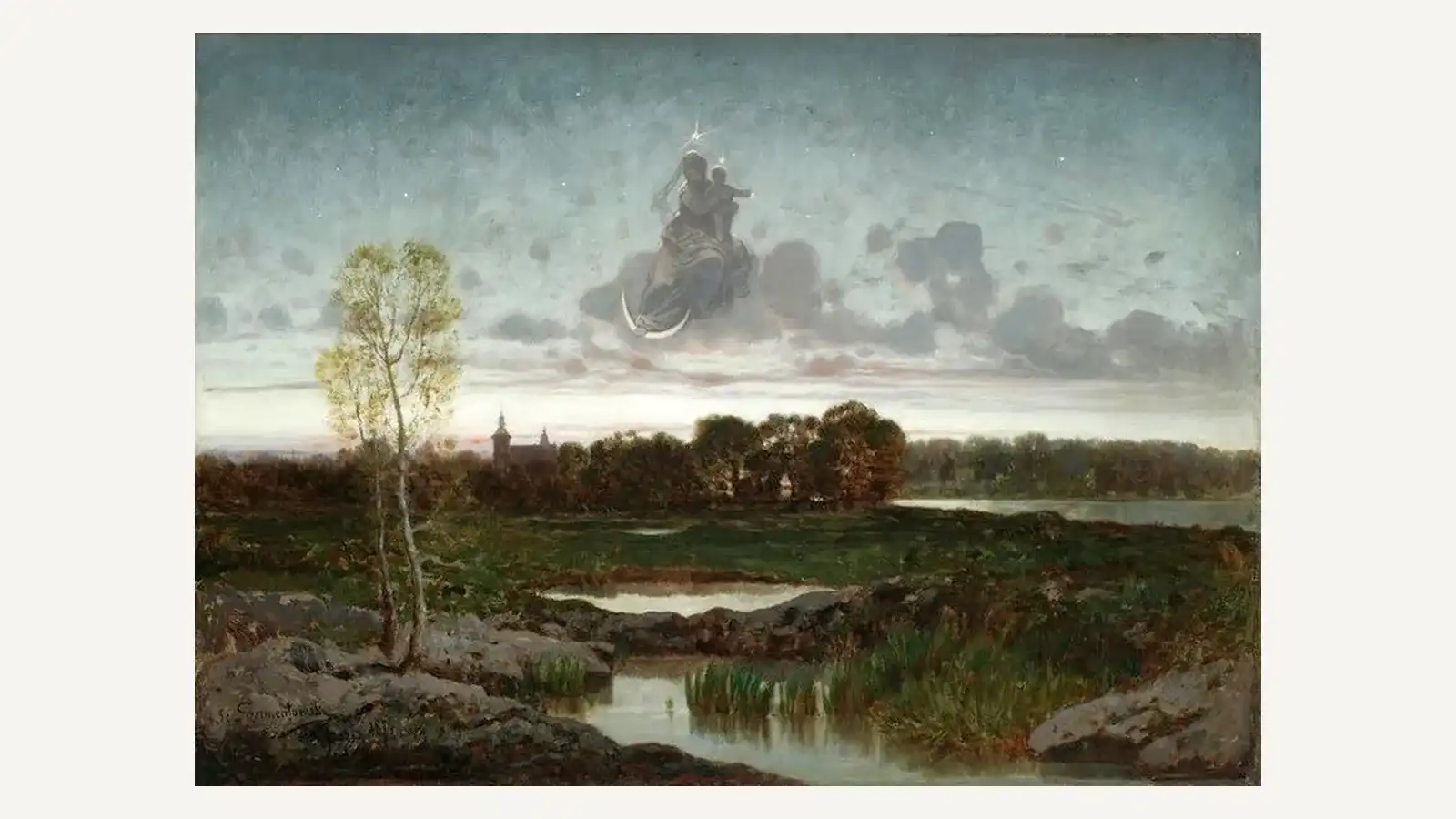
Before Lucifer was a name in theology, it was a light in the sky that anyone could see. The Morning Star is the planet Venus, and its strange, regular dance near the Sun shaped the stories told about it, from Greek genealogies to Roman love poems. In this lesson you will learn how Venus actually moves, what the Greeks and Romans called it and why the evidence points to a beloved star rather than a great god with temples.
How Venus moves
Historical Venus orbits the Sun inside Earth’s orbit, so from Earth it never strays far from the Sun in the sky, about 45 to 47 degrees at most. It is never seen at midnight. It shines either in the east before sunrise or in the west after sunset.
Its cycle, the synodic period, lasts about 584 days. For roughly eight and a half months Venus is a morning star. Then it passes behind the Sun and disappears for several weeks, returns in the evening sky for another eight and a half months or so, passes between Earth and the Sun and vanishes again, this time for only a few days, before coming back in the morning. Five of these cycles take almost exactly eight years, so the pattern repeats, with small shifts, every eight years. Ancient astronomers knew this.
One star or two?
Historical Many early peoples treated the morning and evening appearances of Venus as two different stars. Greek tradition credits Pythagoras or Parmenides with realizing they were the same body, though such attributions are uncertain. Babylonian astronomers already tracked Venus closely. The so-called Venus Tablet of Ammisaduqa, part of a large omen series known from later copies, records the planet’s appearances and disappearances over about twenty years.
In Mesopotamia, Venus was the star of the goddess Inanna, called Ishtar in Akkadian. In the text “The Birth of the Gracious Gods” from Ugarit, on the coast of Syria, Shahar, “Dawn”, and Shalim, “Dusk”, are divine twins. Many scholars link them with the morning and evening appearances of Venus. Remember the name Shahar: you will meet it again in Isaiah 14.
Greek light-bringers
Historical The Greeks called the Morning Star Eosphoros, “dawn-bringer”, or Phosphoros, “light-bringer”. Hesiod’s Theogony, from around 700 BCE, gives the oldest genealogy: Eos, the Dawn, bore to Astraios the star Eosphoros and the gleaming stars (lines 381 to 382). Homer’s Iliad has Heosphoros coming to herald light over the earth (23.226) and calls Hesperos, the Evening Star, the fairest star in heaven (22.317 to 318). Greeks at first may have thought the morning and evening stars were two different bodies. Later writers say they are one, and by Cicero’s time it was common knowledge.
A star, not a great god
Historical Phosphoros was not a major god with temples and festivals. He is a personified star who appears in genealogies, poems and art. On vases and Roman reliefs, the Morning Star sometimes appears as a youth with a torch, running ahead of the Sun’s chariot. Myths give him children.
In Ovid’s Metamorphoses (book 11), his son Ceyx is a king whose wife Alcyone loves him so much that, after he drowns, the two are turned into kingfishers. In Latin poetry, lucifer is the star that ends the night. Poets use it to mark the hour: lovers part when Lucifer rises, travelers set out. It is a word full of morning, not menace.
Why Venus looks so bright
Venus is wrapped in thick, pale clouds that reflect most of the sunlight hitting them. It is also our closest planetary neighbor. At its brightest it outshines everything in the night sky except the Moon, and you can sometimes see it in daylight if you know exactly where to look. In 1610 Galileo saw through his telescope that Venus shows phases like the Moon, which became important evidence that planets circle the Sun.
Hesiod’s line, in an old translation
Historical Here is Hesiod’s oldest mention of the Morning Star in Hugh G. Evelyn-White’s 1914 translation of the Theogony, free on Project Gutenberg: “And after these Erigenia bare the star Eosphorus (Dawn-bringer), and the gleaming stars with which heaven is crowned.” Erigenia, “early-born”, is a title of Eos, the Dawn. The Morning Star is simply one of her children, listed with the other stars. Nothing in the line is dark or rebellious. That is the Greek background the Latin word lucifer inherited.
Watching the cycle yourself
Venus is one of the easiest planets to follow with your own eyes, and its cycle rewards patience. Here are a few things you can watch over months and years.
Its height changes. As a morning star, Venus climbs higher before sunrise week by week, reaches its greatest distance from the Sun, then sinks back toward the dawn glow and disappears.
It changes sides. After a few weeks out of sight, it reappears in the west after sunset as the Evening Star, the Hesperos of the Greeks and the Vesper of the Romans.
Its shape changes. Through a small telescope, Venus shows phases. When it is far from us it looks small and nearly full; when it swings close to Earth it becomes a large, thin crescent. This is what Galileo saw in 1610.
It repeats every eight years. Because five cycles take almost exactly eight years, Venus returns to nearly the same place in the sky on nearly the same date. If you note where you saw it this year, you can look for it again in eight years.
Venus in other cultures
Historical Venus mattered to sky-watchers far beyond Rome. Babylonian astronomers recorded its risings and settings, as you saw above. The Maya also tracked it closely: the Dresden Codex, a Maya book probably from the eleventh to the fifteenth century, contains a Venus table that follows the planet’s cycle with great accuracy. These parallels remind us that the Morning Star was a shared wonder of the human sky, long before it gathered any Christian meaning.
A modern curiosity: the “rose of Venus”
Modern If you mark the points where Venus passes between Earth and the Sun over eight years, the five points form a nearly regular five-pointed pattern around the zodiac. Modern writers sometimes call this the “rose” or “pentagram” of Venus. It is real geometry, though the name and its popularity are modern. It is a lovely example of how a simple observation, repeated patiently, reveals order in the sky.
A worked example: one season of watching
Imagine you check an astronomy app in autumn and see that Venus is a morning star. Once a week, on a clear morning, you step outside about forty minutes before sunrise and note its height above a rooftop, using your outstretched fist as a rough measure. Over two months you see it climb, then hold steady. You write each date, the weather and one line about the light. By the end of the season you have watched with your own eyes the movement that ancient astronomers recorded, and you understand why the Morning Star seemed to rise, shine and fall.
Questions beginners ask
Is the Morning Star really a star? No, it is a planet. “Star” was the old word for any bright point in the sky.
Did the Romans worship Lucifer? Not as a major god. Lucifer was a personified star of poetry and art, not a god with temples.
Is the Morning Star always Venus? Almost always in our sources. Mercury and Jupiter can also appear at dawn, but Lucifer and Phosphoros named Venus.
Myths to drop:
- “Lucifer was a Roman god of evil.” He was the cheerful star of morning.
- “Venus as Lucifer is a secret Satanic symbol.” The link is Roman astronomy, centuries before any Devil.
- “Ancient people did not understand the sky.” Babylonian records of Venus were careful and long-running.
A worked example
Imagine you read online that “Lucifer was an ancient god of light worshipped in great temples across the Roman world.” Check it against the evidence. The Latin word lucifer is real and ancient, and so is the Greek Phosphoros. The Morning Star appears in Hesiod’s genealogy, in Homer, on vases and in Ovid’s story of Ceyx and Alcyone.
But there is no evidence of a major cult with temples and festivals. What survives is a beloved star and a poetic figure, a youth with a torch running before the Sun. The claim takes something true and lovely and inflates it into something it never was.
A beginner’s worry, answered. “I live in a city. Can I still see Venus?” Almost certainly. Venus is so bright that it shines through city light and even thin cloud. What you need is a clear view of the low eastern or western sky, which a park, a bridge or an upstairs window can often give you.
Try this
Open an astronomy app or an almanac and find out whether Venus is a morning star or an evening star this month. Write down the date when it next changes. You will use this in lesson 7.
Journal prompts: When did I last watch the sky before dawn? What does it feel like that a name so loaded today began as a word for morning? What would it mean to me to see Venus with my own eyes?
Recap
Venus orbits inside Earth’s orbit, so it always stays near the Sun in our sky and is never seen at midnight; its cycle lasts about 584 days and repeats every eight years. The Greeks called the Morning Star Eosphoros or Phosphoros, and the Romans called it lucifer. It appears in Hesiod, Homer and Ovid as a personified star, not a great god with temples, and in Latin poetry it simply marks the dawn.
What next
Press “Mark as done” and continue with Isaiah 14 and the fallen angel. Read more on the Lucifer page, and for watching the sky through the month, see my moon guide.
Further reading: E. C. Krupp, Echoes of the Ancient Skies (Harper and Row, 1983; Dover reprint 2003). Anthony Aveni, People and the Sky (Thames and Hudson, 2008). NASA’s free Venus pages explain the planet’s orbit and phases.
Sources
- Hesiod, Theogony 381 to 382.
- Homer, Iliad 22.317 to 318 and 23.226.
- Cicero, On the Nature of the Gods 2.53.
- Ovid, Metamorphoses, book 11.
Quick check
Go deeper: the Lucifer pages on this site
Get the free Mini-Grimoire
A short printable starter guide to tarot and everyday witchcraft, plus my newsletter. Unsubscribe any time.
Opens Substack in a new tab to confirm. More about the newsletter · Privacy
Comments
Questions and notes from readers. Anyone with a free account can comment, and I reply when I can. Please read the community guidelines.
Comments load from Google Firebase (EU) when you ask for them. Nothing is stored on your device. Privacy