


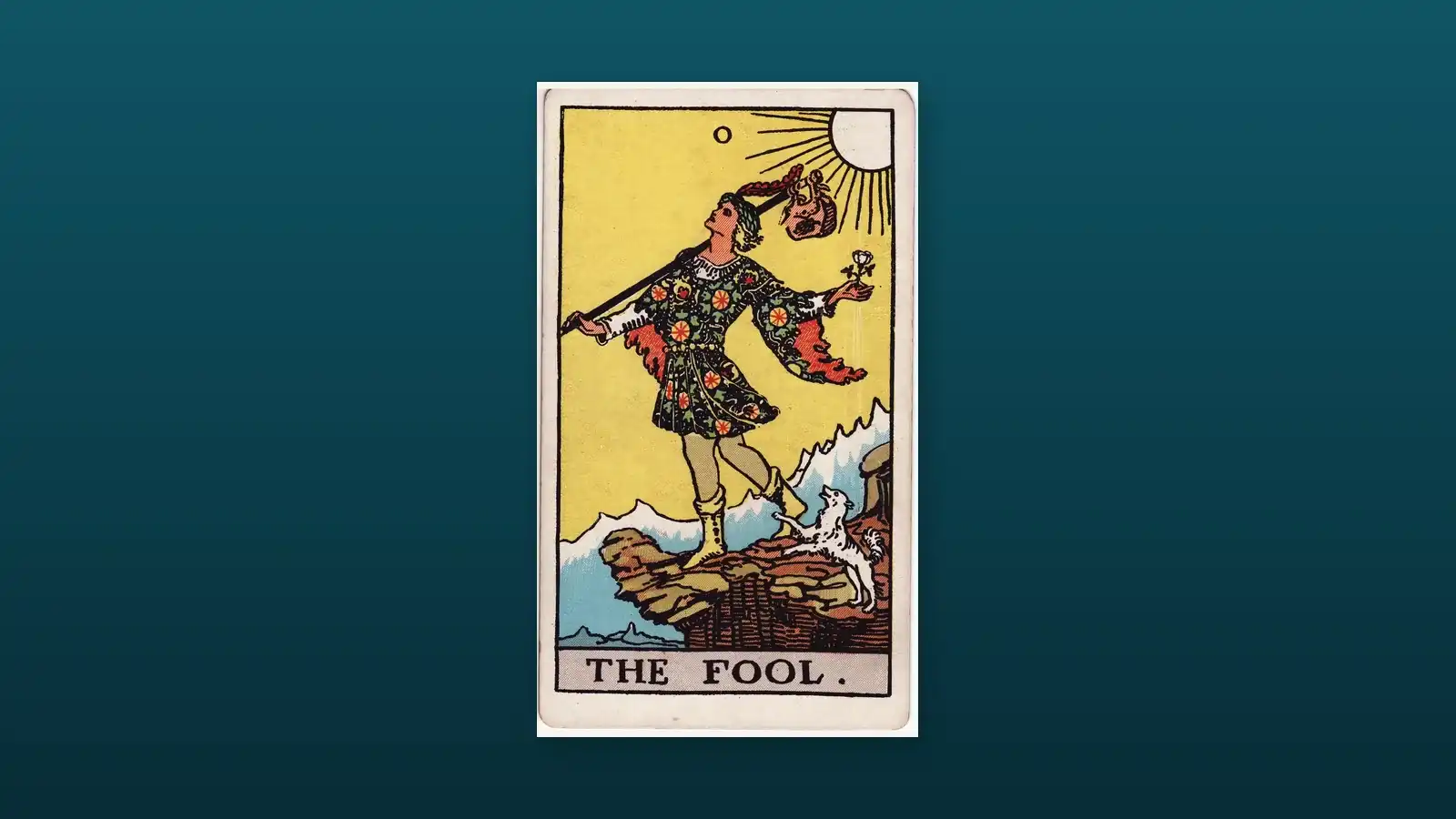
In this lesson: the Fool’s Journey, a simple three-part map that helps you remember all 22 Major Arcana cards as one story.
Twenty-two Major Arcana cards can feel like a lot to remember. A story makes it easier, because the mind holds stories far better than lists. Many teachers read the Majors as a journey: the Fool, card 0, sets out with nothing but trust, meets each of the other cards in turn and arrives at the World, card 21. This idea is called the Fool’s Journey, and in this lesson you will learn how to use it as a map for the next three lessons and for real readings.
Where the idea comes from
The Fool’s Journey is a modern teaching aid. Eden Gray’s A Complete Guide to the Tarot (1970) ended with an epilogue called “The Fool’s Journey”, and many later teachers adapted it. The Renaissance painters of the first decks did not intend a single life story. That is fine. A teaching lens does not have to be ancient to be useful. Use it when it helps you remember the cards, and set it aside when a single card’s picture is doing clearer work on its own.
The Fool in the old game
Historical In the card game, the Fool was not a trump at all. In early Italian decks he was il Matto, the madman, often shown as a ragged figure with feathers in his hair, sometimes teased by children. In the game he worked as an “excuse”: you could play him instead of following suit, and in French tarot he is still called l’Excuse. So the Fool has always stood a little outside the order of the other cards, which is perhaps why later readers found it natural to make him the traveler who passes through all of them.
A cousin of the hero’s journey
Modern The Fool’s Journey has a famous relative. In 1949 the scholar of myth Joseph Campbell published The Hero with a Thousand Faces, describing a pattern he found in many stories: the hero leaves home, faces trials and returns changed. He called it the monomyth and summed it up as departure, initiation and return.
The three stages of the Fool’s Journey fit that shape closely. Campbell’s pattern has been criticized for flattening different cultures’ stories, and tarot did not come from it, but the comparison explains why the journey feels so familiar: it is the shape of countless films and novels.
Three stages of the journey
One common way to teach the journey divides the Majors into three rough movements. Different books draw the lines in slightly different places, so think of this as a practical map rather than a law.
The first stage, roughly the Magician through the Chariot (cards I to VII), is about becoming a self. The traveler gathers tools, discovers intuition, learns nurture and structure, meets tradition, makes a real choice and finally drives forward with directed will. This is the stage of learning how to act and how to belong.
The second stage, roughly Strength through Temperance (cards VIII to XIV), is about meeting the world’s tests. Courage, solitude, change, fairness, surrender, ending and balance follow one another. The traveler learns limits, ethics and resilience, often the hard way.
The third stage, roughly the Devil through the World (cards XV to XXI), is about seeing through and returning. Attachment, upheaval, hope, uncertainty, clarity, reckoning and completion come in turn. The traveler faces their own shadow and comes home to a fuller life.
The Fool stands outside the rows as pure openness, and the World closes the cycle as wholeness. In many readings a new Fool then steps out and the circle begins again, which is a comforting thought when you are in the middle of a hard chapter.
Using the map in a reading
When a Major card appears, ask where it sits on the journey. A card from the first stage often speaks about who you are becoming. A card from the middle stage often names a test or a lesson. A card from the last stage often points to something deep: a pattern, a breakthrough or the end of a whole chapter. When several Majors appear together, notice whether they come from the same stage. Three cards from the last row in one reading usually say that something big is moving.
Imagine a reading for someone who has just left a long job. She draws Temperance, the Hermit and the Star. Two come from the middle stage of tests and lessons, one from the final stage of hope. Even before looking up any meanings, the map tells a story: she is in a period of patient adjustment and reflection, with renewal beginning to show. The individual cards will fill in the detail, but the journey has already given the reading its shape.
A word about the numbers
Your deck may number Strength and Justice differently. The 1909 deck puts Strength at VIII and Justice at XI. Older decks such as the Tarot de Marseille do the reverse. Waite made the swap to fit the astrological order used by the Golden Dawn. If your deck differs, read by the card’s title, and the journey still works.
The three rows of seven
A classic way to see the whole journey at once is to lay the Fool apart, at the top or the left, and the other 21 Majors in three rows of seven: I to VII, VIII to XIV, XV to XXI. Then look down the columns as well as along the rows.
Column one holds the Magician, Strength and the Devil, three cards about power used well or badly. Column two holds the High Priestess, the Hermit and the Tower, three ways of meeting hidden truth. Not every column fits so neatly, and different teachers find different links, but searching for them is one of the best ways to learn the Majors deeply.
A worked example in prose
Imagine someone who has just become a parent and draws the Empress, the Hanged Man and the World. The Empress, from the first stage, speaks of nurture and who she is becoming. The Hanged Man, from the middle stage, names the test: a life on pause, seen from a new angle. The World, from the last stage, points to wholeness and completion. She writes: “I am becoming a new version of myself, and the pause is part of it, not a detour.” The map gave her a story to hold before she looked up a single meaning.
Where Waite placed the Fool
Historical If you read Waite’s The Pictorial Key to the Tarot (1910) in order, you may be surprised. In his card-by-card section, he describes the Fool not first but between Judgement and the World, following Éliphas Lévi, who had linked the unnumbered card to the Hebrew letter Shin and so placed it between those two trumps.
The Fool’s place has varied across the centuries. In the old card game he was not a trump at all but an “excuse”, a card you could play to avoid following suit. Yet Smith’s card is marked 0, and modern teachers such as Eden Gray begin with him, which is what makes the journey possible as a story.
Waite’s description is worth reading slowly. The young man “pauses at the brink of a precipice among the great heights of the world”. “The edge which opens on the depth has no terror; it is as if angels were waiting to uphold him, if it came about that he leaped from the height.” That is the spirit of the Fool on his journey: open, curious and trusting, even at the edge of the unknown.
Practice variations
Your own journey line. Draw a long line across two notebook pages. Mark three or four big changes in your life so far, such as starting school, moving or a new job. For each, choose a Major card that seems to fit. You are not predicting anything; you are practicing the habit of seeing the cards as stages of experience.
Start anywhere. Pick a random Major card and tell the journey from that point forward to the World, then back to the Fool. Starting in the middle shows you that the journey is a circle more than a line.
Two Fools. Compare the Fool in your deck with the Fool in a Marseille-style deck, where he often looks like a wandering traveler with an animal at his legs. Write which version feels more like the start of a journey to you, and why.
Using the journey for a character or story
If you write or draw, the journey is a useful plotting tool. Choose three cards, one from each row of seven, and let them become the beginning, middle and end of a short story about a character. The first row gives a starting situation, the second a test, the third a resolution. Many readers find that writing a story this way helps them remember the cards far better than lists of keywords.
A beginner’s question: “Is the Fool me?” Often, yes. Many readers imagine the Fool as the person asking the question, travelling through the cards. That is one of the reasons the map feels so personal.
Questions beginners ask
Is the journey the “real” meaning of the Majors? It is a modern teaching tool, not the original meaning, but it is very useful.
Do I have to go through the stages in order in life? No. Life loops, repeats and skips. The map is a lens, not a timetable.
What if my deck has different names? Use your deck’s names and pictures; the stages still work.
Myths to drop: The Fool’s Journey is not ancient. The Fool is not “stupid”; he is open. And reaching the World does not mean the end; the circle begins again.
Try this
Lay out all 22 Major Arcana cards in order: the Fool on its own, then three rows of seven. Look at them together for five minutes. Notice how the colors, the skies and the faces change from row to row, then write two or three lines about what you see.
Recap
The Fool’s Journey reads the Major Arcana as a story that begins with the Fool and ends with the World, which closes a cycle. It is a modern teaching aid from Eden Gray’s 1970 book, not a medieval doctrine. Its three stages are becoming a self, meeting the world’s tests, and seeing through and returning. In a reading, the stage a card belongs to tells you what kind of message it carries.
What next
Press “Mark as done” and continue with The Fool to the Chariot, where we meet the first eight cards. For an overview of all 22, see the Major Arcana.
Further reading: Eden Gray, A Complete Guide to the Tarot (Crown, 1970), the epilogue. Joseph Campbell, The Hero with a Thousand Faces (1949).
Sources
- Lauri Mukkala, The Novice’s Guide to Tarot, “The Three Stages of The Fool’s Journey”.
- Eden Gray, A Complete Guide to the Tarot (1970), epilogue “The Fool’s Journey”.
Quick check
Go deeper: The Novice's Guide to Tarot: The Three Stages of The Fool's Journey
Get the free Mini-Grimoire
A short printable starter guide to tarot and everyday witchcraft, plus my newsletter. Unsubscribe any time.
Opens Substack in a new tab to confirm. More about the newsletter · Privacy
Comments
Questions and notes from readers. Anyone with a free account can comment, and I reply when I can. Please read the community guidelines.
Comments load from Google Firebase (EU) when you ask for them. Nothing is stored on your device. Privacy