


| Arcana | Major Arcana |
|---|---|
| Number | XXI |
| Image | RWS 1909 (PD) |
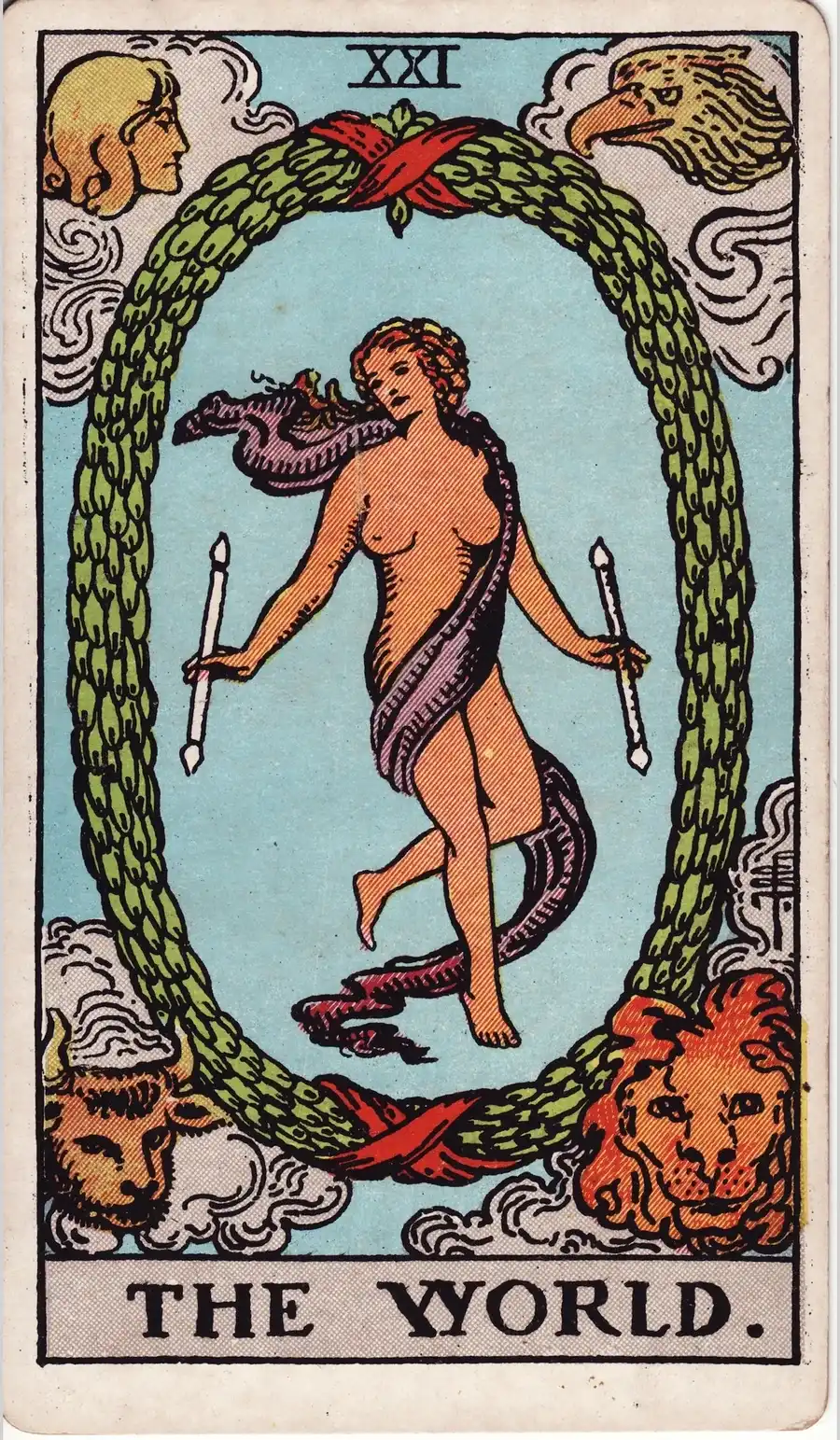
The World is card XXI, the last card of the Major Arcana. A dancer floats inside an oval wreath, with four creatures in the corners of the card.
The long journey that began with the Fool is complete. The card is about completion, wholeness and arrival. Here is what the World means upright and reversed, the symbols in the 1909 card and its history.
Here is the World at a glance.
| At a glance | This card |
|---|---|
| Upright keywords | completion, wholeness, achievement, arrival |
| Reversed keywords | loose ends, delay, a cycle that will not close |
| Number | XXI (21) in the Major Arcana |
| Golden Dawn title | The Great One of the Night of Time Later tradition |
| Hebrew letter | Tau (ת), “cross” or “mark” Later tradition |
| Tree of Life path | 32, from Yesod to Malkuth Later tradition |
| Astrology | Saturn; also earth (Golden Dawn, 777) Later tradition |
| Element | Earth Later tradition |
| Yes or no | Yes Modern |
The Golden Dawn gave the World the planet Saturn and the letter Tau, the last letter of the Hebrew alphabet. Because the three “mother letters” cover only air, water and fire, the Order gave Tau the element of earth as well, and Crowley’s 777 (1909) lists both. That is why many modern tables give the World both Saturn and earth. The four creatures in the corners are the living creatures of Ezekiel and Revelation, long used in Christian art as symbols of the four evangelists.
The card: what Pamela Colman Smith drew
The 1909 card shows a dancer covered only by a floating scarf, holding two wands inside a large oval wreath, with four figures in the corners. Waite called the card “this final message of the Major Trumps” and said it represents “the perfection and end of the Cosmos”.
The wreath. An oval laurel wreath surrounds the dancer, tied with red ribbons at the top and bottom. Laurel was the crown of victory in the ancient world. The wreath is a finished circle.
The dancer. In the 1909 card a figure dances inside the wreath, holding a wand in each hand. Readers often compare her to the Magician, who held one wand: now both hands hold power, and the work is in balance.
The four creatures. In the four corners are an angel, an eagle, a lion and a bull. They also appear on the Wheel of Fortune. They are traditionally linked to the four evangelists and, in modern readings, to the four fixed signs of the zodiac and the four elements.
Movement inside stillness. The dancer moves, but the wreath holds her. The World is not the end of all change. It is a moment of wholeness inside an ongoing dance.
Upright meaning
Upright, the World is completion. A dancing figure, wrapped loosely in a purple scarf and holding a wand in each hand, floats inside an oval wreath tied with red ribbons. In the four corners are an angel, an eagle, a bull and a lion, the same creatures that read their books on the Wheel of Fortune, now without them.
The card describes wholeness, accomplishment and the end of a cycle: a graduation, a finished project, a long journey completed or a stage of life fully lived. It also speaks of integration, the sense that the parts of yourself fit together and that you belong in the world.
Because it is the last card of the Major Arcana, the World is both an ending and a threshold. Celebrate what you have finished. The next cycle begins with the Fool.
Reversed meaning
Reversed, completion is near but not quite reached. The card can describe unfinished business, loose ends, or a fear of finishing because finishing means having to begin something new. It can also describe a short cut that left something out.
Sometimes the reversed World points to feeling stuck at the end of a cycle, such as a degree completed with no next step or a relationship that has outgrown its first form.
Ask what remains to be done, and do the last small piece. Then mark the ending deliberately, with a ritual, a celebration or a simple written note, so that you can step into the next cycle.
In love, work and spirituality
In love. Upright: Fulfillment, commitment and a relationship that feels complete; sometimes travel together. Reversed: Loose ends, or a relationship that needs to grow into its next stage.
At work. Upright: Achievement, completion of a major project and recognition; international work. Reversed: Delays at the finishing line, or reluctance to move on from a completed role.
With money. Upright: Financial goals reached; security and a sense of enough. Reversed: Almost there; finish the plan before celebrating.
In spiritual practice. Upright: Integration, unity and a sense of belonging in the cosmos. Reversed: Feeling incomplete; seeking closure.
As feelings. Contentment and wholeness. The person feels the relationship is right.
As a person. Accomplished, worldly and at ease with themselves.
As advice. Finish fully, celebrate, and step into the next cycle.
Reading the World: positions, pairs and yes or no
In the past position: A chapter you completed well. In the present position: Completion. Acknowledge what you have done.
In the future position: Success and the closing of a cycle. As advice: Finish the last pieces and celebrate.
When the World shows up among mostly Minor cards, give it extra weight: the theme of completion runs under the whole question.
Pairs matter too. Next to The Fool, it can mean the end of one journey and the start of another. Next to The Sun, it can mean success and celebration. Next to The Chariot, it can mean a goal reached through effort.
In modern yes or no readings, the World leans yes. It is the card of completion and success, so it says yes.
The history and art behind the card
In the Tarot de Marseille pattern the card is called Le Monde, the World. Early Italian World cards show a city or a globe held up by two cherubs, or a figure standing on a globe. The Marseille pattern brought in the dancer in the wreath with the four creatures in the corners, and Smith kept that design.
Waite wrote that the design is “unchanged” and in fact “unchangeable”. He dismissed some explanations of the figure as among “the worst”, including the idea that it shows the Magus at the highest initiation, and he called the claim that it represents the absolute “ridiculous”. He said it could be called the Crown of the Magi.
The Golden Dawn gave the card to Saturn, the planet of time and the last of the classical planets. Modern readers often see the World and the Fool as two ends of one circle: when one journey ends, another Fool may step out and begin again.
When A. E. Waite published The Pictorial Key to the Tarot in 1910, he listed these divinatory meanings for the card: “Assured success, recompense, voyage, route, emigration, flight, change of place.”
Reversed, he gave: “Inertia, fixity, stagnation, permanence.” Waite himself called the fortune-telling meanings of the trumps “artificial and arbitrary”, and on this site I read the picture first and treat lists like this as history.
The World closes the cycle. In the modern teaching map called the Fool’s Journey, it is integration: everything learned on the way, gathered into one life, before the Fool steps out again.
Common questions
Is the World a yes or no? Yes. It is the card of completion and success.
What comes after the World? In the tarot journey, the cycle begins again with the Fool. Every ending opens a new beginning.
Try this
Try this small spread for the World. Use it when you finish something important.
| Card | Question | What it shows |
|---|---|---|
| 1 | What have I completed? | The chapter that is ending well. |
| 2 | What have I learned? | The skills and wisdom I take with me. |
| 3 | What begins next? | The first step of the next journey. |
Affirmation: I complete what I began and take in the fulfillment it offers.
Reversed affirmation: I finish the remaining work instead of circling the threshold.
If you keep a tarot journal, take one of these questions to it: What have I completed that I have not yet celebrated? What lessons from this chapter do I carry forward? What loose end is still waiting for me?
What next
Cards that sit close to this one are The Fool (the beginning of the next journey), Wheel of Fortune (the same four creatures in the corners) and Judgement (the card before: the call before the arrival).
The World is part of the lesson The Devil to the World in my free Tarot for Beginners course. To keep walking the Major Arcana, read the card before it, Judgement, or go back to all the card meanings.
For every card with keywords, affirmations and examples, see my book The Novice’s Guide to Tarot. If you would like a printable cheat sheet for all 78 cards, my 45-page Tarot Workbook is on Etsy.
Sources
- A. E. Waite, The Pictorial Key to the Tarot (London: Rider, 1910), Part II and Part III, section 3.
- Pamela Colman Smith and A. E. Waite, the Rider-Waite-Smith tarot (London: Rider, 1909).
- Nicolas Conver, Tarot de Marseille (Marseille, 1760).
- Eden Gray, A Complete Guide to the Tarot (New York: Crown, 1970), epilogue “The Fool’s Journey”.
- Lauri Mukkala, The Novice’s Guide to Tarot, entry for The World.
- Aleister Crowley, 777 (London: Walter Scott, 1909), columns of the Hebrew letters, paths and Tarot trumps.
- Israel Regardie, ed., The Golden Dawn (Chicago: Aries Press, 1937 to 1940), “Book T” and the titles of the trumps.
All 78 cards
Major Arcana
- The Fool
- The Magician
- The High Priestess
- The Empress
- The Emperor
- The Hierophant
- The Lovers
- The Chariot
- Strength
- The Hermit
- Wheel of Fortune
- Justice
- The Hanged Man
- Death
- Temperance
- The Devil
- The Tower
- The Star
- The Moon
- The Sun
- Judgement
- The World
Wands
- Ace of Wands
- Two of Wands
- Three of Wands
- Four of Wands
- Five of Wands
- Six of Wands
- Seven of Wands
- Eight of Wands
- Nine of Wands
- Ten of Wands
- Page of Wands
- Knight of Wands
- Queen of Wands
- King of Wands
Cups
- Ace of Cups
- Two of Cups
- Three of Cups
- Four of Cups
- Five of Cups
- Six of Cups
- Seven of Cups
- Eight of Cups
- Nine of Cups
- Ten of Cups
- Page of Cups
- Knight of Cups
- Queen of Cups
- King of Cups
Swords
- Ace of Swords
- Two of Swords
- Three of Swords
- Four of Swords
- Five of Swords
- Six of Swords
- Seven of Swords
- Eight of Swords
- Nine of Swords
- Ten of Swords
- Page of Swords
- Knight of Swords
- Queen of Swords
- King of Swords
Pentacles
Get the free Mini-Grimoire
A short printable starter guide to tarot and everyday witchcraft, plus my newsletter. Unsubscribe any time.
Opens Substack in a new tab to confirm. More about the newsletter · Privacy