


| Arcana | Major Arcana |
|---|---|
| Number | 0 |
| Image | RWS 1909 (PD) |
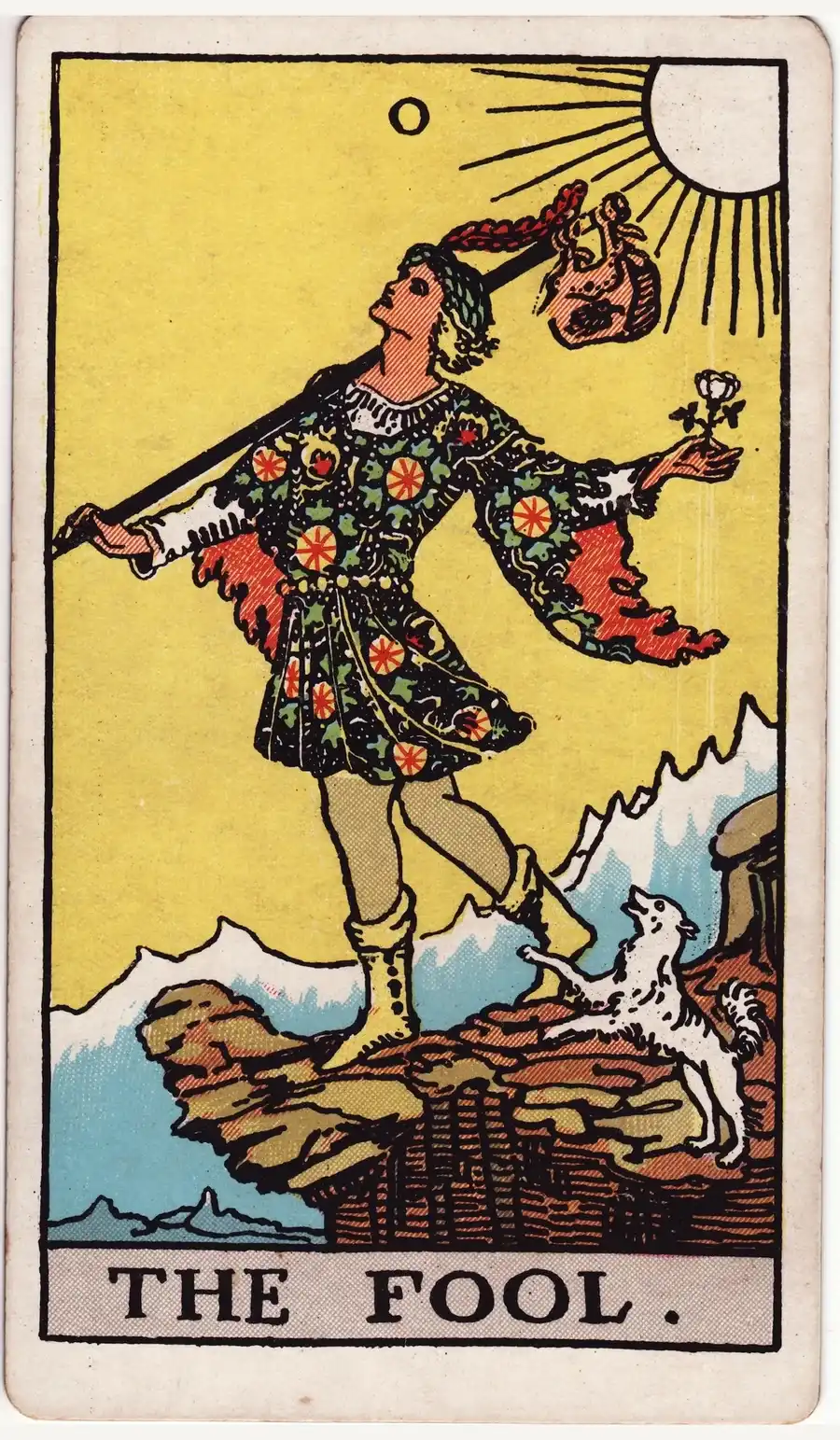
The Fool is card 0, the first card of the Major Arcana and the best card for a beginner to learn first. A young traveler walks toward the edge of a cliff with a flower in one hand and a small bag over his shoulder.
He is not stupid. He is open. This page covers what the Fool means upright and reversed, what Pamela Colman Smith actually drew, and where the card comes from.
Here is the Fool at a glance.
| At a glance | This card |
|---|---|
| Upright keywords | new beginnings, freedom, innocence, curiosity |
| Reversed keywords | recklessness, negligence, fear dressed as endless preparation |
| Number | 0 (0) in the Major Arcana |
| Golden Dawn title | The Spirit of Aethyr Later tradition |
| Hebrew letter | Aleph (א), “ox” Later tradition |
| Tree of Life path | 11, from Kether to Chokmah Later tradition |
| Astrology | Air (Golden Dawn); Uranus is a twentieth-century addition Later tradition |
| Element | Air Later tradition |
| Yes or no | Yes Modern |
The Golden Dawn gave the Fool the first Hebrew letter, Aleph, and the element of air, because Aleph is one of the three “mother letters” of the Sefer Yetzirah and the Fool is the breath before anything takes form. Uranus was added by twentieth-century astrologers who wanted a planet for every trump. Older French occultists, following Éliphas Lévi, put the Fool between Judgement and the World instead of at the start, which is why some books give it the letter Shin.
The card: what Pamela Colman Smith drew
The 1909 Fool is a bright card. The sky is yellow, the sun is white and high, and the figure looks up rather than down.
Waite described “a young man in gorgeous vestments” who “pauses at the brink of a precipice” and called him “the spirit in search of experience”. Every detail in the picture tells you something about how to begin.
The cliff edge. The traveler is one step from a drop he does not seem to notice. The edge is the point of every new beginning: you cannot see the whole road from where you stand. The card does not promise that the fall will not happen. It says the step is worth taking with your eyes open.
The white rose and the bag. In his left hand he holds a white rose, a common sign of innocence and a pure motive. Over his shoulder is a small bag on a staff. He travels light. Waite called it “a wallet curiously embroidered”, and many readers see it as the talents you carry without knowing it yet.
The white dog. A small dog jumps beside him. Some readers see a warning, others a loyal friend. Waite only noted that “his dog is still bounding”. One useful reading is the instinct that barks when you get too close to the edge: listen to it, but do not let it stop the walk.
The zero. The Fool has the number 0. In the older card game the Fool had no number at all and worked a little like a wild card. Zero is a good fit: before the journey, anything is still possible.
Upright meaning
Upright, the Fool is the moment before the first step, when you are already moving but have not yet learned what the road will ask of you. The young traveler in the 1909 card looks up, not down. That is the heart of the card: attention fixed on possibility rather than on danger. It speaks of beginnings that cannot be fully planned, such as a move, a new course, a relationship in its first weeks or a creative project with no outline yet.
The Fool’s gift is permission. It tells you that not knowing is an acceptable place to start, and that experience is something you gather by walking, not something you need before you set out. The little bag on the stick is small on purpose. You carry only what you need.
But the cliff is in the picture for a reason. The Fool is not reckless by nature; it is open. In a reading, notice what kind of openness is being asked for. Sometimes it is a leap of faith. Sometimes it is simply the willingness to look foolish while you learn. The white dog at the traveler’s heels is often read as instinct, the part of you that barks before you step too far. Bring it along.
Reversed meaning
Reversed, the Fool’s openness tips in one of two directions. The first is carelessness: the step taken without looking, the plan with no budget, the promise made on a whim. If the cards around it are practical, such as Pentacles or the Emperor, the reversed Fool often asks you to check the ground before you jump.
The second direction is the opposite, and it is just as common. The reversed Fool can be the traveler who never leaves the cliff top, waiting for a guarantee that no new beginning can give. Fear of looking naive, of failing in public or of starting late keeps the bag packed and the road untried.
Ask which of the two you recognize. The remedy for the first is one sensible precaution. The remedy for the second is one small, real step, taken this week.
In love, work and spirituality
In love. Upright: A fresh start, a new crush or a playful phase in a long relationship. It favors curiosity over rules. Reversed: Rushing in before you know someone, or keeping a partner at arm’s length because commitment feels like losing freedom.
At work. Upright: A new job, an apprenticeship or a change of field. You may not have every skill yet, and that is fine. Reversed: An impulsive resignation, or a career change postponed for years because the timing never feels perfect.
With money. Upright: Money spent on experience, travel or learning. Keep a small reserve and enjoy the adventure. Reversed: Spending without a plan, or refusing every risk so firmly that nothing can grow.
In spiritual practice. Upright: Beginner’s mind. Approach a practice as if for the first time, without needing to be good at it. Reversed: Spiritual shopping: jumping between paths so quickly that none of them has time to teach you.
As feelings. Lightness, excitement and a little nervousness. The person feels free around you, perhaps not yet serious.
As a person. Someone young at heart, spontaneous and curious, who would rather try than theorize.
As advice. Take the first step before you feel ready, and pack only what you need.
Reading the Fool: positions and yes or no
In the past position: A leap you took, or a time you started over with very little. In the present position: A new beginning is open now, and you do not need a finished plan.
In the future position: A fresh start is coming. Leave room for it. As advice: Take one small, honest first step and look where you put your feet.
When the Fool shows up among mostly Minor cards, give it extra weight: the theme of new beginnings runs under the whole question.
In modern yes or no readings, the Fool leans yes.
It favors starting, saying yes and trying something new, as long as you look where you step.
The history and art behind the card
In the Tarot de Marseille pattern the card is called Le Mat, the Fool. In the old Italian card game the Fool was not a trump at all. He was the Matto, the madman, a card you could play to avoid following suit.
The earliest painted Fools, in decks like the Visconti-Sforza cards of the 1400s, show a ragged man with feathers in his hair, closer to a village fool than a spiritual seeker.
The change came with the occult revival. In 1909 Pamela Colman Smith drew him as a young traveler in bright clothes, and that image is why so many modern readers see the Fool as the hero of the whole Major Arcana. The idea of the Fool’s Journey through the other 21 cards is even newer.
When A. E. Waite published The Pictorial Key to the Tarot in 1910, he listed these divinatory meanings for the card: “Folly, mania, extravagance, intoxication, delirium, frenzy, bewrayment.”
Reversed, he gave: “Negligence, absence, distribution, carelessness, apathy, nullity, vanity.” Waite himself called the fortune-telling meanings of the trumps “artificial and arbitrary”, and on this site I read the picture first and treat lists like this as history.
The Fool stands before the three stages as pure openness. In the modern teaching map called the Fool’s Journey, every other Major is a place the Fool visits.
Common questions
Is the Fool a good card? Yes, in most readings the Fool is a hopeful card about new beginnings and openness. It asks you to look where you step, but it rarely means disaster.
What does the Fool mean in a love reading? Upright, a fresh start, a new connection or a playful phase. Reversed, it can warn against ignoring red flags or rushing in without thinking.
Why is the Fool numbered 0? In the old card game the Fool had no number and worked like a wild card. Later decks gave it 0, the number before every beginning.
Try this
Try this small spread for the Fool. Use it when you are standing at the edge of something new. Take out the Fool, put it at the top of your table as a theme card, and draw three cards below it.
| Card | Question | What it shows |
|---|---|---|
| 1 | What is beginning? | The new thing, as it looks right now. |
| 2 | What can I leave behind? | The baggage I do not need for this walk. |
| 3 | What is my first step? | One small, reversible action I can take this week. |
Affirmation: I begin with open eyes and a willingness to learn as I go.
Reversed affirmation: I choose between reckless leaps and fearful stalling, and I move with care.
If you keep a tarot journal, take one of these questions to it: What would I start today if I did not need to be good at it yet? What am I carrying that I could leave behind? Where does my inner “dog” bark, and is it warning me or just nervous?
What next
Cards that sit close to this one are The Magician (the next step after the Fool: from openness to using your tools), The World (the end of the cycle, where the Fool arrives and starts again) and The Star (the same hopeful, open energy, after a storm).
The Fool is part of the lesson The Fool to the Chariot in my free Tarot for Beginners course. To keep walking the Major Arcana, read the card after it, The Magician, or go back to all the card meanings.
For every card with keywords, affirmations and examples, see my book The Novice’s Guide to Tarot. If you would like a printable cheat sheet for all 78 cards, my 45-page Tarot Workbook is on Etsy.
Sources
- A. E. Waite, The Pictorial Key to the Tarot (London: Rider, 1910), Part II and Part III, section 3.
- Pamela Colman Smith and A. E. Waite, the Rider-Waite-Smith tarot (London: Rider, 1909).
- Nicolas Conver, Tarot de Marseille (Marseille, 1760).
- Eden Gray, A Complete Guide to the Tarot (New York: Crown, 1970), epilogue “The Fool’s Journey”.
- Lauri Mukkala, The Novice’s Guide to Tarot, entry for The Fool.
- Aleister Crowley, 777 (London: Walter Scott, 1909), columns of the Hebrew letters, paths and Tarot trumps.
- Israel Regardie, ed., The Golden Dawn (Chicago: Aries Press, 1937 to 1940), “Book T” and the titles of the trumps.
All 78 cards
Major Arcana
- The Fool
- The Magician
- The High Priestess
- The Empress
- The Emperor
- The Hierophant
- The Lovers
- The Chariot
- Strength
- The Hermit
- Wheel of Fortune
- Justice
- The Hanged Man
- Death
- Temperance
- The Devil
- The Tower
- The Star
- The Moon
- The Sun
- Judgement
- The World
Wands
- Ace of Wands
- Two of Wands
- Three of Wands
- Four of Wands
- Five of Wands
- Six of Wands
- Seven of Wands
- Eight of Wands
- Nine of Wands
- Ten of Wands
- Page of Wands
- Knight of Wands
- Queen of Wands
- King of Wands
Cups
- Ace of Cups
- Two of Cups
- Three of Cups
- Four of Cups
- Five of Cups
- Six of Cups
- Seven of Cups
- Eight of Cups
- Nine of Cups
- Ten of Cups
- Page of Cups
- Knight of Cups
- Queen of Cups
- King of Cups
Swords
- Ace of Swords
- Two of Swords
- Three of Swords
- Four of Swords
- Five of Swords
- Six of Swords
- Seven of Swords
- Eight of Swords
- Nine of Swords
- Ten of Swords
- Page of Swords
- Knight of Swords
- Queen of Swords
- King of Swords
Pentacles
Get the free Mini-Grimoire
A short printable starter guide to tarot and everyday witchcraft, plus my newsletter. Unsubscribe any time.
Opens Substack in a new tab to confirm. More about the newsletter · Privacy