


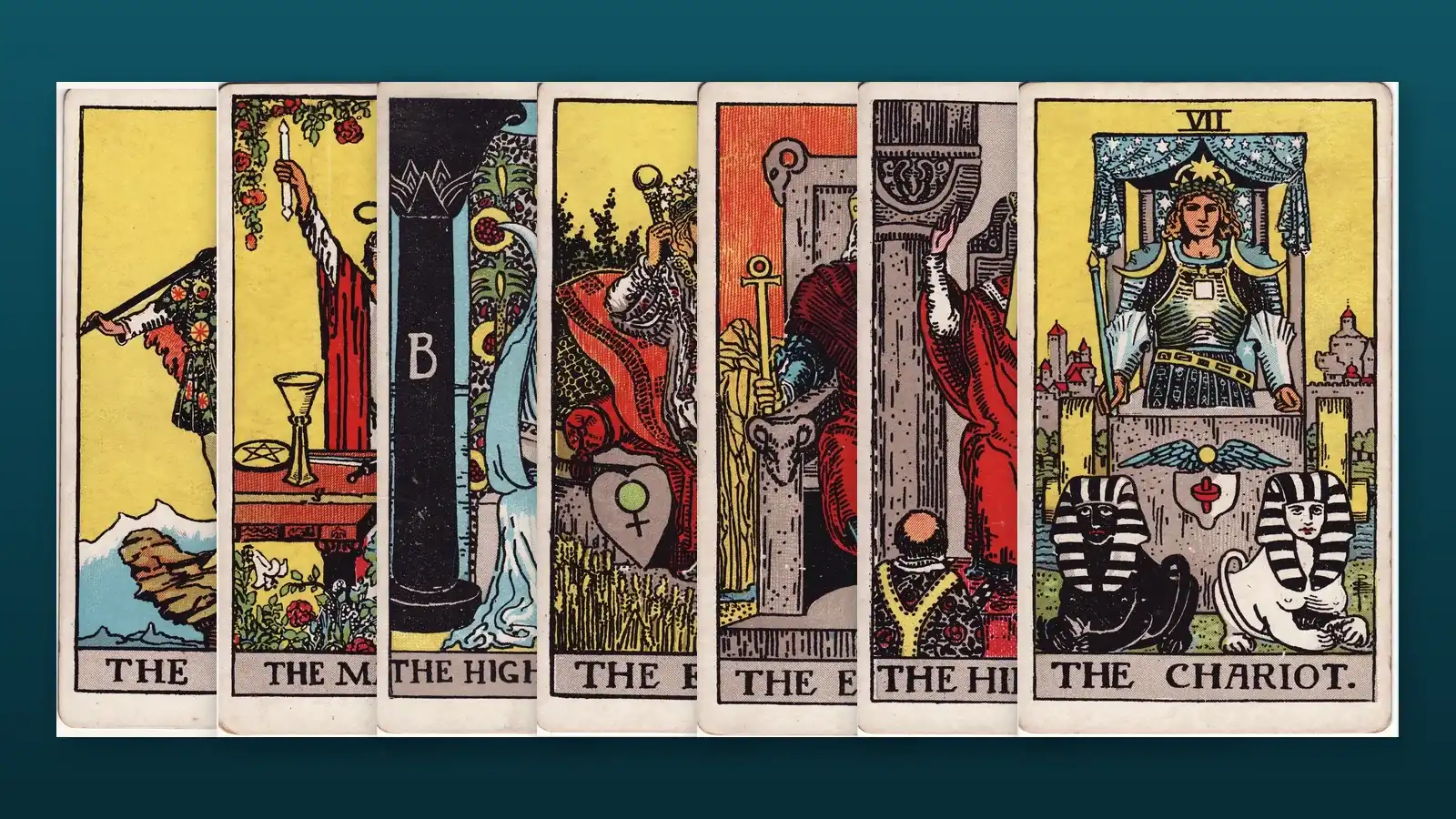
In this lesson you will meet the first eight Major Arcana cards, from the Fool to the Chariot, with keywords, pictures and simple meanings.
Today we meet the first eight cards of the Major Arcana. On the Fool’s Journey these are the cards of becoming a self: learning to act, to feel, to build and to choose. They matter because they turn up constantly in readings about new starts, relationships and decisions. For each card you will learn a few keywords, what the 1909 picture shows and a simple way to read it. Follow the links for the full card pages whenever you want more.
Trust and tools: the Fool and the Magician
The Fool, card 0, is about new beginnings, freedom and innocence. A young traveler steps towards the edge of a cliff with a small dog at their heels and a white rose in hand. Read it as a fresh start taken with an open heart. Reversed, it can warn of recklessness, the step taken without looking at all.
The Magician, card I, is about willpower, manifestation and using your tools. A figure points one hand to the sky and one to the earth, and on the table lie a cup, a sword, a pentacle and a wand, the four suits of the deck. The message is simple: you already have the tools you need. Reversed, beware of manipulation or tricks, the same skill turned towards fooling people.
Inner and outer worlds: the High Priestess, the Empress and the Emperor
The High Priestess, card II, is the card of intuition, mystery and inner wisdom. A calm woman sits between a dark and a light pillar, a scroll in her lap and a crescent moon at her feet. She says: listen inward and wait. Reversed, something may be hidden or pushed down.
The Empress, card III, is about fertility, creation and abundance. A woman rests on cushions in a field of ripe wheat beside a flowing stream. She brings growth, comfort, creativity and care. Reversed, look for overindulgence or stagnation.
The Emperor, card IV, is authority, structure and control. A crowned ruler sits on a stone throne carved with rams’ heads, with bare mountains behind him. He offers order, plans and protection. Reversed, structure turns rigid or controlling. Notice how the Empress’s soft field and the Emperor’s hard rock answer each other. You need both.
Learning and choosing: the Hierophant, the Lovers and the Chariot
The Hierophant, card V, stands for tradition, wisdom and spiritual guidance. A religious teacher raises his hand in blessing over two kneeling students. Read it as learning from a tradition, a teacher or an institution. Reversed, it can mean questioning the rules.
The Lovers, card VI, is love, unity and partnership. Two people stand in a garden beneath an angel and a blazing sun. The card is about love, yes, and it also asks about values and choices: what do you choose when you follow what matters most to you? Reversed, something is out of alignment.
The Chariot, card VII, is victory, direction and determination. A charioteer stands in a chariot drawn by a black and a white sphinx. His willpower holds opposing forces on one course. Reversed, control slips or turns into aggression.
What the older cards show
Historical Several of these cards looked different before 1909, and knowing the older pictures deepens your reading. The Magician was originally a street conjurer or juggler at a table, called Le Bateleur in Marseille decks, a figure of skill, showmanship and a little trickery. The High Priestess was La Papesse, the Female Pope.
Historians do not know exactly why she appeared; one theory links her to the legend of Pope Joan, another to a woman named Maifreda da Pirovano, a relative of the Visconti family, who was chosen as “pope” by a small religious group and burned for heresy in 1300. Both are possibilities, not certainties.
Historical The Hierophant was Le Pape, the Pope, and Waite renamed him to make the card less Catholic and more universal. In Marseille decks, the Lovers shows a young man standing between two women, with Cupid aiming an arrow from above, so the card was about choice as much as romance.
Waite turned it into a scene of Adam and Eve in the garden with an angel. The Chariot echoes the triumphal processions of Renaissance Italy, which the poet Petrarch described in his poem I Trionfi, “The Triumphs”, and which may have inspired the name of the first tarot trumps.
Seeing the pattern
These cards build on each other like chapters. The Fool has trust. The Magician gets tools. The High Priestess adds intuition, the Empress care, the Emperor structure and the Hierophant learning. With the Lovers comes a real choice, and with the Chariot the will to follow it through. That is a whole first chapter of growing up in eight pictures, and once you see it, you will not need to memorize the order.
An example: two cards together
Imagine someone asks, “How should I approach starting my own small business?” and draws the Magician and the Emperor. The Magician says she has the skills and tools already on the table. The Emperor adds that the next step is structure: a plan, a budget, clear rules for herself. Together they make practical advice. If instead she had drawn the Magician and the High Priestess, the second step would be quieter: listen to her own sense of timing before acting.
How to remember them
Do not try to memorize everything. For each card, remember one keyword and one detail in the picture, and let the picture bring back the meaning: the Fool’s cliff, the Magician’s table, the High Priestess’s pillars, the Empress’s wheat, the Emperor’s rams, the Hierophant’s raised hand, the Lovers’ angel and the Chariot’s two sphinxes.
Waite’s Magician, quoted
Historical Waite described his Magician’s table in The Pictorial Key to the Tarot (1910): “On the table in front of the Magician are the symbols of the four Tarot suits, signifying the elements of natural life, which lie like counters before the adept, and he adapts them as he wills.”
Those four objects, cup, sword, wand and pentacle, link the Magician to all 56 suit cards. It is a useful memory hook: the Magician has every tool he needs on the table in front of him, and so, in a reading, he often asks whether you are using what you already have.
A variation for learning the first eight
Lay the eight cards from the Fool to the Chariot in a row. Under each, write one verb: the Fool leaps, the Magician makes, the High Priestess knows, the Empress nurtures, the Emperor structures, the Hierophant teaches, the Lovers choose and the Chariot drives. Read the row aloud as a sentence. The next day, mix the eight cards, draw one and try to recall its verb before you look. That is retrieval practice, and it works.
Waite on three more cards
Historical Waite’s descriptions in The Pictorial Key to the Tarot (1910) are often dense, but a few phrases are wonderfully useful for learners.
Of the High Priestess’s scroll he wrote that it “is partly covered by her mantle, to shew that some things are implied and some spoken.” That one detail sums up the card: knowledge that is only half shown, and the patience to wait for the rest.
The Emperor, for Waite, “is executive and realization, the power of this world”. In plain words, he is the part of life that gets things built and keeps them running.
The Chariot’s driver, he wrote, “is above all things triumph in the mind.” That is a helpful correction for beginners who read the card as pure force. The victory in this card begins with focus and self-command.
Practice: one detail per card
Lay out the eight cards from the Fool to the Chariot in a row. For each, find one small detail you have not noticed before: the Fool’s white rose, the Magician’s tools on the table, the pomegranates on the High Priestess’s veil, the wheat at the Empress’s feet, the rams’ heads on the Emperor’s throne, the crossed keys below the Hierophant, the angel above the Lovers, the sphinxes before the Chariot.
Write each detail on that card’s page in your notebook, with one sentence about what it might add to the meaning. Then check a book or this course’s card pages to see whether others have read it the same way. Sometimes you will agree, and sometimes your own reading will be just as sensible.
When two of these cards appear together
Some pairs from this group come up often and are worth learning as pairs. The Magician and the High Priestess suggest action and stillness in balance: do what you can, and wait for what you cannot yet know. The Empress and the Emperor together often point to care and structure, the warmth of home and the rules that keep it steady. The Hierophant and the Lovers can show a choice between what others expect and what your own values say. The Fool and the Chariot together describe a fresh start that needs direction to succeed. These are starting points, not fixed formulas, but they show how cards talk to each other.
A beginner’s question: “Do I have to memorize all these pairings?” No. Learn the single cards first. Pairings grow naturally once you know each card’s picture well.
Questions beginners ask
Is the Empress always about motherhood? No. She can mean creativity, abundance, comfort or care for the body, for anyone.
Is the Emperor a bad card for people who dislike authority? He can show helpful structure as well as rigid control. Notice which one fits.
Are the Lovers always about romance? Often they point to a choice that reflects your values, which may or may not involve a partner.
Myths to drop: The High Priestess is not a secret Egyptian priestess. The Magician is not about stage magic only. And the numbers on these cards do not mean that one is “better” than another.
Try this
Pick the card from today’s eight that feels most like you right now, and write three lines about why. Then pick the one that feels least like you, and write one line about what it might have to teach you.
Recap
The first eight Majors trace the making of a self. The Fool begins with trust, and the Magician’s main theme is willpower and using your tools. The High Priestess is intuition and inner wisdom, the Empress care and growth, the Emperor structure, and the Hierophant tradition and teaching. The Lovers ask about values and choices as well as romance, and the Chariot drives a choice forward with determination.
What next
Press “Mark as done” and continue with Strength to Temperance. Each card has a full page with history and reversals, starting with the Fool.
Further reading: A. E. Waite, The Pictorial Key to the Tarot (1910), part 2, on the Major Arcana. Robert M. Place, The Tarot: History, Symbolism, and Divination (Tarcher, 2005).
Sources
- Lauri Mukkala, The Novice’s Guide to Tarot, “Major Arcana 0 to VII”.
- A. E. Waite, The Pictorial Key to the Tarot (London: Rider, 1910).
Quick check
Go deeper: The Novice's Guide to Tarot: Major Arcana 0 to VII
Get the free Mini-Grimoire
A short printable starter guide to tarot and everyday witchcraft, plus my newsletter. Unsubscribe any time.
Opens Substack in a new tab to confirm. More about the newsletter · Privacy
Comments
Questions and notes from readers. Anyone with a free account can comment, and I reply when I can. Please read the community guidelines.
Comments load from Google Firebase (EU) when you ask for them. Nothing is stored on your device. Privacy