


In this lesson: how to read Death, the Tower, the Devil and other hard cards calmly, and simple words to use when fear rises.
Sooner or later you will turn over a card that makes your stomach drop. Death. The Tower. Ten swords in someone’s back. How you respond in that moment decides whether tarot becomes a source of fear or a source of insight. This lesson is here so that the moment does not scare you, and so that you know what to do when a card touches something truly serious.
Hard is not the same as bad
Hard cards name pressure, change or a theme worth facing. They are not a curse. Often a hard card is the most honest and useful card in the reading, because it names what everyone was trying not to see. Read it calmly, as information.
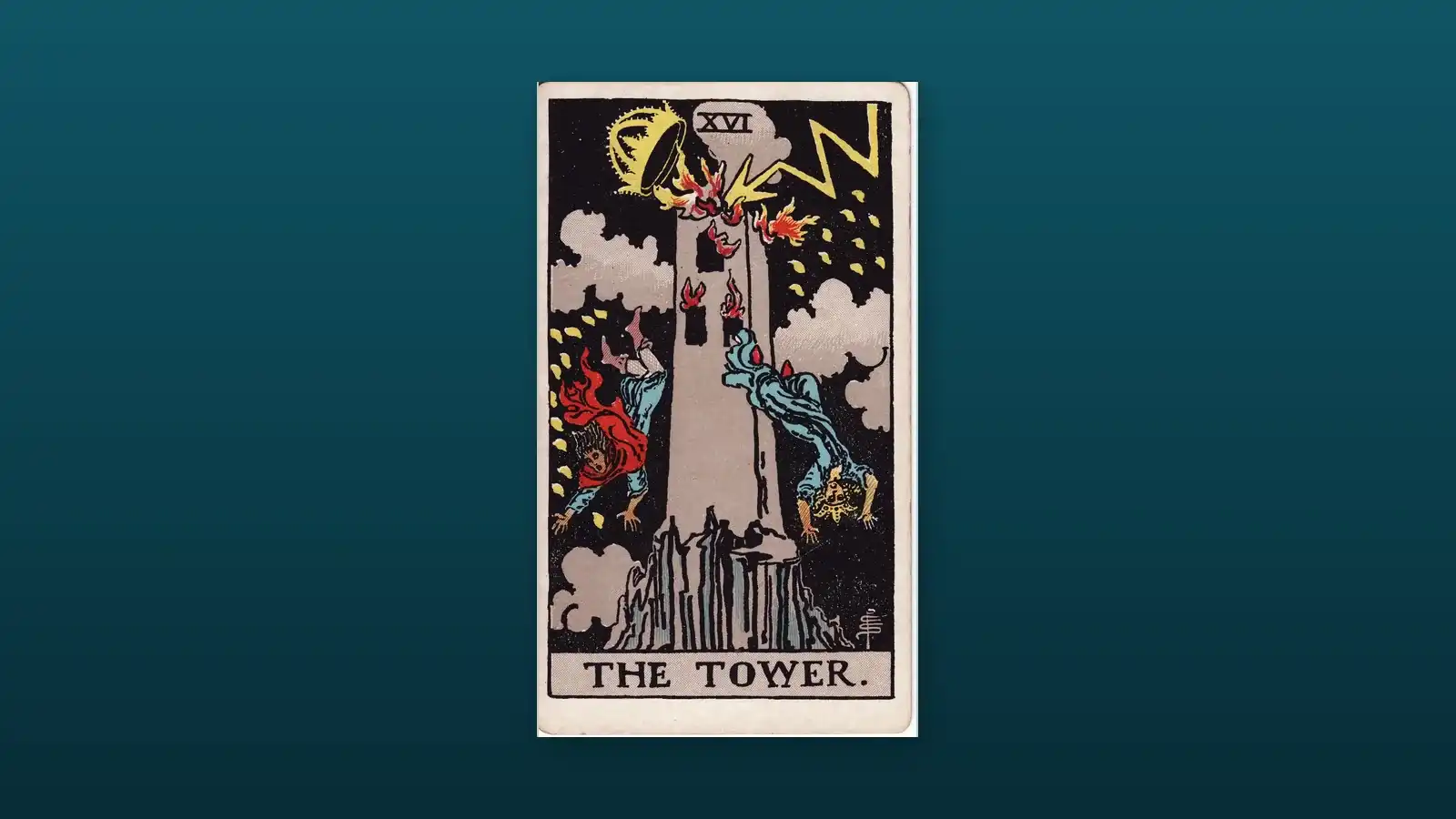
It helps to know what fear tends to hear. When Death appears, fear hears that someone will die. But the Death card does not predict anyone’s physical death. It is about an ending or deep change, the close of one chapter so another can begin. When the Tower appears, fear hears disaster. A calmer reading says that something unstable may break, and that we start with safety, then meaning. When the Devil appears, fear hears a curse. In fact the card names a binding pattern or attachment, and help and exits from it are real-world work.
The Minor Arcana have their own hard cards. The Three of Swords names heart pain, where comfort and time matter more than any prophecy. The Nine of Swords names worry and sleepless nights, not a sentence on your future. The Ten of Swords shows a hard chapter ending, and recovery is not on a deadline. The Five of Pentacles is about scarcity or feeling left out, and practical help still counts. The Ten of Wands says too much is on your back, and asks what you can set down or share.
If an image is too hard to look at today, you can set it aside and still read the position it landed in. That is allowed.
Clear language, not fear theater
Whether you read for yourself or someone else, frame what you see as possibility and choice. Prefer “The cards point to a time when openness matters, and how you show up will shape what grows” over “You will find love in six months.” The first respects the person. The second is a prediction you cannot keep.
The usual “scary” cards, gently
A handful of cards frighten beginners most. Death is about endings and change, not literal death. The Tower is sudden change or a truth breaking through. The Devil is about attachments, habits and what holds us. Three of Swords is heartache and grief. Ten of Swords is a painful ending, often with the sense that the worst is over, since the dawn is breaking in the 1909 picture. Five of Pentacles is hardship and feeling left out in the cold, yet in the picture a lit stained-glass window, which many readers see as a church, suggests help nearby. Each card has a door in it, if you look for it.
Naming the feeling helps
Modern When a card upsets you, try putting the feeling into words. In a 2007 study, the psychologist Matthew Lieberman and colleagues found that simply labeling an emotion, for example “I feel afraid”, reduced activity in the brain’s alarm system, the amygdala, compared with just looking at an upsetting picture. This is called affect labeling. Writing “this card makes me feel scared because…” in your notebook is a small, practical way to calm down before you interpret.
When the card touches something real
Sometimes a hard card lands on something truly serious: addiction, abuse, a health scare. Then the card has done its job by naming it. The next step is not another card. It is a doctor, a support line, a trusted friend or, in an emergency, local emergency services.
An example: the Tower on a Monday
Imagine you draw the Tower on a Monday morning, asking, “What do I need to know about this week?” Lightning strikes a tall tower, its crown flies off and two figures fall. First, breathe. Then ask the question I use for every hard card: “What is this card asking me to face, and what is one small, safe step I can take?”
Perhaps you know that a project at work is built on a shaky plan that nobody wants to question. The Tower names it. Your small step might be to raise the problem in Wednesday’s meeting before it collapses on its own. Write the step down. The card has turned from a threat into a task, and that is the whole skill.
A second worked example
Imagine someone drawing the Three of Swords on the day of a breakup. Her first reaction is “Of course, everything is terrible.” She writes the feeling down: “I feel hurt and angry.” Then she looks at the picture: three swords through a heart, rain behind. She notices that the rain is falling and will stop. Her note reads: “This card names what I feel. It does not say I will always feel this way.” She makes a cup of tea and calls a friend. The card did not make her day worse; it helped her admit how she felt.
A variation: the “door” card
If a hard card leaves you uneasy, you can draw one more card and ask, “What helps me move through this?” Read this card only as support, never as a second warning. Some readers like this practice; others prefer to stay with the first card. Decide your rule before the reading.
How grim the old meanings were
Historical It helps to know that many frightening ideas about hard cards come from older fortune-telling lists. In The Pictorial Key to the Tarot (1910), Waite lists the Tower’s divinatory meanings as “Misery, distress, indigence, adversity, calamity, disgrace, deception, ruin. It is a card in particular of unforeseen catastrophe.” For Death he gives “End, mortality, destruction, corruption”.
Yet even Waite did not treat these lists as the whole truth. In his history chapter he writes that, for the Death card, “the alternatives allocated to the symbol are change and transformation.” And he called the common divinatory meanings “largely arbitrary attributions”. In other words, the author of the deck most beginners use thought the fortune-telling meanings were the least important layer of his cards.
Modern readers have softened these meanings because the reflective approach asks different questions. A card that once meant “ruin” in a prediction now often means “a structure that cannot hold”, which is something you can look at, prepare for and even welcome.
A calm routine for hard cards
When a card makes your stomach drop, try this short routine.
Breathe and name it. Say the card’s name and the feeling: “The Tower. I feel scared.” Naming a feeling often loosens it a little.
Describe the picture. Say three things you can literally see, without interpreting. For the Tower: a lightning strike, a falling crown, two figures in the air.
Find the movement. Ask what is changing in the picture. Hard cards are almost always scenes of change, not fixed states.
Ask the useful question. “What could this help me notice or prepare for?”
Write one line. Put your answer in your notebook, then put the card away. You can come back to it tomorrow with fresh eyes.
Practice: making friends with hard cards
Take the Tower, Death, the Devil, the Ten of Swords and the Three of Swords out of your deck. Spend one day with each, propped up where you can see it. Every time you notice it, find one new detail. By the end of the week these cards will feel familiar, and familiar cards are much less frightening when they appear in a reading.
When a hard card appears for someone else
Reading for a friend adds one more layer. Their face may fall before yours does. Slow down and say what you see in the picture first, then ask, “What does this bring up for you?” Let them speak before you add any meaning. Avoid words like “doom”, “curse” or “warning”, and never make a hard card about their health, death or safety. If the card seems to touch something serious in their life, remember that you are a friend with a deck, not a counsellor, and that suggesting real support is a kindness, not a failure of the reading.
A beginner’s worry: “What if I say the wrong thing?” Then say so. “I don’t think I put that well. Let me try again” is one of the most trustworthy sentences a reader can use.
Questions beginners ask
Should I put a scary card back and draw again? It is better to stay with it and ask what it might be pointing to. Redrawing teaches you to fear cards.
Can a card cause something bad to happen? No. Cards reflect; they do not cause.
What if I keep drawing the Tower? Notice what in your life feels unstable, and check that you are shuffling enough. Repetition can be a coincidence, a shuffling habit or a theme worth journaling about.
Myths to drop: Hard cards are not punishments. The Devil card does not mean demons. And light cards are not always “good”; the Sun can also mean too much exposure.
Try this
Take the Death, Tower and Devil cards out of your deck. Look at each one for a full minute, noticing the details beyond the frightening ones: the rising sun behind Death, the loose chains on the Devil’s figures. Then write one calm sentence about each.
Recap
Hard cards name pressure and change, not curses, and they are often the most useful cards on the table. Death means an ending or deep change, not a physical death. With the Tower, safety comes first, then meaning. The Devil usually names a binding pattern or attachment. Speak in possibilities, not predictions, and when a card touches something serious, the next step is real-world help, not another card.
What next
Press “Mark as done” and continue with The Fool’s Journey, where the Major Arcana begin. Each hard card has its own full page: see Death, the Tower and the Devil.
Further reading: Matthew D. Lieberman and others, “Putting feelings into words”, Psychological Science 18 (2007).
Sources
- Lauri Mukkala, The Novice’s Guide to Tarot, “When a Hard Card Appears”.
Quick check
Go deeper: The Novice's Guide to Tarot: When a Hard Card Appears
Get the free Mini-Grimoire
A short printable starter guide to tarot and everyday witchcraft, plus my newsletter. Unsubscribe any time.
Opens Substack in a new tab to confirm. More about the newsletter · Privacy
Comments
Questions and notes from readers. Anyone with a free account can comment, and I reply when I can. Please read the community guidelines.
Comments load from Google Firebase (EU) when you ask for them. Nothing is stored on your device. Privacy