


| Arcana | Minor Arcana: Swords |
|---|---|
| Image | RWS 1909 (PD) |
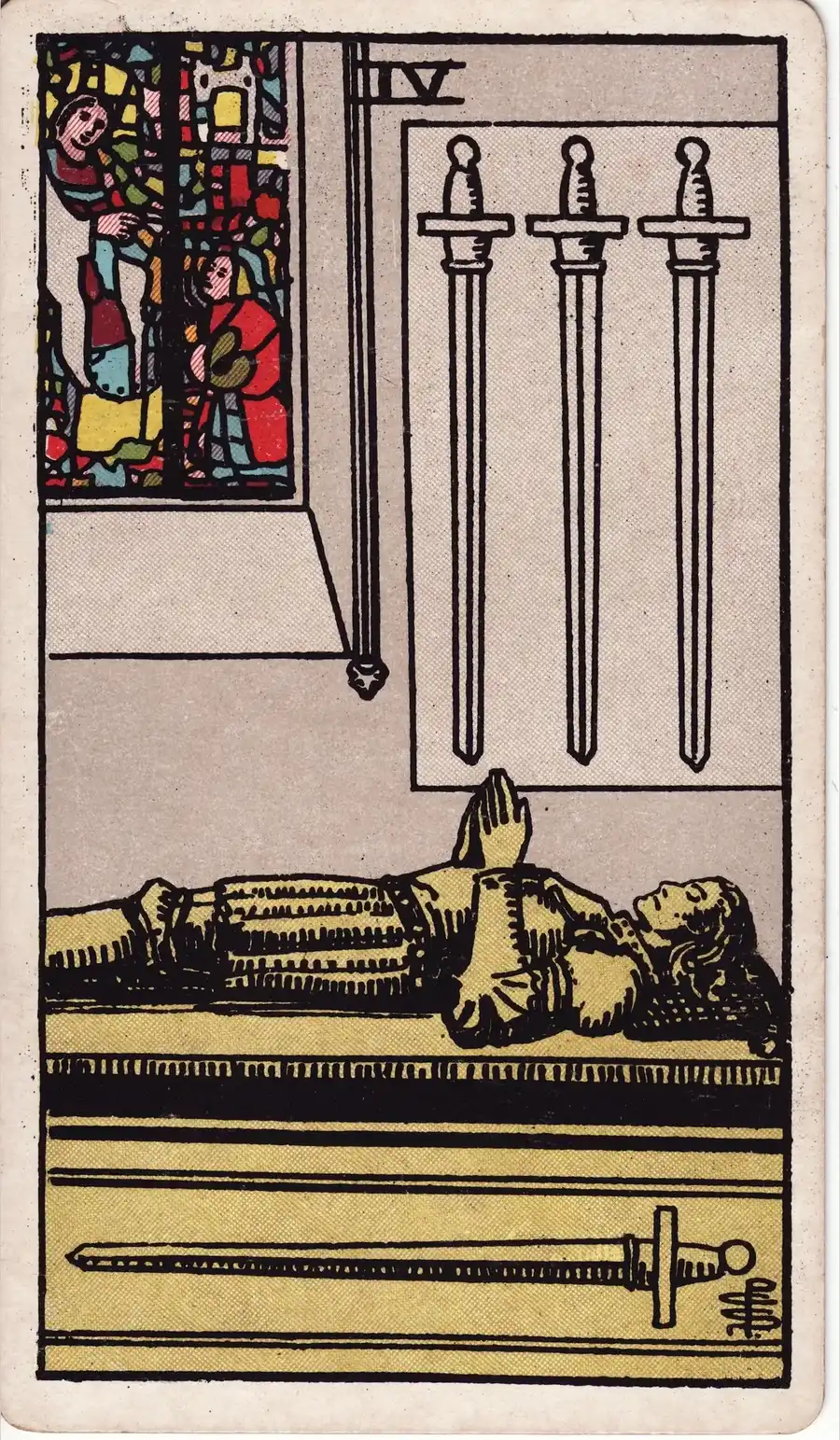
The Four of Swords shows the carved figure of a knight lying on a tomb in a quiet church, his hands joined in prayer. Three swords hang above him and one lies along the tomb.
It is a card of rest, recovery and quiet thinking. Here is what the Four of Swords means upright and reversed, the symbols in the 1909 card and a spread for real rest.
Here is the Four of Swords at a glance.
| At a glance | This card |
|---|---|
| Upright keywords | rest, recovery, contemplation |
| Reversed keywords | restlessness, burnout, refusal to rest |
| Number | 4 in the suit of Swords |
| Golden Dawn title | Lord of Rest from Strife Later tradition |
| Astrology | Jupiter in Libra, third decan (20° to 30° Libra) Later tradition |
| Tree of Life | Chesed (4), Mercy Later tradition |
| Suit and element | Swords, Air Later tradition |
| Yes or no | Maybe Modern |
The Golden Dawn named the Four of Swords the Lord of Rest from Strife and gave it Jupiter in Libra, the last decan of the sign, on Chesed. Jupiter’s generosity brings relief to the airy scales. Smith’s sleeping knight in a quiet church is a gentle picture of that rest.
Later tradition The Golden Dawn also gave each decan two of the 72 Goetic spirits, one for the day and one for the night. For the third decan of Libra, and so for the Four of Swords, they are Marax (spirit 21, day) and Ose (spirit 57, night). Their pages read the old entries as history; see the spirit directory for all 72.
The card: what Pamela Colman Smith drew
Waite wrote: “The effigy of a knight in the attitude of prayer, at full length upon his tomb.” An effigy is a carved likeness. Smith added a stained glass window in the corner with a figure in it.
The resting knight. He is a statue, not a corpse. Read the card as deep rest, not death. The fighter has laid down.
The swords above. Three swords hang over him, still present but not in use. Problems do not vanish when you rest. You simply stop holding them for a while.
The stained glass window. The window shows a scene of comfort and quiet. Many readers link it to sanctuary: a safe place to recover.
Upright meaning
Upright, the Four of Swords is rest. A carved knight lies on a tomb in a quiet church, hands joined in prayer. Three swords hang above him and one lies along the tomb. A stained glass window glows in the corner. The card speaks of recovery, retreat, meditation and taking a break after a struggle.
It often appears after the pain of the Three of Swords, as if to say that you need to stop and heal before doing anything else. It can mean literal rest, a vacation, sick leave or a few days off. It can also mean mental quiet, the decision to stop overthinking for a while.
The knight is not dead. He is resting. Recovery is an active choice, and it gives you back your strength.
Reversed meaning
Reversed, the Four of Swords can show restlessness, burnout, or refusing to rest when you need it. It can also show coming back after a period of rest, ready to engage again.
Ask whether your body and mind are asking you to stop. If so, listen. If you have rested, it may be time to pick up the sword again.
Reversed, the Four can also be enforced rest: illness, a job loss or a canceled plan that stops you whether you want to or not. Resisting that pause usually makes it longer. Use it to recover properly, so you come back with more than you left with.
In love, work and spirituality
In love. Upright: Taking a break, giving each other space, or quiet time together. Reversed: Restlessness, or returning to a relationship after a pause.
At work. Upright: Time off, recharging, or a pause before the next project. Reversed: Burnout, or going back to work after a break.
With money. Upright: A pause in spending, or reviewing finances calmly. Reversed: Financial worry that disturbs rest.
In spiritual practice. Upright: Meditation, retreat and contemplative practice. Reversed: Being unable to quiet the mind.
As feelings. Tired or withdrawn. They may need space.
As a person. Someone who needs rest or is recovering from a hard time.
As advice. Rest now, and let your mind be quiet.
Reading the Four of Swords: positions and yes or no
In the past position: A time of rest or retreat helped you recover. In the present position: Rest now. Your mind needs it.
In the future position: A pause or recovery period is coming. As advice: Lay down the sword for a while.
In modern yes or no readings, the Four of Swords is a maybe. It asks you to rest before deciding.
What the Four means, and the history behind the card
Four brings stability, and in Swords that stability is the stillness of rest. The Golden Dawn named it Rest from Strife, which places it right after the sorrow of the Three.
Here is how the Four looks across the four suits:
- Four of Wands: celebration, harmony, homecoming
- Four of Cups: contemplation, apathy, reevaluation
- Four of Swords (this card): rest, recovery, contemplation
- Four of Pentacles: security, stability, materialism
Waite described the scene as the effigy of a knight in the attitude of prayer, at full length upon his tomb.
In other words, the figure is a stone carving on a tomb in a church, not a living man asleep. That can sound grim, but stone effigies show the dead at peace, and the card is about rest, not death.
The stained glass window above, one of the few in the deck, shows a figure with another kneeling before it, and adds a feeling of quiet sanctuary.
When A. E. Waite published The Pictorial Key to the Tarot in 1910, he listed these divinatory meanings for the Four of Swords: “Vigilance, retreat, solitude, hermit’s repose, exile, tomb and coffin. It is these last that have suggested the design.”
Reversed, he gave: “Wise administration, circumspection, economy, avarice, precaution, testament.”
Common questions
Is the Four of Swords a yes or no card? It is a maybe. It asks for rest before you decide.
Does the Four of Swords mean death? No. The figure is a carved statue on a tomb, and the card means rest and recovery.
What does the Four of Swords mean in love? Taking space to think, or a quieter period. Reversed, avoiding a needed pause.
Try this
Try this small spread for the Four of Swords. Use it when you are tired.
| Card | Question | What it shows |
|---|---|---|
| 1 | What has worn me out? | The struggle to put down. |
| 2 | What kind of rest do I need? | Sleep, quiet, play or solitude. |
| 3 | What can wait? | The task I can leave for now. |
Affirmation: I rest so my mind can recover its clarity.
Reversed affirmation: I stop refusing the rest my life is asking for.
If you keep a tarot journal, take one of these questions to it: What would real rest look like for me this week? What am I afraid will happen if I stop? Where is my sanctuary?
What next
Cards that sit close to this one are The Hermit (the Major Arcana card of solitude), Four of Cups (another Four of withdrawal) and The Hanged Man (the Major Arcana card of a pause that changes your view).
The Four of Swords is part of the lesson Swords in my free Tarot for Beginners course. To see the whole suit on one page, go to the suit of Swords. To keep walking the suit, read the card before it, Three of Swords or the card after it, Five of Swords, or go back to all the card meanings.
For the suits and numbers in one place, see The Minor Arcana: suits and numbers made simple. For every card with keywords, affirmations and examples, see my book The Novice’s Guide to Tarot. If you would like a printable cheat sheet for all 78 cards, my 45-page Tarot Workbook is on Etsy.
Sources
- A. E. Waite, The Pictorial Key to the Tarot (London: Rider, 1910), Part III, sections 1 and 2.
- Pamela Colman Smith and A. E. Waite, the Rider-Waite-Smith tarot (London: Rider, 1909).
- Nicolas Conver, Tarot de Marseille (Marseille, 1760).
- Lauri Mukkala, The Novice’s Guide to Tarot, entry for the Four of Swords.
- Aleister Crowley, 777 (London: Walter Scott, 1909), columns of the decans, the Minor Arcana and the court cards.
- Israel Regardie, ed., The Golden Dawn (Chicago: Aries Press, 1937 to 1940), “Book T”, titles and attributions of the small cards and the court.
All 78 cards
Major Arcana
- The Fool
- The Magician
- The High Priestess
- The Empress
- The Emperor
- The Hierophant
- The Lovers
- The Chariot
- Strength
- The Hermit
- Wheel of Fortune
- Justice
- The Hanged Man
- Death
- Temperance
- The Devil
- The Tower
- The Star
- The Moon
- The Sun
- Judgement
- The World
Wands
- Ace of Wands
- Two of Wands
- Three of Wands
- Four of Wands
- Five of Wands
- Six of Wands
- Seven of Wands
- Eight of Wands
- Nine of Wands
- Ten of Wands
- Page of Wands
- Knight of Wands
- Queen of Wands
- King of Wands
Cups
- Ace of Cups
- Two of Cups
- Three of Cups
- Four of Cups
- Five of Cups
- Six of Cups
- Seven of Cups
- Eight of Cups
- Nine of Cups
- Ten of Cups
- Page of Cups
- Knight of Cups
- Queen of Cups
- King of Cups
Swords
- Ace of Swords
- Two of Swords
- Three of Swords
- Four of Swords
- Five of Swords
- Six of Swords
- Seven of Swords
- Eight of Swords
- Nine of Swords
- Ten of Swords
- Page of Swords
- Knight of Swords
- Queen of Swords
- King of Swords
Pentacles
Get the free Mini-Grimoire
A short printable starter guide to tarot and everyday witchcraft, plus my newsletter. Unsubscribe any time.
Opens Substack in a new tab to confirm. More about the newsletter · Privacy