


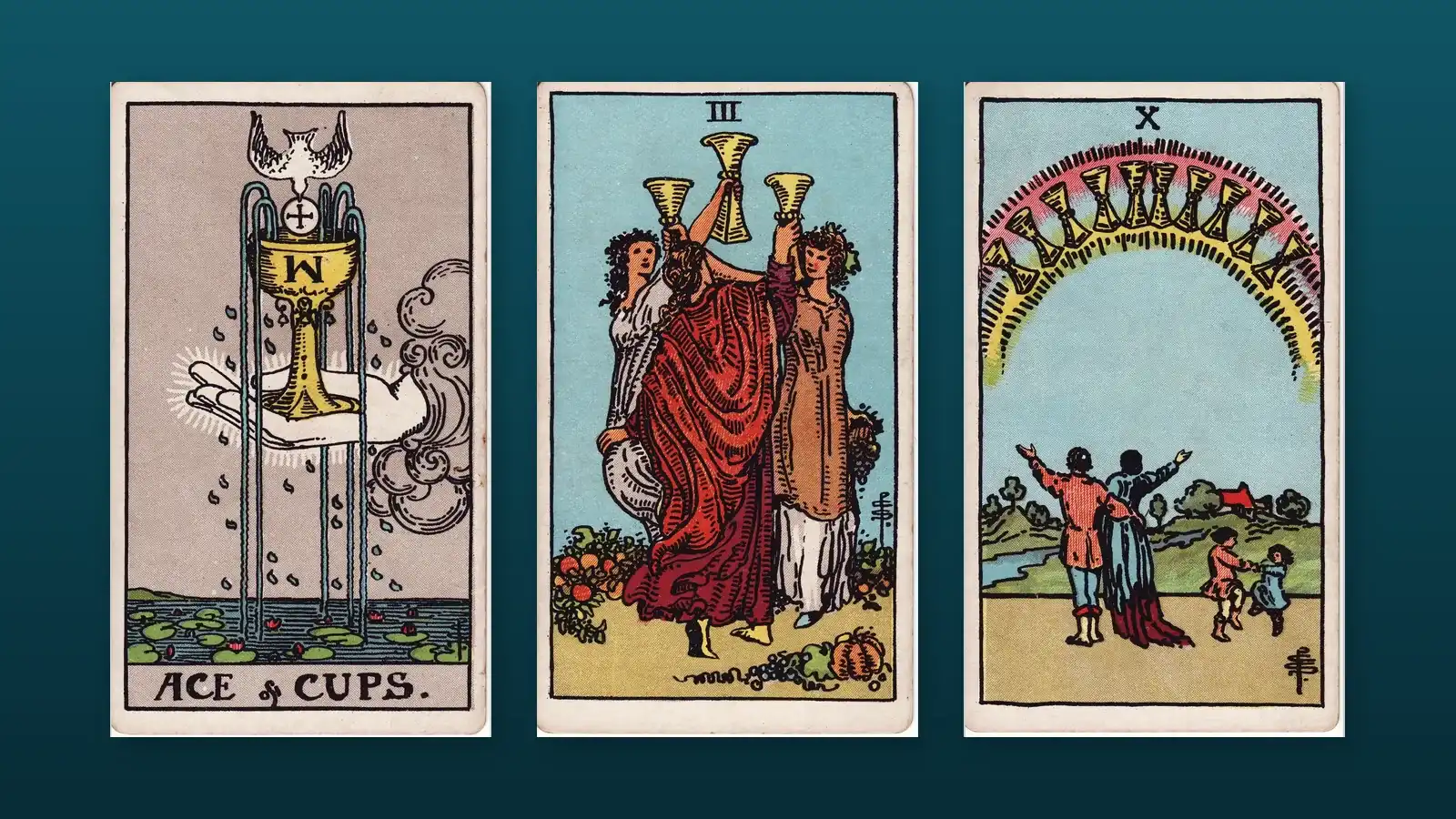
In this lesson: the 14 cards of the suit of Cups, the suit of water, feelings and relationships, with keywords and the 1909 pictures.
Cups are the suit of the heart. They speak to feeling, love, friendship, imagination and the emotional weather of a situation. Their element is water. When Cups fill a reading, the question is usually about how you feel and how you connect. Since so many of the questions people bring to tarot are about relationships, this is a suit you will read again and again.
The climate of Cups
Cups are about emotions, relationships, intuition and creativity. Their gift is connection and empathy. Their risk is overwhelm, daydreaming and getting lost in feeling. A helpful rule for this suit: feelings are information, not instructions. Use what the cards name, then decide with ordinary judgment what to do next.
The number cards as a story
Read in order, the Cups tell the story of an emotional life. The pictures described here are the 1909 Rider-Waite-Smith scenes.
The Ace of Cups shows a hand from a cloud holding an overflowing cup as a dove descends: new emotions, new love, a heart opening. In the Two, two people exchange cups beneath a winged lion’s head, the picture of partnership and mutual attraction. The Three shows three women raising their cups in a dance, friendship and shared joy.
Then the mood changes. In the Four of Cups, a man sits under a tree with his arms crossed, ignoring a cup offered from a cloud. It is contemplation, apathy and missed gifts. In the Five of Cups, a cloaked figure mourns three spilled cups, while two still stand behind. It is grief, and also what remains, if the figure would only turn around. The Six offers comfort: two children share a cup of flowers, a card of nostalgia, memories and simple kindness.
In the Seven, seven cups float in a cloud, each holding a different vision, castles, jewels, a dragon. Too many dreams to choose from, some of them illusions. So in the Eight a figure walks away from eight stacked cups under the moon, leaving what no longer fills them to seek something deeper. The Nine shows a contented man sitting with nine cups arranged behind him, personal satisfaction, a wish fulfilled. And the Ten of Cups shows a family under a rainbow of cups, shared happiness and belonging.
Waite on two Cups cards
Historical Waite’s short descriptions in The Pictorial Key to the Tarot (1910) are a good check on what the pictures were meant to show. Of the Five of Cups he wrote: “A dark, cloaked figure, looking sideways at three prone cups; two others stand upright behind him”.
His meaning is just as balanced: “It is a card of loss, but something remains over; three have been taken, but two are left”. Of the Ten of Cups: “Appearance of Cups in a rainbow; it is contemplated in wonder and ecstasy by a man and woman below”. Reading these lines, you can see that the hopeful details beginners often miss, the two standing cups and the rainbow, were there on purpose.
Cups and the Grail
Later tradition Waite was fascinated by the legend of the Holy Grail and wrote a long book about it, The Hidden Church of the Holy Graal, published in 1909, the same year as the deck. The Ace of Cups, with a dove descending toward a cup overflowing with streams of water, has often been read as a Grail image. You do not need to share Waite’s Christian mysticism to feel what the card suggests: an overflowing source of love and feeling.
The court of Cups
The Page of Cups looks with surprise at a fish rising from a cup, bringing intuition, creative ideas and emotional openness. The Knight of Cups rides slowly, holding out a cup, an offer of the heart, romantic and sometimes idealistic. The Queen of Cups gazes at an ornate closed cup by the sea, compassionate and emotionally secure. The King of Cups sits calmly on a throne floating on rough water: emotional balance, diplomacy and calm in emotional storms.
An example: a Cups reading about a friendship
Imagine someone asks, “What do I need to know about my oldest friendship?” and draws the Six of Cups, the Four of Cups and the Page of Cups. The Six speaks of shared history and warmth. The Four suggests that lately one of them has been withdrawn, perhaps not noticing what the other offers. The Page brings a gentle invitation: a small, playful gesture might reopen the connection. Notice that the cards do not say whose fault anything is. Cups readings are usually about feeling, not blame.
Cups in different areas of life
In love, Cups are the most direct suit: attraction, partnership and sometimes heartbreak. In work, they point to how you feel about your job, creative work and teamwork. In spiritual practice they speak of intuition, dreams and devotion. When a reading has many Cups, ask: what am I feeling, and what do I need?
A practice variation: a Cups-only reading
To learn the suit, take out the fourteen Cups cards, shuffle them and draw three for the question “What does my heart need this week?” Because every card is a Cups card, you will read the numbers and courts carefully instead of leaning on the Majors. Write a sentence for each card using the number keyword and the word “feelings”, then look at the pictures. Do this three or four times over a fortnight, and the suit will become familiar.
A second worked example
Imagine someone drawing the Seven of Cups, the Page of Cups and the Two of Cups about a new friendship. Seven is testing, and the picture shows a figure facing seven cups full of visions: too many fantasies about where this might go.
The Page of Cups, a young person looking at a fish rising from a cup, suggests curiosity and gentle surprise. The Two of Cups, two people exchanging cups, is mutual care. Her note reads: “Stop imagining, stay curious and let it become a real exchange.” It is a simple, warm reading, and every word came from number, suit and picture.
Waite on the Ace and the Eight
Historical Two more lines from The Pictorial Key to the Tarot (1910) help with the suit. Waite’s Ace of Cups is full of detail: “the hand issues from the cloud, holding in its palm the cup, from which four streams are pouring”. He lists its meanings as “House of the true heart, joy, content, abode, nourishment, abundance”. That is a good summary of the whole suit at its best.
Of the Eight of Cups he wrote: “A man of dejected aspect is deserting the cups of his felicity, enterprise, undertaking or previous concern.” Then he admits that its readings vary and that, “In practice, it is usually found that the card shews the decline of a matter, or that a matter which has been thought to be important is really of slight consequence”. Modern readers often read the card as walking away from something that no longer fulfills you, which grows naturally out of Waite’s picture of leaving the cups behind.
Practice variations
Feelings vocabulary. Cups are about emotions, and many of us have only a few words for them. For one week, each time you draw a Cups card, write three precise feeling words instead of one vague one: not “sad”, but perhaps “disappointed, tired, homesick”. The suit will become richer as your vocabulary grows.
The Cups line. Lay out the Ace to Ten of Cups in a row and tell their story as one relationship, from first spark to a settled home. Then tell it again as the story of a creative project. Seeing the same cards fit two different kinds of feeling teaches you how flexible the suit is.
Cups when you are reading for yourself
Cups cards can be the hardest to read honestly for yourself, because feelings are close to the skin. It helps to slow down. When a Cups card appears, ask first, “What am I feeling right now?” and write it down before you read any meaning. If the card shows something you would rather not feel, such as the Five’s grief or the Seven’s confusion, treat it kindly. A card that names a feeling is not telling you to feel worse. It is giving you permission to notice what is already there.
A beginner’s question: “Are Cups always about love?” No. They cover any feeling and any relationship: friendships, family, creative joy, even your relationship with yourself.
A worked example: one Cups card, two questions
Say the Four of Cups appears twice in one week. On Monday the question was “How do I feel about my hobby lately?”, and the seated figure ignoring the offered cup fits a sense of boredom. On Thursday the question was “What am I missing in my friendships?”, and the same card points to an invitation not yet noticed. The picture stays the same; the question decides which detail speaks loudest.
A quick check for any Cups card: who is in the picture, what are they feeling, and are their cups full, spilled or being offered? Those three questions open almost every card in the suit.
Questions beginners ask
Are Cups only about romance? No. They cover all feelings: friendship, family, creativity, grief and joy.
Is the Five of Cups always sad? It names loss honestly, but as Waite noticed, two cups still stand.
What if I get lots of Cups in a work reading? Feelings matter at work too: team spirit, satisfaction, hurt or creative joy.
Myths to drop: The Ten of Cups does not promise a perfect family. Cups are not “weak” or “only emotional”. And the Three of Cups is not only about parties; it is about community and celebration.
Try this
Draw one Cups card and write about a feeling it brings up, without judging the feeling. Then write one sentence about what that feeling might be telling you.
Recap
Cups belong to water and speak of feelings, relationships, intuition and creativity. Their number cards trace an emotional life from an open heart to shared belonging, with loss in the middle: the Five of Cups mourns spilled cups while two still stand. The court cards show water as openness, romance, compassion and calm. The main risk of too much water is overwhelm.
What next
Press “Mark as done” and continue with Swords. Every card in the suit has its own page, starting from the suit of Cups.
Further reading: A. E. Waite, The Pictorial Key to the Tarot (1910), the Cups section, free online.
Sources
- Lauri Mukkala, The Novice’s Guide to Tarot, “Cups”.
- A. E. Waite, The Pictorial Key to the Tarot (London: Rider, 1910).
Quick check
Go deeper: The Novice's Guide to Tarot: Cups
Get the free Mini-Grimoire
A short printable starter guide to tarot and everyday witchcraft, plus my newsletter. Unsubscribe any time.
Opens Substack in a new tab to confirm. More about the newsletter · Privacy
Comments
Questions and notes from readers. Anyone with a free account can comment, and I reply when I can. Please read the community guidelines.
Comments load from Google Firebase (EU) when you ask for them. Nothing is stored on your device. Privacy