


| Arcana | Major Arcana |
|---|---|
| Number | XVI |
| Image | RWS 1909 (PD) |
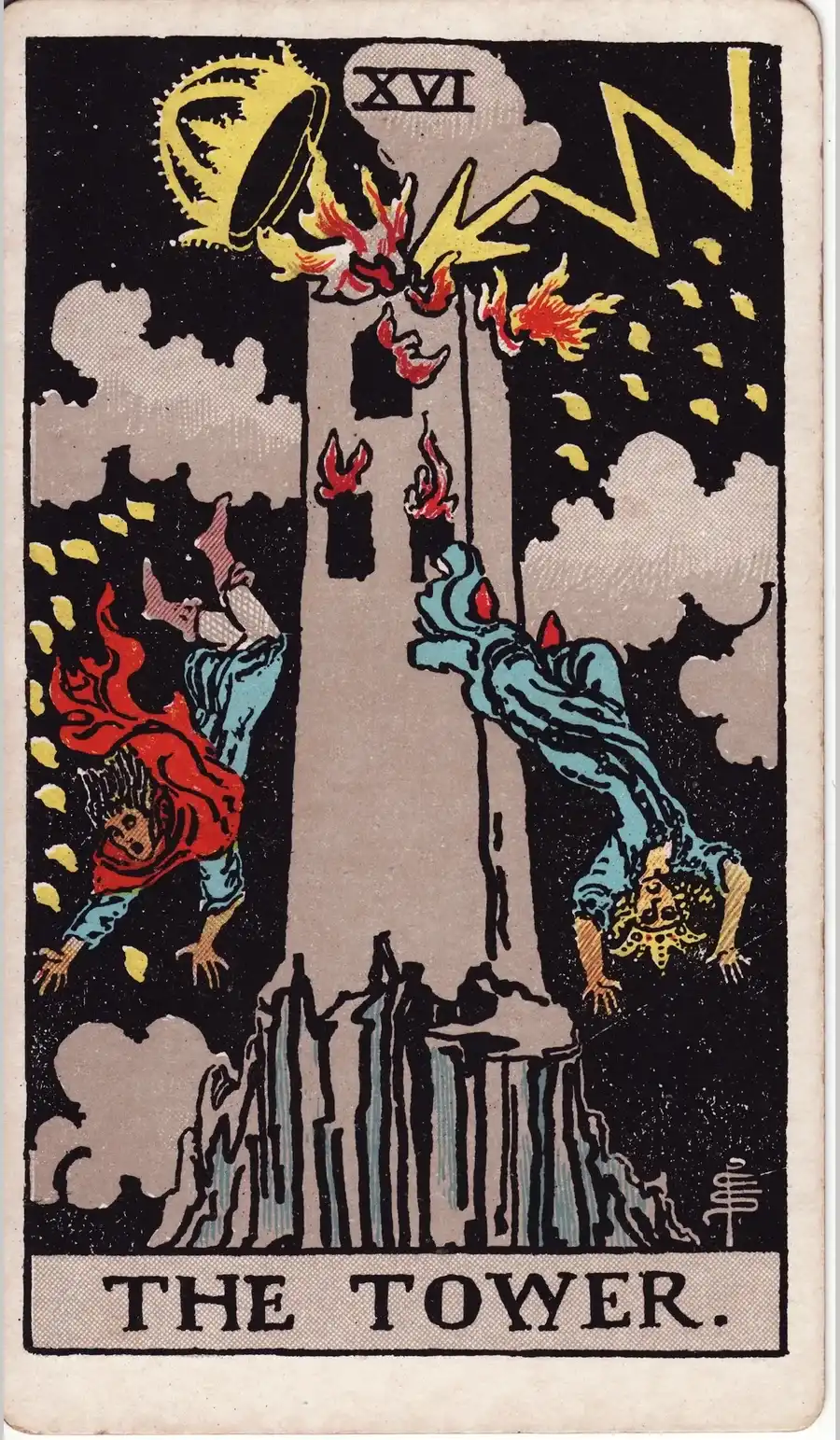
The Tower is card XVI of the Major Arcana, the card of sudden change. Lightning strikes a tall tower, the crown falls off, and two people tumble out. It is a dramatic card and it can be hard to see.
But the Tower usually breaks what was already cracked. Here is what the Tower means upright and reversed, the symbols in the 1909 card and the old names for the tower.
Here is the Tower at a glance.
| At a glance | This card |
|---|---|
| Upright keywords | sudden change, upheaval, revelation, collapse of what was false |
| Reversed keywords | a delayed collapse, fear of change, avoiding the truth |
| Number | XVI (16) in the Major Arcana |
| Golden Dawn title | The Lord of the Hosts of the Mighty Later tradition |
| Hebrew letter | Peh (פ), “mouth” Later tradition |
| Tree of Life path | 27, from Netzach to Hod Later tradition |
| Astrology | Mars Later tradition |
| Element | Fire Modern |
| Yes or no | No Modern |
The Golden Dawn gave the Tower the planet Mars and the letter Peh, the “mouth”, the organ of speech. The path crosses the Tree horizontally between Netzach, feeling, and Hod, intellect, and the Order read the lightning as sudden force striking across that line. The fire element in modern tables follows from Mars and is a later convention. In Marseille decks the card is La Maison Dieu, the House of God.
The card: what Pamela Colman Smith drew
Waite admitted that occult explanations of the card were “meager and mostly disconcerting”. It is, he said, idle to point out that it depicts ruin, “because it bears this evidence on the surface”. He read it as the fall of “a House of Falsehood”.
The lightning. A bolt of lightning hits the top of the tower. The change comes from outside and it is fast. You do not get to choose the hour.
The falling crown. The crown on top of the tower is knocked off. What was ruling your life, a belief, a plan, a false sense of safety, loses its place.
The two falling figures. Two people fall headfirst from the tower. Waite read them as “the literal word made void and the other its false interpretation”. For a reader, they are anyone caught in a sudden change.
The tongues of flame. Small drops of flame, shaped like the Hebrew letter yod, fall around the tower. Many readers see them as sparks of insight: the shock also reveals something true.
Upright meaning
Upright, the Tower is the sudden truth that brings down a false structure. Lightning strikes a tall tower on a rocky peak, knocking off its crown. Flames burst from the windows and two figures fall headfirst. Drops of light shaped like the Hebrew letter Yod fall with them.
The card describes upheaval that cannot be negotiated: a sudden ending, a revelation, a plan that collapses or a shock that changes the shape of a life. It is one of the hardest cards to see, and it is meant to be. But the Tower usually breaks what was already cracked. The crown was never as secure as it looked.
In a reading, deal with safety first: your body, your home, the basics and the people you trust. Then look at what the strike revealed. Insight arrives with the lightning, and you can rebuild on truer ground later.
Reversed meaning
Reversed, the collapse is delayed, partial or happening inside. The card can describe a crisis narrowly avoided, or one you know is coming and are bracing against. It can also describe fear of change so strong that you prop up a structure everybody else can see is failing.
Sometimes the reversed Tower is quieter: an internal upheaval, such as a belief shattering or a sudden insight about yourself, that is not yet visible to anyone else.
Ask what you are holding up that would be better taken down on purpose. A controlled demolition is gentler than a lightning strike.
In love, work and spirituality
In love. Upright: A sudden truth, a breakup or a big argument that clears the air. Reversed: Avoiding a confrontation you know is needed, or staying in a fragile arrangement.
At work. Upright: Job loss, a project collapsing or restructuring; a shock that forces a new direction. Reversed: A crisis narrowly avoided, or ignoring warning signs until failure is total.
With money. Upright: Unexpected expenses or losses. Secure the basics before anything else. Reversed: Financial trouble postponed rather than solved.
In spiritual practice. Upright: Sudden awakening; a belief system shattering under real experience. Reversed: Clinging to a belief after it has already failed you.
As feelings. Shock and upheaval. Something has shaken the person deeply.
As a person. Someone going through a crisis, or someone whose honesty breaks illusions.
As advice. Do not prop up what is cracked. Secure the basics, then rebuild on truth.
Reading the Tower: positions, pairs and yes or no
In the past position: An upheaval that broke something false. In the present position: Sudden change. Take care of safety first.
In the future position: A shake-up that clears the ground. As advice: Do not prop up what is cracked. Rebuild on truer ground.
When the Tower shows up among mostly Minor cards, give it extra weight: the theme of sudden change runs under the whole question.
Pairs matter too. Next to The Star, it can mean a crisis followed by real hope. Next to Death, it can mean major change on every level. Go gently. Next to The Emperor, it can mean a structure or authority that falls.
In modern yes or no readings, the Tower leans no. It means things are not going to plan, so it usually says no, at least for the plan you have now.
The history and art behind the card
In the Tarot de Marseille pattern the card is called La Maison Dieu, the House of God. Early Italian cards called this trump the House of the Devil, the Fire or the Arrow, and some show a tower struck by fire from heaven. Many readers connect it with the biblical Tower of Babel, though early sources do not say so.
The Marseille name is curious: La Maison Dieu, the House of God. Historians are not sure why. One suggestion is a pun on maison Dieu, an old French word for a hospital. Waite read the card through the Bible: “except the Lord build the house, they labor in vain that build it”.
The Golden Dawn gave the Tower to Mars, the planet of war and sudden force, which matches the lightning and the flames.
When A. E. Waite published The Pictorial Key to the Tarot in 1910, he listed these divinatory meanings for the card: “Misery, distress, indigence, adversity, calamity, disgrace, deception, ruin. It is a card in particular of unforeseen catastrophe.”
Reversed, he gave: “According to one account, the same in a lesser degree; also oppression, imprisonment, tyranny.” Waite himself called the fortune-telling meanings of the trumps “artificial and arbitrary”, and on this site I read the picture first and treat lists like this as history.
On the modern Fool’s Journey, the Tower follows the Devil for a reason: what the traveler would not release by choice is now shaken loose. It is the sudden break in the third stage that makes the later cards possible.
Common questions
Is the Tower the worst card in tarot? It is one of the hardest, but no card is simply bad. The Tower often clears away something false to make room for something real.
What does the Tower mean in love? A sudden change: a truth coming out, a breakup or a big conflict that clears the air.
What does the Tower reversed mean? Avoiding a needed change, or a crisis that is coming more slowly. It asks you to deal with the cracks before they widen.
Try this
Try this small spread for the Tower. Use it when something has suddenly fallen apart.
| Card | Question | What it shows |
|---|---|---|
| 1 | What has fallen? | The structure that collapsed. |
| 2 | What truth did it reveal? | What I can see now that I could not see before. |
| 3 | What do I build next? | The first stone on firmer ground. |
Affirmation: I face upheaval practically and rebuild on what proves true.
Reversed affirmation: I stop delaying a necessary collapse and deal with what is already broken.
If you keep a tarot journal, take one of these questions to it: What in my life has felt cracked for a while? What did a past upheaval teach me? What is one thing I can rebuild on solid ground?
What next
Cards that sit close to this one are The Devil (the card before: the chains the Tower breaks), The Star (hope after the storm, the next card) and Death (slow change, where the Tower is sudden).
The Tower is part of the lesson The Devil to the World in my free Tarot for Beginners course. To keep walking the Major Arcana, read the card before it, The Devil or the card after it, The Star, or go back to all the card meanings.
For every card with keywords, affirmations and examples, see my book The Novice’s Guide to Tarot. If you would like a printable cheat sheet for all 78 cards, my 45-page Tarot Workbook is on Etsy.
Sources
- A. E. Waite, The Pictorial Key to the Tarot (London: Rider, 1910), Part II and Part III, section 3.
- Pamela Colman Smith and A. E. Waite, the Rider-Waite-Smith tarot (London: Rider, 1909).
- Nicolas Conver, Tarot de Marseille (Marseille, 1760).
- Eden Gray, A Complete Guide to the Tarot (New York: Crown, 1970), epilogue “The Fool’s Journey”.
- Lauri Mukkala, The Novice’s Guide to Tarot, entry for The Tower.
- Aleister Crowley, 777 (London: Walter Scott, 1909), columns of the Hebrew letters, paths and Tarot trumps.
- Israel Regardie, ed., The Golden Dawn (Chicago: Aries Press, 1937 to 1940), “Book T” and the titles of the trumps.
All 78 cards
Major Arcana
- The Fool
- The Magician
- The High Priestess
- The Empress
- The Emperor
- The Hierophant
- The Lovers
- The Chariot
- Strength
- The Hermit
- Wheel of Fortune
- Justice
- The Hanged Man
- Death
- Temperance
- The Devil
- The Tower
- The Star
- The Moon
- The Sun
- Judgement
- The World
Wands
- Ace of Wands
- Two of Wands
- Three of Wands
- Four of Wands
- Five of Wands
- Six of Wands
- Seven of Wands
- Eight of Wands
- Nine of Wands
- Ten of Wands
- Page of Wands
- Knight of Wands
- Queen of Wands
- King of Wands
Cups
- Ace of Cups
- Two of Cups
- Three of Cups
- Four of Cups
- Five of Cups
- Six of Cups
- Seven of Cups
- Eight of Cups
- Nine of Cups
- Ten of Cups
- Page of Cups
- Knight of Cups
- Queen of Cups
- King of Cups
Swords
- Ace of Swords
- Two of Swords
- Three of Swords
- Four of Swords
- Five of Swords
- Six of Swords
- Seven of Swords
- Eight of Swords
- Nine of Swords
- Ten of Swords
- Page of Swords
- Knight of Swords
- Queen of Swords
- King of Swords
Pentacles
Get the free Mini-Grimoire
A short printable starter guide to tarot and everyday witchcraft, plus my newsletter. Unsubscribe any time.
Opens Substack in a new tab to confirm. More about the newsletter · Privacy