


| Arcana | Major Arcana |
|---|---|
| Number | III |
| Image | RWS 1909 (PD) |
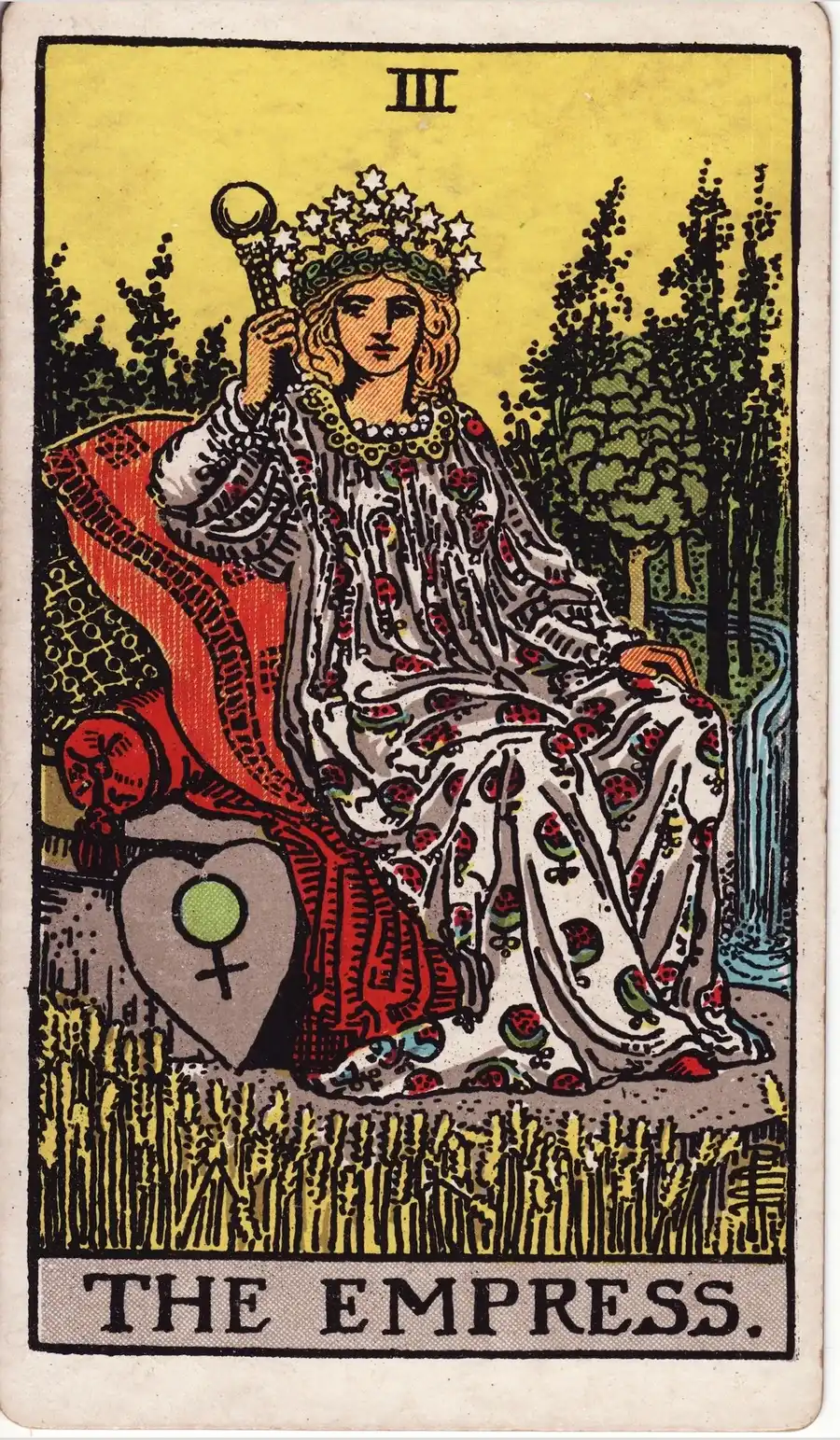
The Empress is card III of the Major Arcana, the warm and generous card of growth. A crowned woman rests on soft cushions in a field of ripe wheat. Everything around her is growing.
She teaches that care, pleasure and patience make things flourish. Here you will find what the Empress means upright and reversed, the symbols in Pamela Colman Smith’s card and the history behind it.
Here is the Empress at a glance.
| At a glance | This card |
|---|---|
| Upright keywords | abundance, creativity, nurture, pleasure |
| Reversed keywords | creative block, smothering care, excess |
| Number | III (3) in the Major Arcana |
| Golden Dawn title | The Daughter of the Mighty Ones Later tradition |
| Hebrew letter | Daleth (ד), “door” Later tradition |
| Tree of Life path | 14, from Chokmah to Binah Later tradition |
| Astrology | Venus Later tradition |
| Element | Earth Modern |
| Yes or no | Yes Modern |
The Golden Dawn gave the Empress Venus and the letter Daleth, the “door”, placing her on the path that joins the two highest forces on the Tree after the crown, wisdom and understanding, father and mother. Smith painted the Venus symbol on the heart-shaped shield beside her, so in this deck the attribution is part of the picture itself. Earth as her element is a modern convention.
The card: what Pamela Colman Smith drew
Smith drew the Empress outdoors, surrounded by nature. Waite described her as “a stately figure, seated, having rich vestments and royal aspect, as of a daughter of heaven and earth”, with “a field of corn” ripening before her and “a fall of water” beyond. The whole picture is about growth you can see and touch.
The crown of twelve stars. Her crown has twelve stars, often read as the twelve months or the signs of the zodiac. Her care is cyclical: seasons, rhythms and the long patience of growing things.
The Venus shield. A heart-shaped shield beside her carries the symbol of Venus, the planet linked to love, beauty and pleasure. Pleasure is allowed to matter in this card.
The wheat field. Ripe grain grows at her feet. It is a picture of harvest: what was planted and tended is ready. This makes the Empress a card of results that came from care rather than force.
The forest and the water. Behind her is a forest and a waterfall flowing into a pool. Water and trees are life itself. Many readers feel this card in the body: rest, food, walking outside.
Upright meaning
Upright, the Empress is abundance that grows rather than abundance that is bought. She reclines in a field of ripening wheat beside a stream, wearing a robe of pomegranates and a crown of twelve stars. Everything around her is alive and in season. The card asks what you are tending and whether you are letting it grow at its own pace.
She is the card of creativity in the widest sense: art, gardens, cooking, homes, projects and, sometimes, pregnancy or parenting. She also speaks of pleasure as a good thing. Rest, comfort, beauty and the body are part of a healthy life, not distractions from it.
In a reading the Empress often follows a long effort and says that it is now time to nourish rather than push. Feed what you have started. Make the space welcoming. Let other people be cared for, and let yourself be cared for too.
Reversed meaning
Reversed, the field is either overgrown or neglected. Overgrown looks like smothering: caring for others so completely that they cannot grow, or giving so much that nothing is left for you. It can also look like overindulgence, comfort that has turned into avoidance.
Neglected looks like creative block, burnout or a home that no longer feels like a refuge. The reversed Empress often appears when someone has been all output for too long and has forgotten that rest is part of growth.
Ask which you recognize. Then do one nourishing thing for yourself that has no purpose except to feel good, and notice how hard or easy it is to allow.
In love, work and spirituality
In love. Upright: Warmth, affection and sensual connection; a relationship that feels like home. Sometimes news of a family. Reversed: Smothering, dependence, or a partnership where one person does all the caring.
At work. Upright: Creative projects flourish. Good for design, hospitality, growing a business and teams that work well. Reversed: Creative block, or work that drains you without feeding you.
With money. Upright: Comfort and steady growth. Spending on quality and on the home is supported. Reversed: Overspending on comfort, or anxiety about scarcity that blocks enjoyment of what you have.
In spiritual practice. Upright: Earth-centered practice: gardens, seasons, the body, beauty as devotion. Reversed: Disconnection from the body and the natural world.
As feelings. Tenderness and care. The person feels nurturing and affectionate towards you.
As a person. Warm, generous, sensual and creative; a natural host or caregiver.
As advice. Nourish what you have started, and include yourself in the care.
Reading the Empress: positions and yes or no
In the past position: A time of care, comfort or creativity that still feeds you. In the present position: Something is growing. Tend it with patience and pleasure.
In the future position: A harvest is on the way, as long as you keep tending. As advice: Feed your body, your home and your creative work, and rest without guilt.
When the Empress shows up among mostly Minor cards, give it extra weight: the theme of abundance runs under the whole question.
In modern yes or no readings, the Empress leans yes. She is a card of growth and good harvests, so she usually says yes, especially for creative and caring questions.
The history and art behind the card
In the Tarot de Marseille pattern the card is called L’Impératrice, the Empress. In the earliest Italian cards she is simply the Empress, a crowned woman holding a shield with an eagle, the badge of the Holy Roman Empire. She was a figure of worldly rank in a card game made for noble families.
The nature imagery is Smith’s and Waite’s. Waite rejected older occult readings of the card and called her “universal fecundity”, and Smith moved her out of the throne room into a wheat field. The Golden Dawn’s link to Venus explains the heart-shaped shield.
When A. E. Waite published The Pictorial Key to the Tarot in 1910, he listed these divinatory meanings for the card: “Fruitfulness, action, initiative, length of days; the unknown, clandestine; also difficulty, doubt, ignorance.”
Reversed, he gave: “Light, truth, the unravelling of involved matters, public rejoicings; according to another reading, vacillation.” Waite himself called the fortune-telling meanings of the trumps “artificial and arbitrary”, and on this site I read the picture first and treat lists like this as history.
Read as a stop on the modern Fool’s Journey, the Empress is where the traveler learns that growth is fed, not forced. In the first stage, becoming a self, she stands for the body, pleasure and care that a person grows inside.
Common questions
Does the Empress mean pregnancy? It can, but only rarely. Most often it means creativity, growth and care in a broader sense. Tarot is not a pregnancy test.
Is the Empress a yes? Usually yes. She is a card of abundance and good growth.
What is the difference between the Empress and the High Priestess? The High Priestess is inner and quiet. The Empress is outward, sensual and growing. One listens, the other nurtures.
Try this
Try this small spread for the Empress. Use it when you want something in your life to grow.
| Card | Question | What it shows |
|---|---|---|
| 1 | What wants to grow? | The seed, project or relationship asking for care. |
| 2 | What does it need from me? | The kind of nourishment it needs now. |
| 3 | What can I harvest already? | What has grown that I have not yet noticed. |
Affirmation: I grow what I love through steady, pleasurable care.
Reversed affirmation: I nourish myself and release smothering or stagnant habits.
If you keep a tarot journal, take one of these questions to it: What in my life is ripening right now? How do I take care of my body this week? Where am I giving more than I can sustain?
What next
Cards that sit close to this one are The Emperor (structure and protection, her partner card), The High Priestess (the inner side of feminine wisdom) and The Star (another card of renewal and gentle hope).
The Empress is part of the lesson The Fool to the Chariot in my free Tarot for Beginners course. To keep walking the Major Arcana, read the card before it, The High Priestess or the card after it, The Emperor, or go back to all the card meanings.
For every card with keywords, affirmations and examples, see my book The Novice’s Guide to Tarot. If you would like a printable cheat sheet for all 78 cards, my 45-page Tarot Workbook is on Etsy.
Sources
- A. E. Waite, The Pictorial Key to the Tarot (London: Rider, 1910), Part II and Part III, section 3.
- Pamela Colman Smith and A. E. Waite, the Rider-Waite-Smith tarot (London: Rider, 1909).
- Nicolas Conver, Tarot de Marseille (Marseille, 1760).
- Eden Gray, A Complete Guide to the Tarot (New York: Crown, 1970), epilogue “The Fool’s Journey”.
- Lauri Mukkala, The Novice’s Guide to Tarot, entry for The Empress.
- Aleister Crowley, 777 (London: Walter Scott, 1909), columns of the Hebrew letters, paths and Tarot trumps.
- Israel Regardie, ed., The Golden Dawn (Chicago: Aries Press, 1937 to 1940), “Book T” and the titles of the trumps.
All 78 cards
Major Arcana
- The Fool
- The Magician
- The High Priestess
- The Empress
- The Emperor
- The Hierophant
- The Lovers
- The Chariot
- Strength
- The Hermit
- Wheel of Fortune
- Justice
- The Hanged Man
- Death
- Temperance
- The Devil
- The Tower
- The Star
- The Moon
- The Sun
- Judgement
- The World
Wands
- Ace of Wands
- Two of Wands
- Three of Wands
- Four of Wands
- Five of Wands
- Six of Wands
- Seven of Wands
- Eight of Wands
- Nine of Wands
- Ten of Wands
- Page of Wands
- Knight of Wands
- Queen of Wands
- King of Wands
Cups
- Ace of Cups
- Two of Cups
- Three of Cups
- Four of Cups
- Five of Cups
- Six of Cups
- Seven of Cups
- Eight of Cups
- Nine of Cups
- Ten of Cups
- Page of Cups
- Knight of Cups
- Queen of Cups
- King of Cups
Swords
- Ace of Swords
- Two of Swords
- Three of Swords
- Four of Swords
- Five of Swords
- Six of Swords
- Seven of Swords
- Eight of Swords
- Nine of Swords
- Ten of Swords
- Page of Swords
- Knight of Swords
- Queen of Swords
- King of Swords
Pentacles
Get the free Mini-Grimoire
A short printable starter guide to tarot and everyday witchcraft, plus my newsletter. Unsubscribe any time.
Opens Substack in a new tab to confirm. More about the newsletter · Privacy