


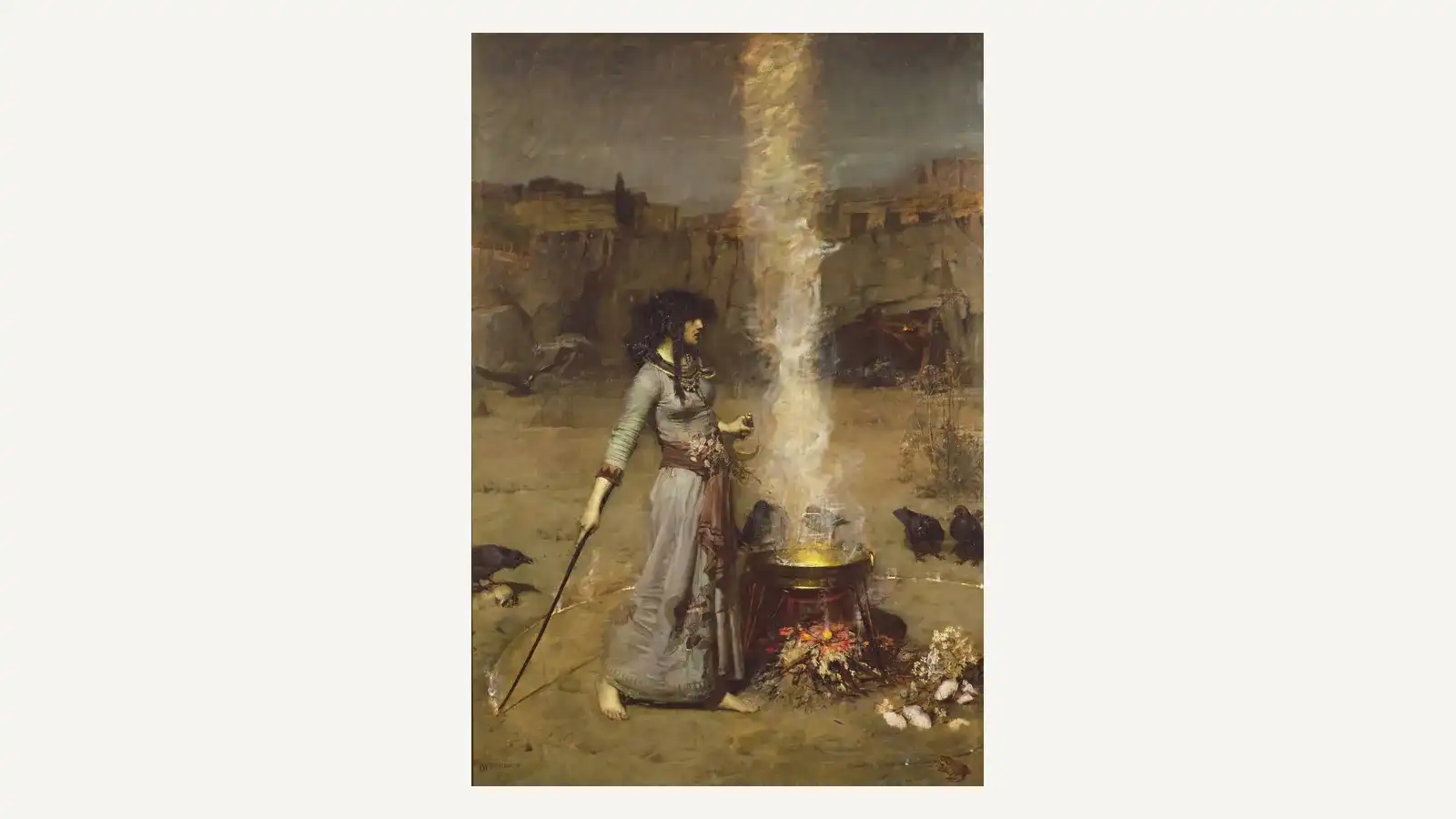
In this lesson: a calm first-year plan with a daily grounding, a source-checked Book of Shadows, monthly and seasonal steps and what next.
You have learned the history, the basic tools and the ethics. Now you need a rhythm. In this last lesson you set up a simple first-year plan: five minutes a day, one small thing a month, one celebration a season, and a Book of Shadows that records where every practice comes from. Slow and steady beats dramatic and short-lived.
What is old and what is new in a witch’s year
Historical Many of the dates witches celebrate are old: midsummer fires, harvest customs, the turning of winter. Personal notebooks of charms, recipes and remedies, often called commonplace books, are old too.
Later tradition The name “Book of Shadows” comes from Gerald Gardner’s circle in the 1940s and 1950s. The eight festivals of the Wheel of the Year were first combined in late 1950s Wicca, and the names Ostara and Mabon for the equinoxes became common from the 1970s. The Wiccan Rede, “An it harm none, do what ye will”, was first published in this form in 1964.
Modern “Grounding and centering” is a modern witchcraft term, popularised by writers such as Starhawk in The Spiral Dance (1979). The breathing practice below is a simple relaxation technique. It calms the body; it is not proof of magic, and it does not need to be.
Your first-year plan, step by step
What you need: your Book of Shadows or a notebook, a pen, a chair or a spot on the floor, a moon calendar, and five minutes a day. A candle is optional; an LED candle works just as well.
- Every day, sit with both feet on the floor, breathe in for four counts, hold for four, breathe out for six, six times, and imagine weight settling into the ground.
- Write one line in your Book of Shadows: what you did and what you noticed.
- Add the source and mark the practice historical or modern in your three columns.
- Every month, keep your moon journal and choose one small practice from this course to try again, such as a candle spell, an altar change or a herb card.
- Every season, mark one festival in a way that suits you: a walk, a meal, a clean altar or a letter to your future self.
- At the end of each month, read back your notes and cross out anything that felt hollow.
- After twelve months, write one page on what your practice has become.
Journal prompts: Which practices from this course felt like yours, and which felt borrowed? What does your practice look like on a tired day, and is that enough? What would you like to understand better in a year’s time?
The “year and a day” and other traditions of time
Historical Many modern witches speak of studying for “a year and a day” before taking a step such as initiation. The phrase comes from medieval law, where a year and a day was a common legal period, for example in English law it was the time a serf had to live in a free town to become free.
Gardnerian Wicca adopted it in the twentieth century as the waiting time before initiation. It is a modern custom built on an old phrase, and a useful one: a full turn of the seasons shows you what your practice is like in every mood.
Modern A year also matches how habits form. Some practices that feel exciting in spring feel like a chore in winter, and some that seem small become precious. A year lets you find the practices that are really yours.
What the seasons of a first year often look like
Many people find their first year has a recognizable shape. The first months are full of enthusiasm: reading, buying a few things, trying everything. Then comes a dip, often around three to six months, when the novelty fades and life gets busy. This is normal. Practices often simplify at this stage, and that is good. Later in the year many people find a steadier rhythm, a few practices they keep without effort, and a clearer sense of what they believe and do not believe. The yearly review at the end turns all of this into knowledge.
How to choose books and teachers in your first year
When you pick a book, look at whether the author separates history from modern practice, gives sources for historical claims, includes safety notes and does not promise guaranteed results. When you find a teacher or group, check that they are transparent about costs, respect consent and privacy, welcome questions and do not ask you to cut off friends or family. These are the same tests you used for claims throughout this course.
A second worked example: a busy parent’s year
Imagine a parent of two small children starting this plan. Daily grounding happens in the car before school pickup, two minutes with the engine off. The moon journal is a single line in a phone note. Festivals become family activities: a candle-free lantern walk at midwinter and flower crowns at midsummer. The yearly review is one quiet evening after the children are asleep, reading the phone notes in one go. Her practice is small, and it lasted the whole year. That is a success.
Writing your yearly review
The one-page review at the end of your first year is the most useful thing you will write. Here is a gentle way to do it. Set aside an evening. Read your Book of Shadows from the first page to the last without stopping to judge. Then answer four questions in plain sentences.
First, what did I actually do most often? Not what I planned, but what the notes show. Second, which practices did I drop, and why? “It took too long” and “it felt like someone else’s religion” are both honest and useful answers. Third, what did I learn about history that changed how I see my practice? Perhaps you found that the Wheel of the Year is modern, or that cunning folk were real people with real clients. Fourth, what do I want to keep for the next year, and what one new thing would I like to study?
Keep the page short. A review that fits on one side of paper is one you will read again next year, and comparing two reviews side by side is a quiet joy.
Practice variations for your first year
The seasonal box. Keep a small box for each season. Put in one thing that marks it for you: a pressed leaf, a shell, a ticket from a festival, a note. At the end of the year you have a small archive of your own wheel.
The study thread. Choose one historical topic for the whole year, such as the witch trials in your own country, the history of a single herb or the life of a writer like Doreen Valiente. Read a little each month and keep notes with sources. By the end of the year you will know more about that subject than most people.
The shared year. If you have a friend who is also learning, agree to share one note a month: one practice and one source. You keep your own path, but you have someone to compare notes with.
A worked example
A learner sets up her columns. “Lit a white candle for focus. Where: this course, lesson 8. Modern.” “Rosemary in the soup. Where: my herb card, Hamlet and a herb book. Both.” “Marked the autumn equinox with an apple and a walk. Where: Wheel of the Year page. Festival modern, harvest custom old.” After three months she sees that her steadiest practice is the breath and the one-line note, and she decides that is her foundation.
Questions beginners ask
People often ask when they can call themselves a witch. There is no exam. Many people use the word as soon as they begin practicing; others wait until after a year. It is your choice.
Another question is what to do if your interest fades. Practice can wax and wane like the moon. Keep your journal, simplify to one practice, and see if interest returns. If it does not, that is also fine.
Beginners ask whether they should join a group in their first year. If a good group is available, it can be a joy. Solitary practice is equally valid, and many people prefer to learn alone first.
Myths to drop: You do not need to be initiated to be a witch. A year of practice does not require money. And nothing bad happens if you stop.
Try this
Set up three columns in your Book of Shadows: “What I did”, “Where I learned it” and “Historical or modern”. Fill in one line for every practice from this course you have tried.
A beginner’s worry, answered. “My year does not look like anyone else’s online.” It should not. Photos of perfect altars show a single moment, not a year of real life. A practice that fits your home, your budget and your energy is the right one, even if nobody would ever photograph it.
Recap
A sustainable first year is five minutes a day, one practice a month and one festival a season. Keep a Book of Shadows that records sources and marks what is historical and what is modern. The Wheel of the Year and the Book of Shadows are modern; many of their ingredients are older.
What next
Keep the plan for a full year. When you want more depth, the free Divination for Beginners course is a natural next step, Tarot for Beginners goes deep into the cards and Occult History for Beginners gives you the bigger story. My book The Novice’s Guide to Witchcraft follows this course chapter by chapter.
You have finished Witchcraft for Beginners. Press “Mark as done” and claim your certificate of completion. Then keep your Book of Shadows going and explore the Wheel of the Year.
Further reading: Ronald Hutton, The Triumph of the Moon (Oxford University Press, 1999). Lauri Mukkala, The Novice’s Guide to Witchcraft, for the practices in this course in book form.
Sources
- Gerald Gardner, Witchcraft Today (London: Rider, 1954).
- Starhawk, The Spiral Dance (San Francisco: Harper and Row, 1979).
- Lauri Mukkala, The Novice’s Guide to Witchcraft, chapters on the Book of Shadows and the Wheel of the Year.
Quick check
Go deeper: the witchcraft pages on this site, and The Novice's Guide to Witchcraft
Your certificate with an account
You have finished every lesson of Witchcraft for Beginners. Well done. Your free certificate of completion is waiting.
Your certificate is ready.
Get the free Mini-Grimoire
A short printable starter guide to tarot and everyday witchcraft, plus my newsletter. Unsubscribe any time.
Opens Substack in a new tab to confirm. More about the newsletter · Privacy
Comments
Questions and notes from readers. Anyone with a free account can comment, and I reply when I can. Please read the community guidelines.
Comments load from Google Firebase (EU) when you ask for them. Nothing is stored on your device. Privacy